

US 10-Year Treasury Yield Tops 5%: Why Buybacks Can’t Offset Inflation and AI Capex Demand
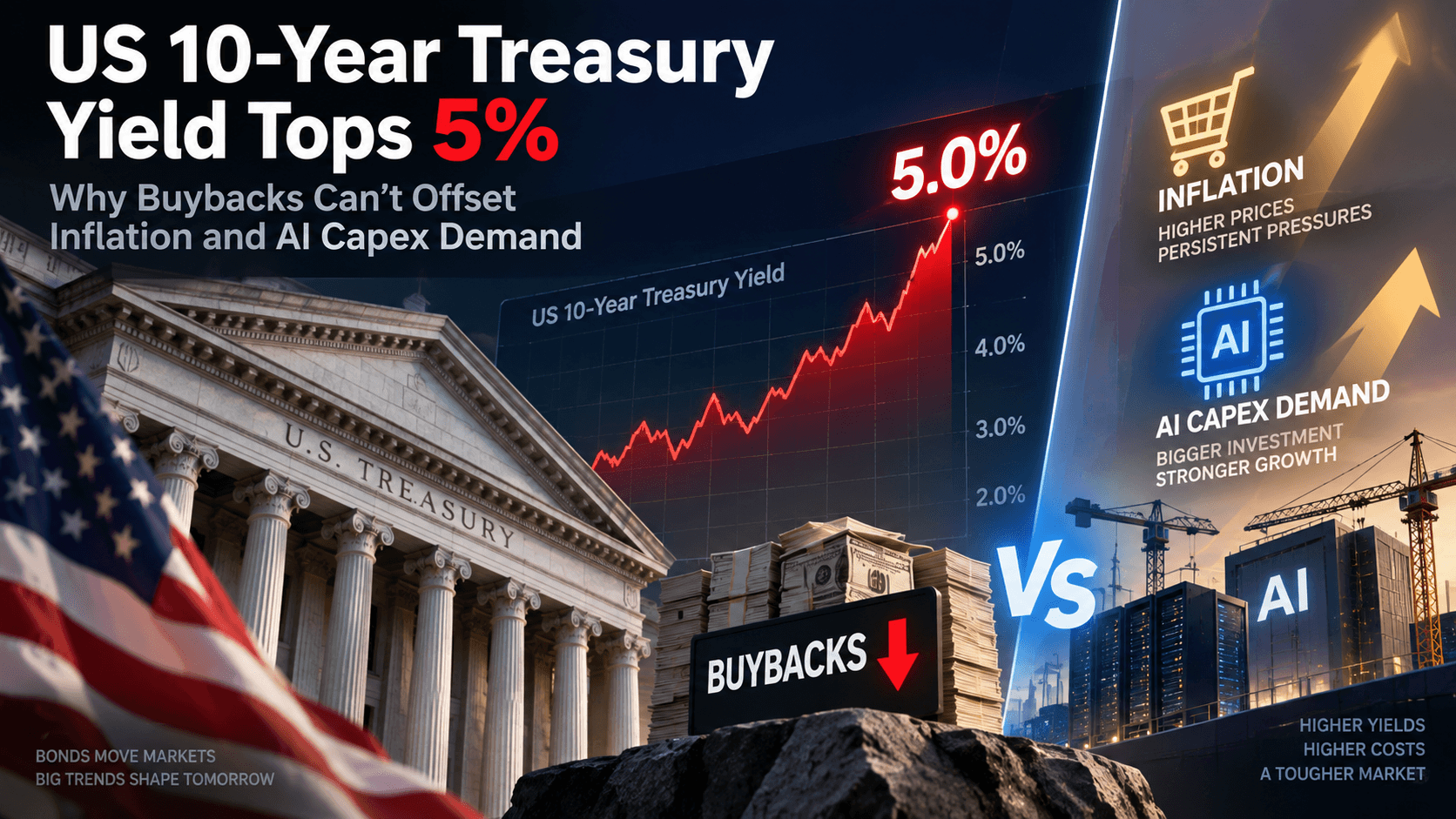
The 10-year US Treasury yield has climbed above 5%, putting the bond market back at the centre of the global economic outlook as investors respond to persistent inflation, changing Federal Reserve rate expectations, heavy US government borrowing and rising demand for long-term capital. Treasury buybacks have been expanded to improve liquidity in parts of the bond market, but they cannot remove the fundamental pressures driving yields higher. The US government still needs to finance large fiscal deficits, inflation remains above the Federal Reserve’s target and major technology companies are spending hundreds of billions of dollars on AI data centres, chips, cloud infrastructure and electricity capacity while increasingly tapping debt markets. Together, these forces help explain why US Treasury yields are rising, why the 10-year Treasury yield has crossed 5% and why higher borrowing costs could remain an important issue for bonds, stocks, crypto markets and the wider economy.
Why the 10-Year US Treasury Yield Has Climbed Above 5%
The 10-year US Treasury yield moved above 5% in September 2026, reaching its highest level since October 2023 and putting renewed pressure on global bond and equity markets. The move reflects more than a single economic report. Investors are demanding higher returns to hold long-term US government debt as inflation remains above the Federal Reserve’s 2% target, energy costs rise, government borrowing stays elevated and expectations for tighter monetary policy increase. At the same time, unusually large capital requirements from the artificial intelligence boom are adding another source of demand for long-term financing.
The 10-year Treasury yield is particularly important because it influences borrowing costs across the economy, including mortgages, corporate debt and other long-term loans. When investors expect inflation or interest rates to remain higher for longer, existing bonds become less attractive, their prices fall and yields rise. That dynamic has become more pronounced as markets reassess how quickly inflation can return to target and how much new debt investors will need to absorb.
Sticky Inflation and Fed Rate Expectations Are Pushing Yields Higher
Inflation has returned to the centre of the Treasury market outlook. US consumer prices rose 3.4% year over year in August 2026, while producer prices increased 5.4%, reinforcing concerns that price pressures are proving harder to contain. Higher energy costs have added to those worries because persistent increases in oil and fuel prices can feed into transport, manufacturing and household expenses and make inflation more difficult for the Federal Reserve to control.
The stronger inflation backdrop has also changed expectations for US monetary policy. Investors have increasingly priced in the possibility that the Federal Reserve will need to maintain restrictive policy or raise rates again rather than move quickly toward easing. Higher expected short-term rates can influence yields across the Treasury curve, while long-term investors may also demand an additional premium for the risk that inflation remains elevated for years rather than months. Together, those forces have helped push the 10-year Treasury yield above 5%.
Heavy US Borrowing and Rising Capital Demand Are Reshaping the Bond Market
Government financing needs are adding another layer of pressure. The US Treasury expects hundreds of billions of dollars in net marketable borrowing during the second half of 2026, meaning investors must absorb a steady flow of new government debt. When Treasury supply increases while demand does not rise at the same pace, bond prices can come under pressure and yields may need to move higher to attract buyers. Concerns about persistent fiscal deficits and the overall size of US federal debt have therefore become increasingly relevant to long-term Treasury pricing.
The competition for capital is also extending beyond Washington. Major technology companies are committing unprecedented sums to AI data centres, chips, power infrastructure and cloud capacity, with large hyperscalers raising hundreds of billions of dollars through debt markets alongside their internal cash flows. This does not mean AI investment alone caused the 10-year Treasury yield to cross 5%, but the surge in corporate borrowing increases the supply of high-quality bonds competing for institutional capital. Investors now have a wider range of attractive fixed-income opportunities, making inflation, government debt issuance and AI-driven capital expenditure part of the same broader story: the cost of long-term capital is rising.
Why Treasury Buybacks Can’t Fully Offset Rising Bond Yields
The US Treasury has expanded its bond buyback program as long-term yields have climbed, particularly in less-liquid parts of the market. These operations can improve trading conditions by purchasing older securities and replacing them with more liquid debt. However, Treasury buybacks are not designed to permanently reduce the government's borrowing needs or force bond yields lower. That distinction is important as investors assess why the 10-year Treasury yield has risen above 5% despite larger buyback operations.
The scale of the broader financing challenge also matters. The Treasury expects hundreds of billions of dollars in net marketable borrowing during the second half of 2026, far exceeding the size of individual buyback operations. As a result, even when the Treasury purchases several billion dollars of older bonds, the market must still absorb substantial new issuance. Inflation expectations, fiscal deficits, interest-rate policy and investor demand therefore remain more powerful drivers of long-term Treasury yields.
Treasury Buybacks Improve Liquidity but Do Not Eliminate New Debt
Treasury buybacks are primarily a debt-management and market-liquidity tool. By repurchasing older or less actively traded securities, Treasury can help improve liquidity and reduce fragmentation across different bond issues. In September, one long-duration operation offered to purchase as much as $6 billion of securities and ultimately accepted about $5.19 billion. The operation was significant for market functioning, but relatively small compared with the government's overall financing requirements.
More importantly, the securities purchased through buybacks are generally offset by new Treasury issuance. This means the program does not remove an equivalent amount of federal debt from the market on a permanent basis. Unlike Federal Reserve quantitative easing, which involves the central bank expanding its balance sheet to purchase securities, Treasury buybacks mainly change the composition of outstanding government debt. That is why they can improve liquidity without necessarily reversing a broader rise in US Treasury yields.
Inflation and Heavy Bond Supply Still Dominate Long-Term Yields
The bond market continues to price risks that Treasury buybacks cannot directly solve. Persistent inflation makes investors demand higher yields to protect the real value of future interest payments, while expectations for tighter Federal Reserve policy can keep borrowing costs elevated across the yield curve. At the same time, large fiscal deficits require the government to issue substantial amounts of new debt, increasing the supply investors must absorb.
This supply-demand imbalance becomes more important when other high-quality borrowers are also tapping bond markets. Large technology companies are raising capital to fund AI infrastructure, data centres, chips and power capacity, creating additional competition for institutional investment. Treasury buybacks may ease pressure in specific parts of the market, but they cannot fully offset the combined effect of inflation, government borrowing and rising corporate capital demand. As long as those forces remain strong, long-term bond yields may stay elevated even when Treasury increases its liquidity-support operations.
How Inflation, Fed Policy and Government Borrowing Are Driving Treasury Yields Higher
The rise in US Treasury yields reflects a combination of persistent inflation, shifting Federal Reserve expectations and heavy government borrowing rather than one isolated market event. With the 10-year Treasury yield moving above 5%, investors are reassessing how long interest rates may remain elevated and how much compensation they require to hold long-term government debt. Higher energy prices and stubborn inflation have increased uncertainty around the Fed’s next moves, while large federal financing requirements continue to add new Treasury supply to the market. Together, these forces are keeping upward pressure on borrowing costs across the US economy.
Inflation Is Raising the Return Investors Demand From Treasuries
Inflation remains one of the clearest pressures on long-term bond yields. US consumer prices rose 3.4% year over year in August 2026, remaining above the Federal Reserve’s 2% inflation objective, while producer-price pressures have also stayed elevated. When investors expect prices to rise faster, the fixed payments offered by existing bonds lose purchasing power, so buyers generally demand higher yields as compensation. Rising energy costs can reinforce this effect by increasing transport and production expenses, raising the risk that inflation remains persistent rather than quickly returning to target.
Fed Rate Expectations Are Repricing the Treasury Market
Federal Reserve policy also shapes the outlook for Treasury yields because investors price bonds according to where they expect interest rates to move over time. As inflation has remained elevated, markets have increasingly considered the possibility that the Fed could keep monetary policy restrictive for longer or raise rates further instead of moving rapidly toward easing. That shift can lift yields across the Treasury curve, while uncertainty over the future path of inflation may also increase the term premium investors require for holding longer-dated government bonds.
Heavy Government Borrowing Is Increasing Treasury Bond Supply
Fiscal policy adds a separate source of pressure. The US Treasury estimated about $739 billion in privately held net marketable borrowing for the July-to-September quarter of 2026, followed by roughly $628 billion for October through December. Large and persistent budget deficits mean the government must continue issuing substantial amounts of Treasury bills, notes and bonds to finance its obligations. When bond supply expands rapidly, yields may need to rise to attract sufficient investor demand, particularly when buyers can choose from increasingly competitive corporate and global fixed-income alternatives.
Why These Pressures Can Keep Long-Term Yields Elevated
Inflation, monetary policy and government borrowing reinforce one another in ways that can make high Treasury yields difficult to reverse quickly. Persistent inflation limits the Fed’s ability to ease monetary conditions, while elevated policy rates increase government interest costs and large deficits require continued bond issuance. Investors therefore have to weigh both inflation risk and an expanding supply of government debt when deciding what yield is attractive enough to hold long-duration Treasuries. Unless inflation cools convincingly, Fed expectations become more dovish or borrowing needs ease, long-term US Treasury yields could remain elevated, even if short-term market volatility produces temporary declines.
How AI Capex and Big Tech Debt Are Adding Pressure to the US Bond Market
The artificial intelligence investment boom is creating a new source of capital demand across US financial markets. Major technology companies are spending heavily on AI data centres, advanced chips, cloud infrastructure, networking equipment and electricity capacity, with annual investment plans now reaching hundreds of billions of dollars. Much of that expansion is funded through operating cash flow, but large technology companies are also increasingly using debt markets to finance long-term infrastructure. This growing supply of corporate bonds does not explain the rise in Treasury yields by itself, but it adds another layer of competition for investor capital at a time when the US government is also issuing large amounts of debt.
Big Tech AI Spending Is Reaching Historic Levels
The largest hyperscalers have sharply increased capital expenditure as they race to expand computing capacity for generative AI and cloud services. Alphabet has projected 2026 capital spending of roughly $195 billion to $205 billion, while Meta expects around $130 billion to $145 billion. Microsoft is also investing heavily in data centres and AI infrastructure. Taken together, these commitments illustrate how the AI boom has evolved from a software story into a capital-intensive infrastructure cycle that requires enormous spending on servers, semiconductor equipment, power systems and real estate.
AI Infrastructure Is Driving More Corporate Bond Issuance
The scale of AI investment is also changing the corporate bond market. Alphabet, Amazon, Meta, Microsoft and Oracle have collectively issued roughly $220 billion of debt over the past year, according to Reuters analysis. Large investment-grade technology companies can often borrow at attractive rates because of their strong balance sheets and cash flows, giving institutional investors an alternative to government securities. As more high-quality corporate bonds enter the market, investors can compare Treasury yields with corporate yields offering an additional credit spread, increasing competition for fixed-income capital.
Treasuries and Big Tech Are Competing for Long-Term Capital
This competition matters because both the US government and the technology sector need access to enormous pools of long-duration financing. Treasury must fund persistent fiscal deficits and refinance existing debt, while technology companies are financing multi-year AI infrastructure projects. Pension funds, insurers, asset managers and other large investors therefore face a wider selection of bonds competing for their portfolios. When debt supply grows across both government and corporate markets, yields may need to remain attractive enough to encourage investors to absorb that issuance.
Why AI Capex Is Only One Part of the Treasury Yield Story
It would be misleading to argue that AI investment alone pushed the 10-year Treasury yield above 5%. Inflation, Federal Reserve policy, fiscal deficits and the scale of Treasury issuance remain more important direct drivers of government borrowing costs. However, the AI investment boom is adding to the broader demand for capital at a time when bond supply is already high. If hyperscaler spending and corporate debt issuance continue expanding, AI capex could remain an important secondary factor shaping liquidity, credit spreads and the overall cost of long-term financing in the US bond market.
🔥 Beyond the Headlines: What KuCoin 5.0 Means for You
Market news moves fast — but where you act on it matters just as much. This October, KuCoin launches KuCoin 5.0, transforming KuCoin into a rebuilt platform. Here's what actually changes for you:
-
One account for everything. Older platforms split your money across separate "spot," "margin," and "futures" accounts and expected you to understand why. KuCoin 5.0's unified account removes that entirely — deposit once, and everything is simply there.
-
Stocks, indices, and commodities. KuCoin 5.0 expands beyond crypto into global markets. When crypto chops sideways and equities rally (or the reverse), you rotate in minutes instead of opening a brokerage account and waiting days for fiat rails.
-
Real-world assets (RWA). Tokenized exposure to traditional assets like commodities, right inside your crypto account. One of the fastest-growing segments in global finance is no longer reserved for institutions — you access it from the same balance you trade with.
-
Earn while you learn. Not ready to trade? KCUSD lets your stablecoins earn daily, auto-compounding interest. The lowest-stress way to put your idle deposit to work for 4% yield.
-
An AI assistant in plain language. Ask questions, get market context, understand what you're looking at — built into the platform, no jargon required.
-
An app that doesn't overwhelm. Faster, cleaner, and consistent — intuitive from the first tap, not after a tutorial.
-
Safety you can check, not just trust. A MiCAR-licensed EU entity, Proof of Reserves you can verify yourself, and internationally certified security (SOC 2 Type II, ISO 27001:2022).
Create your account in minutes — and start on the platform built for where crypto is going, not where it's been.
Conclusion
The 10-year US Treasury yield moving above 5% reflects a broader repricing of inflation, monetary policy and the amount of capital competing across the US financial system. Treasury buybacks can improve market liquidity, but they cannot eliminate large federal borrowing requirements or permanently counter the forces pushing long-term yields higher. Persistent inflation and uncertainty over Federal Reserve policy continue to influence investor expectations, while substantial government debt issuance keeps Treasury supply elevated.
The AI investment boom adds another dimension. Big Tech companies are spending extraordinary amounts on data centres, chips and power infrastructure while increasingly tapping corporate bond markets to help finance that expansion. AI capex is not the primary cause of higher Treasury yields, but it adds to the competition for long-term capital at a time when government borrowing is already substantial. Whether Treasury yields remain near or above 5% will ultimately depend on how inflation, Fed policy, economic growth, government financing needs and investor demand evolve from here.
FAQs
What does a 5% 10-year Treasury yield mean for investors?
A 5% 10-year Treasury yield means investors can earn a relatively high nominal return from US government debt without taking corporate credit risk. That can make Treasuries more competitive with stocks, corporate bonds and other risk assets, potentially influencing how investors allocate capital.
How do higher Treasury yields affect mortgage rates?
US mortgage rates are influenced more closely by longer-term bond yields than by the Federal Reserve’s policy rate alone. When the 10-year Treasury yield rises, mortgage rates often face upward pressure because lenders require higher returns to compensate for funding costs, inflation risk and mortgage-specific risks.
Why do Treasury bond prices fall when yields rise?
Bond prices and yields move in opposite directions. When newly issued Treasuries offer higher yields, older bonds paying lower rates become less attractive, so their market prices usually fall until their effective yields become competitive with newer securities.
Are higher Treasury yields bad for the stock market?
Not necessarily, but rapidly rising yields can create pressure on equity valuations. Higher risk-free rates increase the discount rate applied to future corporate earnings and give investors an attractive alternative to stocks, which can be particularly important for high-growth companies and other risk assets whose valuations depend heavily on expected future profits.
Which stocks are most sensitive to rising Treasury yields?
Long-duration growth stocks, including many technology companies, can be particularly sensitive because much of their valuation is based on earnings expected far into the future. Banks, insurers, utilities, real estate companies and other rate-sensitive sectors can also react strongly, although the impact varies depending on the shape of the yield curve and broader economic conditions.
Can a 5% Treasury yield strengthen the US dollar?
Higher US yields can support the dollar if they make dollar-denominated assets more attractive relative to assets in countries offering lower returns. However, currency markets also respond to economic growth, inflation, central-bank policy and global risk sentiment, so Treasury yields are only one part of the exchange-rate outlook.
Disclaimer: This article is for informational purposes only and does not constitute investment advice. Crypto assets can be highly volatile, and market conditions, token liquidity and project developments may change rapidly. Readers should conduct their own research and assess their risk tolerance before making financial decisions.