

ZCSH 3-for-1 Split: Grayscale Makes Its Zcash ETF More Affordable for Retail Investors
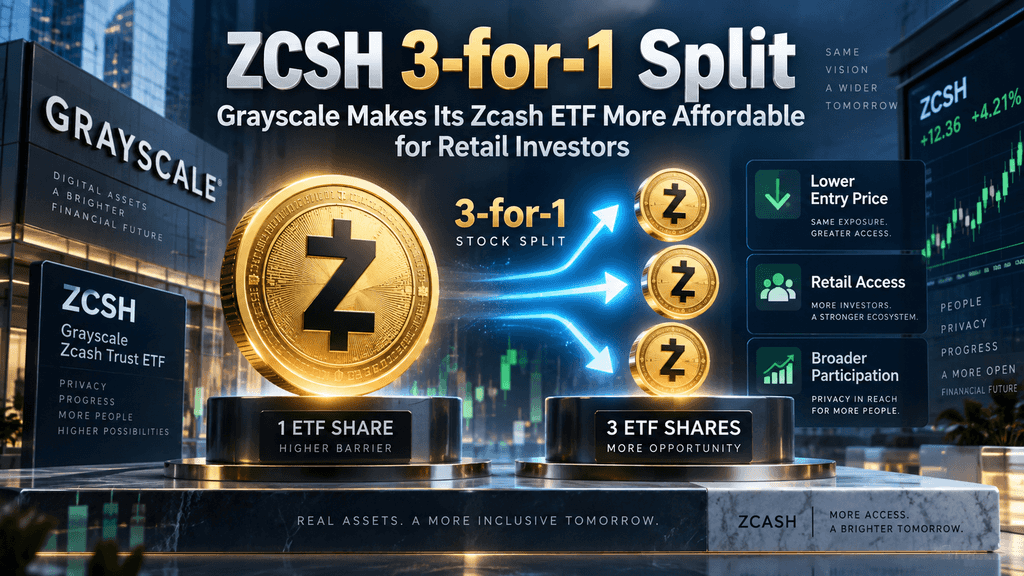
Grayscale announced on September 18, 2026, that its Zcash ETF, trading under the ticker ZCSH on NYSE Arca, intends to implement a 3-for-1 forward share split. The move comes less than a month after the fund converted from a trust structure and began trading on August 25, 2026. Shareholders of record at market close on September 28, 2026, will receive two additional shares for every share held, with distribution after market close on September 29 and post-split trading expected to begin before the market opens on September 30. The total value of each investor’s position remains unchanged, while the per-share net asset value is expected to drop to approximately one-third of its pre-split level.
The ticker and CUSIP stay the same. This adjustment follows substantial investor interest, with cumulative net inflows exceeding $233 million by mid-September and net assets reaching around $890 million to over $915 million in recent data, alongside more than $11 billion in cumulative trading volume. Zcash’s native token ZEC has risen sharply, trading near $1,500 levels after significant yearly gains, which elevated the ETF’s share price and prompted the structural change to improve practical access for smaller investors through traditional brokerage accounts that typically lack fractional-share support.
Shareholders must hold ZCSH shares at the close of trading on September 28, 2026, to qualify as record holders entitled to the additional shares under the forward split. According to the official announcement filed with the U.S. Securities and Exchange Commission, these holders will receive two extra shares for each share owned, distributed after the market closes on September 29. The new shares then become available for trading on a split-adjusted basis before the market opens on September 30. This sequence ensures an orderly transition without interruption to continuous trading on NYSE Arca. The process mirrors standard forward-split mechanics used by other exchange-traded products when share prices rise substantially, ensuring that ownership percentages remain identical before and after the adjustment.
Data from sources tracking the fund show that ZCSH had already accumulated meaningful assets and trading activity by mid-September, making the timing relevant for a product that only listed in late August. Investors monitoring brokerage accounts should note that the distribution occurs automatically for eligible positions, with no action required beyond maintaining ownership through the record date. The unchanged CUSIP and ticker facilitate seamless recognition by clearing systems and brokers, reducing potential settlement friction. Overall, the calendar provides clear milestones that allow market participants to plan around the adjustment while the underlying Zcash holdings continue to determine the fund’s net asset value.
Operational Readiness and Implications of the Share Split
Market participants have observed that the short interval between announcement and effective date reflects confidence in operational readiness. Reports indicate the fund generated substantial volume in its initial weeks, supporting the view that infrastructure can handle the increased share count without disruption. The proportionate increase in outstanding shares is expected to lower the nominal price, potentially encouraging smaller-ticket purchases that were previously constrained by higher unit costs. Historical parallels exist in Grayscale’s earlier adjustments for other digital-asset products when prices appreciated, demonstrating a consistent approach to accessibility.
Verification of holdings through account statements closer to the record date remains advisable for precision. The announcement explicitly states that the split does not alter the total investment value, reinforcing that the change is structural rather than economic. As trading continues under the same symbol, liquidity patterns may evolve once the lower per-share price takes effect, though actual outcomes will depend on subsequent order-flow dynamics. This timeline anchors the entire process in transparent, publicly disclosed dates drawn directly from the SEC filing and related press materials.
Zcash’s token ZEC experienced a pronounced advance in the period leading to the split announcement, with intraday levels reaching approximately $1,521 and subsequent trading near $1,500. This performance contributed to the rise in ZCSH’s net asset value per share, which traded in the $117–$120 range around the mid-September announcement period according to market data. The ETF launched with an existing base of Zcash holdings from the prior trust structure, valued near $313 million at conversion, and then attracted further capital that expanded assets toward the $890 million to $915 million range.
Elevated unit prices can limit participation for retail accounts that do not support fractional shares, a practical constraint on many traditional brokerage platforms. The forward split addresses this by reducing the nominal cost of each share while leaving the proportional ownership of the underlying Zcash unchanged. Sources covering the development note that the fund’s cumulative trading volume surpassed $11 billion within weeks of listing, indicating active secondary-market interest concurrent with the price appreciation in ZEC. The combination of asset growth and higher share prices created the conditions under which a 3-for-1 ratio became a logical structural response.
Zcash ETF Split Preserves Exposure While Adjusting Share Structure
Analysis of the timeline shows the ETF’s rapid expansion coincided with broader attention to privacy-focused digital assets. ZEC’s fixed supply of 21 million coins and optional shielded transaction features using zero-knowledge proofs have long differentiated it within the sector. The split does not modify these fundamental characteristics or the fund’s objective of tracking the value of Zcash held. Instead, it recalibrates the share count to align better with retail trading conventions.
Market data around September 17–22 confirmed net assets in the high $800 million to low $900 million area and ongoing inflows, providing context for the decision. Investors evaluating the change can reference the official illustration of a hypothetical position of 10 shares at $300 becoming 30 shares at $100, preserving the $3,000 total. This arithmetic clarity helps clarify that the adjustment is mechanical. Continued monitoring of ZEC price action remains relevant because the ETF’s net asset value continues to reflect the underlying token’s market value after expenses.
Net Inflows Exceeding $233 Million Underscore Early Demand for ZCSH Exposure
Cumulative net inflows into ZCSH surpassed $233 million in the weeks following its August 25, 2026, listing, according to multiple reports citing flow data providers. Specific sessions included more than $112 million on September 8 and approximately $46.6 million on a mid-September Wednesday. These figures, combined with the conversion of the prior trust’s holdings, propelled net assets to roughly $890 million by September 17 and higher levels near $915 million in subsequent updates. The inflows demonstrate measurable investor appetite for regulated exposure to Zcash through a traditional exchange-traded vehicle.
High trading volume exceeding $11 billion cumulative further indicates secondary-market activity supporting the product’s early development. The forward split occurs against this backdrop of capital formation rather than as a response to weak demand. By lowering the per-share price, the adjustment may facilitate additional participation from accounts that allocate in smaller increments, potentially extending the inflow trend if interest persists.
ZCSH Accumulation Reflects Sustained Investor Demand
The concentration of larger inflow days highlights episodic institutional or larger retail interest alongside broader participation. Flow tracking shows positive net activity on multiple sessions, contributing to the overall accumulation. Because the ETF holds Zcash directly, inflows translate into additional purchases of the underlying token, subject to the fund’s operational processes. The split itself does not generate new inflows; it redistributes the existing share base. Market observers have noted that improved accessibility can support tighter spreads and deeper order books over time, though such outcomes depend on actual post-split trading behavior.
Verification of the inflow totals comes from consistent reporting across financial and digital-asset news outlets referencing the same underlying data sets. As of the latest available figures around September 21–22, cumulative inflows continued to register positive increments, reinforcing the product’s early momentum. The structural change therefore arrives at a moment when demand metrics already reflect substantial engagement with the Zcash exposure offered by ZCSH.
Under the 3-for-1 forward split, every pre-split share converts into three post-split shares, each representing ownership in approximately one-third of the prior net asset value. The official illustration provided in the announcement uses a hypothetical holding of 10 shares valued at $300 each for a total of $3,000; after the split, the same position becomes 30 shares valued at $100 each, still totaling $3,000. This proportional adjustment ensures that the economic interest of every shareholder remains identical.
The increase in outstanding shares is expected to lower the trading price, improving the practicality of buying and selling in whole-share increments on platforms that do not offer fractional trading. The fund’s CUSIP and ticker remain unchanged, so brokerage systems continue to identify the security without modification. Expense ratios and the underlying investment objective are unaffected by the share-structure change.
How the ZCSH Share Split Affects Price and Investor Holdings
The mechanical nature of the adjustment means no new capital is created or destroyed within the fund. Shareholders receive the additional shares automatically if they meet the record-date requirement. Post-split trading begins on the effective date under the same market infrastructure. Historical precedent for similar actions in digital-asset products shows that markets typically adapt quickly to the new share count and price level.
Data around the announcement period placed ZCSH’s market price near $117–$120, so the post-split level would reflect the one-third reduction applied to the then-prevailing net asset value. Investors should distinguish between the nominal price change and the constant total value of their position. The announcement emphasizes that the split is expected to decrease the price per share with a proportionate increase in shares outstanding, providing a clear description of the arithmetic involved. Continued reference to the official SEC exhibit confirms these parameters without ambiguity.
Conversion from Trust Structure Provided Immediate Asset Base for ZCSH
ZCSH began trading on August 25, 2026, as a conversion of Grayscale’s existing Zcash Trust rather than a completely new launch. The trust already held approximately $313 million in ZEC at the time of the transition, giving the ETF a substantial starting asset base. Subsequent net inflows then expanded the fund further, reaching the $890 million range within weeks. This conversion path allowed the product to list with established holdings and operational history rather than building assets solely from new subscriptions. The transition to ETF form improved secondary-market liquidity characteristics compared with the prior trust structure, as evidenced by the rapid accumulation of trading volume. The forward split occurs against this foundation of pre-existing assets plus new capital, reinforcing the product’s early scale.
The conversion itself did not alter the fundamental exposure to Zcash; it changed the vehicle’s listing and trading conventions. Market participants gained the ability to buy and sell shares throughout the trading day on NYSE Arca under standard brokerage processes. The subsequent inflows and volume growth validated demand for the converted product. By the time of the split announcement, the combination of the initial trust assets and new capital had produced a fund of meaningful size. The 3-for-1 adjustment therefore addresses share-price levels that developed after this successful conversion rather than any deficiency in the underlying structure. Official materials confirm the continuity of the investment objective across the transition. Investors evaluating the product can view the split as a refinement of share accessibility built upon an already functional and growing asset base.
Retail Brokerage Constraints Highlight the Practical Value of Lower Nominal Prices
Many traditional brokerage platforms do not support fractional-share purchases of exchange-traded products. When an ETF’s share price rises into higher ranges, the minimum capital required to acquire even one share can exclude smaller retail allocations. ZCSH’s price levels in the period preceding the announcement reflected the appreciation in ZEC and the fund’s asset growth, creating precisely this practical barrier for some accounts. The 3-for-1 forward split reduces the nominal price, enabling whole-share purchases at lower dollar amounts while preserving the same proportional ownership of the underlying Zcash. This structural response aligns the product more closely with the trading conventions of retail brokerage systems. The announcement explicitly frames the expected decrease in price per share as a consequence of the proportionate increase in shares outstanding.
The benefit is mechanical rather than promotional. Existing holders experience no dilution of economic interest, and new buyers encounter a lower entry threshold for whole shares. Market data showing rapid volume accumulation already indicated interest; the lower price may expand the set of accounts able to participate. Privacy-oriented digital assets have historically faced distribution challenges on regulated platforms, so improving share accessibility within an ETF structure carries relevance for broader adoption pathways. The unchanged ticker and CUSIP ensure that existing order-routing and settlement processes continue without reconfiguration. Post-split trading behavior will ultimately determine whether the lower price translates into measurably broader participation, but the design of the adjustment directly addresses the fractional-share limitation common in traditional accounts.
Cumulative Trading Volume Above $11 Billion Signals Secondary-Market Engagement
ZCSH generated more than $11 billion in cumulative trading volume by mid-September 2026, according to reports citing market data for the period since the August 25 listing. This figure reflects secondary-market transactions rather than net inflows and demonstrates that shares changed hands actively in the early weeks of trading. High volume supports tighter bid-ask spreads and more efficient price discovery relative to less liquid products. The forward split increases the number of outstanding shares, which can further support liquidity if trading interest remains consistent on a post-split basis. Volume metrics provide an independent indicator of market engagement alongside the inflow and asset figures. The concentration of activity within a short post-listing window underscores the product’s early visibility among traders.
Secondary-market volume does not equate to net capital entering the fund, yet it confirms that buyers and sellers found the shares of practical interest. The split’s effect on share count may influence average trade sizes and the distribution of orders across price levels. Market structure considerations suggest that a lower nominal price can attract a wider set of participants whose order sizes previously faced friction. Data consistency across multiple reporting outlets reinforces the volume figure as a reliable marker of activity. As the effective date approaches, continued volume observation will help assess whether the structural change sustains or amplifies secondary-market participation. The underlying exposure to Zcash remains the primary driver of value, while the share-structure adjustment seeks to optimize the vehicle’s tradability characteristics.
Privacy Features of Zcash Underpin the Investment Thesis for ZCSH Holdings
Zcash enables users to choose between transparent and shielded transactions, with the latter relying on zk-SNARKs to prove validity without revealing sender, recipient, or amount. This optional privacy mechanism distinguishes ZEC from fully transparent ledgers while retaining a fixed maximum supply of 21 million coins comparable to Bitcoin. The ZCSH ETF provides exposure to these holdings through a regulated vehicle that holds the tokens directly. The forward split does not alter the composition or characteristics of the underlying assets; it only adjusts the share structure of the fund itself. Market attention to privacy-focused digital assets has increased alongside broader discussions of data protection and selective disclosure, contributing to the price performance that elevated ZCSH share levels. Institutional commentary, including disclosed purchases by known market participants, has further highlighted interest in Zcash’s design.
The combination of auditability for transparent transactions and cryptographic privacy for shielded ones has supported continued listing on major platforms. The ETF structure channels this exposure into traditional brokerage accounts, subject to the fund’s expense ratio and operational terms. The split improves the granularity of that exposure for smaller positions without changing the privacy or supply attributes of ZEC. Continued development of the Zcash protocol, including scheduled network upgrades, remains relevant to the long-term characteristics of the holdings. Investors assessing the product evaluate both the structural accessibility improvement and the fundamental properties of the underlying asset. Official fund materials confirm that the investment objective centers on reflecting the value of Zcash held, less expenses and liabilities.
Grayscale previously executed a 9-for-1 split on its Ethereum Trust in December 2020 after significant appreciation in ETH elevated the share price. The logic applied then mirrors the current rationale for ZCSH: reduce the nominal price to improve accessibility without altering economic ownership. Similar mechanical adjustments have appeared across other digital-asset vehicles when unit prices rose beyond levels convenient for retail trading. The ZCSH 3-for-1 ratio follows this established pattern, calibrated to the specific price levels observed in September 2026. Precedent demonstrates that markets typically absorb the increased share count and adjusted price without lasting disruption to liquidity or valuation relationships. The current announcement references the expected one-third reduction in net asset value per share, consistent with the arithmetic of a threefold increase in shares.
These historical actions provide a reference framework for understanding the ZCSH process. Each instance responded to organic price appreciation rather than to any change in the underlying asset’s fundamentals. The ZCSH split likewise responds to the combination of ZEC performance and fund growth. Continuity of ticker and CUSIP across the adjustment further aligns with prior practice, minimizing operational complexity for brokers and custodians. Observation of post-split trading in earlier cases showed adaptation within normal market timeframes. The present adjustment therefore sits within a recognized set of structural tools used by digital-asset product sponsors when share prices warrant recalibration for broader access.
Expense Ratio and Operational Continuity Remain Unchanged by the Split
The ZCSH fund operates with a stated expense ratio of 2.50 percent, a figure that continues after the share split. The adjustment affects only the number of shares outstanding and the corresponding net asset value per share; it does not modify fees, custody arrangements, or the methodology for valuing the underlying Zcash. The investment objective remains the provision of exposure reflecting the value of ZEC held, less expenses and other liabilities. Operational continuity includes the same listing venue, the same security identifiers, and the same settlement processes. Investors therefore experience the split solely as a change in the unit size of their holdings rather than as a revision to the product’s cost structure or mandate. Official materials accompanying the announcement confirm that the total value of shareholder investments is unaffected.
This continuity allows market participants to evaluate the accessibility improvement in isolation from other product features. The expense ratio applies to the assets under management regardless of share count, so the economic impact on returns remains consistent. Custody of the Zcash tokens and the processes for creation and redemption of shares proceed under the existing framework. The forward split simply multiplies the share count by three and divides the per-share value by the same factor. Clarity on these unchanged elements helps distinguish the structural event from any alteration in the fund’s fundamental terms. Reference to the SEC filing and sponsor materials provides the authoritative basis for confirming operational continuity across the effective date.
Potential Effects on Liquidity and Order-Book Depth After the Adjustment
An increase in the number of outstanding shares can, under conditions of sustained trading interest, contribute to greater order-book depth and potentially tighter spreads. The lower nominal price may attract additional participants whose preferred trade sizes previously encountered friction at higher unit costs. ZCSH already demonstrated substantial volume in its initial weeks, establishing a baseline of secondary-market activity. The split multiplies the share count while the underlying asset base remains the same, so the relationship between total fund value and trading volume will evolve according to post-split order flow. Market structure analysis suggests that accessibility improvements of this type have supported liquidity in other products, though outcomes depend on actual investor behavior after the effective date. Continuous monitoring of volume, spreads, and premium or discount to net asset value will provide empirical evidence of any liquidity changes.
The mechanical increase in shares does not guarantee higher volume; it creates the conditions under which smaller absolute-dollar orders can more readily translate into whole-share transactions. Existing holders retain their proportional claims, so the adjustment does not redistribute value among shareholders. Data from the pre-split period showing cumulative volume above $11 billion indicate that the product already attracted active trading. The post-split environment will test whether the lower price level expands that activity further. Official descriptions emphasize the expected decrease in price per share and the proportionate increase in shares, leaving liquidity effects as a market-determined outcome rather than a predetermined result. Observation of trading patterns in the days following September 30 will clarify the practical impact on market depth.
ZCSH represents the first U.S.-listed ETF providing direct exposure to a privacy-focused digital asset. The product’s early asset accumulation and trading activity occurred alongside rising attention to selective disclosure and cryptographic privacy tools. Zcash’s design, combining transparent and shielded options with a fixed supply, positions it within ongoing discussions of digital-asset utility beyond pure store-of-value narratives. The forward split improves the granularity of access to this exposure through conventional brokerage channels. Institutional disclosures of ZEC purchases and commentary on the relevance of privacy features in an environment of advancing computational capabilities have accompanied the price performance that prompted the share adjustment. The ETF structure channels these attributes into a vehicle subject to standard market regulation and disclosure.
The split itself remains a share-structure event rather than a statement on the long-term trajectory of privacy coins. It responds to the practical consequences of price appreciation within a successful early listing. Continued protocol development, including planned network upgrades, will influence the characteristics of the holdings over time. Investors assessing the product weigh the accessibility improvement against the inherent volatility and specialized nature of the underlying asset. Market data confirming inflows, assets, and volume provide quantitative context for the product’s initial reception. The structural change positions ZCSH for potentially wider participation while the fundamental exposure to Zcash continues to drive net asset value.
🔥 Beyond the Headlines: What KuCoin 5.0 Means for You
Market news moves fast — but where you act on it matters just as much. This October, KuCoin launches KuCoin 5.0, transforming KuCoin into a rebuilt platform. Here's what actually changes for you:
-
One account for everything. Older platforms split your money across separate "spot," "margin," and "futures" accounts and expected you to understand why. KuCoin 5.0's unified account removes that entirely — deposit once, and everything is simply there (only available to VIPs for now).
-
Stocks, indices, and commodities. KuCoin 5.0 expands beyond crypto into global markets. When crypto chops sideways and equities rally (or the reverse), you rotate in minutes instead of opening a brokerage account and waiting days for fiat rails.
-
Real-world assets (RWA). Tokenized exposure to traditional assets like commodities, right inside your crypto account. One of the fastest-growing segments in global finance is no longer reserved for institutions — you access it from the same balance you trade with.
-
Earn while you learn. Not ready to trade? KCUSD lets your stablecoins earn daily, auto-compounding interest. The lowest-stress way to put your idle deposit to work for 4% yield.
-
An AI assistant in plain language. Ask questions, get market context, understand what you're looking at — built into the platform, no jargon required.
-
An app that doesn't overwhelm. Faster, cleaner, and consistent — intuitive from the first tap, not after a tutorial.
-
Safety you can check, not just trust. A MiCAR-licensed EU entity, Proof of Reserves you can verify yourself, and internationally certified security (SOC 2 Type II, ISO 27001:2022).
Create your account in minutes — and start on the platform built for where crypto is going, not where it's been.
FAQs
What exactly happens to the total value of a ZCSH position after the 3-for-1 split?
The total value of any shareholder’s investment remains the same. Each pre-split share becomes three post-split shares, and the net asset value per share adjusts to approximately one-third of its prior level.
When do shareholders need to own ZCSH to receive the additional shares?
Eligibility requires ownership as of market close on the record date of September 28, 2026. Holders of record on that date receive two additional shares for every share owned, with distribution occurring after market close on September 29. Post-split trading begins before the market opens on September 30.
Does the split change the expense ratio or the fund’s investment objective?
No. The expense ratio remains 2.50 percent, and the investment objective continues to seek to reflect the value of Zcash held by the fund, less expenses and other liabilities. The split affects only the number of shares outstanding and the corresponding net asset value per share.
How does the ZCSH split compare with earlier Grayscale adjustments for other products?
Grayscale previously implemented a 9-for-1 split on its Ethereum Trust in December 2020 after ETH appreciation raised the share price. The current 3-for-1 ratio for ZCSH follows the same principle of lowering the nominal price to improve accessibility while preserving economic ownership. Both actions responded to organic price increases rather than to changes in the underlying assets.
What was the scale of inflows and assets before the split announcement?
Cumulative net inflows exceeded $233 million by mid-September 2026, including notable single-day figures such as more than $112 million on September 8 and approximately $46.6 million on a subsequent Wednesday. Net assets reached around $890 million by September 17 and continued near or above $915 million in later data. The fund began with approximately $313 million in Zcash from the prior trust conversion.
Disclaimer: This content is for informational purposes only and does not constitute investment advice. Cryptocurrency investments carry risk. Please do your own research (DYOR).