

Why Did the S&P 500 and Nasdaq Fall on November 2, 2026, Despite Oil Prices Dropping 7.6%? The AI Sell-Off Explained
Introduction
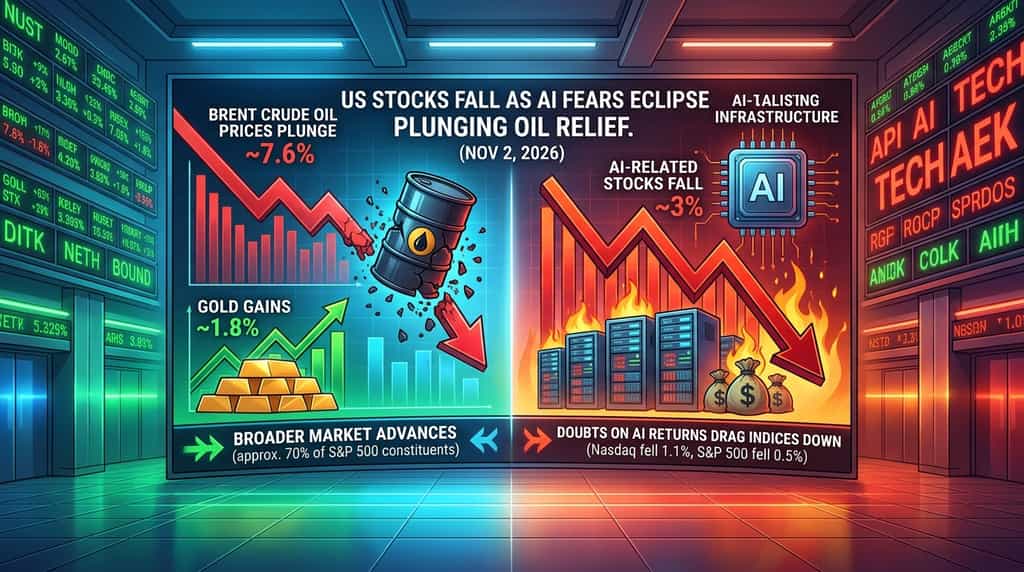
Why did US stocks fall on November 2, 2026, even as Brent crude prices plunged approximately 7.6% and gold gained around 1.8%? The answer lies in two opposing forces shaping financial markets: easing geopolitical and inflation concerns, and growing doubts about the returns on massive artificial intelligence (AI) investments. The Nasdaq Composite fell 1.1% and the S&P 500 declined 0.5%, while the Dow Jones Industrial Average advanced 0.4%.
The apparent contradiction reflects a significant divergence beneath the headline index figures. Lower oil prices supported companies exposed to fuel and transportation costs, and approximately 70% of S&P 500 constituents advanced. However, AI-related stocks fell around 3%, weighing on the technology-heavy indexes. Investors were increasingly distinguishing between businesses benefiting from lower operating costs and technology companies that still need to demonstrate that their enormous AI investments can generate sufficient revenue and cash flow.
Why Did US Stocks Fall on November 2 Despite Lower Oil Prices?
US stocks declined because selling pressure in large technology and AI-related companies outweighed gains across many other sectors. Falling oil prices improved the outlook for businesses exposed to energy costs, but they did not resolve concerns about AI capital expenditure, financing requirements, and future profitability.
The Nasdaq's larger decline reflected its greater exposure to technology and growth companies. The S&P 500 also came under pressure because its market-capitalization weighting gives its largest constituents substantial influence over the index. When several heavily weighted technology stocks fall together, their losses can outweigh advances among hundreds of smaller constituents.
The Dow's gain illustrates why the session should not be interpreted as a uniform sell-off across the US equity market. Its different composition and weighting methodology meant that gains in other large companies could offset weakness in some technology names. The broader market was showing signs of recovery even while the headline technology indexes remained under pressure.
The distinction is important for interpreting market sentiment. A declining index does not necessarily mean that most listed companies are losing value. On November 2, the market's internal performance was considerably stronger than the S&P 500 and Nasdaq closing figures suggested.
Why Did the AI Sell-Off Outweigh the Positive Impact of Lower Oil Prices?
The AI sell-off outweighed the broader market relief because investors were questioning whether enormous investments in AI infrastructure would generate sufficient financial returns. Lower oil prices can improve the macroeconomic environment, but they do not answer questions about the profitability of data centers, computing capacity, AI software, and the financing used to build them.
The November 2 market divergence was particularly revealing. Approximately 70% of S&P 500 constituents advanced, while AI-related stocks as a group declined around 3%. Meanwhile, the S&P 500 excluding AI-related components gained approximately 1% over the same period. These figures indicate that the weakness was concentrated in a specific group of influential technology and AI-linked companies rather than being representative of the entire market.
This distinction also explains why the Nasdaq fell more sharply than the Dow. The Nasdaq has substantial exposure to technology companies whose valuations are sensitive to expectations about future earnings growth. When investors reassess the returns on AI investments, companies associated with the AI infrastructure cycle can experience selling pressure even if other sectors benefit from improving economic conditions.
Three questions are particularly important to the current AI valuation debate:
-
Can AI Companies Generate Enough Revenue to Justify Their Capital Expenditure?
Investors are increasingly asking whether AI infrastructure spending can translate into sustainable revenue and operating profits. Building data centers requires substantial investment in computing hardware, networking equipment, electricity, cooling systems, and physical facilities. These costs may be incurred well before the resulting infrastructure generates enough revenue to justify the investment.
The commercial opportunity is substantial, but the timing of returns remains uncertain. Technology companies must demonstrate that customers are willing to pay for AI services, that usage can expand sustainably, and that revenue growth can keep pace with infrastructure costs. High demand for AI computing does not automatically establish that every infrastructure investment will produce attractive returns.
Alphabet's third-quarter 2026 earnings provide a useful example of this tension. According to its official Q3 2026 earnings call transcript, Alphabet reported quarterly capital expenditure of $51.4 billion, with most of the spending directed toward technical infrastructure supporting AI. The company also reported negative free cash flow of $9.1 billion for the quarter, primarily reflecting its capital expenditure program and other cash-flow factors.
Alphabet emphasized that AI investments were supporting demand across Search, Google Cloud, and its subscription products. The figures therefore do not establish that its investments are unproductive. Instead, they illustrate the scale of spending and why investors are examining the relationship between AI revenue growth, infrastructure costs, and free cash flow.
-
Are AI Infrastructure Companies Becoming More Dependent on External Financing?
Financing has become another important part of the AI investment debate. Building infrastructure at an unprecedented scale can require companies to use operating cash flow, debt, equity issuance, customer prepayments, and other funding arrangements. Investors must consider not only the potential revenue from new infrastructure, but also the financial obligations created to build it.
Oracle provides a recent example. At its October 28, 2026, Investor Day, the company outlined its expectations for substantial long-term growth while also discussing its capital requirements. According to Oracle's official Investor Day announcement, Oracle expects to limit additional capital-market funding for its FY2027-FY2030 investment cycle to $20 billion, comprising an expected $10 billion in equity and $10 billion in gross debt. This is in addition to a previously completed $20 billion at-the-market equity issuance.
These disclosures highlight why financing matters to the AI investment thesis. Debt creates interest and repayment obligations, while issuing additional shares can dilute existing shareholders' ownership. Even when new financing supports business expansion, investors may question whether the expected future earnings justify the additional financial commitments.
The relevant issue is not whether companies should invest in AI infrastructure. It is whether the expected returns can support the cost of funding, operating, and eventually refreshing that infrastructure.
-
How Long Will It Take for AI Investment to Generate Positive Cash Flow?
The timing of cash-flow generation is central to the current reassessment of AI valuations. Investors may accept high capital expenditure when they believe it will produce substantial future earnings, but uncertainty about the payback period can make valuations more sensitive to disappointing results.
AI infrastructure has a relatively complex investment cycle. Companies first commit capital to data centers, servers, networking equipment, and energy capacity. They then need to attract customers, increase utilization, establish recurring revenue, and manage depreciation and operating expenses. If customer demand grows more slowly than expected, the time required to generate attractive returns may extend.
Alphabet's third-quarter disclosures illustrate both sides of the equation. Its management described strong demand for AI infrastructure and solutions, while also reporting significant capital expenditure and negative quarterly free cash flow. Oracle's October Investor Day similarly showed that the company is setting out a multiyear funding and cash-flow plan for its infrastructure expansion.
Consequently, the market is moving beyond the question of which companies are spending the most on AI. It is increasingly asking which companies can convert that spending into durable revenue, operating income, and free cash flow. Until those answers become clearer, positive macroeconomic developments may not be sufficient to restore confidence in every AI-related stock.
Why Did Gold Rise 1.8% While Oil and Stocks Moved in Different Directions?
Gold rose approximately 1.8% on November 2 because a weaker US dollar and lower Treasury yields provided support, while equity-market volatility maintained demand for defensive assets. The move demonstrates that gold was responding to several macroeconomic factors rather than simply following geopolitical risk sentiment.
Ordinarily, easing geopolitical tensions can reduce demand for traditional safe-haven assets. However, gold prices are also sensitive to currency movements and interest rates. When the dollar weakens, gold priced in dollars can become more affordable for holders of other currencies, potentially supporting demand. Lower Treasury yields can also reduce the opportunity cost of holding gold, which does not pay interest.
On November 2, the dollar weakened and most US Treasury yields declined. These movements helped support gold even as diplomatic developments reduced part of the geopolitical premium in energy markets. The approximately 1.8% rise in gold therefore reflected the combined influence of currency, interest-rate, and defensive-positioning factors.
This divergence also highlights the importance of distinguishing between different market mechanisms. Oil prices were reacting primarily to expectations about future energy supply, while gold was receiving support from currency and yield movements. Equity investors, meanwhile, were reassessing the financial returns associated with AI infrastructure investment.
Gold's advance should not automatically be interpreted as evidence that investors expected a broader financial crisis. Defensive asset demand can remain meaningful during periods of uncertainty even when some geopolitical risks are easing.
Conclusion
The November 2, 2026, market divergence showed why falling oil prices do not automatically produce a broad US stock-market rally. Brent crude declined approximately 7.6% as progress in diplomatic discussions improved expectations for future energy supply. Lower oil prices supported businesses exposed to fuel costs and helped ease inflation concerns, while gold gained around 1.8% amid a weaker dollar, lower Treasury yields, and continued defensive demand.
However, the Nasdaq fell 1.1% and the S&P 500 declined 0.5% because weakness in AI-related stocks outweighed gains across much of the broader market. Approximately 70% of S&P 500 constituents advanced, illustrating how headline index performance can conceal significant differences between individual sectors and companies.
The central issue for technology investors is whether massive AI infrastructure investments can generate sufficient revenue, earnings, and free cash flow to justify their costs. Financing requirements, debt obligations, and potential shareholder dilution add further complexity. Going forward, energy supply developments will influence the inflation outlook, while AI earnings and cash-flow disclosures will remain important for assessing technology valuations. The market is no longer evaluating AI companies solely on their spending ambitions; it is increasingly examining the financial returns behind those ambitions.
FAQs
-
Why did the Nasdaq fall more than the Dow on November 2, 2026?
The Nasdaq has greater exposure to large technology and growth companies, making it more sensitive to the decline in AI-related stocks. The Dow has a different composition and weighting methodology, allowing gains in other constituents to offset weakness in some technology companies.
-
Did oil prices fall because an agreement to reopen the Strait of Hormuz was finalized?
No. The decline reflected improved expectations following positive developments in diplomatic discussions. It should not be interpreted as confirmation that a final agreement had been reached or that energy transportation conditions had already returned to normal.
-
Why can lower oil prices benefit airlines and cruise companies?
Fuel is an important operating expense for airlines and cruise operators. Lower energy prices can reduce their fuel costs and potentially support margins, although actual profitability also depends on passenger demand, ticket pricing, labor costs, financing, and other expenses.
-
What does negative free cash flow mean for an AI company?
Negative free cash flow means a company's operating cash flow was insufficient to cover its capital expenditure and other relevant cash investments during a reporting period. It does not automatically indicate financial distress, but investors should examine the reasons for the shortfall, available funding, and expected timing of future cash generation.
-
Why can gold rise when geopolitical tensions appear to ease?
Gold responds to several factors, including the US dollar, Treasury yields, inflation expectations, and defensive asset demand. A weaker dollar and lower yields can support gold prices even when a reduction in geopolitical risk limits one source of safe-haven demand.
Disclaimer
This general market information, possibly from third-party, commercial, or sponsored sources, is provided for reference and educational purposes only and does not constitute financial or investment advice, an offer, solicitation, or guarantee. We disclaim liability for its accuracy, completeness, reliability, and any resulting losses. Investments/trading are risky; past performance doesn’t guarantee future results. Users should research, judge prudently, and take full responsibility. For further details, please consult KuCoin’s Terms of Use and Risk Disclosure.