

Why Arbitrum (ARB) Surged 50% in 24 Hours: Robinhood Chain Revenue Boom and the Solana Debate
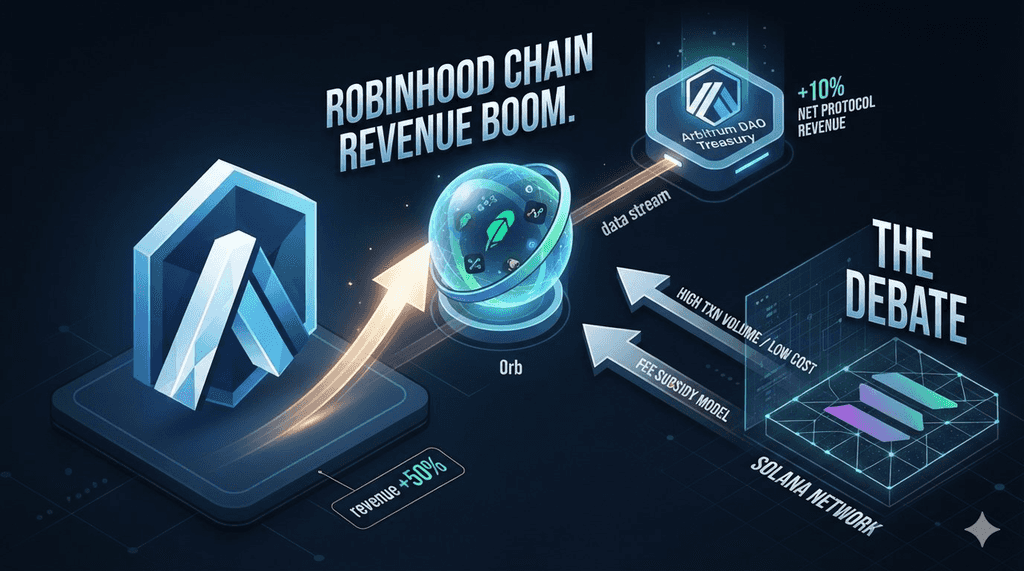
Arbitrum’s native token ARB delivered one of the sharpest single-day moves among major cryptocurrencies on September 6, 2026, climbing approximately 49 percent to trade near $0.197 according to market data reported across multiple outlets. The advance pushed the token’s market capitalization above $1.3 billion at its peak and lifted 24-hour trading volume into the hundreds of millions of dollars. The catalyst centered on explosive activity and fee generation on Robinhood Chain, the dedicated Ethereum Layer-2 network launched by the brokerage on July 1, 2026, using Arbitrum’s Orbit technology stack. Under the Arbitrum Expansion Program, 10 percent of that chain’s net protocol revenue flows back to the Arbitrum ecosystem, creating a direct economic link that traders rapidly repriced.
The same period also featured a high-profile exchange between Offchain Labs co-founder Steven Goldfeder and Solana co-founder Anatoly Yakovenko over whether Robinhood’s decision to operate its own chain represented superior value capture compared with deploying applications on a high-throughput Layer-1. This combination of concrete revenue figures and philosophical debate about blockchain business models produced the rapid market reaction. ARB’s near-50 percent surge reflected markets assigning higher value to Arbitrum’s ability to monetize third-party Orbit chains through a fixed revenue share, amplified by Robinhood Chain’s sudden leadership in daily fees and the public contrast with Solana’s alternative architecture.
Robinhood Chain’s Record Daily Fees Directly Boost Arbitrum Ecosystem Revenue
Robinhood Chain recorded daily chain revenue figures that repeatedly ranked among the highest across all tracked blockchains in early September 2026. DefiLlama data showed the network generating approximately $1.92 million in revenue over one 24-hour window in early September, later climbing to peaks near $2.9 million in fees and corresponding revenue retention after costs. On certain days, the figure exceeded $4 million and even approached $6 million in gross fees before deductions. These numbers placed Robinhood Chain ahead of Ethereum mainnet, Base, and other established networks for short periods. Because the chain operates under the Arbitrum Expansion Program, 10 percent of net protocol revenue is automatically directed to the Arbitrum ecosystem.
Of that share, 8 percent reaches the ArbitrumDAO treasury controlled by ARB holders, and 2 percent supports the Developer Guild. Reports indicated the DAO received more than $175,000 in a single peak day and several hundred thousand dollars over recent weekly and monthly windows. This cash-flow stream is independent of Arbitrum One’s own sequencer fees and Timeboost auctions, giving the DAO a new, scalable income source tied to the success of external Orbit deployments. Traders observed that the revenue share scaled with activity rather than remaining a fixed licensing fee, which strengthened the narrative that Arbitrum technology itself had become a monetizable platform. The sudden visibility of these numbers, combined with transparent on-chain reporting, produced an immediate upward revaluation of ARB as the governance token of the receiving DAO.
How the Arbitrum Expansion Program Converts Orbit Chain Success into DAO Income
The Arbitrum Expansion Program establishes a clear commercial relationship between Offchain Labs’ technology stack and any third-party chain that settles outside Arbitrum One or Nova. Participating chains, including Robinhood Chain, must route 10 percent of net protocol revenue back to the ecosystem after deducting Ethereum data-posting and other operational costs. Documentation and foundation statements confirm the split allocates 8 percent to the ArbitrumDAO treasury and 2 percent to developer-support initiatives. In July 2026, the first full month of Robinhood Chain mainnet operations, licensing revenue from this program already represented a meaningful portion of the DAO’s monthly income. By early September, the absolute dollar amounts had grown sharply as daily activity on the new chain accelerated.
This structure differs from pure software licensing because the payment obligation is proportional to realized network revenue rather than a flat fee. As a result, sustained high usage on Orbit chains directly enlarges the resources available for governance decisions, grants, and treasury management. Market participants interpreted the arrangement as evidence that Arbitrum had successfully productized its stack for enterprise-grade deployments while retaining a long-term economic interest. The model also creates an incentive alignment: the more successful an Orbit chain becomes, the larger the absolute contribution to Arbitrum’s treasury. This feedback loop became highly visible once Robinhood Chain’s daily figures entered the multi-million-dollar range, prompting rapid price discovery in the ARB token.
DEX Volume and Stablecoin Balances on Robinhood Chain Signal Real Usage Intensity
Beyond pure fee numbers, supporting metrics confirmed that the revenue boom rested on substantial trading activity. Robinhood Chain processed decentralized-exchange volumes that reached into the billions of dollars on peak days, with 24-hour figures reported above $1.3 billion and weekly totals climbing past previous records. Stablecoin balances on the network expanded quickly after launch and later approached or exceeded $900 million according to dashboard data. Total value locked in DeFi protocols on the chain moved into the high hundreds of millions and, at points, approached or surpassed $1 billion when broader metrics were included. Much of the early volume originated from memecoin trading and launchpad activity, yet the presence of established protocols such as Uniswap and lending platforms indicated broader infrastructure utilization.
These on-chain indicators mattered because they demonstrated that the fee generation was not an accounting artifact but the product of actual user transactions. Higher volume and deeper liquidity also increase the probability that tokenized real-world assets and other intended use cases will find a ready market once they scale. For ARB holders, the combination of rising DEX volume, growing stablecoin supply, and expanding TVL translated into greater confidence that the revenue share would remain material rather than temporary. The speed at which these metrics improved after the July 1 mainnet launch surprised many observers and contributed to the intensity of the September price reaction.
The Landlord-Versus-Tenant Argument That Defined the Solana Debate
The revenue figures quickly spilled into a public discussion between Steven Goldfeder of Offchain Labs and Anatoly Yakovenko of Solana. Goldfeder argued that by launching a dedicated Orbit chain, Robinhood retained roughly 90 percent of net gas revenue, positioning the brokerage as a landlord that controls its own sequencer economics. On a shared Layer-1 such as Solana, he contended, the same activity would generate fees that accrue to network validators rather than to the application operator, leaving Robinhood as a pure tenant. Yakovenko countered that the 10 percent share paid to Arbitrum would have covered Solana transaction fees multiple times over, potentially allowing Robinhood to subsidize user gas costs entirely and still monetize at the application layer.
He framed the higher average transaction costs observed on Robinhood Chain, reported near $0.40 during congestion, as evidence of misaligned incentives that profit from network demand rather than minimizing user friction. The exchange showed a fundamental design choice: whether a large consumer brand prefers to operate its own high-margin infrastructure or to leverage an existing high-throughput base layer while focusing solely on product distribution. Because the debate occurred precisely while Robinhood Chain’s revenue numbers were setting records, it amplified market attention on the economic model underpinning ARB’s price move.
Average Transaction Costs and Congestion Dynamics on the New Chain
During the period of peak activity, average transaction fees on Robinhood Chain rose to levels well above those typical of Solana or even Ethereum mainnet at the time. Figures near $0.40 per transaction were cited in the founder debate and reflected periods of heavy demand, largely from speculative trading. The chain employs a first-come, first-served sequencing model without a public mempool, which aims to reduce certain forms of maximal extractable value while still allowing fees to rise with congestion. Critics viewed the elevated costs as a feature that benefits the sequencer operator; supporters noted that the same congestion produces the revenue stream shared with Arbitrum. In absolute terms, the fee revenue remained substantial even after
Ethereum data costs and the 10 percent expansion-program obligation. For users, the experience differed markedly from ultra-low-fee environments, yet the combination of Robinhood’s distribution reach and the availability of tokenized products appeared sufficient to sustain volume. The fee dynamics also illustrated a practical trade-off inherent in dedicated chains: greater control over ordering and revenue comes with the responsibility of managing congestion pricing. Market observers tracking ARB recognized that any sustained reduction in average fees would lower absolute revenue and therefore the contribution to the Arbitrum treasury, making the durability of high-activity regimes an important variable.
Tokenized Stock Products as the Long-Term Use Case Beyond Memecoins
Robinhood Chain was designed primarily to support tokenized real-world assets, beginning with stock tokens that track the economic performance of major U.S. equities and are available to users in more than 120 countries. These instruments settle on the dedicated chain and can interact with DeFi protocols for lending and trading. While early revenue was dominated by memecoin launchpads and trading bots, the presence of Morpho lending markets and Uniswap liquidity indicated that the infrastructure could support more traditional financial products once volumes matured. Foundation commentary noted that the bulk of anticipated tokenized-asset activity had yet to arrive at the time of the initial revenue spike.
The potential for continuous 24/7 trading of equity exposure, combined with self-custody through the Robinhood wallet, differentiates the chain from pure speculation venues. If institutional or retail adoption of these products expands, the resulting steady transaction flow would provide a more predictable revenue base than episodic memecoin cycles. For the Arbitrum ecosystem, the implication is that the 10 percent share could evolve from a high-variance stream into a more durable contribution. The September price action in ARB partly reflected anticipation that the chain’s original product roadmap would eventually complement the speculative activity already generating large fees.
Market Capitalization Expansion Far Exceeded Immediate Treasury Inflows
ARB’s market capitalization increased by roughly $170 million during one of the sharper 24-hour windows, a figure that substantially outpaced the tens or hundreds of thousands of dollars flowing into the ArbitrumDAO treasury over the same period. This disparity is typical of narrative-driven rallies in which traders price in the discounted value of future cash flows rather than current distributions. Because ARB functions as a governance token rather than a direct claim on sequencer revenue, any conversion of treasury assets into token-holder value requires explicit DAO decisions that had not been proposed at the time of the surge.
Nevertheless, the visibility of multi-million-dollar daily contributions improved the perceived optionality of the treasury. Higher open interest in ARB perpetual futures and elevated spot volume accompanied the move, indicating that leveraged positioning amplified the price response once the fundamental catalyst became clear. Technical indicators such as RSI readings above 80 signaled overbought conditions and raised the possibility of short-term mean reversion, yet the underlying revenue data provided a floor of fundamental support that earlier ARB rallies often lacked. The market therefore treated the Robinhood Chain contribution as a structural improvement in Arbitrum’s economic model rather than a one-off event.
Technical Breakout and Derivatives Positioning Amplified the Price Move
From a pure price perspective, ARB broke out of a multi-month range that had contained the token between roughly $0.07 and $0.10 for much of the summer. The advance through resistance levels attracted momentum traders and forced short liquidations, contributing to the nearly 50 percent single-day gain. Open interest in ARB futures rose sharply in the days preceding the peak, then contracted as positions were closed, consistent with a short-squeeze component. Funding rates turned positive, reflecting long-side demand.
Spot volume expanded multiple times relative to prior averages, confirming that the move was not confined to derivatives markets. Chart patterns showed a steep ascent that temporarily pushed the price well above upper Bollinger bands and produced overbought readings on shorter time frames. While such technical conditions often precede consolidations, the simultaneous arrival of verifiable revenue data differentiated this breakout from purely speculative pumps. Traders monitoring both on-chain metrics and technical levels therefore viewed the combination as more durable than earlier ARB advances that lacked a clear cash-flow narrative.
Comparison of Revenue Capture Models Across Competing Architectures
The debate between the Arbitrum and Solana founders crystallized two distinct approaches to monetizing blockchain infrastructure. In the Orbit model, a consumer platform can launch a customized chain, retain the majority of sequencer revenue, and still benefit from Ethereum security and the broader Arbitrum developer ecosystem. In a pure Layer-1 deployment, the same platform would pay network fees without receiving any portion of the base-layer revenue generated by its users. Application-layer monetization remains available in both cases, yet the Orbit structure adds an infrastructure-level profit center. Robinhood’s choice illustrated that at least one large financial brand preferred the landlord position even at the cost of higher average user fees during congestion.
Solana’s counter-argument emphasized user experience and the possibility of front-end subsidies funded by application revenue. The market’s quick revaluation of ARB suggested that participants assigned meaningful probability to the Orbit approach becoming a template for other enterprises seeking both performance control and residual economics. Continued observation of fee levels, retention rates, and the eventual arrival of larger tokenized-asset volumes will determine which model proves more sustainable over multi-year horizons.
Results for Future Orbit Chain Deployments and Arbitrum’s Platform Strategy
Robinhood Chain is the highest-profile but not the only deployment using Arbitrum’s dedicated-chain toolkit. The success of its early revenue generation raises the possibility that additional enterprises in finance, gaming, or other verticals will evaluate similar launches. Each new Orbit chain that settles outside Arbitrum One automatically contributes under the same 10 percent net-revenue formula, expanding the potential income base for the DAO without requiring Arbitrum itself to operate the sequencers. This platform strategy converts technological leadership into a recurring revenue interest across an expanding set of independent networks.
For ARB, the long-term value proposition therefore includes both governance over the core protocol and a growing claim on the economic output of the wider Orbit universe. The September surge demonstrated that markets are beginning to price this optionality more explicitly. Whether the model scales will depend on the ability of new chains to attract sustained usage beyond initial speculative phases and on the continued competitiveness of Arbitrum’s technology relative to alternative stacks. Early evidence from Robinhood Chain provided the first large-scale proof point that the expansion program can deliver material treasury inflows.
Risk Factors Including Token Unlocks and Activity Sustainability
Despite the strong fundamental catalyst, several near-term risks remained visible. An upcoming unlock of approximately 92.6 million ARB tokens, largely allocated to team and investor schedules, was scheduled in the weeks following the rally and could introduce additional supply pressure. Open-interest dynamics and overbought technical readings raised the probability of profit-taking after such a rapid advance. More fundamentally, a significant portion of Robinhood Chain’s early volume and fees originated from memecoin activity, which historically exhibits high volatility and rapid decay.
If that segment contracts without a corresponding rise in tokenized-equity or other RWA trading, daily revenue figures could decline and reduce the absolute contribution to the Arbitrum treasury. Average transaction costs that remain elevated relative to competing networks may also limit mainstream adoption over time. Finally, because ARB does not automatically distribute treasury income, any positive cash-flow story still requires governance action to translate into direct holder value. These factors collectively suggest that the September price action, while grounded in real revenue data, remains subject to both technical and fundamental mean-reversion pressures.
Conclusion
The Robinhood Chain episode occurs against a backdrop in which Ethereum Layer-2 networks continue to absorb the majority of ecosystem transaction volume while competing on both cost and value-capture mechanisms. Arbitrum’s combination of a mature core chain, an expanding Orbit toolkit, and a formal revenue-share program positions it differently from pure low-fee competitors. The ability to attract a regulated brokerage to launch a dedicated chain and then share in its success strengthens the case that Arbitrum technology can serve institutional-grade requirements. At the same time, the public debate with Solana underscores that Layer-1 high-throughput designs remain attractive for applications prioritizing minimal user friction.
ARB’s price response indicates that markets currently assign premium value to the hybrid model that retains economic upside for the technology provider. Continued tracking of Orbit-chain revenue contributions, DAO treasury growth, and relative performance against other Layer-2 tokens will determine whether the September revaluation marks the beginning of a more sustained re-rating or a temporary narrative peak. The data released in early September provided the clearest evidence to date that Arbitrum’s platform strategy can generate meaningful, observable cash flows beyond its own flagship network.
Beyond the Headlines: What KuCoin 5.0 Means for You
Market news moves fast — but where you act on it matters just as much. This October, KuCoin launches KuCoin 5.0, transforming KuCoin into a rebuilt platform. Here's what actually changes for you:
-
One account for everything. Older platforms split your money across separate "spot," "margin," and "futures" accounts and expected you to understand why. KuCoin 5.0's unified account removes that entirely — deposit once, and everything is simply there.
-
Stocks, indices, and commodities. KuCoin 5.0 expands beyond crypto into global markets. When crypto chops sideways and equities rally (or the reverse), you rotate in minutes instead of opening a brokerage account and waiting days for fiat rails.
-
Real-world assets (RWA). Tokenized exposure to traditional assets like commodities, right inside your crypto account. One of the fastest-growing segments in global finance is no longer reserved for institutions — you access it from the same balance you trade with.
-
Earn while you learn. Not ready to trade? KCUSD lets your stablecoins earn daily, auto-compounding interest. The lowest-stress way to put your idle deposit to work for 4% yield.
-
An AI assistant in plain language. Ask questions, get market context, understand what you're looking at — built into the platform, no jargon required.
-
An app that doesn't overwhelm. Faster, cleaner, and consistent — intuitive from the first tap, not after a tutorial.
-
Safety you can check, not just trust. A MiCAR-licensed EU entity, Proof of Reserves you can verify yourself, and internationally certified security (SOC 2 Type II, ISO 27001:2022).
Create your account in minutes — and start on the platform built for where crypto is going, not where it's been.
FAQs
What caused ARB to rise nearly 50 percent on September 6, 2026?
The primary driver was the sudden surge in daily revenue and trading volume on Robinhood Chain, which operates on Arbitrum Orbit technology and routes 10 percent of its net protocol revenue to the Arbitrum ecosystem. Market data showed the token advancing approximately 49 percent in 24 hours as traders priced in the improved cash-flow outlook for the ArbitrumDAO treasury.
How does the 10 percent revenue share actually work?
Under the Arbitrum Expansion Program, any Orbit chain settling outside Arbitrum One or Nova contributes 10 percent of net protocol revenue after operational costs. Eight percentage points flow to the ArbitrumDAO treasury, and two percentage points support the Developer Guild. The obligation scales with the chain’s own activity, so higher usage produces larger absolute payments.
Did memecoin trading account for most of the early volume?
Yes. Reports indicated that a substantial portion of the initial DEX volume and fee generation on Robinhood Chain originated from memecoin launchpads and trading bots. Tokenized stock products and other intended real-world-asset use cases had not yet reached comparable scale at the time of the revenue peaks.
What was the core disagreement between the Arbitrum and Solana founders?
Steven Goldfeder emphasized that Robinhood retains roughly 90 percent of net gas revenue by operating its own Orbit chain, functioning as a landlord. Anatoly Yakovenko argued that the same 10 percent share paid to Arbitrum could have covered Solana fees multiple times, enabling a lower-cost or subsidized user experience while still allowing application-layer monetization.
Disclaimer
The information provided on this page may originate from third-party sources and does not necessarily represent the views or opinions of KuCoin. This content is intended solely for general informational purposes and should not be considered financial, investment, or professional advice. KuCoin does not guarantee the accuracy, completeness, or reliability of the information, and is not responsible for any errors, omissions, or outcomes resulting from its use. Investing in digital assets carries inherent risks. Please carefully evaluate your risk tolerance and financial situation before making any investment decisions. For further details, please consult KuCoin’s Terms of Use and Risk Disclosure.