

Visa Stablecoin Adoption 2026: $20 Billion in Annualized Settlements Explained
Visa Turns Stablecoins Into Scalable Payment Infrastructure
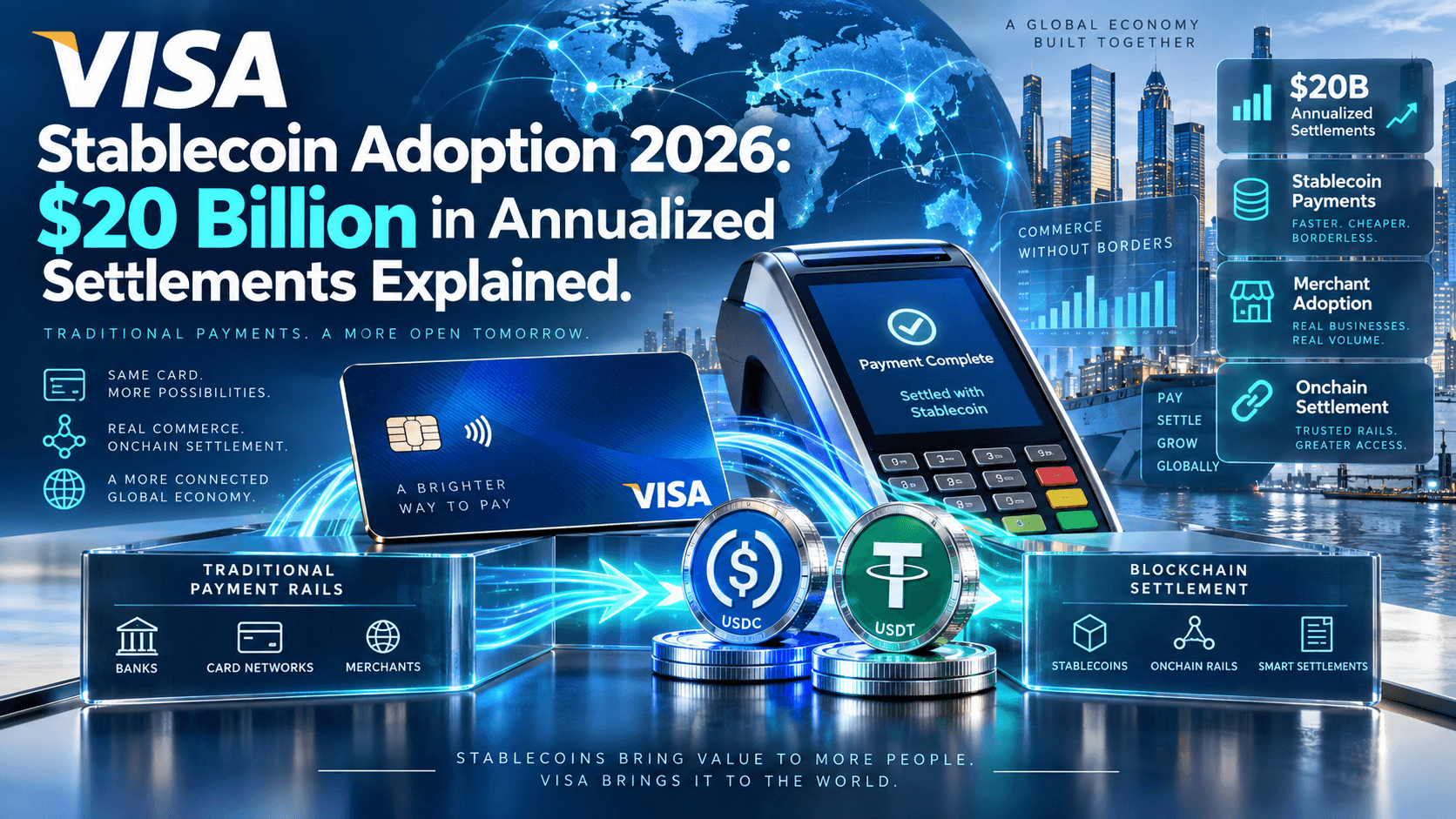
Visa’s stablecoin settlement activity has reached a significant operational milestone. In its fiscal second quarter of 2026, the company reported that stablecoin settlement volume surpassed a $20 billion annualized run rate, representing growth of more than 15 times compared with the same period a year earlier. At the same time, more than 160 stablecoin-linked card programs were live on the network globally, and payment volume on those programs rose nearly 200 percent year over year. These figures, disclosed alongside an expansion of onchain settlement-financing capabilities with Credit Coop, illustrate how stablecoins are moving from experimental pilots into routine network infrastructure.
The core development is that Visa has converted rising stablecoin card usage into a measurable settlement scale while simultaneously addressing the working-capital friction that accompanies rapid program growth. By combining VisaNet settlement data with blockchain-based revolving credit facilities, the company is enabling early-stage issuers to fund daily obligations more efficiently, with reported cumulative financed volume exceeding $2.5 billion since 2023 and zero defaults to date. This combination of volume growth and capital-market tooling marks a practical step toward embedding programmable money into everyday card payments.
How Visa’s $20 Billion Annualized Stablecoin Settlement Figure Was Calculated and What It Reflects
Visa’s $20 billion annualized run-rate figure is derived from recent settlement activity projected over a full year rather than from a completed calendar-year total. The company stated that the run rate was achieved in fiscal second quarter 2026 and represents more than a fifteen-fold increase from the comparable prior-year period. Earlier reference points help contextualize the acceleration: late 2025 activity was described near a $3.5 billion annualized pace, while the run rate stood at approximately $7 billion by April 2026 before climbing further. Monthly settlement volume has been reported in the vicinity of $1.2 billion in recent disclosures. These numbers sit alongside broader on-chain stablecoin activity tracked by Visa’s analytics tools, which recorded adjusted stablecoin transaction volume reaching $1.79 trillion in June 2026 alone.
The distinction between Visa’s own network settlement and overall market volume is important: the $20 billion figure specifically measures obligations settled through Visa’s rails using stablecoins, primarily in support of card programs where consumers spend stablecoins and merchants receive fiat. Growth has been supported by multi-chain capabilities that now include nine blockchains following additions announced earlier in 2026. The run-rate methodology means the figure can fluctuate with near-term activity, yet the direction from low single-digit billions to $20 billion within roughly a year demonstrates rapid operational scaling rather than one-time spikes.
The Expansion of Stablecoin-Linked Card Programs Beyond 160 Live Initiatives
More than 160 stablecoin-linked card programs operated on Visa’s network during fiscal second quarter 2026, with associated payment volume increasing nearly 200 percent from the prior year. These programs allow cardholders to hold stablecoins while spending at any merchant that accepts Visa; the network manages conversion and settlement so that merchants receive traditional currency. Geographic reach has widened through partnerships, including expanded collaboration with Stripe-owned Bridge that extended stablecoin card capabilities to more than 100 countries. Earlier in 2026, Visa reported more than 130 programs across more than 50 countries, indicating continued program launches and maturation. The programs range from consumer-facing debit-style products to specialized offerings such as travel cards.
Payment volume growth of nearly 200 percent signals that end-user spending, not merely program count, is rising. Visa has described the segment as one of the fastest-growing parts of its network. Operational complexity increases with scale because each program must meet daily settlement obligations to the network before collecting from cardholders, creating a structural need for short-term liquidity that traditional banking facilities sometimes struggle to supply at small ticket sizes or daily frequency. The combination of program proliferation and volume growth has therefore elevated working-capital management from a secondary concern to a central operational requirement.
Working-Capital Constraints Facing Early-Stage Stablecoin Card Issuers
Card issuers face a classic timing mismatch: they must fund settlement with Visa on a daily basis while cardholder repayments or balances may lag. For early-stage stablecoin-linked programs, the absolute dollar amounts can be modest, sometimes only a few million dollars, yet the settlement cycle is continuous. Traditional warehouse lines or bank facilities often carry minimum sizes, lengthy underwriting, or pricing that becomes uneconomic at small scale and high frequency. Visa has noted that some programs are constrained less by consumer demand or network acceptance than by access to working capital structured for their daily operating rhythm. This friction becomes more pronounced as programs grow because settlement obligations scale with volume.
Without efficient funding, issuers may limit issuance, delay expansion into new markets, or hold excess idle capital as a buffer. The problem is structural rather than cyclical; it arises directly from the intermediated nature of card networks even when the consumer asset is a stablecoin. Addressing it therefore requires tools that can evaluate settlement receivables in near real time, automate collateral and repayment, and operate at the speed of daily settlement files. The emergence of onchain solutions has been positioned precisely against this operational reality.
Credit Coop’s Revolving Facility and the Role of Settlement Receivables as Collateral
Visa’s collaboration with Credit Coop centers on a stablecoin-denominated revolving credit facility secured by settlement receivables. With customer authorization, Credit Coop combines VisaNet settlement data with on-chain transaction records to assess performance and support automated financing. The Spigot smart-contract mechanism routes incoming settlement proceeds to repay outstanding balances before funds reach the borrower, creating a programmatic repayment path. Since 2023, the model has supported more than $2.5 billion in cumulative financed settlement volume, encompassing more than 3,000 borrow events and 9,000 repayment events, with zero defaults reported across participating facilities.
One early user, Rain, a Visa Principal Member operating multiple stablecoin card programs, has financed approximately $2 billion through the facility since August 2023, involving more than 2,000 on-chain borrowing events and over 7,000 repayments. Borrowing costs for some programs have declined by as much as 30 percent relative to traditional alternatives. The facility’s design converts what was previously opaque or manually underwritten collateral into observable, continuously updated data, allowing capital to be deployed and repaid in alignment with actual settlement cycles rather than static credit lines.
Rain’s Multi-Year Track Record Using Onchain Settlement Financing
Rain’s experience provides a concrete operational case study. As a Visa Principal Member focused on stablecoin-linked cards, Rain began using the Credit Coop facility in August 2023 to fund daily settlement obligations. Over the subsequent period, it has drawn approximately $2 billion in cumulative financing across more than 2,000 borrow events while completing more than 7,000 repayment events, with no defaults. Because Rain manages multiple programs and cardholders, a single draw can cover aggregated settlement needs, while repayments arrive in batches as merchants and cardholders flow clear. The automated repayment logic ensures that settlement proceeds first satisfy the facility before residual funds become available to the issuer.
This structure has allowed Rain to scale programs without proportionally increasing balance-sheet capital locked against settlement risk. In parallel, related programs such as the travel-focused Karta card have used similar facilities during growth phases before securing larger institutional credit lines. The multi-year zero-default record supplies performance data that traditional lenders can evaluate, potentially lowering future financing costs and broadening the set of capital providers willing to participate. The example demonstrates that settlement receivables, when made transparent through network data and on-chain records, can function as reliable collateral even for relatively young programs.
Integration of VisaNet Data with Onchain Lending Protocols
Visa is extending the model beyond a single partner by enabling broader access to VisaNet settlement data for blockchain-based lenders. With authorization, lenders can incorporate verified settlement performance into credit decisions, creating a feedback loop between payment activity and capital availability. The company estimates that more than $694 billion in stablecoin-denominated loans have flowed through on-chain protocols since 2020, yet most of that activity has remained inside crypto-native markets. Connecting network settlement data to that liquidity pool aims to redirect capital toward everyday payment businesses.
Settlement files that once served only accounting and risk functions can now serve as underwriting inputs, potentially allowing facilities to expand or contract with verified volume rather than remaining fixed. Automated repayment reduces operational friction and counterparty risk. The approach does not replace traditional banking relationships; it supplements them with a parallel, data-driven channel that operates continuously. Success depends on data-quality standards, authorization frameworks, and the willingness of lenders to treat programmable receivables as first-class collateral. Early results from the Credit Coop pilots supply a performance baseline against which broader adoption can be measured.
Multi-Chain Settlement Capabilities Supporting the Volume Ramp
Visa’s stablecoin settlement infrastructure now supports nine blockchains following the addition of five networks earlier in 2026. Existing support for Avalanche, Ethereum, Solana, and Stellar was expanded to include additional chains purpose-built or optimized for payments and settlement. Multi-chain capability reduces dependency on any single network’s throughput, fees, or availability and allows issuers and acquirers to choose rails that match their operational preferences. The $7 billion annualized run rate reported in April 2026 already reflected 50 percent quarter-over-quarter growth; the subsequent rise to a $20 billion run rate indicates that the expanded chain set has been utilized.
Settlement in USDC and other stablecoins can occur directly on supported chains, improving speed and capital efficiency for banks and fintechs compared with purely fiat correspondent arrangements. The technical architecture treats stablecoins as settlement assets while preserving Visa’s existing merchant acceptance and risk-management layers. This hybrid design allows volume to scale without requiring every participant to rebuild core payment infrastructure.
Broader Stablecoin Market Context Surrounding Visa’s Network Activity
Visa’s network figures sit inside a larger stablecoin ecosystem that processed record-adjusted transaction volumes in mid-2026. June 2026 alone saw $1.79 trillion in adjusted stablecoin volume, up 63 percent month-over-month and 125 percent year-over-year, according to Visa’s own analytics. Trailing twelve-month adjusted volume has exceeded $10 trillion. USDC has accounted for a rising share of economically meaningful activity in certain periods. These market-level numbers dwarf Visa’s $20 billion settlement run rate, underscoring that network settlement remains a specialized subset focused on card-related obligations rather than the full spectrum of on-chain transfers.
The distinction matters for interpretation: Visa’s growth reflects successful integration of stablecoins into regulated card rails, while overall market volume includes trading, DeFi, and cross-border transfers. The two trends reinforce each other; rising general adoption increases the pool of users and issuers interested in card products, and successful card programs normalize stablecoins as everyday payment instruments.
Results for Card Issuers and Fintech Operators
Issuers operating or planning stablecoin-linked programs now have an additional capital channel that scales with settlement activity rather than requiring large upfront facilities. Reduced borrowing costs of up to 30 percent in early cases improve unit economics, particularly for programs still building volume. Automated repayment lowers operational overhead and default risk. Access to continuous performance data can help issuers demonstrate creditworthiness to larger institutional lenders once they outgrow revolving facilities.
For fintechs the model shortens the path from program launch to sustainable funding, potentially accelerating geographic or product expansion. Merchants continue to receive fiat settlement, so acceptance friction remains low. Consumers gain the ability to spend stablecoin balances without converting in advance. The net effect is a more capital-efficient growth path for the segment, provided data-sharing authorization and smart-contract execution remain reliable.
Risk Considerations and Performance Safeguards Observed to Date
While the zero-default record across more than $2.5 billion of financed volume is notable, the facilities remain relatively concentrated among early adopters, and the absolute scale is still modest relative to Visa’s overall network. Smart-contract risk, oracle or data-feed integrity, and regulatory treatment of on-chain credit arrangements constitute ongoing considerations. Concentration in specific stablecoins or chains could introduce liquidity or operational dependencies. Visa and its partners emphasize customer authorization for data use and programmatic repayment controls as primary safeguards.
Traditional credit underwriting continues to operate in parallel for larger or more complex exposures. The performance data accumulated since 2023 provides a transparent audit trail that can inform risk models, yet past results do not guarantee future outcomes under stress conditions or rapid volume spikes. Continuous monitoring of repayment ratios, collateral coverage, and settlement-file accuracy remains essential as the model expands.
Strategic Positioning of Stablecoins Within Visa’s Broader Payments Infrastructure
Visa has framed stablecoins as complementary to existing rails rather than replacements. The Visa Stablecoin Platform, launched earlier, provides a managed environment for minting, redeeming, holding, and transferring stablecoins. Settlement pilots, card-program enablement, and now data-enabled onchain credit form successive layers of the same strategy: make stablecoins operationally usable inside the network’s existing trust, risk, and acceptance framework.
The $20 billion settlement run rate and 160-plus programs supply measurable evidence that the strategy is progressing from pilots to production scale. By treating settlement data as an underwriting primitive, Visa is extending its role from pure transaction processing into adjacent capital-market functions. This evolution aligns with the broader industry movement toward real-time, data-rich payment ecosystems in which liquidity and credit can adjust continuously to observed activity.
Future Scalability Factors and Open Operational Questions
Further growth will depend on continued program launches, sustained end-user spending, expansion of multi-chain settlement, and the willingness of additional lenders to participate in data-driven facilities. Regulatory clarity around stablecoin issuance and on-chain credit in major jurisdictions will influence institutional participation. Technical resilience of the supported blockchains and the smart-contract infrastructure will be tested as volumes increase.
Data privacy and authorization frameworks must scale without introducing friction that slows program onboarding. The gap between the $20 billion settlement run rate and the multi-trillion-dollar broader stablecoin market indicates substantial remaining headroom if card usage continues to convert a larger share of stablecoin balances into everyday spend. Operational focus will likely remain on refining the capital tools that allow issuers to grow without disproportionate balance-sheet strain.
Measuring Success Beyond Headline Volume Figures
While the $20 billion annualized settlement figure and 200 percent payment-volume growth attract attention, longer-term success metrics include default rates under varied market conditions, the percentage of programs that graduate from revolving facilities to permanent capital, geographic diversification of activity, and the share of overall Visa volume attributable to stablecoin-linked products. Cost reductions realized by issuers, speed of settlement finality, and capital efficiency relative to pure-fiat alternatives will determine whether the model becomes standard infrastructure or remains a specialized niche.
Transparent reporting of financed volumes, repayment events, and performance data will allow external observers to track progress independently of run-rate projections. The combination of network scale, data assets, and programmable finance tools positions Visa to convert stablecoin adoption into durable operational capacity provided the observed performance characteristics persist at larger absolute volumes.
🔥 Beyond the Headlines: What KuCoin 5.0 Means for You
Market news moves fast — but where you act on it matters just as much. This October, KuCoin launches KuCoin 5.0, transforming KuCoin into a rebuilt platform. Here's what actually changes for you:
-
One account for everything. Older platforms split your money across separate "spot," "margin," and "futures" accounts and expected you to understand why. KuCoin 5.0's unified account removes that entirely — deposit once, and everything is simply there.
-
Stocks, indices, and commodities. KuCoin 5.0 expands beyond crypto into global markets. When crypto chops sideways and equities rally (or the reverse), you rotate in minutes instead of opening a brokerage account and waiting days for fiat rails.
-
Real-world assets (RWA). Tokenized exposure to traditional assets like commodities, right inside your crypto account. One of the fastest-growing segments in global finance is no longer reserved for institutions — you access it from the same balance you trade with.
-
Earn while you learn. Not ready to trade? KCUSD lets your stablecoins earn daily, auto-compounding interest. The lowest-stress way to put your idle deposit to work for 4% yield.
-
An AI assistant in plain language. Ask questions, get market context, understand what you're looking at — built into the platform, no jargon required.
-
An app that doesn't overwhelm. Faster, cleaner, and consistent — intuitive from the first tap, not after a tutorial.
-
Safety you can check, not just trust. A MiCAR-licensed EU entity, Proof of Reserves you can verify yourself, and internationally certified security (SOC 2 Type II, ISO 27001:2022).
Create your account in minutes — and start on the platform built for where crypto is going, not where it's been.
FAQs
What exactly does an annualized run rate of $20 billion mean for Visa’s stablecoin settlements?
An annualized run rate projects recent settlement activity forward over twelve months. It does not mean Visa has already settled $20 billion in the calendar year; rather, the pace observed in the relevant quarter, if sustained, would equate to that annual total. The figure can rise or fall with subsequent monthly volumes and is therefore a forward-looking indicator of current operational scale rather than a historical cumulative total.
How do stablecoin-linked Visa cards work for consumers and merchants?
Consumers hold approved stablecoins and use a Visa-branded card at any accepting merchant. The network converts the stablecoin value and settles with the merchant in fiat currency through existing acquirer relationships. Cardholders experience a familiar card interface while the underlying funding asset remains a stablecoin until the point of settlement.
Why do card programs need special financing for daily settlement?
Issuers must meet network settlement obligations on a fixed cycle, often daily, before they collect corresponding amounts from cardholders. This timing gap creates a recurring working-capital need. At a small scale or high frequency, the gap is difficult to fund economically with conventional bank lines, which is why purpose-built revolving facilities secured by settlement receivables have emerged.
What role does Credit Coop play in the financing structure?
Credit Coop operates a stablecoin-denominated revolving facility that uses Visa settlement data and on-chain records to underwrite and automate funding. Smart contracts manage collateral and route repayment from settlement proceeds. The arrangement has financed more than $2.5 billion cumulatively since 2023 with no reported defaults.
Has the financing model been tested with real programs over multiple years?
Yes. Rain, a Visa Principal Member, has used the facility since August 2023 to fund approximately $2 billion of settlement volume across thousands of on-chain borrow and repayment events with zero defaults. Other programs have also participated during growth phases before securing larger institutional facilities.
Disclaimer: This content is for informational purposes only and does not constitute investment advice. Cryptocurrency investments carry risk. Please do your own research (DYOR).