

US Strategic Bitcoin Reserve: Lawmakers Introduce Bill to Lock Bitcoin as National Asset for 20 Years
2026/05/25 17:15:01
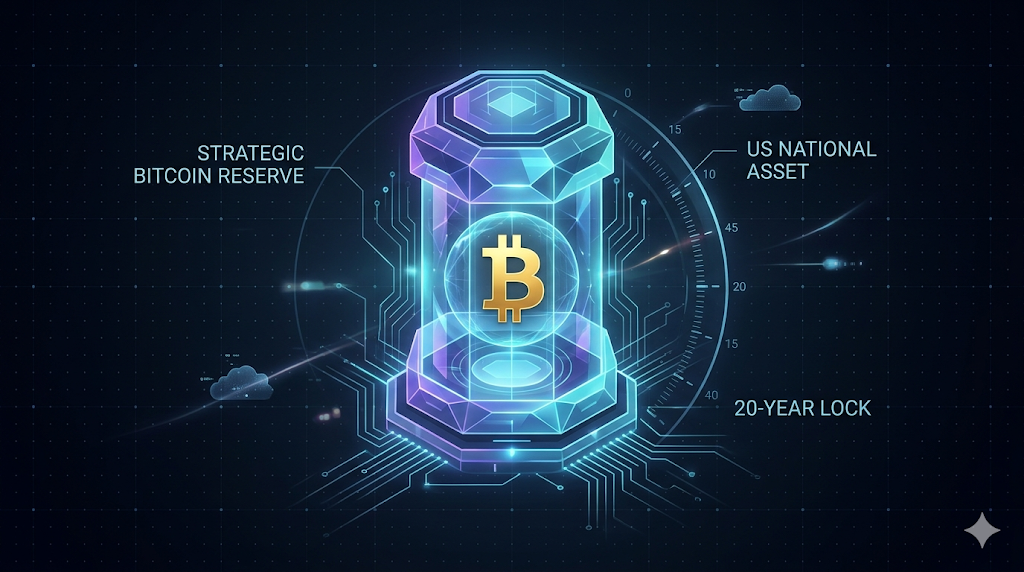
The United States Strategic Bitcoin Reserve legislation, officially known as the BITCOIN Act, legally mandates the federal government to acquire Bitcoin and lock it away for a minimum of twenty years. This unprecedented financial strategy transforms decentralized digital currency into a sovereign treasury asset designed to offset the soaring national debt. Lawmakers introduced this bill to permanently prevent the premature sale of these national assets, effectively establishing a digital Fort Knox.
The Mechanics of the BITCOIN Act and the 20-Year Lock
Purchasing One Million Bitcoin
The federal government will actively purchase one million Bitcoin over a five-year period to build the national reserve. The legislation strictly caps the acquisition rate at two hundred thousand Bitcoin annually to minimize catastrophic market disruption. By accumulating exactly one million coins, the United States aims to capture approximately five percent of the total global supply. This massive accumulation explicitly mirrors the historical size and scope of the traditional American gold reserves, cementing the asset as a permanent geopolitical cornerstone.
Treasury officials are legally bound to conduct these acquisitions in a highly transparent and strategic manner. The explicit legal framework ensures that sovereign purchases do not inadvertently trigger massive, unmanageable retail price spikes across global exchanges. The government will utilize existing federal funds and resources from the Federal Reserve System to facilitate these continuous purchases without immediately burdening the everyday taxpayer, effectively reallocating excess capital into a highly resilient, globally recognized digital commodity.
The 20-Year Minimum Holding Period
The legislation strictly prohibits the United States government from selling, swapping, or auctioning any reserve assets for exactly twenty years. This mandatory holding period guarantees the long-term stability and security of the Strategic Bitcoin Reserve, entirely removing short-term political influence from the equation. Lawmakers designed this absolute lock-up period to allow the digital asset to compound in value across multiple global macroeconomic cycles, completely shielding the sovereign treasury from the devastating impacts of immediate market volatility.
During this two-decade lock-up, the assets can only be utilized for one highly specific purpose — retiring outstanding federal debt instruments. The government cannot leverage the reserve to fund standard operational budgets or new legislative spending packages. This rigid financial structure permanently transforms the digital currency from a highly speculative trading instrument into a foundational pillar of American economic security. By aggressively locking the asset, the government effectively signals absolute confidence in the long-term viability of cryptographic decentralized networks.
Decentralized Cold Storage Network
The Treasury Department will establish a decentralized network of highly secure storage facilities distributed geographically across the United States. This physical decentralization minimizes the existential risk of a simultaneous compromise and heavily enhances the overall resilience of the national reserve. The government refuses to rely on a single centralized vault, learning from the vulnerabilities inherent in legacy financial infrastructure. Distributing the cryptographic keys prevents localized natural disasters from suddenly destroying the entire sovereign digital wealth portfolio instantaneously.
These facilities will exclusively utilize advanced cold storage methods to secure the vital cryptographic private keys. The hardware remains completely isolated from all internet connections, providing an impenetrable defense against sophisticated global cyberattacks. The Secretary of the Treasury bears the ultimate legal responsibility for the ongoing monitoring, security, and frequent transparent auditing of these decentralized federal holdings. Strict institutional oversight guarantees that the American public can continually verify the exact status of the massive cryptographic treasury reserves.
Technical Compliance and Network Participation
Running Sovereign Validator Nodes
To properly audit and verify the massive national stockpile, the United States government will likely deploy its own sovereign validator nodes. Running dedicated network nodes allows the Treasury to independently verify every single transaction without relying on third-party block explorers or foreign corporate entities. This extreme level of technical independence is absolutely crucial for maintaining flawless national security. By actively participating in the decentralized consensus mechanism, the government formally validates the underlying mathematical integrity of the entire global protocol.
The Financial Rationale: Offsetting the US National Debt
Projections for the Year 2049
The twenty-year holding period directly targets the projected explosion of the United States national debt by the year 2049. Economic models, based on VanEck projections published in early 2025, indicate that the federal debt could compound to a staggering $116 trillion within the next two decades. The sovereign reserve acts as a highly aggressive financial countermeasure designed to outpace this devastating fiat debt spiral over the designated holding cycle.
If the digital asset maintains a twenty-five percent compound annual growth rate, a single coin could reach $21 million by 2049. Under these specific mathematical parameters, the fully matured one-million-coin reserve would be worth roughly $21 trillion. This staggering valuation would successfully offset approximately eighteen percent of the total projected national debt, providing unprecedented fiscal relief for the federal government.
Eliminating Fiat Debasement Risk
Sovereign nations increasingly recognize that holding infinite fiat currency fails to protect national purchasing power during periods of severe inflation. The strategic reserve directly addresses this macroeconomic vulnerability by anchoring a portion of the national balance sheet to an asset with a mathematically capped supply. Because nobody can ever print more than twenty-one million Bitcoin, it serves as the ultimate hedge against perpetual monetary debasement.
Lawmakers clearly view this accumulation as an essential defensive maneuver to preserve American global economic hegemony. As foreign nations slowly abandon the traditional dollar standard, the United States must aggressively diversify its sovereign reserves to maintain absolute financial dominance. This proactive legislative shift essentially modernizes the treasury for the digital age, securing the future purchasing power of public assets for upcoming generations.
Executive Action Versus Legislative Power in 2026
The 2025 Executive Order Baseline
The momentum for this massive reserve originated with an executive order issued by President Donald Trump in March 2025. This historic directive formally established the initial Strategic Bitcoin Reserve by permanently retaining digital assets seized during federal criminal investigations. According to Wikipedia's 2026 tracking data, the federal government already held approximately 328,000 Bitcoin from previous law enforcement operations, forming the absolute foundational baseline for the new national stockpile.
This executive order mandated that all federal agencies immediately provide a full accounting of their digital asset holdings to the Treasury. The directive explicitly forbade the government from selling these seized assets, ending the previous practice of randomly auctioning them to the public. However, executive orders carry severe limitations because they cannot authorize the expenditure of new capital to actively purchase additional assets on the open market.
The Shift to Active Accumulation
The BITCOIN Act bridges the crucial gap between passively holding seized assets and aggressively purchasing new ones. While the executive branch successfully secured existing government funds, active open-market accumulation requires formal congressional approval and legislative funding mechanisms.
According to legislative summaries from early 2026, the active accumulation plan involves:
-
Purchasing 200,000 Bitcoin annually to mitigate extreme market volatility.
-
Utilizing resources from the Federal Reserve to completely offset immediate taxpayer costs.
-
Storing all newly acquired assets directly into the localized strategic reserves.
The political alignment between the House, the Senate, and the White House during early 2026 created the perfect legislative window for this bill. Prominent lawmakers continuously argue that the United States must rapidly pass this framework before any potentially hostile, anti-crypto administration takes power in the future. Establishing this law permanently ensures that subsequent political regimes cannot easily dismantle the sovereign digital reserve.
Managing Forked Assets and Airdrops
Handling Blockchain Splits
The proposed legislation includes highly specific legal protocols for managing sudden blockchain forks and unexpected network airdrops. When a decentralized network forks into two separate ledgers, the government will strictly retain the digital asset possessing the dominant market capitalization. The Treasury is legally mandated to promptly liquidate the non-dominant forked asset to prevent the national reserve from holding useless, speculative alternative tokens.
All fiat proceeds generated from liquidating these non-dominant forked assets must be deposited directly into the general fund of the Treasury. However, the Secretary of Commerce can grant a rare legal exception if a newly forked asset demonstrates novel technological utility or strategic value. This rigid legal framework ensures the sovereign reserve remains purely focused on top-tier assets without ignoring potentially revolutionary technological breakthroughs.
Global and State-Level Reserve Initiatives
State Legislation in Arizona and Beyond
Multiple American states refuse to wait for the federal government and are aggressively advancing their own local reserve legislation. Arizona successfully passed a bill allowing the state government to hold seized digital assets in a localized strategic reserve. Although Arizona law explicitly precludes actively buying new assets, it firmly establishes the legal precedent for sovereign state-level crypto accumulation.
As of early 2026, sixteen different states have actively introduced varying forms of strategic reserve legislation to protect their local treasuries. This massive grassroots political movement heavily pressures federal lawmakers to swiftly finalize the national BITCOIN Act. State governors recognize that holding decentralized assets perfectly insulates their local economies from federal monetary mismanagement and runaway national inflation.
The International Accumulation Race
The United States currently finds itself locked in a massive digital space race against rival geopolitical superpowers. While the U.S. currently leads with the world’s largest foundational baseline derived from federal criminal seizures, other nations are aggressively re-evaluating their positions. Rather than auctioning off confiscated assets, several foreign governments are quietly laying the groundwork for their own sovereign digital holdings.
If the United States successfully executes the one-million-coin purchase program under the BITCOIN Act, it will trigger a game-theoretic feedback loop on a global scale. Rival nations and central banks will be forced to front-run the American government by quietly accumulating their own sovereign reserves. This fierce international competition will likely spark an unprecedented global supply shock, as institutional states scramble to secure a finite digital commodity before the open market dries up.
Macroeconomic Impact on Global Markets
Institutional Capital Inflows
Massive pension funds, university endowments, and traditional wealth managers require absolute legal clarity before deploying billions into novel asset classes. When the federal government legally recognizes Bitcoin as a twenty-year treasury reserve asset, it instantly eliminates the existential regulatory risk for traditional finance.
This macroeconomic legitimization triggers a massive cascade of institutional adoption across the entire global financial sector. Corporate treasuries will eagerly mimic the federal government's strategy, placing digital assets on their own corporate balance sheets to hedge against inflation. This intense institutional demand will completely permanently reshape the global financial landscape, integrating decentralized networks directly into legacy banking infrastructure.
Supply Shock and Price Dynamics
Removing one million Bitcoin from active circulation will induce a devastating supply shock across all major global trading platforms. The decentralized protocol inherently limits total creation to twenty-one million coins, with millions already permanently lost to inaccessible wallets. When the American government blindly absorbs five percent of the total supply, it permanently starves the open market of vital retail liquidity.
This massive structural illiquidity historically leads to violent, exponential price appreciation during periods of high macroeconomic demand. Retail traders and institutional algorithms will fiercely compete for the dwindling available supply, driving spot prices to unprecedented historical highs. Financial analysts warn that this sovereign accumulation phase will completely break historical predictive pricing models due to the sheer magnitude of the government's purchasing power.
Criticisms and Potential Risks
Market Manipulation Concerns
Prominent economists aggressively criticize the strategic reserve concept, arguing that a highly volatile digital asset cannot reliably secure the national debt. Critics highlight the severe systemic risk of a sudden, devastating market crash completely wiping out billions in taxpayer value overnight. Because digital asset markets routinely experience massive cyclical drawdowns, relying on them for national security introduces unprecedented fiscal instability.
Opponents also fiercely argue that massive government accumulation will inevitably lead to severe sovereign market manipulation over the long term. By controlling such a massive percentage of the total supply, the Treasury could eventually weaponize the asset to manipulate global financial markets. Critics frequently compare this terrifying potential scenario to the historical market distortions caused by massive sovereign gold and fiat currency hoarding during the twentieth century.
Political and Legislative Hurdles
The legislation faces intense, highly coordinated resistance from skeptical lawmakers who firmly believe digital assets offer absolutely no strategic national benefit. Ranking members of the House Financial Services Committee have previously dismissed the entire stockpile concept as a silly distraction from vital economic issues. Opponents constantly emphasize the massive environmental energy toll required to secure the underlying decentralized network globally.
Passing the bill requires navigating a treacherous, highly polarized political landscape where financial policy frequently becomes weaponized. If the legislation fails to secure sufficient bipartisan congressional support, the United States will remain entirely dependent on executive orders that can be easily reversed. The ultimate success of the strategic reserve relies entirely on convincing traditional lawmakers that digital assets represent the unavoidable future of global finance.
Navigating the heightened market volatility triggered by sovereign digital asset accumulation requires a highly functional trading environment. Global cryptocurrency exchanges like KuCoin offer deep global liquidity pools. This deep liquidity helps traders execute high-volume orders efficiently, minimizing severe price slippage during major macroeconomic announcements.
To mitigate human emotional bias during chaotic market cycles, retail day-traders frequently deploy sophisticated, automated algorithmic trading tools. Utilizing KuCoin’s built-in Spot Grid or Futures Grid bots, users can continuously capture fractional, intraday price fluctuations as larger institutional buyers gradually absorb the circulating market supply.
Always ensure full compliance with local Know Your Customer (KYC) mandates and evaluate individual risk tolerance before deploying active capital into volatile digital asset markets.
Conclusion
The introduction of the American Reserve Modernization Act (ARMA) permanently redefines the fundamental relationship between sovereign governments and decentralized digital assets globally. By establishing a Secure Strategic Bitcoin Reserve with a strict twenty-year minimum lock-up period, American lawmakers aim to institutionalize a modern national fiscal defense infrastructure. This milestone legislative framework permanently shifts the United States from a passive, unpredictable auctioneer of seized criminal assets into a disciplined, long-term sovereign custodian.
Executing this massive acquisition program requires the immediate establishment of a highly resilient, geographically decentralized cold storage network to absolutely protect the national treasury. While traditional economic critics fiercely warn of severe market manipulation and unprecedented fiscal volatility, proponents firmly view this sovereign transition as an absolutely vital defense against perpetual fiat currency debasement.
This unprecedented sovereign accumulation forces intense global game theory, compelling rival nations to urgently secure their own strategic reserves before the finite digital supply completely evaporates. As the 2026 legislative battle unfolds, the establishment of this digital Fort Knox ensures that cryptographic networks will permanently dictate the future trajectory of international macroeconomic policy.
FAQs
What is the primary purpose of the US Strategic Bitcoin Reserve?
The primary purpose is to institutionalize a modern national fiscal defense mechanism by elevating digital assets into a sovereign store-of-value. By permanently securing a strictly capped digital asset, the federal government aims to establish a macroeconomic hedge against structural fiat currency inflation, while bolstering America's competitive position in the global digital economy.
Why does the legislation mandate a twenty-year holding period?
Lawmakers enforced a strict twenty-year minimum lock-up period to ensure that strategic digital assets remain protected across multiple global halving and financial cycles. This legally binding statutory restriction prevents subsequent administrations or short-sighted political regimes from prematurely liquidating national reserve assets to fund temporary operational government deficits.
How will the government acquire one million Bitcoin without crashing the market?
The legislation explicitly restricts the federal government to purchasing a maximum of two hundred thousand Bitcoin annually over a five-year period. The Secretary of the Treasury is legally required to execute these continuous purchases in a highly transparent, strategic manner specifically designed to minimize market disruption. The government will also actively utilize existing seized assets to offset these massive open-market purchase requirements.
Will the Strategic Reserve hold other digital assets besides Bitcoin?
Yes, while the core BITCOIN Act focuses specifically on acquiring one million Bitcoin, previous executive orders established a broader United States Digital Asset Stockpile. This secondary stockpile formally retains other major digital assets, such as Ethereum and Solana, that the federal government legally seizes during criminal investigations. However, the government will not actively use taxpayer funds to aggressively purchase these alternative network tokens.
Where will the federal government securely store this cryptocurrency?
The Treasury Department is statutory mandated to implement a highly resilient, geographically decentralized custody infrastructure across the United States. To eliminate single points of failure, the framework requires the enforcement of advanced institutional standards, including cold-storage vaults, air-gapped security protocols, distributed private-key management, and multi-signature authorization to prevent both localized disasters and cyber-attacks.
Disclaimer:This content is for informational purposes only and does not constitute investment advice. Cryptocurrency investments carry risk. Please do your own research (DYOR).