

US Stocks Fall as Bessent’s Treasury Buybacks Fail to Curb Yields; Gold and Bitcoin Rally
2026/08/21 11:50:00
Introduction
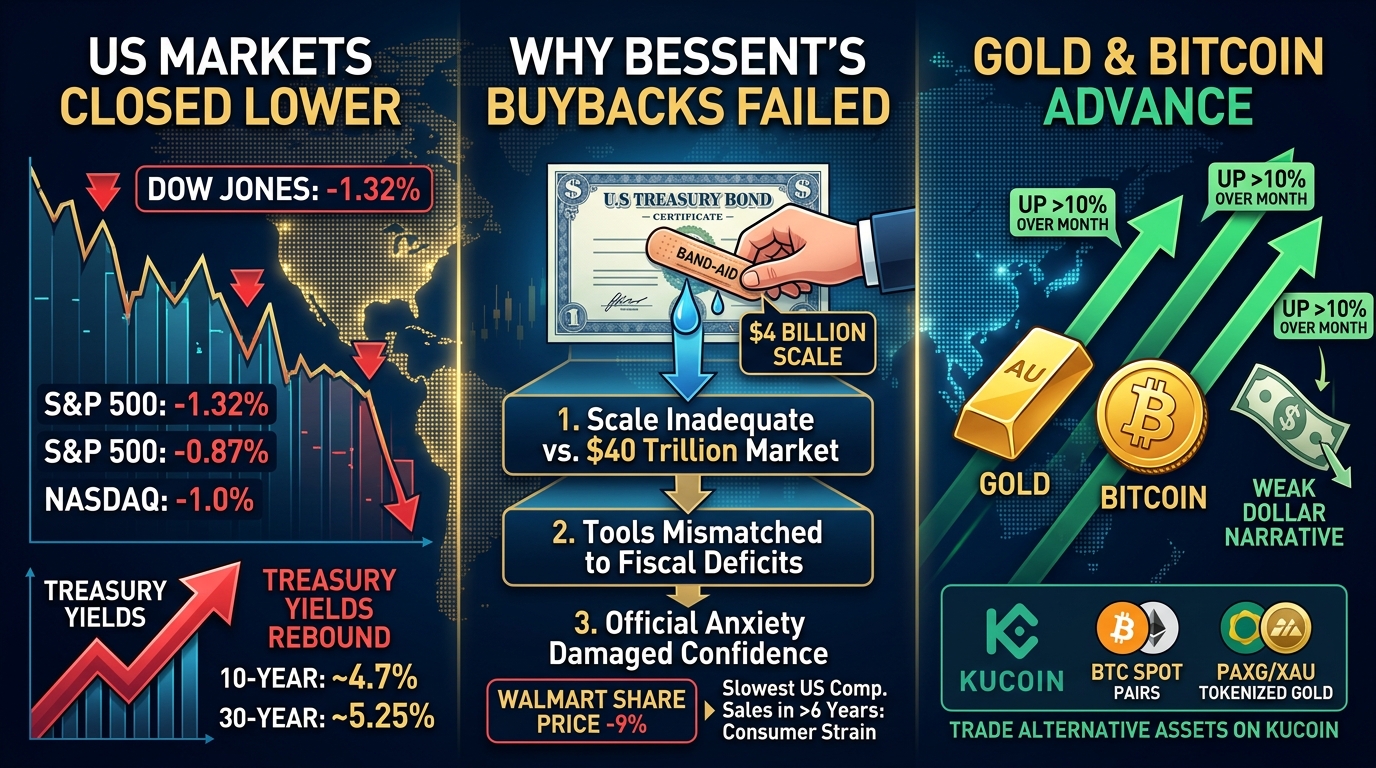
US stocks closed lower on August 20, 2026, after Treasury Secretary Scott Bessent’s expanded bond buybacks failed to hold down long-term yields. The Dow Jones Industrial Average dropped 1.32%, the S&P 500 fell 0.87%, and the Nasdaq Composite declined 1%, according to market closes reported that day. Ten-year Treasury yields settled near 4.7% and 30-year yields near 5.25%—levels almost unchanged from before the interventions. Gold and Bitcoin both gained more than 10% over the prior month as investors sought alternatives to weakening Treasuries and a softer dollar narrative.
The core outcome is clear: the two rounds of Treasury support produced only temporary relief before yields rebounded and equities sold off. Scale limitations, mismatched tools, and damaged market confidence explain the shortfall. Consumer data from Walmart reinforced broader economic caution, while safe-haven flows lifted traditional and digital gold.
What Happened to US Stocks and Treasury Yields After Bessent’s Interventions?
Major US equity indexes finished lower on August 20, 2026, after a brief rebound the previous session evaporated. The Dow Jones Industrial Average fell 703.84 points, or 1.32%, to 52,759.21. The S&P 500 declined 0.87% to 7,641.16. The Nasdaq Composite dropped 1% to 26,067.17. These moves reversed much of the prior day’s gains that followed the first buyback announcement.
Treasury yields told the same story of fleeting support. On August 19 the Treasury said it would at least double liquidity-support buybacks of longer-dated securities, lifting the per-operation size from $2 billion to a minimum of $4 billion for the period from September 9 through November 4. Yields fell initially. By the next session they had climbed again. The 10-year yield closed near 4.7% and the 30-year near 5.25%, according to market data from August 20. These levels stood almost unchanged from the readings recorded before the interventions began.
The “Magnificent Seven” technology names posted modest declines. Storage-chip and optical-module stocks moved mixed but without large swings. Energy prices added pressure as Brent crude moved above $93 a barrel amid heightened geopolitical tensions. Overall market breadth remained negative, with declining issues outnumbering advancers on the New York Stock Exchange.
The sequence matched the pattern described across recent trading days: an initial positive response to the first expansion of buybacks, followed by skepticism when Bessent indicated on television that operations “could be more” than the $4 billion figure. Investors treated the second signal as insufficient.
Why Did Treasury Secretary Bessent’s Bond Buybacks Fail?
Bessent’s two interventions failed primarily because the $4 billion scale was too small relative to the overall Treasury market, the chosen tool addressed only liquidity rather than underlying drivers of higher yields, and the actions themselves signaled official concern that further eroded confidence.
First, the scale proved inadequate. The US Treasury market is measured in the tens of trillions of dollars. A $4 billion repurchase per operation represents a small fraction of daily trading volume and of the roughly $550 billion in new issuance expected in the current quarter, according to analyst estimates reported in August 2026. The initial announcement produced a short-lived drop in yields because markets responded to the signal that the Treasury preferred not to see long-term rates rise too quickly. When Bessent later suggested the size could increase further, that incremental signal no longer moved prices. The market had already discounted the limited capacity of the program.
Second, the tool itself was mismatched to the problem. Buybacks can improve liquidity in less actively traded longer-dated securities and temporarily support prices. They cannot, however, offset the fundamental forces pushing yields higher: persistent inflation concerns, large fiscal deficits, and heavy ongoing Treasury supply. US public debt crossed the $40 trillion mark in mid-August 2026. Deficits continue to run near 6% of GDP. Corporate borrowing for AI-related capital spending has also competed for investor capital. These structural pressures remained intact after the announcements.
Third, the interventions damaged rather than restored market confidence. Repeated official efforts to support the long end of the curve highlighted official anxiety about rising borrowing costs. Analysts described the moves as a “band-aid” or “technical backstop” rather than a solution to the root fiscal issues. Once investors concluded that the Treasury was reacting to market pressure rather than leading with a comprehensive plan, selling resumed and yields recovered almost all of the earlier decline.
The combined result was that both the first $4 billion expansion and the subsequent verbal hint of larger operations produced only temporary relief. Yields finished the period essentially where they had stood before the rescue attempts began.
How Did Walmart’s Earnings Reflect Broader US Consumer Weakness?
Walmart’s second-quarter results, released on August 20, 2026, showed that US consumers are under growing pressure even as the company beat headline revenue and earnings estimates. The stock fell more than 9% in the session, becoming the largest single drag on the S&P 500 that day.
US comparable sales rose only 2.6%, the slowest pace in more than six years and well below analyst expectations of roughly 3.8%. Excluding a regulatory impact on pharmacy pricing, the figure was still just 3.4%. Average spending per transaction slowed sharply. The company raised its full-year sales and adjusted-earnings guidance, yet its third-quarter profit outlook came in softer than consensus forecasts. Management pointed to higher gasoline prices above $4 per gallon as a key factor forcing shoppers to make trade-offs.
These numbers serve as a real-time thermometer for the US consumer. Elevated credit-card interest rates, ongoing mortgage burdens, and broad price increases have left ordinary households with less discretionary room. When the largest US retailer reports its weakest domestic same-store growth in years, the implication extends beyond one company. Softening consumer spending in the world’s largest economy raises the risk of a broader macroeconomic slowdown.
The Mag7 and other growth-oriented sectors had dominated recent market attention, but Walmart’s results pulled focus back to the traditional consumer economy. The sharp share-price reaction underscored investor concern that the spending engine supporting US growth is losing momentum.
Why Are Gold and Bitcoin Rising Amid US Bond and Stock Pressure?
Gold and Bitcoin both advanced more than 10% over the past month because investors increasingly treat them as alternatives when the dual narrative of weak Treasuries and a softer dollar gains traction. The failed buyback efforts reinforced that narrative.
Long-term US government bonds have faced sustained selling pressure. At the same time, any successful attempt to suppress yields risks weakening the dollar by reducing its interest-rate advantage. Markets therefore confront a policy dilemma: support the bond market or protect the currency. Either choice highlights underlying stress. Once that framing takes hold, capital seeks assets viewed as stores of value outside the traditional US fixed-income complex.
Gold, the classic safe-haven metal, benefited directly. Spot prices climbed toward multi-month highs after the buyback announcements temporarily lowered yields and the dollar. Bitcoin, often called “digital gold,” followed a parallel path. It pushed above $70,000 and at times traded near $72,000 in the days surrounding the Treasury actions, according to market data from August 19–20, 2026. The moves occurred alongside broader risk-asset flows once yields initially declined, then continued as the rebound in yields failed to restore full confidence in Treasuries.
The simultaneous strength in both assets is consistent with a search for alternatives rather than pure risk-on speculation. When official interventions cannot permanently stabilize long-term yields and consumer data points to slower spending, the relative attractiveness of scarce, non-sovereign stores of value increases. Both gold and Bitcoin have responded to that shift over the past month.
How to Trade Bitcoin and Gold-Related Opportunities on KuCoin?
KuCoin provides direct access to Bitcoin and a wide range of gold-linked crypto products in a single platform. Users can buy, sell, or trade BTC/USDT spot pairs with competitive fees and deep liquidity. For those seeking exposure tied to precious-metals themes, KuCoin also lists tokenized gold products and related derivatives, such as PAXG or XAU, that allow both long and short positioning.
Registration is straightforward: create an account, complete identity verification, and deposit funds via supported methods. Once funded, traders can execute market or limit orders on BTC/USDT and other major pairs, or explore gold-related tokens that track physical bullion prices. Advanced tools include futures contracts for leveraged strategies and copy-trading features for those who prefer to follow experienced signal providers.
The platform’s security infrastructure, multi-layer risk controls, and 24/7 customer support make it suitable for both new and experienced participants navigating periods of elevated macroeconomic uncertainty. When traditional markets face simultaneous pressure from rising yields and softening consumer data, the ability to move quickly into Bitcoin or gold-themed assets on a reliable exchange becomes a practical advantage.
Conclusion
Treasury Secretary Scott Bessent’s two rounds of bond buybacks produced only temporary relief. Yields on the 10-year and 30-year notes rebounded to approximately 4.7% and 5.25%, respectively, while the Dow, S&P 500, and Nasdaq all closed lower on August 20, 2026. The limited scale of the $4 billion operations, the inability of liquidity tools to address inflation, deficits, and supply pressures, and the negative confidence signal sent by repeated interventions explain the failure.
Walmart’s weakest US comparable-sales growth in more than six years added evidence of consumer strain under high interest costs and rising prices. That micro-level weakness feeds into the broader macro picture. As long-term Treasuries remain under pressure and the dollar faces competing demands, investors have rotated toward gold and Bitcoin, both of which rose more than 10% over the past month.
The episode underscores a simple reality: technical market support cannot substitute for durable fiscal credibility. Until the underlying drivers of higher yields ease, equity markets will remain sensitive to every shift in bond yields, and alternative assets will continue to attract capital seeking protection outside the traditional government-debt complex.
FAQs
What size were the Treasury buybacks announced by Bessent?
The Treasury raised the per-operation ceiling for longer-dated securities from $2 billion to a minimum of $4 billion, effective from September 9 through November 4, 2026. Bessent later indicated the figure could exceed that amount.
Why did Walmart shares drop more than 9% despite beating earnings estimates?
US comparable sales grew only 2.6%, the slowest pace in over six years, and the third-quarter profit outlook came in below expectations, raising concerns about consumer spending strength.
Does a Treasury buyback program change the total amount of US government debt?
No. Buybacks redistribute existing securities and can improve liquidity, but they do not reduce the overall stock of outstanding debt or the need for future issuance.