

The Macro Maestro: Who Is Arthur Hayes and Why Does He Command the Crypto Narrative?
2026/05/25 15:48:34
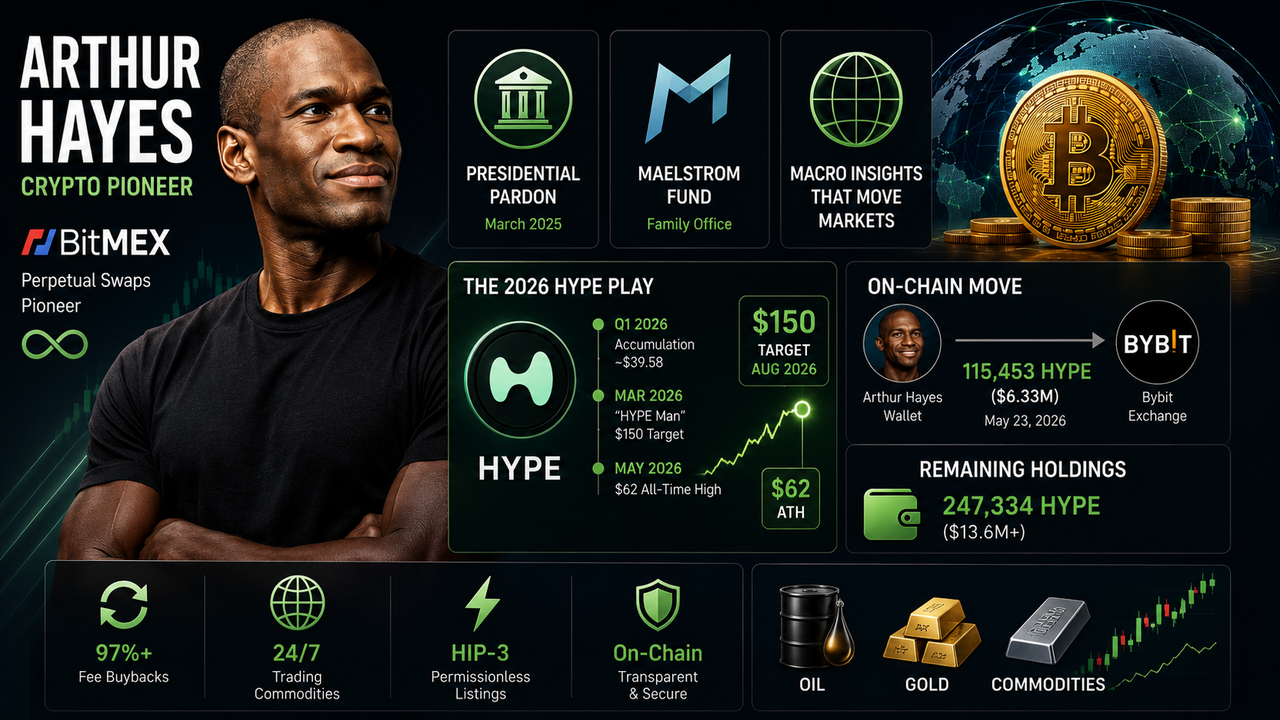
Arthur Hayes, the co-founder and former CEO of BitMEX, remains one of the most polarizing, influential, and high-profile figures in the global cryptocurrency ecosystem. Renowned for inventing pioneering financial derivatives and navigating intense regulatory storms, his macroeconomic insights and whale-sized on-chain transactions consistently dictate market sentiments and trigger massive trading volumes worldwide.
As an institution-grade crypto exchange platform, we provide this comprehensive analysis of Arthur Hayes, exploring his legacy, his market-moving venture fund, and his explosive 2026 Hyperliquid ($HYPE) trading strategy.
Key Takeaways
-
Derivatives Pioneer: Arthur Hayes permanently transformed market structures by inventing the perpetual swap contract at BitMEX, introducing 100x leverage and non-expiring derivative trading to the digital asset industry.
-
Presidential Pardon Recipient: After a high-profile legal battle with U.S. regulators regarding Bank Secrecy Act violations, his legal saga concluded with a full presidential pardon from Donald Trump in March 2025.
-
The HYPE Narrative Catalyst: In Q1 2026, Hayes orchestrated a massive market narrative by predicting that Hyperliquid ($HYPE) would hit $150 by August 2026, positioning it as his fund's largest non-Bitcoin liquid holding.
-
On-Chain Whale Movement: Blockchain tracking in May 2026 revealed Hayes depositing $$6.33 million worth of$$HYPE to Bybit immediately after the asset hit a historic all-time high of $62, highlighting his immense power to trigger market volatility.
-
Commodity Arbitrage Champion: Hayes successfully anticipated that geopolitical tension would drive 24/7 on-chain oil and commodity trading via Hyperliquid's HIP-3 framework, outperforming legacy, time-constrained traditional finance systems.
Decoding the Enigma of Crypto’s Most Vocal Pioneer
The trajectory of the modern digital asset market cannot be fully understood without examining the footprints of Arthur Hayes. Long before institutional asset managers embraced Bitcoin, Hayes recognized the profound structural inefficiencies of traditional banking systems and bridged them with decentralized alternatives.
The Genesis of an Industry Titan: From Wharton to BitMEX
Arthur Hayes graduated from the Wharton School of the University of Pennsylvania in 2008, entering the financial sector during the chaotic onset of the Global Financial Crisis. He honed his skills as an equity derivatives market-maker at Deutsche Bank and Citibank in Hong Kong, mastering the mechanics of complex trading instruments. When he was laid off in 2013, he turned his attention to the nascent crypto market, identifying a massive gap in infrastructure. In 2014, alongside Ben Delo and Samuel Reed, he built BitMEX (Bitcoin Mercantile Exchange), a platform designed specifically to give retail and institutional traders institutional-grade leverage over crypto assets, transforming him into one of the youngest African American billionaires in financial history.
Redefining Market Structure: The Perpetual Swap Legacy
Before BitMEX, crypto trading was severely constrained by spot liquidity and rigid, expiring futures contracts that required complex rollover mechanics. To solve this friction, Hayes and his team engineered the perpetual swap contract. This financial derivative offered three distinct advantages that fundamentally redefined global market structures:
-
No Expiration Date: Traders could maintain exposure indefinitely without rolling over contracts.
-
Funding Rate Mechanism: A periodic exchange of fees between longs and shorts ensured the contract price stayed pegged to the underlying spot index.
-
100x Leverage: An unprecedented offering that amplified both capital efficiency and systemic volatility across the crypto industry.
Anatomy of a High-Profile Persona: Why the Market Hangs on Every Word
Arthur Hayes does not merely participate in the market; he actively shapes it through calculated public transparency, intellectual provocations, and massive financial plays. His high-profile status is a deliberate mix of legal drama, institutional capital dominance, and exceptional macroeconomic literacy.
The Regulatory Crucible: Indictment, Guilt, and the 2025 Presidential Pardon
The aggressive, offshore growth model of BitMEX eventually drew the ire of United States regulators. In October 2020, the Department of Justice (DOJ) and the Commodity Futures Trading Commission (CFTC) indicted Hayes and his partners for willfully failing to maintain an adequate anti-money laundering (AML) architecture and violating the Bank Secrecy Act. After a high-profile legal standoff, Hayes pleaded guilty in 2022, serving six months of home detention alongside a $10 million criminal fine. The dramatic saga reached its ultimate resolution in March 2025, when Hayes received a full presidential pardon from Donald Trump, an event that permanently cemented his status as an untouchable, legendary iconoclast within crypto culture.
The Maelstrom Effect: How a Billion-Dollar Family Office Moves Order Books
Following his departure from operational duties at BitMEX, Hayes established Maelstrom, a highly sophisticated family office fund focused on early-stage venture infrastructure, decentralized finance (DeFi), and Web3 protocols. Maelstrom operates with deep liquid reserves, targeting projects that solve fundamental scaling, liquidity, or derivative pricing problems. Because the crypto community aggressively tracks Hayes’ verified personal and fund wallet addresses via on-chain analytics platforms, any deployment of capital by Maelstrom instantly creates a massive wave of copy-trading, causing immediate and dramatic shifts in order-book liquidity across global exchanges.
The Financial Evangelist: Substack Essays That Shape On-Chain Sentiments
Through his widely read blog, Hayes acts as a financial evangelist, translating complex central bank policies, reverse repo market data, and geopolitical events into digestible, actionable strategies. His essays are famous for their irreverent tone, historical analogies, and bold price targets—such as his recurring thesis that rampant fiat debasement will eventually propel Bitcoin to $1,000,000. When Hayes writes an essay diagnosing structural flaws in a specific sector or highlighting a preferred asset class, tens of thousands of traders instantly rebalance their portfolios, altering on-chain spot and derivatives trends within minutes of publication.
Case Study: The 2026 Hyperliquid ($HYPE) $150 Price Call Controversy
The true extent of Arthur Hayes' narrative dominance became blindingly obvious during the first half of 2026, when he orchestrated a massive, public campaign around Hyperliquid ($HYPE), a decentralized perpetual exchange that grew to challenge centralized market leaders.
Arthur Hayes' 2026 HYPE Playbook:
-
Q1 2026 (The Paradigm Shift): Clears portfolio, accumulates HYPE at ~$39.58.
-
March 2026 (The Manifesto): Publishes "HYPE Man", issues $150 price target.
-
May 2026 (The Local Top): HYPE hits $62 ATH; Hayes moves $6.33M to Bybit.
From "Tactical Short" to "Only Buying HYPE": The Dramatic 2026 Shift
Late in the previous year, Hayes maintained a highly cautious, tactically short stance on several decentralized perpetual protocols, citing looming token unlocks and unsustainable yield rewards. However, by Q1 2026, his stance underwent a complete structural shift as he witnessed Hyperliquid’s explosive, organic user retention. On March 9, 2026, Hayes published a seminal essay titled "HYPE Man," where he openly declared that Maelstrom had cleared out underperforming liquid altcoins to establish $HYPE as their single largest liquid position outside of Bitcoin. He boldly stated that his fund was aggressively buying every structural dip, instantly igniting a wave of intense retail FOMO.
The $150 Vision: Breaking Down the August 2026 Valuation Model
Arthur Hayes did not just tell his followers to buy; he provided a rigorous mathematical model arguing that $HYPE would reach $150 per token by August 2026. The framework rested on two core pillars:
-
The Revenue Multiplier: Hyperliquid’s 30-day annualized protocol revenue needed to scale from its March baseline of $843 million to $1.4 billion. Hayes demonstrated that this was easily achievable if the platform captured just 3.97% of the total derivatives market share currently held by centralized exchange giants.
-
P/E Ratio Re-rating: He argued that the market was fundamentally mispricing decentralized infrastructure, valuing Hyperliquid at a modest 12x price-to-earnings multiple. Hayes claimed a standard sector re-rating to 25x, combined with expanding volume, made the $150 price target a mathematical certainty.
Reality Check: HYPE’s Historic $62 All-Time High Milestone in May 2026
The market responded to Hayes' thesis with unprecedented capital velocity. Supported by rumors of institutional accumulation and potential tier-one spot listings, $HYPE experienced an explosive rally throughout April and May. On May 21, 2026, the token shattered expectations by hitting a historic all-time high of $62, driving Hyperliquid into the top 15 digital assets by market capitalization. While the asset fell short of the ultimate $150 projection, the rally validated Hayes’ ability to single-handedly engineer massive liquidity surges by aligning macro narratives with aggressive on-chain accumulation.
The Financial Mechanics Behind Hayes’ Bull Case for Hyperliquid
To look past the bombastic headlines, an institutional analyst must dissect the specific financial engineering metrics that Arthur Hayes used to defend his high-conviction bet on Hyperliquid over other layer-one or DeFi protocols.
Hyperliquid vs. Traditional DeFi Protocols Comparison:
-
Fee Allocation: 97% to 99% dedicated to token buybacks in Hyperliquid ($HYPE) Architecture.
-
Listing Mechanism: HIP-3 permissionless asset creation in Hyperliquid ($HYPE) Architecture.
-
Order Book Transparency: 100% on-chain, verifiable L1 consensus in Hyperliquid ($HYPE) Architecture.
-
Macro Asset Coverage: 24/7 perpetuals for Oil, Gold, Commodities in Hyperliquid ($HYPE) Architecture.
The 97% Buyback Machine: A Masterclass in Token Deflationary Dynamics
The cornerstone of the investment thesis put forth by Arthur Hayes was Hyperliquid's aggressive value-capture mechanism. Unlike legacy DeFi protocols that distribute fees to concentrated equity holders or emit dilutive tokens to subsidize yields, Hyperliquid routes between 97% and 99% of all platform transaction fees directly into its native insurance and stabilization fund. This fund systematically executes market buybacks of $HYPE. This structural design ensures that as long as trading volume remains high, a relentless, non-discretionary buying pressure actively shrinks the circulating token supply, engineering a powerful deflationary flywheel that rewards long-term token holders.
Market Share Conquest: Siphoning Volume from CEX Giants to Hit $1.4B Revenue
For a decentralized exchange to generate $1.4 billion in annualized revenue, it must directly disrupt established centralized entities. Hayes argued that centralized exchanges (CEXs) suffer from structural friction points, including opaque internal market-making, geographic regulatory blockades, and counterparty custody risks. Hyperliquid bypassed these vulnerabilities by offering a seamless user experience built on a custom, high-throughput AppChain. By matching the execution speed of a centralized clearinghouse while maintaining non-custodial asset security, the platform easily siphoned high-frequency retail and institutional volume away from legacy platforms, rapidly scaling its top-line protocol revenue.
The ADV-to-OI Metric: Identifying "Real" vs. "Fugazi" Wash Trading Volumes
A recurring criticism of the decentralized derivatives sector is the prevalence of wash trading, where protocols artificially inflate volume to look attractive to investors. Hayes debunked this skepticism regarding Hyperliquid by utilizing the Average Daily Volume to Open Interest (ADV-to-OI) ratio.
-
Low Quality Platforms: Typically display highly volatile, erratic spikes in ADV while Open Interest remains flat, indicating automated bots executing zero-fee wash trades to farm incentives.
-
Hyperliquid’s Profile: Exhibited a linear, highly correlated growth curve between ADV and Open Interest, proving that the liquidity on the platform consisted of genuine, capital-at-risk institutional positions and retail liquidations rather than artificial volume manipulation.
Geopolitical Triggers and Real-World Assets (RWA) Dominance
Arthur Hayes' investment thesis extended far beyond simple token economics; it integrated broader geopolitical realities and the evolution of Real-World Assets (RWAs) in a world plagued by international conflict and financial censorship.
Opening Pandora's Box: 24/7 Commodity Trading Amid Mid-East Chaos
During the spring of 2026, escalating geopolitical tensions in the Middle East sparked severe volatility across global energy and commodity markets. Traditional financial infrastructure proved incapable of handling this continuous risk, as legacy brokers and futures exchanges closed down during weekends, leaving multinational corporations and macro traders exposed to massive weekend gap risk. Hayes pointed out that Hyperliquid stepped in to fill this critical vacuum, keeping its decentralized order books open 24/7. When military actions or supply chain disruptions occurred on a Saturday, billions of dollars in volume flooded onto Hyperliquid, establishing it as a primary global venue for real-time commodity price discovery.
HIP-3 Framework: How Permissionless Contract Creation Changes the Game
The catalyst for this commodity trading boom was the implementation of the HIP-3 (Hyperliquid Improvement Proposal 3) framework. Prior to this upgrade, adding a new trading pair to an exchange required centralized governance votes, extensive market-maker negotiations, and lengthy engineering pipelines. HIP-3 completely dismantled this barrier by allowing any user or entity to launch a perpetual futures contract for any underlying asset—whether a volatile meme coin, a foreign fiat currency, or a physical commodity like Brent Crude Oil—simply by staking 500,000 $HYPE as a collateralized liquidity backstop. This permissionless innovation effectively decentralized the creation of financial derivatives.
Weekend Volatility Arbitrage: Trading Oil While Wall Street Is Asleep
The convergence of 24/7 availability and the HIP-3 architecture birthed a highly lucrative trading ecosystem: weekend volatility arbitrage. Traditional Wall Street desks routinely found themselves completely trapped when market-shifting news broke on a Sunday morning. Sophisticated algorithmic trading firms quickly adapted by utilizing Hyperliquid's RWA perpetual contracts to hedge their portfolios ahead of the Monday morning market open. This structural arbitrage not only brought massive, sticky liquidity to the $HYPE ecosystem, but it also vindicated Hayes’ long-held view that legacy, time-constrained financial institutions are fundamentally obsolete compared to decentralized alternatives.
Tracking the Whale: The $6.33M Bybit Deposit Scandal Explained
Despite his eloquent conceptual defense of the platform, Arthur Hayes triggered intense market skepticism and controversy in late May 2026 due to his personal, high-stakes on-chain activities.
On-Chain Capital Flow Analytics (May 23, 2026):
-
Arthur Hayes Wallet Address transferred 115,453 $HYPE to the Bybit Exchange Address.
-
The residual balance remaining in the wallet was 247,334 $HYPE.
-
The estimated remaining value on-chain was $13.6M USD.
-
The fiat value of the deposit was $6.33M USD, yielding an estimated realized profit of ~$1.76M.
Chronology of a Trade: From $39.58 Accumulation to $6.33M CEX Inflow
The controversy began when on-chain tracking protocols flagged a series of large, coordinated transactions linked directly to Hayes' verified public wallet addresses. Public data showed that during the market consolidation in April 2026, Hayes had systematically withdrawn 115,453 $HYPE tokens from Bybit into a private cold wallet at an estimated average accumulation price of $$39.58 per token. On May 23, 2026—just two days after$$HYPE achieved its historic all-time high of $62—the exact same allocation of 115,453 tokens was abruptly transferred back onto Bybit. At the time of the deposit, the tokens were valued at approximately $6.33 million, locking in an estimated $1.76 million in paper profits within a single month.
Pump-and-Dump Allegations vs. Strategic Rebalancing: The Community Divide
The massive, highly visible transfer to a centralized exchange sent shockwaves through crypto social media platforms, sparking a fierce debate within the trading community.
-
The Critics' Stance: Retail traders and skeptics accused Hayes of blatant hypocrisy, arguing that he used his massive public platform and his $150 price target manifesto to manufacture retail exit liquidity, allowing him to dump tokens at a massive profit well before his stated target.
-
The Defenders' Stance: Seasoned market analysts defended the move as standard capital rebalancing. They noted that a multi-million dollar deposit does not automatically mean a market-wide dump, pointing out that Hayes frequently utilizes exchange custody to access advanced derivatives hedging strategies, deploy capital into market-making strategies, or settle private over-the-counter (OTC) fund obligations.
The Remaining Stash: Analyzing Hayes’ Residual $13.6M HYPE Exposure
To evaluate the situation objectively, institutional investors looked closely at the residual holdings within Hayes' primary architectural wallets. Even after moving $$6.33 million worth of tokens to Bybit, blockchain records confirmed that Hayes' wallets retained a massive balance of 247,334$$HYPE tokens, valued at more than $13.6 million at prevailing market rates. The fact that he kept more than 68% of his total token exposure firmly locked on-chain strongly suggested that the deposit was a tactical liquidity play rather than a total loss of confidence in the asset's long-term potential, cooling down immediate panic-selling across global spot markets.
Conclusion
Arthur Hayes remains an absolute titan of crypto narrative construction, effortlessly blending deep macroeconomic theory with highly profitable, market-moving on-chain trading plays. His legendary creation of the perpetual swap at BitMEX fundamentally built the trading architecture we use today, while his highly public 2026 Hyperliquid campaign perfectly illustrates how his voice can single-handedly alter capital flows and redefine decentralized asset valuations. While his controversial $6.33 million Bybit transfer serves as a stark reminder to closely monitor on-chain whale activity, his underlying insights into token deflation and 24/7 real-world asset trading continue to chart the path forward for the broader digital asset industry.
FAQ
Who is Arthur Hayes and why is he famous in crypto?
Arthur Hayes is a prominent entrepreneur and co-founder of BitMEX, famous for inventing the perpetual swap contract, which revolutionized modern crypto derivatives trading and market structure.
Did Arthur Hayes receive a presidential pardon?
Yes, in March 2025, Arthur Hayes received a full presidential pardon from Donald Trump, resolving his high-profile legal battle with the U.S. government over Bank Secrecy Act violations.
What is Arthur Hayes' 2026 price prediction for Hyperliquid ($HYPE)?
Arthur Hayes publicly predicted that $HYPE would hit $150 by August 2026, citing Hyperliquid's 97% fee-buyback architecture and its expansion into 24/7 real-world commodity trading.
Why did Arthur Hayes move $6.33 million worth of HYPE to Bybit?
On-chain data from May 2026 revealed Arthur Hayes deposited 115,453 $HYPE to Bybit near its $62 all-time high, prompting speculation about profit-taking, portfolio rebalancing, or derivatives hedging.
What is the HIP-3 framework mentioned by Arthur Hayes?
HIP-3 is a decentralized upgrade on Hyperliquid allowing any entity staking 500,000 $HYPE to permissionlessly launch 24/7 perpetual contracts for any real-world asset or cryptocurrency.
Does Arthur Hayes still hold HYPE tokens after his May 2026 deposit?
Yes, blockchain analysis confirmed that Arthur Hayes retained a massive residual balance of 247,334 $HYPE, worth over $13.6 million, proving his continued exposure to the project.