

Spaces Protocol Launches Trust Anchor for Bitcoin-Verified Human-Readable Identities
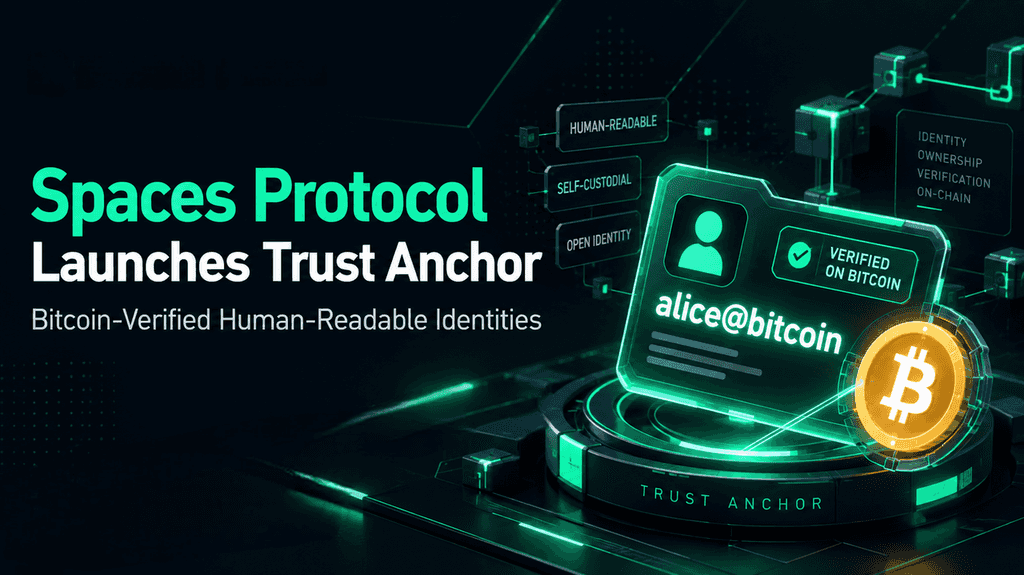
Spaces Protocol has introduced Trust Anchor, a Bitcoin-backed verification system designed to make human-readable digital identities easier to use without requiring a centralized resolver to act as the final source of trust. The system allows identities such as alice@bitcoin to connect readable names with cryptographic keys, Bitcoin payment information, Nostr profiles, websites, and other records while applications independently verify the underlying proofs. The launch builds on Spaces Protocol's September 2026 mainnet rollout and introduces Trust ID and Veritas as tools for verifying identity state against Bitcoin. Rather than putting every username and record directly on-chain, Spaces combines Bitcoin-anchored commitments with off-chain certificates and local verification, extending the ways Bitcoin network fundamentals can support applications beyond basic value transfer.
What Is Spaces Protocol Trust Anchor and How Does It Bring Human-Readable Identity to Bitcoin?
Spaces Protocol Trust Anchor is designed to make Bitcoin identity verification easier to understand and use without forcing people to depend on a centralized resolver as the final source of truth. Instead of identifying someone only through a long Bitcoin address or public key, Spaces supports human-readable handles such as alice@bitcoin. These handles can be linked to cryptographic keys, payment information, and other records while their authenticity is checked against protocol state anchored to Bitcoin. The goal is to give users the convenience of familiar usernames while preserving the ability to independently verify who controls a Bitcoin-based identity.
How Spaces Protocol Creates Bitcoin-Verified Human-Readable Identities
Spaces Protocol brought its off-chain handle system to Bitcoin mainnet with the v0.4.2 release in September 2026, with @bitcoin becoming the first production operator. This makes it possible to create readable identities such as alice@bitcoin rather than relying entirely on long cryptographic strings. A Spaces handle is tied to a script public key, giving compatible applications a cryptographic way to confirm control of an identity instead of simply accepting information returned by a traditional naming server. The model could make human-readable Bitcoin identities more practical for payments, social applications, messaging, and other services where users need to recognize who they are interacting with.
Spaces also avoids storing every username and identity record directly on Bitcoin. Operators organize handles inside a Binary Merkle Trie and periodically commit a 32-byte Merkle root to Bitcoin. Handle owners receive off-chain certificates containing cryptographic proofs that applications can compare with the Bitcoin-anchored state. This allows Bitcoin to provide the underlying verification layer while most identity records remain off-chain, reducing unnecessary demand for block space. It creates a hybrid architecture in which Bitcoin secures the state commitment while identity data can be distributed more efficiently elsewhere.
How Trust ID Veritas and Bitcoin Anchoring Verify Spaces Handles
At the center of the system is the Trust ID, a compact identifier representing a locally verified view of Spaces Protocol state. Users can scan or paste a Trust ID into a compatible application and use it to verify human-readable Bitcoin handles without treating a remote server as the ultimate authority. A Trust ID can remain usable for up to 14 days, although users may need to refresh it when checking newly created contacts or when a contact changes the cryptographic key associated with a handle.
Important parts of the Spaces Trust Anchor system include:
-
Veritas can calculate a Trust ID on macOS while verifying Bitcoin's header chain without requiring a conventional full-node setup.
-
Users already running Bitcoin Core can derive the same trusted protocol state through space-cli trust.
-
Spaces handles can reference information such as Bitcoin payment addresses Nostr public keys and websites.
-
Certrelay can distribute records and certificates off-chain while applications independently verify the cryptographic evidence attached to them.
-
Spaces describes validly issued handles as permanent and non-revocable, limiting an operator's ability to redirect an established identity after issuance.
-
Merkle proofs connect handle information back to protocol state committed to Bitcoin.
How Trust ID Veritas and Bitcoin-Backed Handle Verification Actually Work
The key idea behind Spaces Protocol is that a readable handle should not automatically become trustworthy just because a server returns it. Trust ID and Veritas create a verification path back to Bitcoin, allowing compatible applications to check cryptographic evidence behind a Spaces handle. The process combines Bitcoin block information, locally calculated protocol state, Merkle proofs, and off-chain certificates so readable identities can be resolved efficiently without placing every lookup or identity record directly on the Bitcoin blockchain.
How a Spaces Trust ID Is Derived From Bitcoin Protocol State
A Trust ID acts as a compact fingerprint of verified Spaces Protocol state. The Spaces software processes relevant Bitcoin data, applies the protocol rules, and builds a local view of the anchor state. A hash derived from that state becomes the Trust ID. Rather than forcing a wallet or mobile application to replay the entire history of the protocol every time someone looks up a handle, the user can provide this compact anchor and allow the application to verify certificates against an already established state.
This design separates the process of establishing a trusted Bitcoin state from resolving individual identities. Once an application has the relevant anchor, it can check whether the cryptographic evidence attached to a handle is consistent with known protocol state rather than asking a central database to declare that a username is genuine. The readable name can therefore remain simple from the user's perspective while the verification process happens behind the interface. For crypto applications, this could make decentralized identity easier to integrate without exposing users to every technical step involved.
How Veritas and Bitcoin Core Generate the Same Trust Anchor
Veritas is designed to make Bitcoin-backed handle verification practical for people who do not want to maintain the infrastructure normally associated with running a complete Bitcoin node. On macOS, Veritas can start from a checkpoint, verify Bitcoin's header chain, process transactions relevant to Spaces, and calculate the resulting Trust ID locally. Users who prefer stronger independent verification can also connect it to their own Bitcoin infrastructure. Someone already running Bitcoin Core can instead use the Spaces client and space-cli trust to calculate the trusted state from their own node.
The available verification paths provide different options depending on how much infrastructure a user or developer wants to operate:
-
Veritas on macOS offers a lighter route for calculating the Trust ID without requiring a typical full-node workflow.
-
Bitcoin Core with spaced lets users derive the anchor from Bitcoin data obtained through their own synchronized node.
-
Spaces has also outlined plans for a roughly 250 KB recursive STARK proof, targeted for 2027, that is intended to make similar verification more practical directly on mobile devices.
These options matter because a Bitcoin identity system becomes more useful when verification can work across different types of devices. Requiring every ordinary user to maintain complex node infrastructure would limit adoption. Spaces is instead attempting to preserve independent verification while reducing the amount of technical work users need to perform themselves.
How Merkle Proofs and Bitcoin Confirmations Verify a Human-Readable Handle
When an application resolves a handle such as alice@bitcoin, the name itself is not enough to establish authenticity. A Spaces certificate can include the handle and associated records together with a Merkle inclusion proof showing that the information belongs to a committed state root. The certificate also contains evidence connecting that state commitment back to Bitcoin. Under the current Spaces specification, verification includes checking the Merkle proof, confirming the commitment against protocol state, and applying Bitcoin confirmation requirements.
This certificate-based approach allows most routine identity activity to remain off-chain. Records can travel through Certrelay, an HTTP-based relay network, while the application checks the proof accompanying the response. If a relay returns altered information or an invalid certificate, the information should fail verification against trusted Bitcoin-derived state instead of becoming valid merely because it came from a known server. Bitcoin therefore acts primarily as the root of verification, while identity lookups and certificate distribution can remain comparatively lightweight.
The same architecture places limits on what a handle operator can do after an identity has been issued. Spaces describes valid handles as permanent and non-revocable, with existing certificates designed to remain independently verifiable even if the original operator later becomes unavailable. An operator could still affect future issuance if its infrastructure fails or publishes invalid commitments, but that is different from having unrestricted power to rewrite already established identities. This separation between initial issuance and continued verification distinguishes the model from conventional online identity systems where the service provider normally retains ongoing control over the username.
Why Spaces Trust Anchor Could Matter for Bitcoin Payments Decentralized Identity and BIP-353
Spaces Trust Anchor could matter because it addresses one of Bitcoin's long-standing usability problems: people are better at recognizing names than checking long wallet addresses, public keys, or technical identifiers. By allowing readable handles such as alice@bitcoin to be verified against Bitcoin-backed protocol state, Spaces Protocol aims to make Bitcoin payments and decentralized identity easier to use without making a centralized resolver the permanent source of authority. The broader value is not simply replacing complex strings with shorter names but creating human-readable Bitcoin identities that retain a cryptographically verifiable connection to Bitcoin.
Human-Readable Bitcoin Payments Could Improve the User Experience
Bitcoin payments often require users to copy, paste, scan, or manually check long addresses, which can create friction and increase the chance of mistakes. Spaces Protocol introduces a more familiar naming layer where a readable identity can be associated with Bitcoin payment information and other cryptographic records. A compatible wallet could potentially display a verified handle before a transaction is created, helping users identify the intended recipient without relying only on an unfamiliar address. Because most records can remain off-chain, every update or lookup does not need to consume Bitcoin block space. Readers following the asset itself can track current market conditions through the Bitcoin live price and market overview, while Spaces focuses on improving the identity and payment experience around Bitcoin.
Decentralized Bitcoin Identity Without a Central Naming Authority
The major difference between Spaces and a traditional username system is where authority ultimately resides. Conventional accounts generally depend on the company operating the platform, which controls the username database and may be able to suspend, recover, redirect, or modify identities. Spaces is designed so compatible applications can independently verify the proof behind a handle against Bitcoin-anchored state instead of simply trusting whatever response a remote naming server provides.
That does not mean every part of Spaces operates without servers. Infrastructure such as Certrelay can still distribute certificates and identity records off-chain, but those servers are intended to transport information rather than become the final authority over ownership. If altered or invalid information is returned, the associated cryptographic proof should fail verification against the trusted Bitcoin state. This separation between data delivery and identity verification is one of the more important ideas behind decentralized identity systems.
Spaces Protocol vs BIP-353 for Human-Readable Bitcoin Addresses
Spaces is part of a wider effort to make Bitcoin payment information easier for humans to identify and use. BIP-353 addresses a similar usability problem by allowing human-readable payment identifiers based on DNS records protected by DNSSEC. That approach builds on existing internet domain infrastructure, allowing compatible wallets to retrieve authenticated payment information without requiring users to exchange long payment strings manually.
Spaces takes a different route by anchoring its naming and verification state to Bitcoin instead of relying primarily on DNSSEC. The two approaches therefore target a similar user problem while using different trust models. BIP-353 benefits from the familiarity and broad deployment of DNS infrastructure, while Spaces is pursuing a more Bitcoin-native naming and identity layer based on cryptographic proofs connected to Bitcoin protocol state. Future adoption of either approach is likely to depend on wallet integrations, developer support, user experience, interoperability, and how easily each system can fit into existing payment workflows.
What Spaces Trust Anchor Could Mean for Bitcoin Identity Adoption
The potential usefulness of Trust Anchor extends beyond making Bitcoin wallet addresses easier to recognize. A verified handle could serve as a readable entry point for payment details, Nostr public keys, websites, and other cryptographic records. For users, this could reduce the amount of technical information they need to manage directly while giving applications a consistent method for checking whether records associated with an identity are authentic.
Broader adoption will still depend on integration across wallets, payment applications, social platforms, and other Bitcoin services. A human-readable naming standard becomes more valuable when enough applications can resolve and verify it reliably. Spaces is also working toward lighter mobile verification, which could reduce dependence on desktop tooling. If developer support and integrations expand, Spaces Trust Anchor could become part of a broader Bitcoin identity layer designed to improve usability without abandoning independent verification. That identity layer would sit alongside established Bitcoin market infrastructure such as the BTC/USDT spot market, serving a different role focused on usability and verification rather than trading.
Conclusion
Spaces Protocol Trust Anchor represents an attempt to solve a practical problem at the intersection of Bitcoin payments decentralized identity and human-readable naming. Instead of making users rely only on long addresses or placing complete identity databases on-chain, the system combines readable handles, off-chain certificates, Merkle proofs, Trust ID, Veritas, and Bitcoin-backed state commitments. Its most important distinction is that servers can help distribute information without necessarily becoming the authority that determines whether that information is valid. The project is still developing, and wider adoption will depend heavily on wallet support, mobile verification, developer integrations, and real-world usability. However, the launch shows how Bitcoin's security model can potentially support more familiar identity experiences while keeping cryptographic verification at the center of the system.
🔥 Beyond the Headlines: What KuCoin 5.0 Means for You
Market news moves fast — but where you act on it matters just as much. This October, KuCoin launches KuCoin 5.0, transforming KuCoin into a rebuilt platform. Here's what actually changes for you:
-
One account for everything. Older platforms split your money across separate "spot," "margin," and "futures" accounts and expected you to understand why. KuCoin 5.0's unified account removes that entirely — deposit once, and everything is simply there (only available to VIPs for now).
-
Stocks, indices, and commodities. KuCoin 5.0 expands beyond crypto into global markets. When crypto chops sideways and equities rally (or the reverse), you rotate in minutes instead of opening a brokerage account and waiting days for fiat rails.
-
Real-world assets (RWA). Tokenized exposure to traditional assets like commodities, right inside your crypto account. One of the fastest-growing segments in global finance is no longer reserved for institutions — you access it from the same balance you trade with.
-
Earn while you learn. Not ready to trade? KCUSD lets your stablecoins earn daily, auto-compounding interest. The lowest-stress way to put your idle deposit to work for 4% yield.
-
An AI assistant in plain language. Ask questions, get market context, understand what you're looking at — built into the platform, no jargon required.
-
An app that doesn't overwhelm. Faster, cleaner, and consistent — intuitive from the first tap, not after a tutorial.
-
Safety you can check, not just trust. A MiCAR-licensed EU entity, Proof of Reserves you can verify yourself, and internationally certified security (SOC 2 Type II, ISO 27001:2022).
Create your account in minutes — and start on the platform built for where crypto is going, not where it's been.
FAQs
Can Spaces Protocol handles replace Bitcoin wallet addresses?
Not directly. A Spaces handle can act as a human-readable identity layer linked to Bitcoin payment information, but an actual Bitcoin transaction still requires valid payment instructions underneath. The handle is primarily intended to make the recipient easier to recognize and verify before payment details are used.
What happens if a Spaces handle operator goes offline?
Existing valid handles are designed to remain verifiable even if the original operator becomes unavailable because their verification depends on cryptographic evidence tied to Bitcoin-backed state. New handle issuance could be interrupted if an operator disappears, but previously issued certificates are intended to remain independently checkable.
What happens if a user loses the private key controlling a Spaces handle?
Spaces relies heavily on cryptographic ownership, so key management is important. Unlike a traditional online account where a company may reset a password, recovery can be more complicated when ownership depends on private keys. Users should therefore treat key backups and any supported rotation mechanisms as an important part of securing a Spaces identity.
Could Bitcoin wallets integrate Spaces Protocol handles?
Yes. Wallet integration is one of the clearest potential use cases. A compatible wallet could resolve a readable handle, verify the certificate and cryptographic proof, retrieve the associated payment information, and then prepare the transaction. Whether this becomes common will depend on adoption by wallet developers and broader ecosystem support.
Disclaimer
The information provided on this page may originate from third-party sources and does not necessarily represent the views or opinions of KuCoin. This content is intended solely for general informational purposes and should not be considered financial, investment, or professional advice. KuCoin does not guarantee the accuracy, completeness, or reliability of the information, and is not responsible for any errors, omissions, or outcomes resulting from its use. Investing in digital assets carries inherent risks. Please carefully evaluate your risk tolerance and financial situation before making any investment decisions. For further details, please consult KuCoin’s Terms of Use and Risk Disclosure.