

SEC Chair Atkins: Crypto Rules Coming With or Without CLARITY Act
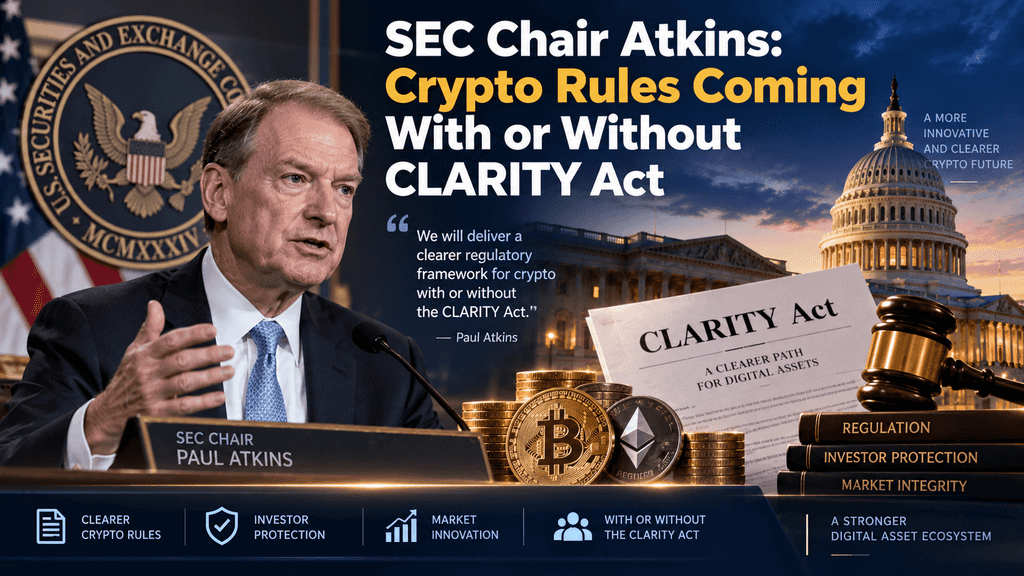
SEC Turns to Independent Crypto Rulemaking as CLARITY Act Stalls
In the days following a procedural Senate vote that blocked further consideration of the Digital Asset Market Clarity Act, Securities and Exchange Commission Chair Paul S. Atkins delivered a clear message to markets and innovators. The agency will proceed with tailored crypto rules using its existing statutory powers. Atkins has repeatedly emphasized that durable legislation remains the preferred path for long-term certainty, yet the Commission will not pause its work. On September 16, 2026, he stated that the SEC will act decisively within its authority to deliver regulatory clarity for investors and entrepreneurs.
This stance builds directly on the agency’s Project Crypto initiative and recent proposals that already outline concrete exemptions and frameworks. With the CLARITY Act stalled after a 49-50 Senate cloture failure on September 15, 2026, Chair Atkins is shifting the SEC toward independent rulemaking under current law, advancing Regulation Crypto Assets, the Innovation Exemption for tokenized securities, and related custody and venue standards to reduce uncertainty while Congress continues deliberations.
Senate Procedural Vote Leaves CLARITY Act Short of Floor Debate
The Digital Asset Market Clarity Act reached a critical procedural hurdle on September 15, 2026, when the Senate voted 49-50 against invoking cloture on the motion to proceed. Sixty votes were required to open formal debate. Four Republican senators joined Democrats in opposition, citing unresolved concerns over ethics provisions governing officials’ digital-asset holdings and potential impacts of stablecoin rewards on community-bank deposits. The bill had previously passed the House in July 2025 by a 294-134 margin and cleared the Senate Banking Committee earlier in 2026. The failed cloture vote does not extinguish the legislation; Senator Thom Tillis’s procedural switch preserves a path for later reconsideration. However, with Congress preparing to recess ahead of midterm elections, the practical window for 2026 enactment has narrowed significantly.
Atkins acknowledged the outcome the following day, thanking participants across government, industry, and innovation communities while reaffirming the agency’s independent mandate. Market reaction was measured but noticeable. Bitcoin traded near the $76,000 level in the immediate aftermath, reflecting tempered expectations rather than sharp dislocation. Industry participants noted that the absence of statutory definitions for digital commodities and jurisdictional boundaries between the SEC and the Commodity Futures Trading Commission leaves existing interpretive guidance as the primary reference point. Atkins has consistently described legislation as the only reliable method to future-proof rules against shifts in administration, yet he has simultaneously directed staff to prepare rulemakings that address the same core issues under present authority.
Atkins Reiterates Commitment to Certainty Under Existing Statutory Powers
Chair Atkins has maintained a consistent public position across multiple venues. In a September 14 appearance at the Solana Policy Institute Summit, he stated that the administration would deliver for investors and innovators with or without the pending legislation. The following day, after the Senate vote, he posted that the Commission would act decisively within its statutory authority. These remarks align with earlier comments made in late July 2026, when Atkins told CNBC the agency was “ready, willing, and able” to issue rules covering the ground contemplated by the Clarity Act should congressional progress stall. He has repeatedly stressed that the statute provides superior durability because agency rules remain subject to reversal by future commissions.
The practical implication is that the SEC will continue filling interpretive and exemptive gaps while supporting any renewed legislative effort. Project Crypto, launched more than a year earlier, serves as the organizational framework for this work. It encompasses token taxonomy interpretations issued in March 2026, the August Regulation Crypto Assets proposal, transfer-agent modernization, and custody standards under development. Atkins has framed these steps as interim measures that preserve investor protections while enabling on-chain activity. The Commission’s insistence on proceeding independently reduces the risk that market participants will face prolonged regulatory silence. At the same time, it leaves open the possibility that future legislation could codify or modify the agency’s interim framework.
Regulation Crypto Assets Proposal Offers Tailored Offering Exemptions
On August 18, 2026, the SEC proposed Regulation Crypto Assets, described by Atkins as one of the most significant steps the Commission has taken to modernize securities regulation for digital assets. The package creates two fit-for-purpose offering exemptions consistent with the agency’s earlier token-taxonomy interpretation. A startup exemption would permit offerings of up to $5 million over four years. A fundraising exemption would allow up to $75 million in twelve months, subject to enhanced disclosure and audited financial statements once certain thresholds are reached. Both exemptions incorporate principles-based disclosure requirements designed for the distinctive characteristics of crypto assets rather than forcing them into traditional registration templates.
The proposal also includes a conditional investment-contract safe harbor. Under the safe harbor, an issuer that certifies it has ceased the essential managerial efforts promised in connection with the original investment contract and that satisfies additional conditions would no longer have the related non-security crypto asset treated as subject to an investment contract. This mechanism addresses a long-standing source of uncertainty for projects that transition from centralized development to more decentralized operation. Public comments on the proposal remain open, with feedback already showing questions about the precise point at which managerial efforts are deemed complete. Atkins has noted that legislation would provide greater permanence on this point, yet the proposal itself supplies workable interim clarity under existing law.
Innovation Exemption Facilitates On-Chain Trading of Tokenized Stocks
On September 17, 2026, the Commission issued an order granting temporary, conditional exemptive relief known as the Innovation Exemption. The order exempts certain Tokenized Securities Venues from the definition of “exchange” and certain liquidity providers from the definition of “dealer” under the Securities Exchange Act of 1934. The relief is designed to enable responsible on-chain trading of tokenized National Market System stocks while maintaining investor protections and market-integrity standards. Key conditions require venues to be U.S. persons, to comply with Office of Foreign Assets Control sanctions programs, to limit access to eligible participants, and to ensure that tokenized shares confer the same rights, including dividends and voting, as traditional shares. Issuers retain the ability to object to trading of their securities on such venues.
Atkins described the exemption as a bridge toward durable rulemaking. It allows firms to operate in a permissioned environment today while the Commission gathers operational data and considers permanent standards. Anti-fraud and anti-manipulation provisions continue to apply in full. The temporary character of the relief underscores the agency’s preference for eventual legislative or permanent rulemaking solutions. Market participants interested in tracking related asset prices can consult resources that display real-time Bitcoin price movements alongside broader digital-asset data. The Innovation Exemption represents the most concrete post-vote demonstration of Atkins’s stated willingness to act within existing authority.
Project Crypto Framework Coordinates Multiple Workstreams
Project Crypto functions as the coordinating structure for the SEC’s crypto-related initiatives under Atkins. Announced more than a year before the Senate vote, it aims to modernize federal securities rules so that American capital markets can incorporate on-chain activity. The initiative has produced the March 2026 interpretive release clarifying the application of the Howey test to various digital-asset categories, the August Regulation Crypto Assets proposal, proposed updates to transfer-agent rules, and staff work on custody standards that would permit investment advisers to self-custody certain crypto assets or rely on state trust companies where qualified custodians remain scarce.
Each workstream addresses a distinct friction point identified by market participants. The interpretive release established four categories of non-security digital assets, digital commodities, collectibles, tools, and payment stablecoins meeting certain criteria, thereby narrowing the residual set of digital securities. Custody proposals respond to the practical shortage of qualified third-party custodians for many assets. Transfer-agent modernization seeks to accommodate tokenized ownership records. Taken together, these efforts form a coherent interim architecture that reduces the need for ad hoc enforcement while legislation remains pending. Atkins has characterized the package as a bridge rather than a permanent substitute for statute.
Jurisdictional Clarity Between SEC and CFTC Remains Incomplete
Absent statutory definitions, the boundary between securities and digital commodities continues to rest primarily on the SEC’s March 2026 interpretive guidance and parallel CFTC statements. Atkins and CFTC leadership have both indicated readiness to issue rules under their respective existing authorities. The CFTC chair stated shortly after the Senate vote that the agency is prepared to advance rules for the new frontier of finance. Coordination between the two agencies has improved under the current administration, yet the absence of congressional allocation of exclusive jurisdiction over spot digital-commodity markets leaves residual ambiguity for certain tokens and trading venues.
Market structure participants must therefore continue to evaluate each asset and activity against the existing interpretive framework. The SEC’s safe-harbor proposal offers a pathway for projects to exit securities treatment once managerial efforts conclude, but it does not create a parallel registration regime for pure digital commodities. This gap is precisely the territory the CLARITY Act sought to address. Until legislation or further joint guidance emerges, firms will rely on the combination of interpretive releases, exemptive orders, and proposed rules to structure compliant operations. Resources explaining how crypto futures leverage works can help participants understand related risk-management tools available in existing markets.
Custody Standards Under Development Address Practical Market Gaps
Atkins has directed staff to develop custody proposals that would allow investment advisers to self-custody crypto assets in certain circumstances and to use state-chartered trust companies as custodians. The rationale is pragmatic: for many digital assets, a traditional qualified third-party custodian simply does not yet exist. Existing custody rules were written for conventional securities and cash, creating friction when applied to native digital assets. The forthcoming proposal aims to align regulatory requirements with operational realities while preserving investor-protection principles.
This workstream complements the Innovation Exemption and Regulation of Crypto Assets. Together they address issuance, trading, transfer, and safekeeping, the core lifecycle of digital assets under securities law. Market participants monitoring developments can track price discovery for major assets through publicly available Ethereum price data feeds that reflect broader liquidity conditions. The custody initiative illustrates the Commission’s willingness to adapt existing tools rather than await comprehensive legislation, consistent with Atkins’s post-vote statements.
Temporary Nature of Exemptions Underscores Preference for Durable Rules
Both the Innovation Exemption and the proposed Regulation Crypto Assets are structured as interim or conditional measures. Atkins has repeatedly described legislation as indispensable for future-proofing the framework against reversal by subsequent administrations. Agency rules and exemptive orders remain subject to amendment or withdrawal. The temporary character of the Innovation Exemption, initially framed as a multi-year bridge, explicitly invites public comment to inform subsequent permanent rulemaking.
This sequencing reflects a deliberate policy choice. The Commission prioritizes immediate reduction of uncertainty for responsible innovators while preserving the option for Congress to codify more permanent boundaries and registration regimes. Market participants therefore operate under a two-tier system: workable interim relief today, with the prospect of statutory permanence if legislative negotiations resume successfully. The approach reduces the risk of regulatory vacuum without locking in technology-specific standards that could become obsolete.
Industry Reaction Reflects Cautious Optimism Mixed With Legislative Preference
Following Atkins’s statements and the Innovation Exemption order, industry leaders expressed appreciation for the agency’s willingness to act. At the same time, many continue to prefer comprehensive legislation that would establish clear jurisdictional lines and statutory definitions. The dual-track reality, agency rulemaking proceeding in parallel with residual legislative possibility, creates a period of constructive uncertainty. Firms can structure activities around the proposed exemptions and temporary relief while monitoring congressional developments.
Price action in major digital assets remained relatively orderly, suggesting that market participants had already priced in a meaningful probability of legislative delay. The SEC’s concrete steps have supplied a floor of predictability that pure legislative uncertainty would have lacked. Participants seeking a deeper understanding of margin frameworks can review explanations of the differences between isolated and cross-margins to inform risk management under evolving regulatory conditions.
Investor-Protection Conditions Remain Central to All Exemptive Relief
Every major initiative under Project Crypto incorporates explicit investor-protection conditions. The Innovation Exemption requires sanctions compliance, access restrictions, identical economic and governance rights for tokenized shares, and issuer objection rights. Regulation Crypto Assets embeds disclosure and certification requirements within its exemptions and safe harbor. Anti-fraud provisions apply fully to all covered activities. Atkins has stressed that innovation relief does not dilute core protections; it channels innovation into supervised channels that preserve market integrity.
This emphasis distinguishes the current approach from earlier periods characterized primarily by enforcement. By combining tailored exemptions with ongoing anti-fraud authority, the Commission seeks to attract domestic capital formation while maintaining the ability to address misconduct. The result is a more predictable compliance environment for legitimate projects without sacrificing the tools necessary to protect retail and institutional investors.
Path Forward Depends on Both Agency Action and Potential Legislative Revival
The immediate path is clear: the SEC will continue advancing proposed rules, gathering public comment, and implementing temporary relief under existing authority. Parallel discussions in Congress may produce a revised CLARITY Act text capable of securing the necessary votes at a later date. Atkins has indicated that the Commission will continue providing technical assistance to lawmakers. The combination of independent agency progress and residual legislative possibility defines the regulatory outlook for the remainder of 2026 and into the following year.
Market participants should therefore treat the current suite of interpretive guidance, proposed exemptions, and temporary orders as the operative framework while remaining attentive to any renewed legislative movement. The Commission’s demonstrated willingness to act reduces the cost of legislative delay, yet the preference for statutory durability remains explicit in every major statement from the Chair.
Broader Impacts for On-Chain Capital Markets Development
The sequence of events, legislative setback followed by rapid agency action, illustrates a pragmatic adaptation of the U.S. regulatory system to technological change. By using exemptive authority and interpretive guidance, the SEC is enabling limited on-chain experimentation with tokenized equities and tailored capital-raising pathways.
Success of these temporary measures will supply operational data that can inform either permanent agency rules or future legislation. The approach prioritizes measured progress over indefinite delay, consistent with the administration’s stated goal of positioning the United States as a leading jurisdiction for digital-asset innovation.
🔥 Beyond the Headlines: What KuCoin 5.0 Means for You
Market news moves fast — but where you act on it matters just as much. This October, KuCoin launches KuCoin 5.0, transforming KuCoin into a rebuilt platform. Here's what actually changes for you:
-
One account for everything. Older platforms split your money across separate "spot," "margin," and "futures" accounts and expected you to understand why. KuCoin 5.0's unified account removes that entirely — deposit once, and everything is simply there.
-
Stocks, indices, and commodities. KuCoin 5.0 expands beyond crypto into global markets. When crypto chops sideways and equities rally (or the reverse), you rotate in minutes instead of opening a brokerage account and waiting days for fiat rails.
-
Real-world assets (RWA). Tokenized exposure to traditional assets like commodities, right inside your crypto account. One of the fastest-growing segments in global finance is no longer reserved for institutions — you access it from the same balance you trade with.
-
Earn while you learn. Not ready to trade? KCUSD lets your stablecoins earn daily, auto-compounding interest. The lowest-stress way to put your idle deposit to work for 4% yield.
-
An AI assistant in plain language. Ask questions, get market context, understand what you're looking at — built into the platform, no jargon required.
-
An app that doesn't overwhelm. Faster, cleaner, and consistent — intuitive from the first tap, not after a tutorial.
-
Safety you can check, not just trust. A MiCAR-licensed EU entity, Proof of Reserves you can verify yourself, and internationally certified security (SOC 2 Type II, ISO 27001:2022).
Create your account in minutes — and start on the platform built for where crypto is going, not where it's been.
FAQs
How does the SEC’s Innovation Exemption actually work for tokenized stocks?
The September 17, 2026, order grants temporary relief, allowing designated Tokenized Securities Venues to operate without full exchange registration and certain liquidity providers to operate without dealer registration when facilitating on-chain trading of tokenized NMS stocks. Conditions require U.S. person status, OFAC compliance, restricted access, identical shareholder rights, and issuer consent rights. The relief is explicitly temporary and invites public comment to shape durable follow-on rules.
What are the key numerical thresholds in the proposed Regulation Crypto Assets exemptions?
The startup exemption would permit capital raising of up to $5 million over a four-year period. The fundraising exemption would allow up to $75 million in twelve months, with audited financial statements required once higher thresholds are crossed. Both incorporate tailored disclosure requirements designed for crypto-asset characteristics.
Why does Chair Atkins prefer legislation even while advancing agency rules?
Atkins has stated repeatedly that only statute can future-proof a regulatory framework against reversal by a subsequent administration. Agency rules and exemptive orders remain subject to change. Legislation provides greater permanence and clearer jurisdictional boundaries between the SEC and CFTC.
Does the failed Senate vote permanently kill the CLARITY Act?
No. The September 15 vote was a procedural cloture failure on the motion to proceed, not a final rejection of the bill’s substance. Procedural mechanisms exist for later reconsideration, although the practical calendar before midterm elections is constrained.
What happens to projects that complete their promised managerial efforts under the safe-harbor proposal?
Under the proposed investment-contract safe harbor, an issuer that certifies cessation of essential managerial efforts and meets additional conditions would no longer have the related non-security crypto asset treated as subject to an investment contract, thereby exiting ongoing SEC securities treatment for that asset.
Disclaimer: This content is for informational purposes only and does not constitute investment advice. Cryptocurrency investments carry risk. Please do your own research (DYOR).