

AVAX Rises Nearly 10% as NYSE Selects Avalanche for Tokenized Securities Settlement
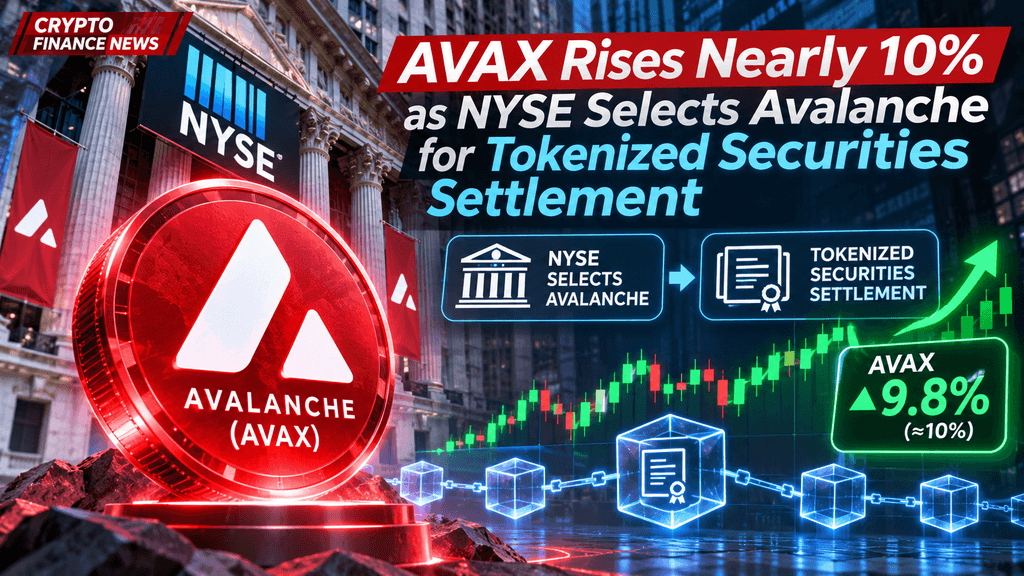
On November 9, 2026, Ava Labs announced that Avalanche would provide the core ledger technology to the clearing firm supporting an upcoming New York Stock Exchange-affiliated alternative trading system for tokenized securities. The disclosure prompted an immediate market response in the network’s native token. AVAX rose as much as 10 percent during the session, making it the leading gainer among the 100 largest cryptocurrencies by market capitalization at the time. Later data from CoinGecko placed the token near $8.86, still up more than 8 percent, with a market capitalization around $3.95 billion and 24-hour trading volume of $439.7 million. The planned venue is designed to support around-the-clock trading, clearing, and settlement of tokenized equities for its subscribers, subject to regulatory approval, and targets a potential fourth-quarter launch.
NYSE’s existing Pillar matching technology would handle order execution while the Avalanche-based ledger records and settles the resulting trades. The arrangement separates issuance, which can occur across multiple blockchains, from the single settlement layer. Market participants viewed the announcement as a concrete step in traditional market infrastructure adopting blockchain tools for post-trade functions, though the platform remains in development and the direct fee impact on the public Avalanche network has not been quantified. The NYSE selection of Avalanche technology for the settlement ledger of its planned tokenized securities platform demonstrates how established exchanges are embedding specialized blockchain infrastructure into post-trade processes, offering a reference case for institutional use while actual transaction volumes and token demand depend on subsequent approvals and operational activity.
Key Takeaways
-
NYSE affiliate selected Avalanche as the core clearing and settlement ledger for a planned 24/7 tokenized securities platform.
-
AVAX rose as much as 10% on November 9, leading large-cap gains before settling higher with elevated volume.
-
Platform pairs NYSE Pillar matching with a custom Avalanche chain for instant atomic settlement.
-
Choice followed more than a year of technical, business, and ecosystem reviews focused on speed and controls.
-
Launch targets the fourth quarter of 2026 pending regulatory steps, with multi-chain issuance supported.
-
Broader context includes other Wall Street tokenization efforts and existing institutional products on Avalanche.
Why Did NYSE Select Avalanche for Tokenized Securities Settlement
Ava Labs stated on November 9 that Avalanche would supply the core ledger technology to the clearing firm of the NYSE-affiliated digital alternative trading system under development. The platform is intended to enable 24/7 trading, clearing, and settlement of tokenized securities for subscribers once applicable regulatory approvals are obtained. NYSE had previously indicated that an affiliate was building the venue, and the November announcement named the settlement technology after an extended evaluation period. Dennis Lee, Head of Digital Issuance at NYSE, explained in the release that the exchange is selecting appropriate technologies for different functions. He noted that the platform would support equities listed on a range of blockchains while the ledger recording and settling trades required speed, reliability, predictable costs, participation controls, and a substantial developer community.
Avalanche met those criteria according to the statement. Emin Gün Sirer, founder and CEO of Ava Labs, described the infrastructure as supporting 24/7 atomic settlement with dedicated performance and cost characteristics plus the controls needed for regulatory and operational requirements. The selection was also referenced in NYSE’s pre-market update that day and covered by The Wall Street Journal, which reported exclusive use of Avalanche for settlement on the upcoming platform. The announcement positions Avalanche technology inside institutional market infrastructure rather than as a public-chain trading venue. No contract value or specific revenue projections were disclosed in the available statements.
How Is the NYSE Tokenized Stock Platform Architecture Designed
The planned venue relies on NYSE’s existing Pillar system to match buyers and sellers, while the Avalanche-based ledger handles the subsequent recording and settlement of those trades. This division of functions appears consistently across the Ava Labs release and contemporaneous coverage. John Nahas, chief business officer at Ava Labs, told CoinDesk that the exchange would operate its own custom blockchain built on Avalanche technology rather than relying on the public Avalanche network for settlement. The custom chain is tailored to the platform’s regulatory and operational requirements, allowing control over participation and performance parameters. Stocks or other securities can be issued on multiple networks, yet the trades clear and settle through the designated Avalanche ledger. This multi-issuance, single-settlement design aims to accommodate existing tokenized assets while concentrating post-trade processing on infrastructure that offers predictable costs and controlled access.
Atomic settlement means the exchange of the tokenized security and the corresponding cash or stablecoin occurs together rather than leaving the trade open until a later business day. The architecture therefore targets the reduction of counterparty and operational risk that can arise during conventional settlement windows. Reports noted that the venue remains an alternative trading system rather than a replacement for the primary NYSE market. Distribution is expected through participating broker-dealers on a non-discriminatory basis, consistent with earlier platform descriptions from January 2026. The design choices reflect institutional preferences for dedicated infrastructure over fully public networks when handling regulated securities.
How Much Did AVAX Rise After the NYSE Announcement
AVAX advanced as much as 10 percent on November 9 following the disclosure, according to multiple market reports that cited CoinGecko and other data providers. The token later eased to approximately $8.86, still higher by more than 8 percent on the day, with a market capitalization near $3.95 billion. Twenty-four-hour trading volume reached $439.7 million in one snapshot and exceeded $500 million in others as the session progressed. Earlier in the day, the price had traded around $7.93 at the prior close and moved through intraday highs near $9.03 in some feeds. The move made AVAX the strongest performer among the largest cryptocurrencies during that period. Volume expansion accompanied the price gain, indicating that the announcement drew incremental trading interest rather than solely a revaluation of existing positions.
Subsequent sessions showed the token consolidating near the $8.50–$8.70 area as broader market conditions fluctuated. Market-cap figures remained in the $3.7–$4.0 billion range across sources in the immediate aftermath. On-chain metrics such as total value locked on Avalanche stood near $633 million, according to DeFiLlama at the time of the reports, up modestly on the day. The price reaction illustrates how infrastructure announcements can influence token demand in the short term even when the platform itself has not yet launched. Tracking of current AVAX price performance across major venues continued to reflect the elevated activity levels that followed the news. Longer-term effects on circulating supply dynamics or staking participation were not quantified in the initial coverage.
What Was the Year-Long Evaluation Process Behind the Selection
Conversations between the NYSE team and Ava Labs began nearly a year before the November 9 announcement, according to John Nahas in comments to Cointelegraph and CoinDesk. During that period, the parties conducted extensive technical, business, and ecosystem reviews. Charley Cooper, president and chief operating officer of Ava Labs, had noted in September that the exchange had spent roughly a year testing Avalanche technology and examining how it could integrate with existing systems. The evaluation examined performance characteristics, operating costs, and compatibility with regulatory and operational constraints. Kevin Tyrrell, chief product officer at NYSE, was reported by The Wall Street Journal to have cited speed, throughput, and the ability to support a controlled network with compliance tools as factors in the choice after testing multiple providers.
The process culminated in the designation of Avalanche as the ledger technology for the clearing firm. NYSE’s January 2026 description of the platform had left the specific post-trade ledger open; the November update filled that element. The duration of the review indicates that the selection was not a short-term pilot outcome but the result of sustained diligence. No public scoring or comparative data from the evaluation were released. The timeline aligns with broader industry patterns in which large market operators test blockchain options for extended periods before committing infrastructure components. The outcome provides a documented case of an established exchange completing a multi-stage assessment that ended with a named technology provider for settlement functions.
What Criteria Did NYSE Use to Choose Avalanche
Dennis Lee outlined the requirements in the Ava Labs announcement: the ledger needed to be fast and reliable, allow control over who can participate, keep costs predictable, and rest on a large community of developers. He stated that Avalanche met all those needs. The emphasis on participation controls reflects institutional requirements for permissioned or selectively accessible environments when handling securities. Predictable costs address concerns about variable network fees that can arise on fully public chains under high load. Speed and reliability support the goal of atomic settlement that completes at the moment of trade execution rather than on a delayed cycle.
The presence of an established developer base was listed as a practical consideration for ongoing maintenance and potential extensions. Emin Gün Sirer separately highlighted dedicated infrastructure that could deliver predictable performance and costs while satisfying regulatory and operational controls and connecting to a wider ecosystem of assets. The stated priorities therefore center on operational fitness for a regulated clearing function rather than on open-network characteristics alone. No quantitative benchmarks, such as target transactions per second or maximum fee levels, were published in the available materials. The public articulation of the criteria offers market participants a clear view of the factors that influenced the technology decision after the year-long process.
Key selection criteria included
-
Speed and reliability for near-instant settlement.
-
Participation controls to meet compliance needs.
-
Predictable costs rather than variable public-network fees.
-
Access to a large developer community.
Why Is the Custom Avalanche Chain Important for Settlement
John Nahas confirmed to CoinDesk that the NYSE would run its own custom blockchain built on Avalanche technology rather than using the public Avalanche network for settlement. The custom chain is intended to meet the platform’s specific regulatory needs and to provide control over access and performance parameters. Avalanche’s architecture supports the creation of such dedicated environments through tools that allow operators to set rules for participation, capacity, and cost behavior. This approach differs from deploying settlement activity directly on a shared public ledger where any participant meeting basic requirements can interact. The custom setup is described as enabling the 24/7 atomic settlement requirements with more predictable characteristics. Report noted that securities can still be issued on other networks and then settled through the designated chain.
The design therefore concentrates the clearing function while remaining compatible with multi-chain issuance. No details on validator sets, exact consensus configuration, or governance of the custom chain were released in the initial statements. The arrangement positions Avalanche technology as the underlying ledger layer supplied to the clearing firm rather than as the operator of the trading venue itself. Market reports consistently distinguished this post-trade role from any broader replacement of existing NYSE systems. The use of a custom chain addresses institutional preferences for controlled environments when moving regulated securities into blockchain-based settlement.
How Does Atomic Settlement Compare with Traditional Equity Cycles
The platform is designed so that settlement occurs at the moment of trade execution rather than on the conventional T+1 or longer cycle used in traditional equity markets. Atomic settlement means the tokenized security and the corresponding payment complete together, reducing the period during which counterparty exposure or operational risk can accumulate. NYSE’s Pillar system continues to match orders, after which the Avalanche ledger records the outcome and effects the transfer. This structure aims to free capital that would otherwise remain tied up during the settlement window and to support around-the-clock activity. Analysis showed the instant-settlement objective as a core feature of the planned venue. Stablecoin funding was mentioned in earlier platform descriptions as a possible method for providing the cash leg of trades.
The combination of continuous matching and immediate settlement is intended to expand the hours during which tokenized equities can trade and clear. No specific estimates of capital-efficiency gains or volume projections were provided in the announcements. The technical description focuses on the ledger’s ability to deliver the atomic outcome with the performance and control characteristics required by the clearing firm. Implementation details, including how cross-chain issuance assets are represented on the settlement ledger, remain subject to further disclosure as the platform advances. The design choice reflects a targeted application of blockchain capabilities to the post-trade segment of the market lifecycle.
How Does Multi-Chain Issuance Work with the Avalanche Settlement Layer
Dennis Lee stated that the upcoming digital trading platform would support equities listed on a range of blockchains while the ledger that records and settles trades operates on Avalanche technology. This separation allows issuers or tokenized-asset providers to utilize their preferred networks for the creation of the digital securities and then route the resulting trades through the designated settlement infrastructure. The approach is intended to avoid forcing all issuance activity onto a single chain while still concentrating clearing on infrastructure that meets the stated speed, cost, and control requirements. It is noted that the platform would handle both tokenized versions of traditionally issued securities and natively digital securities.
Tokenized shareholders are expected to retain traditional dividend and governance rights under the design outlined in January. The multi-chain element therefore expands potential compatibility with existing tokenized products, while the single settlement ledger provides a consistent post-trade record. No exhaustive list of supported issuance networks was published. The architecture requires mechanisms to represent or bridge assets from other chains onto the settlement ledger in a manner that preserves the economic rights of holders. Those technical linkages were not detailed in the initial materials. The design choice illustrates one model for integrating blockchain settlement into markets that already contain assets originated on multiple networks.
Which Institutional Partners Support the NYSE Tokenized Platform
NYSE has expanded its roster of partners supporting the platform to include Broadridge Financial Solutions, Computershare, Equiniti, Superstate, Securitize, and tZERO for issuance, transfer agent, and related functions. These additions were noted in coverage of the November announcement and in prior updates. The partnerships address operational components that sit alongside the settlement ledger. Separately, Avalanche already hosts institutional products such as BlackRock’s BUIDL tokenized fund and offerings from other asset managers, including Franklin Templeton and Apollo. Goldman Sachs has also utilized Avalanche infrastructure for certain institutional payments and settlement activities through related projects. These existing deployments provide operational precedents for the technology in regulated or institutional settings.
The NYSE selection adds a market-infrastructure reference point to that set of use cases. Coverage placed the announcement within the wider pattern of traditional firms evaluating or adopting blockchain tools for post-trade and issuance functions. No direct linkage between the existing institutional products and the new NYSE platform was described. The combination of prior deployments and the new clearing-ledger role supplies a broader picture of Avalanche technology appearing in capital-market contexts. Further partner announcements or integration updates would clarify how the various components interact once the venue moves closer to launch.
What Do Current Avalanche Network Metrics Show
At the time of the November 9 reports, Avalanche’s total value locked stood near $633 million, according to DeFiLlama, reflecting a modest daily increase. One contemporaneous summary of on-chain data noted roughly 2.3 million C-Chain transactions over the prior seven days, averaging about 329,000 transactions per day, an increase of approximately 13 percent from the preceding week. Decentralized-exchange volume over the same period was reported near $471 million, lower than the prior week, while on-chain fees were also lower. Stablecoin holdings on the network were cited at around $1.32 billion. These figures sit well below historical peaks: total value locked had reached approximately $11.5 billion in late 2021, and seven-day decentralized-exchange volume had previously exceeded $6 billion in earlier periods.
When Could the NYSE Tokenized Securities Platform Launch
The platform is targeting a fourth-quarter 2026 launch pending regulatory approval, according to The Wall Street Journal and consistent statements from Ava Labs and NYSE-related updates. No firm date has been set, and the announcements emphasize that applicable approvals must still be obtained. The venue is structured as an alternative trading system affiliated with the NYSE rather than as an expansion of the primary exchange. Earlier descriptions from January 2026 had outlined the intended capabilities of 24/7 trading, fractional shares, and instant settlement. The November technology selection fills in the settlement-ledger component of that design.
Regulatory processes for alternative trading systems and for tokenized securities involve reviews that can affect timing. Operational readiness of the custom chain, transfer-agent integrations, and broker distribution channels would also need to align with any approval timeline. The absence of a fixed launch date means that market participants are pricing the announcement on the basis of a planned rather than an operating venue. Updates from NYSE, Ava Labs, or relevant authorities would be required to confirm progress toward the fourth-quarter window or any adjustments to the schedule. The current public information therefore centers on the technology choice and the intended capabilities rather than on a committed operational start date.
How Does This Fit into Broader Wall Street Tokenization Efforts
Other market operators have advanced their own tokenization or blockchain-related initiatives during the same period. Nasdaq has explored tokenized-stock infrastructure, including partnerships involving other technology providers. The Depository Trust & Clearing Corporation has developed tokenization services that utilize private blockchain components and networks such as Canton for certain custody and transfer functions. Intercontinental Exchange, the parent of NYSE, has also engaged in additional digital-asset and blockchain-related projects. These parallel tracks indicate that multiple infrastructure firms are testing or deploying blockchain tools for different segments of the securities lifecycle.
The NYSE selection of Avalanche for the clearing-firm ledger of its planned venue is one specific outcome within that broader activity. No direct competitive comparison of technical performance or cost was published in the available materials. The existence of concurrent projects supplies industry context for why an established exchange would complete a year-long evaluation and name a settlement technology provider. Continued development across these initiatives will determine how widely blockchain-based post-trade processes are adopted and which technical approaches gain operational traction.
What Does the NYSE Selection Mean for AVAX Holders and Network Demand
The designation of Avalanche technology as the settlement ledger for the planned NYSE-affiliated venue supplies a high-profile institutional reference case. The role is focused on the clearing firm’s ledger rather than on operating the trading system or capturing all issuance activity. Because the chain is custom and controlled, the volume of settlement activity may not translate directly into fee revenue or transaction demand on the public Avalanche network. Short-term price and volume increases in AVAX followed the announcement, consistent with market reactions to infrastructure news. Longer-term effects depend on whether the platform receives approval, launches, and generates sustained trading activity that utilizes the designated ledger.
Existing institutional products on Avalanche provide additional context for the technology’s presence in capital-market settings. No quantitative forecasts of future network usage or token utility from the platform were included in the statements. Market participants therefore have a documented technology selection and an observed price reaction, while the operational impact remains prospective. Updates on platform progress, partner integrations, or on-chain metrics after any launch would allow assessment of whether the settlement role produces measurable activity. The announcement adds one concrete data point to the ongoing evaluation of how blockchain ledgers are incorporated into regulated market infrastructure.
FAQs
What exactly did the NYSE select Avalanche to do?
Ava Labs announced on November 9 that Avalanche would provide the core ledger technology to the clearing firm of the upcoming NYSE-affiliated alternative trading system for tokenized securities. The platform is designed for 24/7 trading and settlement pending regulatory approval. NYSE’s Pillar system is expected to match orders, while the Avalanche-based ledger records and settles the trades. Securities can be issued on multiple blockchains, but settlement concentrates on the designated ledger. The role is post-trade rather than a replacement of the primary NYSE market.
How much did AVAX rise after the news?
AVAX climbed as much as 10 percent on November 9, according to contemporaneous market reports. It later traded near $8.86, still up more than 8 percent, with a market capitalization around $3.95 billion and 24-hour volume exceeding $439 million in CoinGecko snapshots. The token led gains among large-capitalization cryptocurrencies during the session. Subsequent price action showed consolidation as broader market conditions varied.
Will the platform use the public Avalanche network?
John Nahas of Ava Labs stated that the NYSE would operate its own custom blockchain built on Avalanche technology rather than the public network for settlement. The custom chain is tailored to regulatory and operational requirements, including controls over participation. This setup aims to deliver predictable performance and costs for the clearing function while remaining compatible with multi-chain issuance.
When might the tokenized platform launch?
The platform is targeting a fourth-quarter 2026 launch pending regulatory approval, according to The Wall Street Journal and related statements. No firm date has been set. The venue remains in development as an alternative trading system, and further approvals plus operational readiness steps are required before any start of trading.
What criteria did NYSE cite for choosing Avalanche?
Dennis Lee, Head of Digital Issuance at NYSE, said the settlement ledger needed to be fast and reliable, allow control over participation, keep costs predictable, and have a large developer community. He stated that Avalanche met those needs. The criteria were outlined in the Ava Labs announcement and echoed across coverage of the selection.
How does this fit with other Avalanche institutional activity?
Avalanche already supports products such as BlackRock’s BUIDL and offerings from other asset managers, along with certain institutional payment and settlement uses. The NYSE clearing-ledger role adds a market-infrastructure example to those deployments. The announcement does not describe direct operational linkages between the existing products and the planned venue.
Disclaimer: This general market information, possibly from third-party, commercial, or sponsored sources, is provided for reference and educational purposes only and does not constitute financial or investment advice, an offer, solicitation, or guarantee. We disclaim liability for its accuracy, completeness, reliability, and any resulting losses. Investments/trading are risky; past performance doesn’t guarantee future results. Users should research, judge prudently, and take full responsibility. For further details, please consult KuCoin’s Terms of Use and Risk Disclosure.