

Nebius Group (NBIS) Stock Is Rocketing 15%: What's Driving the Rally Ahead of Q3 Earnings?
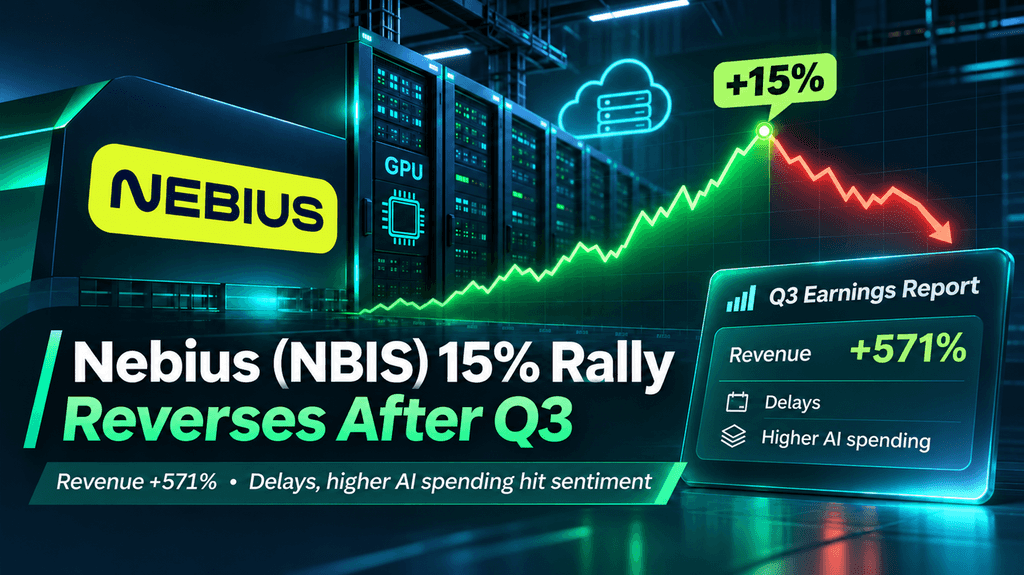
Nebius Group stock surged 15.44% on November 11, 2026, closing at $154.69 as strong quarterly results from rival CoreWeave boosted confidence in AI infrastructure companies ahead of Nebius's Q3 earnings. However, the rally reversed after Nebius reported its results on November 12, despite revenue climbing 571% year over year to $980.8 million. Shares closed at $128.64, down 16.84%, as investors focused on delayed data center capacity, revised growth expectations, and higher capital spending requirements. The contrasting market reactions raised questions about whether Nebius could translate strong demand for AI computing into sustainable revenue growth while managing the costs of its infrastructure expansion.
Key Takeaways
-
Nebius stock surged 15.44% on November 11, 2026, closing at $154.69 as strong CoreWeave earnings supported renewed investor confidence in AI infrastructure companies.
-
Q3 revenue climbed 571% year over year to $980.8 million, exceeding analyst expectations, while Nebius reported $465.8 million in adjusted EBITDA and a $37.5 million GAAP net loss from continuing operations.
-
Data center deployment delays pushed some expected revenue into 2027, prompting Nebius to lower its near-term growth expectations and postpone its $7 billion annualized revenue run-rate target to February 2027.
-
Capital spending is increasing, with Nebius projecting approximately $27 billion in 2026 expenditures and $40 billion–$45 billion in 2027 to support AI computing infrastructure expansion.
-
Management forecasts $12 billion–$13 billion in 2027 revenue, with customer prepayments and asset-backed financing expected to cover approximately 75%–85% of planned capital expenditures.
-
Execution and financing risks remain significant, as infrastructure delivery schedules, borrowing costs, equipment depreciation, and future profitability could influence Nebius's financial performance and investor sentiment.
Why Did Nebius (NBIS) Stock Surge 15% Ahead of Q3 Earnings?
Nebius Group shares climbed 15.44% on November 11, 2026, closing at $154.69 from $134.00 in the previous session. The rally coincided with renewed investor confidence in artificial intelligence infrastructure companies following strong quarterly results from rival CoreWeave. Expectations surrounding Nebius's November 12 earnings announcement also supported interest in the stock, although the exact contribution of each factor remains uncertain.
How Did CoreWeave's Strong Q3 Earnings Fuel the AI Cloud Stock Rally?
CoreWeave (NASDAQ: CRWV) reported third-quarter revenue of $3.66 billion, representing approximately 168% year-over-year growth, and raised its full-year 2026 revenue forecast to $13.0 billion–$13.3 billion. The company also disclosed a revenue backlog of approximately $132.5 billion, reflecting substantial contracted demand for future AI computing services. These results helped ease concerns about slowing infrastructure demand and contributed to a broader recovery in AI-related stocks.
CoreWeave shares advanced approximately 24.7% on November 11, while other AI infrastructure companies, including Nebius and Applied Digital, also recorded strong gains. Investors appeared encouraged by evidence that major technology customers continued committing substantial resources to AI computing. However, CoreWeave's performance did not guarantee comparable results for Nebius, as the companies operate with different infrastructure deployment schedules, financing arrangements, and customer contracts. Both companies operate in the neocloud sector, providing specialized computing infrastructure for AI training, inference, and enterprise applications. Market interest in Nebius also extends to crypto-settled derivatives, including the NBISUSDT stock-linked perpetual contract. Such instruments track underlying equity prices but do not represent ownership of ordinary shares.
What Were Investors Expecting Before Nebius Reported Earnings?
Ahead of its November 12 announcement, analysts expected Nebius to generate approximately $901 million–$907 million in third-quarter revenue, depending on the consensus provider. That compared with $582.3 million in the preceding quarter and $146.1 million a year earlier. The forecasts reflected expectations for rapid expansion in AI cloud services, but investors were also looking for evidence that the company could manage the substantial costs associated with building computing infrastructure.
The main factors investors were monitoring included:
-
Revenue growth: Whether expanding demand for AI computing would translate into quarterly sales above analyst estimates.
-
Profitability: Whether adjusted EBITDA margins would improve as additional infrastructure entered service.
-
Capacity expansion: Progress in deploying GPUs and bringing new data center capacity online.
-
Financial sustainability: Whether Nebius could support its expansion through available financing and customer commitments without placing excessive pressure on its balance sheet.
The November 11 rally therefore reflected both stronger sentiment across AI cloud stocks and high expectations for Nebius's financial performance. Whether those expectations were justified depended on the company's reported results and its ability to execute its infrastructure expansion plans.For investors following Nebius through digital-asset platforms, the distinction between listed shares and derivatives is important.
What Did Nebius Report in Q3 2026 Earnings, and Why Did Its Stock Fall?
Nebius reported strong third-quarter 2026 revenue growth on November 12, but its shares declined as investors focused on delayed data center capacity and rising infrastructure spending. Although revenue exceeded Wall Street expectations, management revised its near-term growth outlook, raising questions about when expanding AI computing demand would translate into additional revenue. The stock closed at $128.64, down 16.84% from the previous session, reversing the earlier rally.
How Did Nebius's Revenue, Adjusted EBITDA, and Net Loss Compare With Expectations?
According to Nebius's official Q3 2026 earnings release, quarterly revenue reached $980.8 million, up 571% from $146.1 million a year earlier. The result exceeded the approximately $907.2 million analyst consensus reported by Investing.com by about 8.1%. Adjusted EBITDA improved to $465.8 million from a $5.2 million loss in Q3 2025, representing an adjusted margin of approximately 47.5%. However, Nebius still recorded a GAAP net loss of $37.5 million from continuing operations, demonstrating that stronger adjusted profitability had not yet translated into a GAAP quarterly profit.
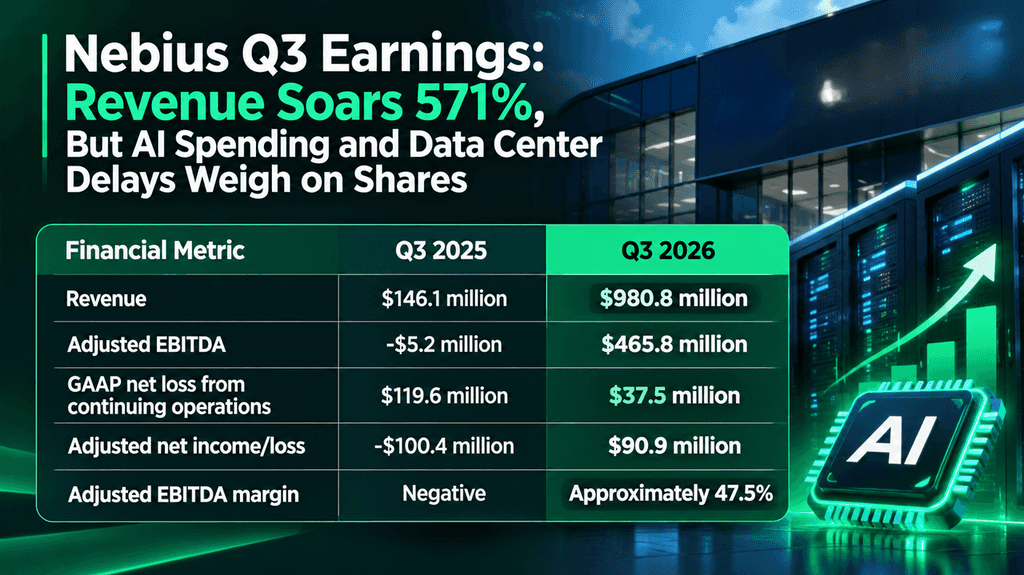
Source: Nebius Q3 2026 unaudited financial results. Adjusted EBITDA and adjusted net income are non-GAAP measures.
Additional details from the financial statements provide important context for the reported growth:
-
Non-recurring revenue: Approximately $325 million came from the initial rollout of Nebius's asset-light partnership model, making revenue composition important when assessing recurring growth.
-
Core cloud business: Nebius AI Cloud generated $973.8 million in revenue, accounting for approximately 99% of consolidated sales.
-
Operating efficiency: Cost of revenue declined to 22% of total revenue from 29% a year earlier, although depreciation and amortization increased substantially as infrastructure expanded.
These figures show improving operating scale, but the non-recurring contribution and continuing GAAP losses remain important when evaluating the sustainability of future earnings.
Why Did Data Center Delays Force Nebius to Revise Its 2026 Outlook?
The most significant concern in Nebius's earnings announcement involved delays at third-party colocation facilities, where the company relies on external operators to provide data center infrastructure. Management disclosed that capacity originally expected to become operational in 2026 would instead arrive during the first half of 2027. In New Jersey, where Nebius is developing infrastructure under an agreement with Microsoft, the remaining capacity deliveries were rescheduled for the second quarter of 2027 as the site transitioned toward permanent power generation. The company stated that the affected customer contracts remained in place and that its owned data center developments were progressing on schedule or ahead of expectations.
As a result, Nebius now expects full-year 2026 revenue near the lower end of its previous $3.0 billion–$3.4 billion forecast, while maintaining an approximately 40% adjusted EBITDA margin target. The company also postponed its goal of exceeding $7 billion in annualized run-rate revenue from December 2026 to February 2027. This measure annualizes revenue from a particular month rather than representing full-year recognized revenue. Although management characterized the delays as timing adjustments, they introduced uncertainty about when contracted computing capacity would become operational and begin contributing to reported sales.
Why Did NBIS Stock Fall Despite Strong Quarterly Revenue Growth?
The negative market reaction reflected concerns about the gap between Nebius's reported growth and the financial commitments required to sustain its expansion. The company increased its 2026 capital expenditure forecast to approximately $27 billion, up from an earlier range of $20 billion–$25 billion, primarily to support additional infrastructure development for 2027. Higher spending alongside delayed revenue raised questions about the timing of investment returns and the company's future financing requirements. Investors also had to consider that customer commitments, while supporting demand visibility, do not eliminate construction delays or guarantee that revenue will be recognized on the original schedule.
The sell-off also occurred amid broader weakness in AI-related equities, making it difficult to attribute the entire decline to Nebius's earnings announcement alone. Nevertheless, the revised guidance highlighted a central challenge for rapidly expanding AI infrastructure providers: securing demand is only one part of the business, while delivering computing capacity on time and managing the associated costs are equally important.
What Could Drive Nebius Stock Next After Q3 Earnings?
Nebius Group's stock outlook will depend largely on whether the company can translate growing demand for AI computing into sustainable revenue and profitability. Following its Q3 2026 earnings announcement, investors are likely to focus on infrastructure expansion, financing arrangements, and the timing of new computing capacity. Management's ambitious 2027 growth projections offer potential opportunities, but their execution will be important in determining future market confidence.
How Much Will Nebius Spend on AI Infrastructure in 2026 and 2027?
Nebius expects capital expenditures of $40 billion–$45 billion in 2027, reflecting plans to accelerate GPU deployment, expand data center operations, and develop additional computing infrastructure. The company aims to bring more than one gigawatt of new capacity online annually, with an increasing proportion coming from facilities it owns rather than leases from third-party operators. Management believes this approach could improve operating margins by providing greater control over construction, electricity infrastructure, and long-term facility costs. However, building and operating proprietary data centers requires substantial upfront investment and introduces additional construction and operational risks.
The expansion strategy also reflects Nebius's expectations for sustained demand from enterprise customers and AI developers. Management forecasts $12 billion–$13 billion in revenue for 2027, approximately four times its anticipated 2026 revenue. Achieving this target will depend on deploying computing equipment, securing reliable power supplies, completing facilities, and converting customer commitments into billable services. Although company-owned infrastructure could strengthen margins over time, higher depreciation expenses and financing costs may continue affecting reported profitability.
Can Customer Prepayments and Financing Support Nebius's Expansion Plans?
Nebius is increasingly using long-term customer agreements and advance payments to finance its infrastructure expansion. In its Q3 shareholder letter, management estimated that customer prepayments and asset-backed financing tied to investment-grade contracts could cover approximately 75%–85% of planned 2027 capital expenditures. The company expects customer prepayments of $17 billion–$20 billion in 2027, although the final amount will depend on the structure and timing of future agreements. These arrangements could reduce immediate reliance on conventional fundraising, but they do not eliminate borrowing costs, contractual obligations, or the possibility of additional financing requirements.
Several financial developments provide further context for Nebius's funding strategy:
-
Customer commitments: Nebius reported more than $12 billion in new total contract value signed since the beginning of Q3, providing additional visibility into future computing demand.
-
Improved contract economics: The estimated payback period for comparable new agreements shortened to one year and seven months, compared with one year and ten months in the previous quarter.
-
Available liquidity: Nebius held approximately $7.4 billion in cash and cash equivalents at September 30, 2026, providing resources for ongoing infrastructure development.
-
External financing: The company secured a $3.5 billion senior secured financing facility with Citi in October 2026, supplementing its existing financing arrangements.
Despite these funding sources, the company's future capital requirements remain substantial. Additional borrowing could increase interest expenses, while issuing new shares could dilute existing shareholders. The effectiveness of Nebius's financing model will therefore depend on its ability to balance expansion costs, customer payments, and long-term financial stability.
Which Growth Targets and Financial Risks Should Investors Monitor in 2027?
Nebius has identified several operating and financial milestones that could influence investor sentiment in 2027. Management expects to achieve pretax breakeven in the fourth quarter of 2027, assuming a five-year depreciation period for computing equipment. The company also plans to increase the contribution from owned data centers, which it believes can generate stronger margins than third-party facilities. These objectives provide measurable indicators of progress, although the breakeven forecast applies to a specific quarter rather than the entire financial year.
Investors will also be watching infrastructure deployment schedules, particularly the delivery of additional capacity in New Jersey and other planned facilities. Progress in expanding contracted power capacity, maintaining competitive AI cloud pricing, and attracting customers beyond existing major technology partners could influence future revenue expectations. Conversely, construction delays, higher borrowing costs, GPU depreciation, or weaker demand could affect financial performance.
Conclusion
Nebius's Q3 2026 earnings demonstrated strong demand for its AI computing services, but the stock's reversal showed that revenue growth alone was insufficient to satisfy investors. Although the company exceeded quarterly revenue expectations and improved adjusted operating performance, infrastructure delays and substantial capital requirements introduced uncertainty about the timing of future returns. The market reaction reflected growing attention to how effectively AI infrastructure providers can convert customer commitments into operational capacity and sustainable earnings.
Looking ahead, Nebius's performance will depend on meeting its revised deployment schedules, securing financing, and maintaining operating efficiency as its infrastructure expands. Management's 2027 revenue forecast and profitability objectives remain projections rather than guaranteed outcomes. Progress toward the February 2027 annualized revenue target, customer prepayment arrangements, and capital expenditure plans will provide important indicators of whether the company's expansion strategy is progressing as expected.
FAQs
What does Nebius Group do in the AI cloud market?
Nebius Group provides specialized cloud infrastructure for artificial intelligence applications, including AI model training and inference. Unlike traditional cloud providers offering broad computing services, Nebius focuses on high-performance GPU computing and infrastructure designed for demanding AI workloads.
What is the difference between Nebius's annualized revenue run rate and actual revenue?
Annualized run-rate revenue estimates yearly sales based on revenue generated during a particular month. It is not the same as revenue recognized over a completed financial year. This distinction matters because newly deployed computing capacity may increase the run rate before its full contribution appears in quarterly financial statements.
Why can Nebius report positive adjusted EBITDA while recording a net loss?
Adjusted EBITDA excludes certain expenses, including depreciation, interest, taxes, and specified adjustments. GAAP net income accounts for a broader range of costs. For capital-intensive AI infrastructure companies, substantial equipment depreciation and financing expenses can produce a net loss despite positive adjusted EBITDA.
What is the difference between contracted power and operational data center capacity?
Contracted power represents electricity capacity secured through agreements, while operational capacity refers to infrastructure that is installed, powered, and available for computing workloads. A company may secure substantial power commitments before its data centers are ready to generate revenue.
Disclaimer
This general market information, possibly from third-party, commercial, or sponsored sources, is provided for reference and educational purposes only and does not constitute financial or investment advice, an offer, solicitation, or guarantee. We disclaim liability for its accuracy, completeness, reliability, and any resulting losses. Investments/trading are risky; past performance doesn’t guarantee future results. Users should research, judge prudently, and take full responsibility. For further details, please consult KuCoin’s Terms of Use and Risk Disclosure.