KuCoin Ventures Weekly Report: Wall Street Moves On-Chain as Market Liquidity Tightens
KuCoin Ventures Weekly Report: Wall Street Moves On-Chain as Market Liquidity Tightens
1. Weekly Market Highlights
From Perpetual Futures to Tokenized Securities, Wall Street Accelerates Its Move into On-Chain Markets
Last week brought several complementary developments in the convergence of traditional finance and on-chain markets: ICE announced plans to bring Hyperliquid-based perpetual futures into the U.S. regulated market, prominent macro investor Stanley Druckenmiller publicly confirmed his investment in Trade[XYZ], and DTCC officially launched its securities tokenization service. Meanwhile, some listed companies objected to their shares being traded on a tokenized securities venue. Infrastructure development and capital commitments are advancing, while issuer acceptance remains mixed.
On October 29, ICE, the parent company of the New York Stock Exchange, announced an agreement with Trade[XYZ] and a strategic investment in the company. The partners plan to establish a regulated perpetual futures market for retail traders and a dedicated clearing structure built on Hyperliquid, offering price exposure to crypto, equities, commodities, foreign exchange and other assets. ICE’s joint venture with OKX is also expected to serve as a distribution channel. The partnership remains subject to regulatory approval, but its significance is already clear: traditional exchanges are committing market operations, clearing capabilities and distribution resources to on-chain perpetual futures.
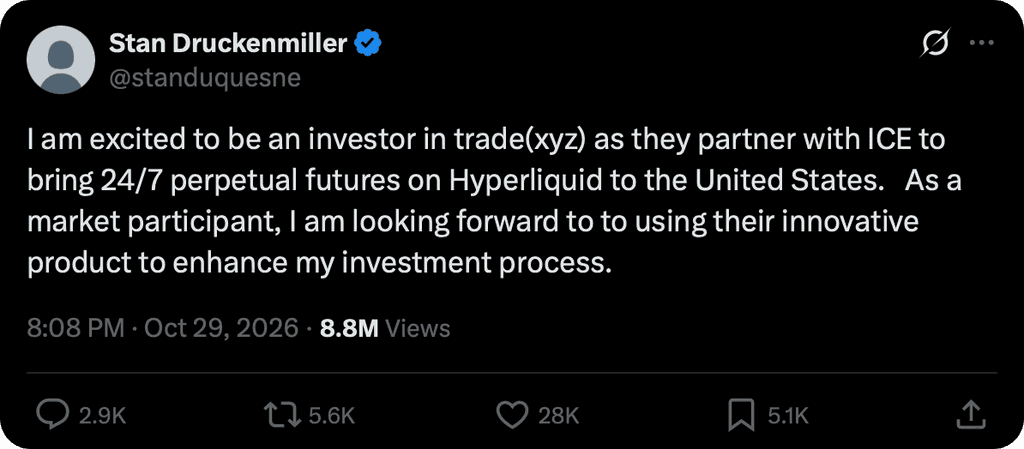
On the same day, renowned Wall Street investor Stanley Druckenmiller confirmed in his first post on X that he was an investor in Trade[XYZ] and looked forward to using its products to enhance his investment process. The investment amount was not disclosed. His involvement offers a concrete example of on-chain perpetual futures attracting traditional financial market participants, combining a capital commitment with an expressed intention to use the product.
There was also tangible progress in securities mobility. On October 28, DTC, a subsidiary of DTCC, officially launched its tokenization service, enabling entitlements to securities held in custody to be converted between traditional and tokenized forms while preserving the associated ownership rights, economic interests and investor protections. The service is currently integrated with Canton and DTCC’s private Besu network. Twenty DTC participants have signed agreements to access it, including J.P. Morgan, Citi, Morgan Stanley and Fidelity, with 34 securities initially available for tokenization. Its immediate value lies in improving the efficiency of securities transfers and collateral movements.
Issuers, however, are taking a more cautious stance. An October 28 notice from the ICE–OKX joint venture, OKXICE, listed 38 companies that had objected to tokenized trading of their shares, including Walmart and Eli Lilly. These objections concern the arrangements at this particular venue. The notice did not disclose each company’s reasons, so they should not be interpreted as a blanket rejection of securities tokenization.
Together, these developments point to a broader shift: on-chain finance is entering a phase in which trading mechanisms, asset rights and market rules are being put into practice together. Perpetual futures provide exposure to asset prices, while tokenized securities represent rights to the underlying securities, serving different needs. The former’s expansion depends on regulatory access, liquidity and risk management; the latter also requires coordinated arrangements for custody, the transmission of investor entitlements and asset transfers.
Key developments to watch include regulatory approvals and launch timelines for ICE’s proposed markets, the actual scale of tokenized assets and collateral usage through DTCC, and whether issuers and trading platforms can agree on more widely accepted product arrangements. These developments will determine how broadly around-the-clock multi-asset trading and on-chain securities transfers become part of everyday financial activity.
2. Weekly Selected Market Signals
Fed Pauses Rate Hikes but Keeps December Window Open, AI Capex Concerns Pressure Tech Stocks, and Binance Security Incident Amplifies Crypto Weakness Amid Fund Outflows
The Federal Reserve paused rate hikes as expected at its October meeting, keeping the federal funds target range unchanged at 3.75%–4.00%. The decision passed by a 10–2 vote, with two members favoring an immediate 25-basis-point hike. The statement also upgraded its assessment of economic activity from “solid” to “strong” while reiterating that inflation remains elevated, suggesting that the pause is more about waiting for additional data than signaling the end of the tightening cycle. Warsh also avoided giving clear guidance on the December path during the press conference, emphasizing that the coming month would be an important window for assessing incoming data.
Subsequent data further reinforced the combination of strong growth and still-elevated inflation in the U.S. economy. Real GDP grew at an annualized rate of 3.4% in the third quarter, up from 2.2% in the second quarter, with consumption and AI-related business investment remaining key contributors. Meanwhile, headline PCE inflation rose from 3.4% to 3.6% year-on-year in September, while core PCE was approximately 3.1%. Strong growth reduces the Fed’s immediate need to worry about recession, while renewed inflation pressure continues to provide justification for another rate hike before year-end.
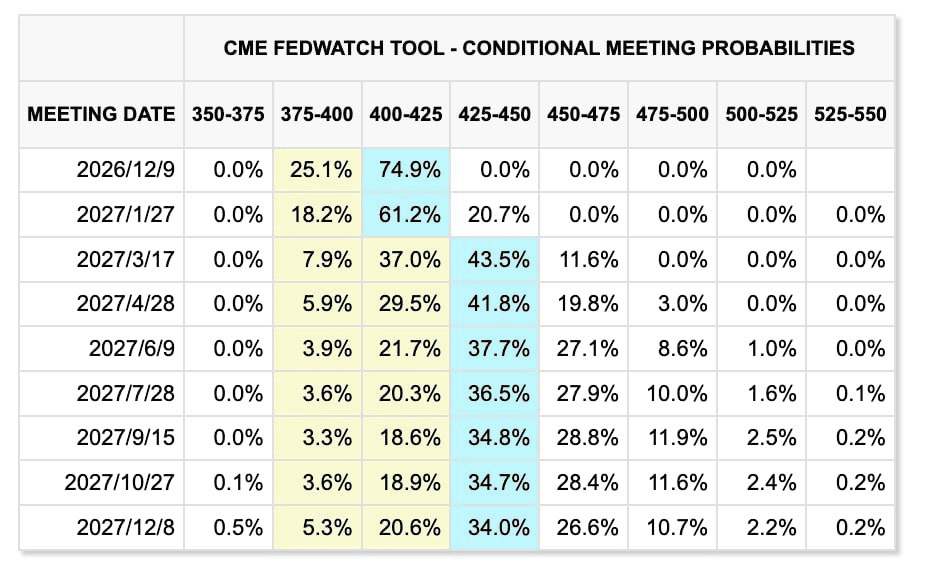
As of November 2, the CME FedWatch Tool showed that markets were pricing in an approximately 74.6% probability of a 25-basis-point rate hike in December, which remains the clear base case.
In other words, the October pause has already been absorbed by markets, and attention has shifted to whether November employment and inflation data will be strong enough to support another move in December.
Source: CME FedWatchTool
The core concern behind the latest market adjustment is not that AI demand has suddenly disappeared, but that investors are increasingly questioning when massive AI investment will translate into free cash flow and profits. Amazon said AI-related capital expenditure would continue to expand, while Intel warned of continued cash-burn pressure. Alphabet had also previously come under meaningful selling pressure amid high investment levels and weakening free cash flow.
The AI trade is therefore continuing to shift from “who is spending more” toward whether revenue, earnings, and cash flow can ultimately justify sustained expansion in capital expenditure. This risk quickly spread to the Asian AI hardware supply chain. South Korea’s KOSPI fell approximately 4.5% on Friday, with Samsung Electronics and SK Hynix both weakening sharply. Japan’s Nikkei declined around 2.1% on the day, led lower by AI- and semiconductor-related names including Advantest, Tokyo Electron, and SoftBank. Although the Nikkei still posted a modest weekly gain of around 1%, Japanese and South Korean markets are becoming increasingly sensitive to shifts in expectations around the U.S. AI capital-expenditure cycle.
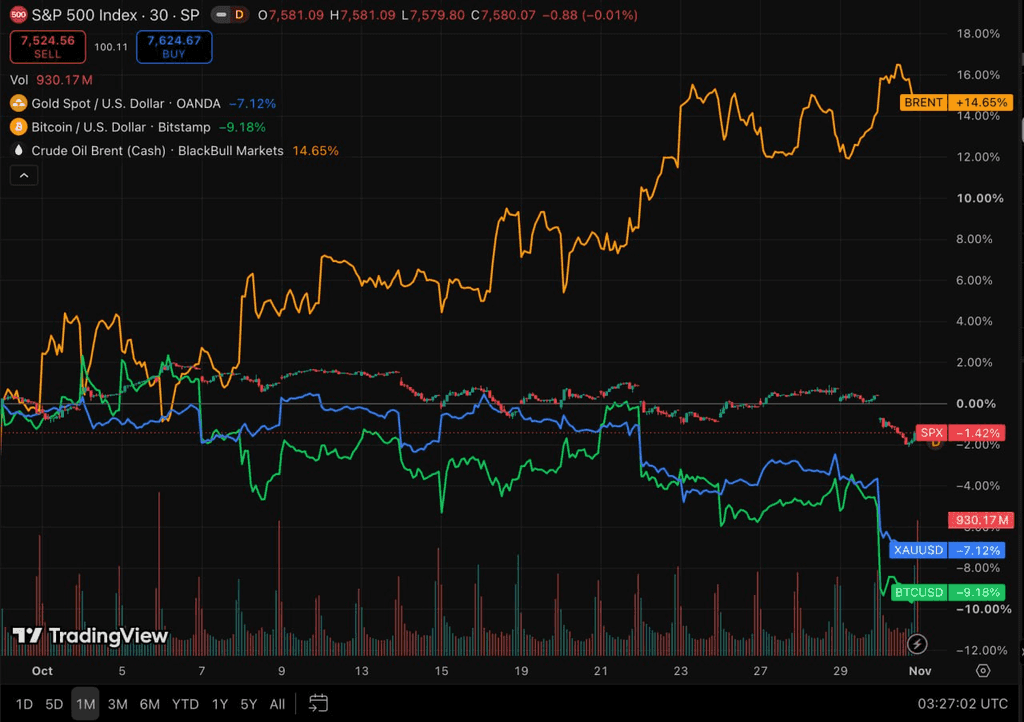
In energy markets, elevated Middle East tensions continued to sustain a substantial geopolitical risk premium. Another tanker was attacked in the Strait of Hormuz, Houthi forces continued to threaten Saudi energy infrastructure, and whether the U.S. could expand military action against Iran following the midterm elections also became a market variable. Brent crude rose 2.4% on Friday to $117.64 per barrel and gained approximately 13.6% over October, while WTI closed at $104.12 per barrel.
Although the U.S. and Iran continue to communicate indirectly through Qatar, shipping and military risks have yet to ease materially. Elevated energy prices may therefore continue to constrain the Federal Reserve’s ability to loosen policy. Gold, meanwhile, came under further pressure from the high-rate environment. Prices fell below $4,000 per ounce on Friday and touched their lowest level since July, marking a second consecutive monthly decline in October. Fiscal and geopolitical risks have not disappeared, but resilient growth, elevated inflation, and expectations for another rate hike before year-end have allowed real-rate pressure to temporarily outweigh safe-haven demand.
Source: TradingView
Crypto Assets and ETFs: Binance Security Incident Amplifies Risk Reduction, While Persistent ETH ETF Outflows Remain More Pronounced
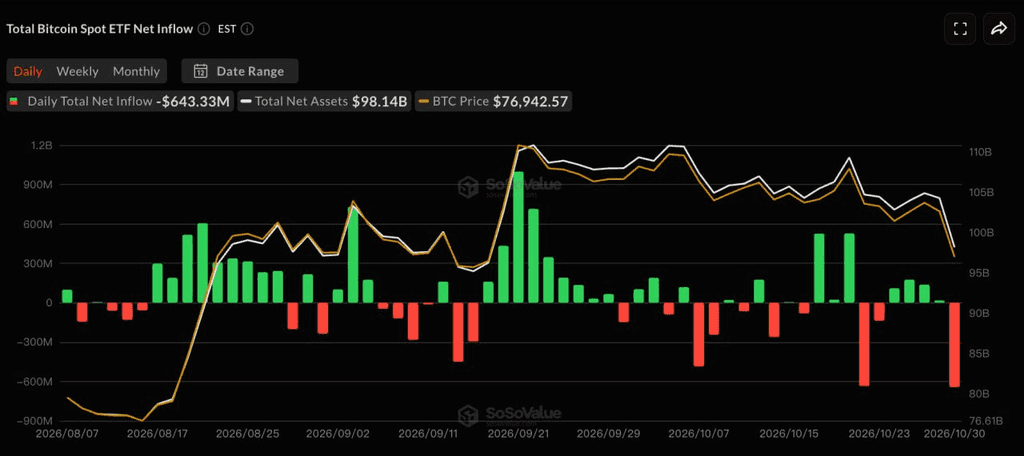
The crypto market initially recovered alongside broader risk assets last week before weakening sharply from Thursday into Friday. BTC briefly climbed back above $81,000 midweek, but quickly fell below $77,000 after Binance disclosed a major security incident, reaching a low of around $76,000. ETH fell to approximately $2,200 over the same period and underperformed BTC.
Binance said the security incident involved large-scale abnormal asset transfers and that it had frozen several billion dollars in related assets. As a result, the week’s crypto correction cannot be attributed solely to the interest-rate environment. It reflected a combination of weaker macro risk appetite and an industry-specific security shock.
Source: SoSoValue
According to SoSoValue, U.S. spot BTC ETFs recorded approximately $203 million in net outflows between October 26 and October 30. The first four trading sessions still generated approximately $440 million in cumulative net inflows, but Friday alone saw around $643 million in net outflows, completely reversing earlier institutional buying. IBIT, FBTC, and ARKB recorded approximately $234 million, $201 million, and $130 million in outflows, respectively.
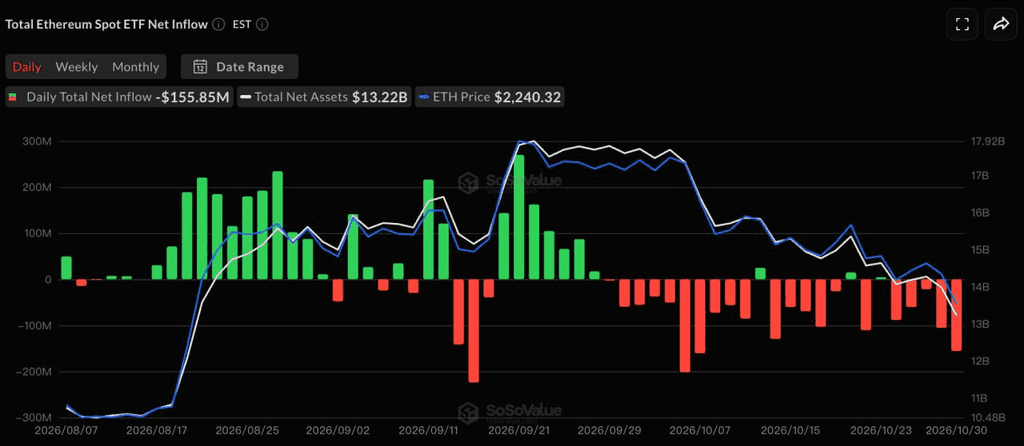
Funding pressure was more persistent in ETH ETFs. Over the same period, they recorded approximately $432 million in net outflows, with all five trading sessions posting redemptions. BlackRock’s ETHA accounted for approximately $391 million in weekly outflows, making it the primary source of redemptions. Cumulative ETH ETF outflows also expanded further over October, helping explain ETH’s weaker performance relative to BTC.
Unlike some previous weeks, when capital rotated between BTC and ETH, this week was more consistent with a broader reduction in institutional risk exposure. The fact that BTC ETFs still attracted inflows during the first four sessions suggests that institutional demand has not disappeared entirely. However, Friday’s large-scale redemptions also show that when technology-sector risk and crypto-specific events deteriorate simultaneously, ETF demand is not sufficient to provide a stable price floor.
Stablecoins: Market Capitalization Continues to Contract as Funding Weakness Extends from ETFs to the On-Chain Dollar Base
Source: DeFiLlama
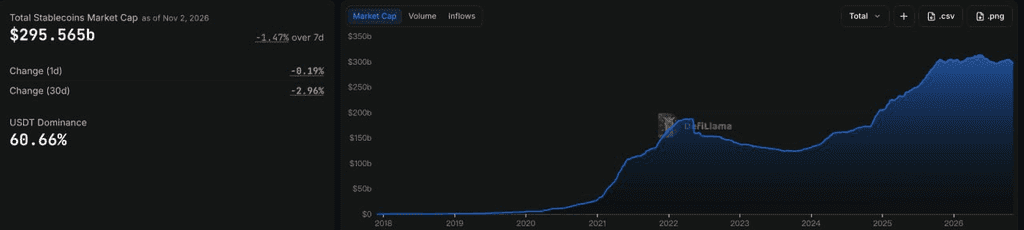
DeFiLlama data showed that, as of November 2, total stablecoin market capitalization stood at approximately $295.6 billion, down around 1.47% over the previous seven days and approximately 2.96% over the previous 30 days. USDT’s market share stood at around 60.66%. Unlike earlier periods when changes were mainly driven by rotation between individual products, overall stablecoin supply has recently entered a clearer phase of sustained contraction.
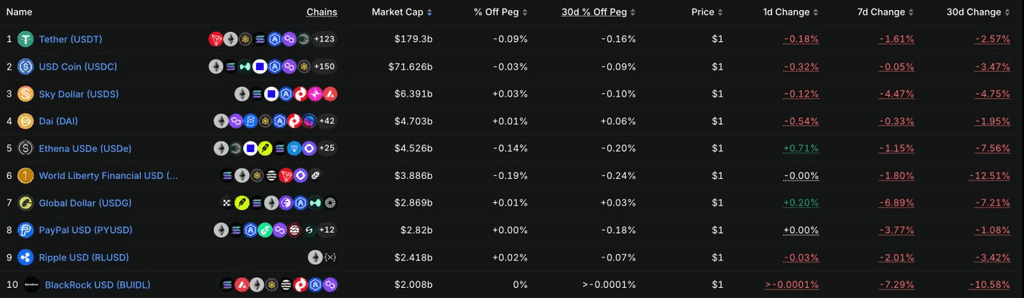
Among the top 10 stablecoins, USDT declined approximately 1.61% over the week, while USDC was broadly unchanged. USDS, USDe, and USD1 declined by approximately 4.47%, 1.15%, and 1.80%, respectively, while USDG, PYUSD, and BUIDL fell by around 6.89%, 3.77%, and 7.29%. The simultaneous contraction across different types of stablecoins suggests that the current trend cannot be explained simply by market-share shifts between individual products.
Combined with BTC and ETH ETF redemptions and weaker crypto prices, funding conditions are showing a more consistently cautious signal: institutional ETF exposure is declining at the same time that total on-chain dollar supply is shrinking, leaving the market without sufficient new liquidity to support broad-based risk expansion. If stablecoin market capitalization begins to stabilize before prices do, it could become an important signal that a funding bottom is beginning to form.
Key Events to Watch This Week
Markets will focus on the U.S. midterm elections, October employment data, and earnings from major AI-related technology companies. For crypto markets, election outcomes could affect fiscal policy, regulation, and broader risk appetite, while also reshaping the political environment for U.S. crypto legislation over the next two years. Nonfarm payrolls, meanwhile, will directly affect the current market pricing of roughly a 70% probability of another rate hike in December.
November 3: The U.S. holds its midterm elections, with all House seats and roughly one-third of Senate seats up for election. Based on current polling and market expectations, Democrats appear to have a relatively stronger position in the House, while several key Senate races remain close, leaving control of the chamber more uncertain. For markets, the key issue is not simply partisan control, but how the outcome may affect fiscal policy, corporate taxes, AI data-center regulation, financial regulation, and the efficiency of congressional policymaking.
November 3–4: AMD reports third-quarter earnings, while Apple, Palantir, and other major technology companies also release results. Following the previous week’s sharp increase in concerns over AI capital expenditure, markets will focus on AI chip demand, data-center investment, and whether cash flow can help stabilize expectations for technology stocks. AMD has confirmed that it will report after the U.S. market close on November 3.
November 6: The U.S. releases October nonfarm payrolls, the unemployment rate, and average hourly earnings. September payrolls increased by only 29,000. If employment remains weak, the probability of a December rate hike could fall materially. If job growth rebounds strongly, the combination of “resilient growth + elevated inflation” would provide further support for additional Fed tightening before year-end.
On the geopolitical front, indirect U.S.-Iran talks, shipping conditions through the Strait of Hormuz, and U.S. military policy following the midterm elections remain key variables for oil prices.
OPEC+ has decided to keep its December production target unchanged, meaning that short-term oil prices will depend more on actual Middle East exports and transportation risks than on additional supply-policy changes.
Primary Market Funding Update:Kalshi Raises Another $1 Billion as Prediction-Market Valuations Become Increasingly Institutionalized, While Overall Funding Remains Highly Concentrated
Source: RootData
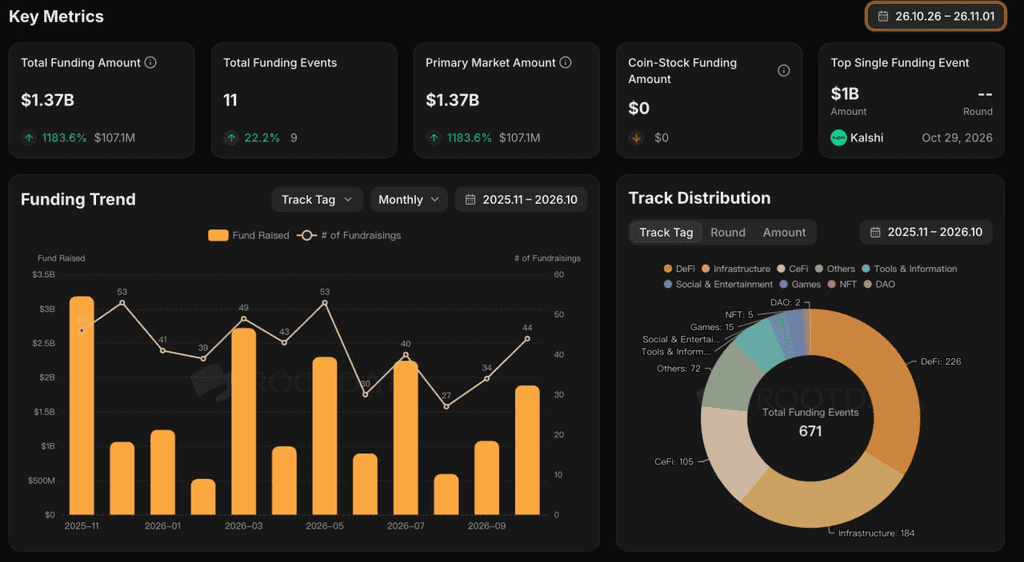
According to RootData, the crypto private market disclosed 11 funding events last week, with approximately $1.37 billion in disclosed capital raised, up 1,183.6% week-on-week. However, the increase was highly concentrated: Kalshi’s $1 billion round alone accounted for approximately 73% of total disclosed funding. The sharp increase in weekly funding therefore does not indicate a corresponding recovery in early-stage Crypto VC risk appetite.
The most representative transaction of the week was Kalshi’s $1 billion financing round at a $40 billion valuation, led by Sequoia Capital and Wellington Management, with participation from Morgan Stanley Investment Management, Coatue, a16z, and others. As recently as May, Kalshi was valued at approximately $22 billion, meaning its valuation increased sharply again within only a few months.
The more important signal from this round is not simply that prediction markets have become a popular narrative again. Rather, capital is increasingly valuing Kalshi as a large regulated trading platform rather than as a single betting or event-based product. Its long-term value will increasingly depend on whether it can expand beyond political events into macro, rates, commodities, and other financial contracts, while building exchange-like network effects through licensing, liquidity, and distribution.
At the same time, a $40 billion valuation already prices in substantial long-term growth expectations, leaving regulatory boundaries and the sustainability of trading volumes as key risks. In stablecoin payments, PhotonPay raised a $40 million Series C, led by Blockchain Capital with participation from SBI Group, IDG Capital, and others. The company already covers stablecoin and fiat wallets, card issuance, local clearing, and cross-border payments, and holds more than 30 payments and financial-services licenses. The financing further reflects how the stablecoin investment thesis is shifting away from simply “issuing a new stablecoin” toward embedding stablecoins into enterprise cross-border treasury management and local payment channels.
In AI+Crypto, RootData disclosed a financing package related to Pearl Research Labs totaling approximately $130 million, including around $55 million in equity financing and an additional $75 million earmarked for a GPU infrastructure fund. Pearl aims to combine block production with AI GPU computing through a Proof of Useful Work model. However, questions remain around the transparency of the financing structure, the operation of the GPU fund, and verification of actual compute usage. Compared with a purely narrative-driven AI+Crypto project, this type of model will need to demonstrate whether compute demand is genuine, whether protocol incentives are sustainable, and whether token value can establish a durable link with real AI workloads.
Overall, while headline private-market funding improved sharply in October, activity remained highly concentrated in prediction markets, stablecoin payments, AI infrastructure, and institutional financial services. Capital remains willing to pay premium valuations for platforms that already have licenses, trading volume, users, or established commercial distribution, while generalized protocols without meaningful commercial validation continue to face a more selective funding environment.
About KuCoin Ventures
KuCoin Ventures, is the leading investment arm of KuCoin Exchange, which is a leading global crypto platform built on trust, serving over 40 million users across 200+ countries and regions. Aiming to invest in the most disruptive crypto and blockchain projects of the Web 3.0 era, KuCoin Ventures supports crypto and Web 3.0 builders both financially and strategically with deep insights and global resources. As a community-friendly and research-driven investor, KuCoin Ventures works closely with portfolio projects throughout the entire life cycle, with a focus on Web3.0 infrastructures, AI, Consumer App, DeFi and PayFi.
Disclaimer This general market information, possibly from third-party, commercial, or sponsored sources, is not legal, compliance, financial, or investment advice, an offer, solicitation, or guarantee. We make no express or implied representations or warranties regarding its accuracy, completeness, or reliability, and disclaim liability for any resulting losses. Investments/trading are risky; past performance doesn't guarantee future results. Users should research, judge prudently, and take full responsibility. Please consult professional legal, tax, or financial advisors if necessary.