

KuCoin Ventures Weekly Report: Trust Improves, Liquidity Lags: Tether Completes Big Four Audit as Global Markets and Crypto Flows Diverge Amid Cooling Macro Data
1. Weekly Market Highlights
Tether Receives First Unqualified Audit from Big Four Accounting Firm; Enhanced Transparency May Reshape Market Trust Anchors
After a prolonged market wait, stablecoin issuer Tether announced it has received its first comprehensive independent audit of its financial statements from KPMG US. KPMG issued an "unqualified audit opinion" for its financial statements for the year ending December 31, 2025. The audit was conducted in accordance with AICPA standards, and the financial statements were prepared under US GAAP. The scope encompasses the balance sheet, income statement, statement of changes in equity, and cash flow statement, rather than merely verifying whether "reserves are sufficient on a specific day." Tether also disclosed that KPMG conducted a physical, bar-by-bar count of its gold reserves.

Data Source: https://tether.io/news/tether-completes-the-largest-inaugural-financial-audit-in-history/
Historically, Tether was not entirely without third-party verification. Independent audit firm BDO Advisory Services S.r.l. issued an assurance report on Tether's latest financial figures and reserves report as of June 30, 2026. Approximately $140.64 billion of its reserves are in cash, cash equivalents, and other short-term deposits, accounting for about 75% of total assets. Among this, U.S. Treasury Bills alone reach $114.96 billion, with a weighted average maturity of less than 90 days, representing approximately 61% of total assets. In addition, Tether directly holds roughly $18.84 billion in gold, $5.80 billion in Bitcoin, $13.45 billion in secured loans, $3.76 billion in public equities, and $5.24 billion in other investments. During the reporting period, the value of its asset reserves exceeded token-related liabilities by approximately $4.11 billion, continuing to maintain an over-collateralized reserve status.
However, the boundaries between the two reports are distinctly different. The BDO report explicitly states that its reserves report "does not represent the financial statements of the Company," but only discloses financial information extracted from accounting records. Furthermore, its assurance opinion is limited solely to the assets and liabilities at the specific point in time of June 30, 2026, providing no assurance on operational activities prior to or following this date.
The recent KPMG audit report addresses a long-standing and damaging skepticism surrounding Tether: why a stablecoin issuer managing over a hundred billion dollars in reserves had never completed a full financial statement audit by a major accounting firm. It can now be confirmed, at a minimum, that KPMG accepted this engagement, completed the audit, and issued an unqualified opinion.
In fact, the absence of comprehensive audits had previously acted as a direct impediment to Tether's capital expansion. Prior to this, Tether attempted to raise up to $20 billion in the market at a $500 billion valuation, but some potential investors adopted a wait-and-see approach specifically due to the lack of an independent audit, resulting in the fundraising plan being subsequently put on hold. Obtaining an "unqualified audit opinion" from KPMG may have filled a crucial gap in the due diligence standards of traditional financial institutions. The enhancement of financial governance and institutional credibility may provide a stronger foundation for resuming large-scale private financing or strategic partnerships in the future.
Nevertheless, Tether has not yet publicly released the full KPMG audit report and the audited financial statements, meaning external parties are still unable to independently review its detailed financial data and notes. This audit more directly addresses Tether's long-standing issues of "auditability" and institutional credit; there remains room for further improvement in public transparency.
Regarding its legal and regulatory history, Tether and its affiliated trading platform Bitfinex reached a settlement with the NYAG in 2021 over reserve disclosure issues. In the same year, the CFTC imposed a $41 million civil penalty on Tether regarding past statements about its USDT dollar reserves, and an additional $1.5 million penalty on Bitfinex, totaling $42.5 million. The latest BDO report also objectively disclosed an ongoing legal risk: Tether is currently facing a civil class action lawsuit in a New York court, primarily involving allegations related to the drop in Bitcoin prices in 2017 and 2018. At present, management and counsel are unable to reliably estimate the final outcome of this litigation; therefore, no provision has been recognized in the financial report.
Overall, Tether's introduction of a traditional Big Four accounting firm to complete its annual financial statement audit, alongside the continued publication of quarterly reserve reports assured by BDO, reflects that leading crypto enterprises are further aligning with the financial governance standards of traditional financial institutions. For Tether, which now manages nearly $190 billion in assets, market focus is gradually shifting from early skepticism about "whether reserves truly exist" to whether it can establish a long-term, institutionalized audit and information disclosure mechanism.
2. Weekly Selected Market Signals
Cooling Inflation and Consumption Reduce September Rate-Hike Expectations, U.S. Equities Hold Near Highs, Gold and Oil Gain Support from Fiscal and Geopolitical Risks, While Crypto ETF Flows Weaken Again
U.S. economic data for July continued to point toward cooling momentum. Headline CPI slowed from 3.5% to 3.4% year-on-year, while core CPI eased from 2.6% to 2.5%. PPI was unchanged month-on-month, with the annual rate falling from 5.5% to 4.7%. July retail sales unexpectedly declined 0.6% month-on-month, the largest drop in more than a year, suggesting that the consumption boost from earlier one-off factors is fading and underlying household demand is beginning to soften. The combination of cooling inflation and weaker demand prompted markets to scale back expectations for near-term Federal Reserve tightening.
As of August 16, the CME FedWatch Tool showed that the market-implied probability of a 25-basis-point rate hike in September had fallen to approximately 30%, while the probability of rates remaining unchanged had risen to around 70%.
Although three FOMC members supported an immediate rate increase at the July meeting, and some officials continue to express concerns over energy prices and sticky inflation, recent employment, inflation, and consumption data are weakening the case for tightening as early as September. Goldman Sachs has gone further, arguing that unless August data reverse sharply, a September rate hike is unlikely to remain the base case.
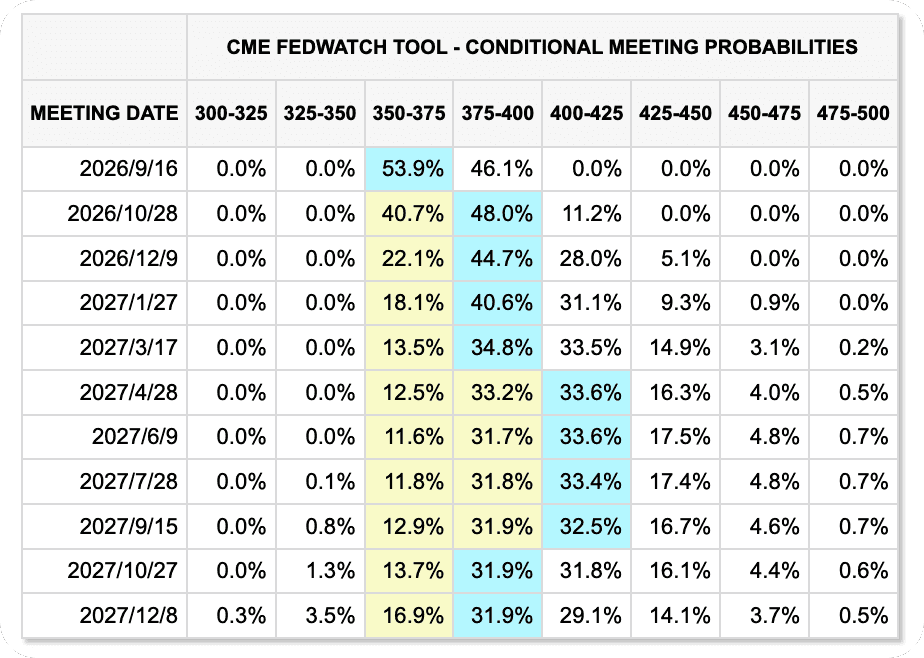
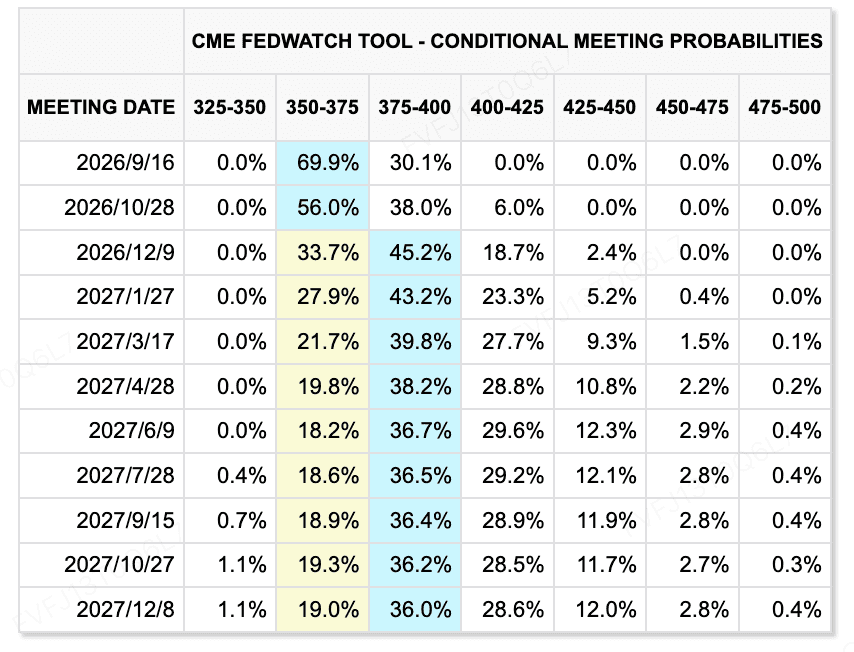
Change in market pricing over the past two weeks
(Previous week shown first; current week shown second)
Data Source: CME FedWatchTool
However, lower expectations for short-term policy tightening have not fully relieved pressure at the long end of the yield curve. U.S. federal debt is approaching $40 trillion, while the latest 30-year Treasury auction cleared at a yield of 5.126%, the highest level in roughly 25 years. At the same time, large-scale capital expenditure related to AI data centers is driving higher corporate bond issuance. Fiscal deficits, bond supply, and term premiums are therefore becoming increasingly important drivers of long-term yields. In other words, a Federal Reserve decision not to raise rates does not necessarily translate into easier long-term financing conditions.
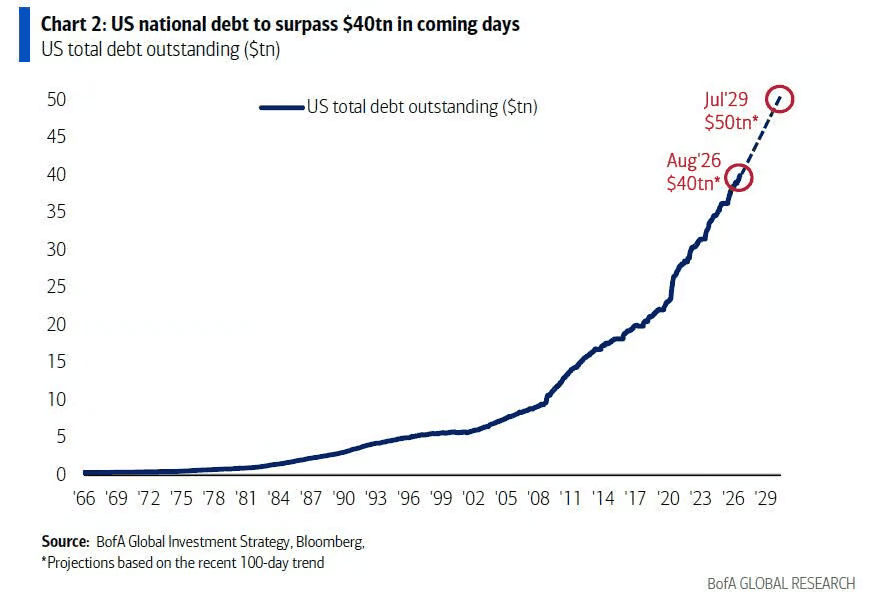
This backdrop also strengthens the medium- to long-term allocation case for gold. Bank of America’s Michael Hartnett views gold as a hedge against declining U.S. dollar purchasing power, fiscal expansion, and risks in the bond market. COMEX gold futures rose approximately 0.9% last week to around $4,380 per ounce, marking a second consecutive weekly gain.
Gold remains constrained in the near term by elevated real yields. However, as expectations for policy-rate increases decline while fiscal and long-duration bond risks continue to build, gold benefits from two simultaneous sources of support: expectations for monetary easing and growing fiscal risk. Its allocation case is therefore becoming broader than a simple geopolitical safe-haven trade.
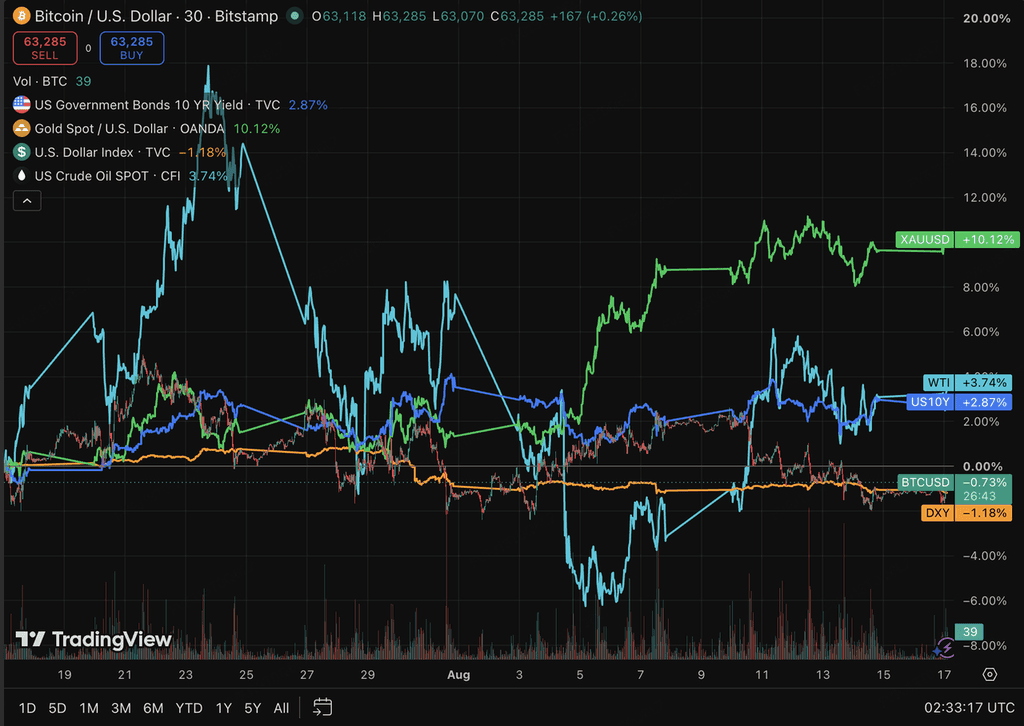
Data Source: TradingView
Geopolitical risks continued to support energy prices. U.S.-Iran negotiations remain without a clear breakthrough, while arrangements governing shipping through the Strait of Hormuz have yet to produce a stable solution. Washington has also signaled further economic sanctions and blockade pressure on Iran, renewing the supply risk premium.
WTI crude rose approximately 5.4% last week to $82.40 per barrel, while Brent gained around 6.0% to $88.50. Oil remains caught between cooling demand and supply risk. Softer U.S. consumption and weaker expectations for global demand constrain the upside, but geopolitical premiums are unlikely to disappear as long as the Strait of Hormuz remains materially disrupted.
U.S. equities continued to trade near record highs, with the S&P 500 and Nasdaq posting modest weekly gains. While softer inflation supports valuations, investors are becoming increasingly sensitive to the returns and financing sustainability of the massive capital expenditure associated with AI. Technology-sector performance is consequently becoming more differentiated. The memory supply chain performed particularly well, with Sandisk and SK Hynix among the stronger performers. Meanwhile, capital-intensive AI infrastructure companies with substantial debt exposure, including CoreWeave and Oracle, continue to face greater scrutiny over financing costs, cash flow, and investment returns. The AI trade is therefore evolving from simply pursuing demand for compute toward assessing whether revenue growth can ultimately cover increasingly expensive capital expenditure and financing costs.
South Korea’s KOSPI gained nearly 11% following seven consecutive weeks of declines, with semiconductors driving much of the rebound. Part of the move reflected position rebuilding following substantial deleveraging, while resilient demand for AI servers and memory brought investors back to Samsung Electronics, SK Hynix, and related names. For now, the move appears closer to a rapid recovery from previously oversold conditions. Whether it can be sustained will still depend on memory pricing, export data, and actual earnings delivery.
Crypto Assets and ETFs: Improving Macro Conditions Fail to Lift Prices as ETF Flows Turn Negative Again
Data Source: SoSoValue
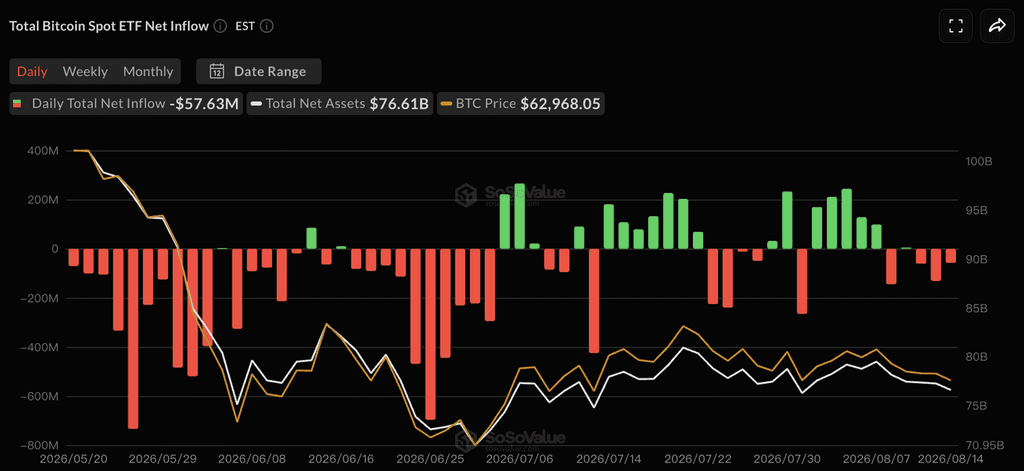
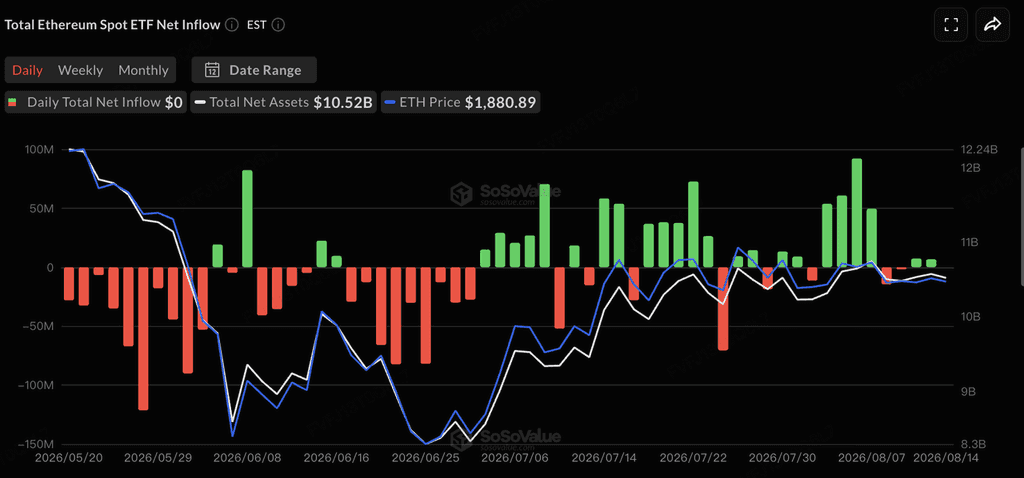
Crypto assets underperformed U.S. equities last week. BTC fell from approximately $65,000 at the beginning of the week to around $62,500–$63,000, declining roughly 3% over the week. ETH also weakened modestly, falling from approximately $1,910 to around $1,880. The fact that crypto failed to benefit meaningfully from softer U.S. inflation and lower rate-hike expectations suggests that macro interest rates are no longer the only constraint on prices.
According to SoSoValue, U.S. spot BTC ETFs recorded approximately $390 million in net outflows between August 10 and August 14, with four of the five trading sessions posting net redemptions. This represented a sharp reversal from approximately $854 million in net inflows during the previous week. Fidelity’s FBTC, ARKB, and GBTC were among the main sources of outflows, while BlackRock’s IBIT also turned negative on a weekly basis. Spot ETH ETFs were broadly flat, recording a small weekly net outflow of approximately $2.26 million.
The deterioration in ETF flows helps explain why BTC failed to respond positively to improving short-end Treasury yields and reduced expectations for another rate increase. At the same time, the U.S. Senate postponed further procedural progress on the Clarity Act until September, reducing expectations for an immediate regulatory catalyst. The market has therefore returned to a pattern of incrementally improving macro conditions but insufficient crypto-native demand. For BTC and ETH to resume a more durable recovery, either ETF flows or stablecoin liquidity will likely need to return to sustained expansion.
Stablecoins: Total Market Capitalization Stabilizes After Consecutive Contraction, but New Liquidity Remains Limited
Data Source: DeFiLlama
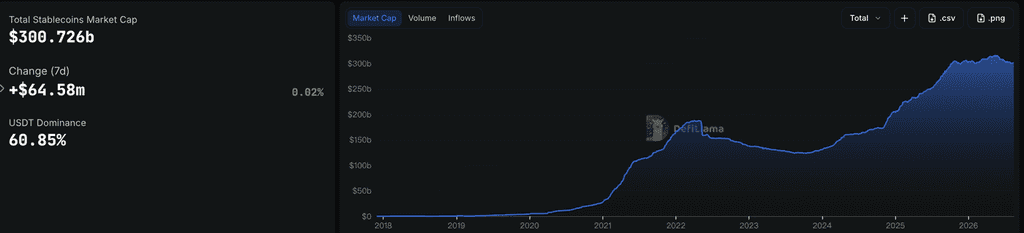
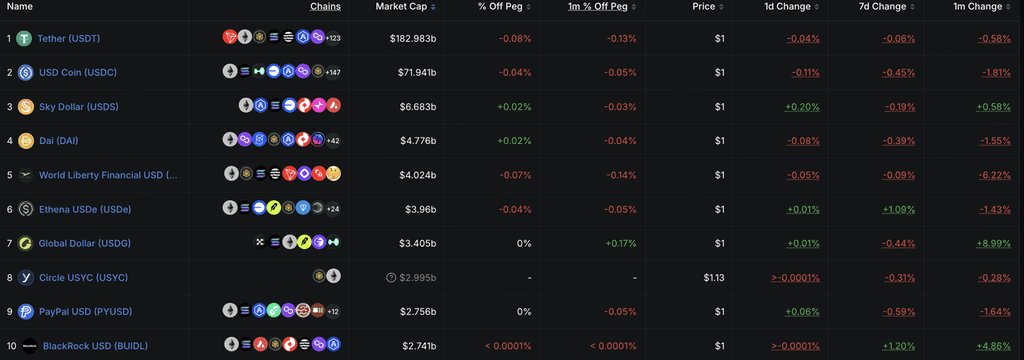
Under DeFiLlama’s current methodology, total stablecoin market capitalization stood at approximately $300.7 billion. Supply was broadly unchanged over the previous seven days, increasing by only around 0.02%, while remaining approximately 0.53% lower over the previous 30 days. USDT’s market share increased further to approximately 60.85%.
Stablecoin supply has therefore shifted from consecutive contraction toward stabilization, but there is still little evidence of meaningful new dollar liquidity entering the market. Changes among the ten largest stablecoins were relatively limited. USDC declined approximately 0.46% over the week, while USDT remained broadly unchanged. USDe increased by around 1.1% and BUIDL by approximately 1.2%, suggesting that the limited incremental liquidity continues to favor yield-bearing products.
Overall, the on-chain dollar liquidity base has stabilized compared with previous weeks but remains insufficient to support a renewed phase of broad-based crypto risk expansion.
Important Financial/Macro Events to Watch Next Week
Markets will focus on the minutes from the July FOMC meeting, subsequent U.S. measures toward Iran, and major economic and technology-sector data from China, the United States, Japan, and South Korea. The FOMC minutes should provide more detail on the disagreement behind the three votes in favor of an immediate rate hike and help determine whether current market pricing of roughly a 30% probability of a September increase remains too hawkish.
-
August 17: China releases July industrial production, retail sales, and fixed-asset investment data, providing further indications of domestic demand and manufacturing momentum.
-
August 18: Xiaomi and Baidu report earnings, with attention focused on smart vehicles, AI investment, and large-model commercialization.
-
August 19: The 2026 World Robot Conference opens in Beijing. An additional 50% U.S. tariff on selected Canadian products also takes effect, bringing trade risks back into focus.
-
August 20: The Federal Reserve releases the minutes from its July FOMC meeting. Alibaba and Walmart report earnings, offering respectively a read-through on AI/cloud investment and the resilience of U.S. consumption.
-
August 21: Japan releases July CPI, while South Korea publishes export data for the first 20 days of August. Markets will focus on the conditions for further Bank of Japan tightening and the strength of AI and memory-chip exports.
On the geopolitical front, the U.S. Treasury has signaled that additional economic pressure on Iran is forthcoming. The Strait of Hormuz therefore remains an important variable for oil prices and global inflation expectations. If energy prices again move materially above $90 per barrel, the Federal Reserve’s policy flexibility could remain constrained even if U.S. economic data continue to soften.
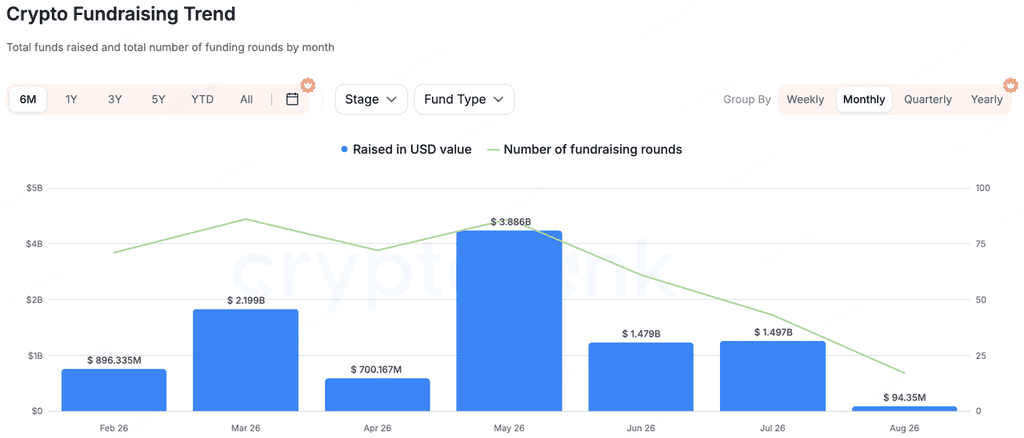
Crypto Primary Market Events :Activity Remains Muted as Capital Shifts Further Toward Institutional Finance and RWA Infrastructure
Data Source: CryptoRank
Based on RootData, CryptoRank, and publicly disclosed transactions, the number of crypto private-market deals announced last week remained relatively low. Most financings with disclosed amounts were in the single-digit millions of dollars. This contrasts with the second quarter, when headline funding totals were disproportionately lifted by a small number of large strategic investments and debt transactions. There is still little evidence of a broad recovery in private-market risk appetite. Capital continues to favor projects with clearly defined commercial use cases and institutional customers.
Among the larger disclosed deals, crypto-native travel infrastructure provider Entravel raised $7.5 million, with participation from Ethereal Ventures, Finality Capital, and other investors. Entravel’s core value proposition extends beyond a simple “crypto travel” narrative. The company provides white-label hotel booking and payment infrastructure to exchanges and FinTech platforms, making its business model closer to a B2B SaaS platform with an embedded crypto payment layer.
Institutional finance and RWA infrastructure were also notable areas of activity.
-
RWA.xyz, a data platform focused on real-world assets, completed a seed round led by Neoclassic Capital.
-
Digital Prime Technologies received strategic investment from LTP and other investors. Its business spans institutional digital-asset execution, lending, and prime brokerage.
-
Ondo Finance also made a strategic investment in Saturn, a Bitcoin-backed credit protocol.
Although the amounts of these transactions were not disclosed, they point to a common trend: capital is continuing to move away from generalized on-chain applications and toward RWA data, institutional credit, asset issuance, and trading infrastructure.
Overall, the current private-market environment remains characterized by low deal volume and greater selectivity. Compared with narrative-driven general-purpose protocols, projects with institutional distribution, real transaction or payment use cases, and infrastructure capable of connecting on-chain assets with traditional finance are finding it easier to attract new capital.
About KuCoin Ventures
KuCoin Ventures, is the leading investment arm of KuCoin Exchange, which is a leading global crypto platform built on trust, serving over 40 million users across 200+ countries and regions. Aiming to invest in the most disruptive crypto and blockchain projects of the Web 3.0 era, KuCoin Ventures supports crypto and Web 3.0 builders both financially and strategically with deep insights and global resources.
As a community-friendly and research-driven investor, KuCoin Ventures works closely with portfolio projects throughout the entire life cycle, with a focus on Web3.0 infrastructures, AI, Consumer App, DeFi and PayFi.
Disclaimer This general market information, possibly from third-party, commercial, or sponsored sources, is not legal, compliance, financial, or investment advice, an offer, solicitation, or guarantee. We make no express or implied representations or warranties regarding its accuracy, completeness, or reliability, and disclaim liability for any resulting losses. Investments/trading are risky; past performance doesn't guarantee future results. Users should research, judge prudently, and take full responsibility. Please consult professional legal, tax, or financial advisors if necessary.