

How Hush Money Sends Bitcoin Ecash Through Sound: Cashu Explained
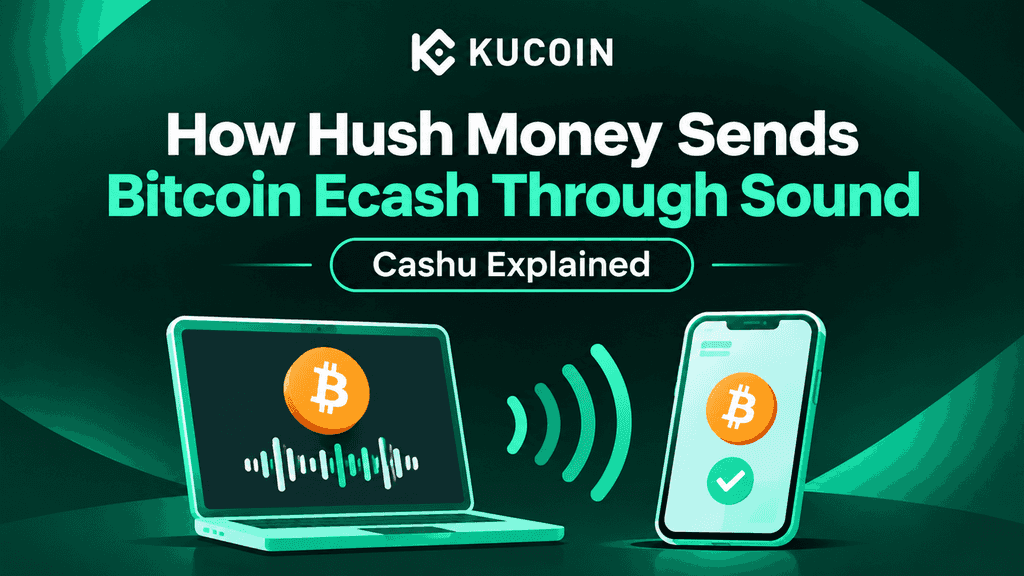
Bitcoin payments may soon travel through something as simple as a melody. Hush Money, a newly launched tool, allows users to transfer Bitcoin-backed electronic cash between devices using sound. A laptop generates a unique pentatonic bell melody containing 17 bytes of encoded payment data, which a smartphone captures and decodes to receive the ecash through a Cashu wallet.
The development introduces an unconventional approach to transferring Bitcoin ecash, moving beyond familiar methods such as QR codes and payment links. It also brings renewed attention to Cashu, an open-source protocol designed to enable private, Bitcoin-backed electronic cash transactions.
Understanding how Hush Money works offers a glimpse into how developers are rethinking the way Bitcoin value can move between users.
Key Takeaways
-
Hush Money uses sound to transfer Bitcoin-backed ecash, encoding payment data into a melody that a smartphone can capture and decode.
-
The technology relies on Cashu, an open-source protocol that represents Bitcoin value through digital tokens held by a mint.
-
Cashu uses blind signatures to improve transaction privacy and enables token transfers without recording every payment on the Bitcoin blockchain.
-
These tokens can be shared through QR codes, text messages, Bluetooth and sound, with each method offering a different transfer experience.
-
Despite its privacy benefits, Cashu carries risks involving mint custody, lost tokens and double-spending during offline transfers.
-
Sound-based payments could make peer-to-peer ecash transfers more flexible, while potential Lightning address support may simplify how users receive payments.
How Does Hush Money Transfer Bitcoin Through Sound?
Hush Money replaces the usual process of sharing payment information with an audio-based transfer. Instead of scanning a QR code or copying a payment string, users can send Bitcoin-backed ecash from a laptop to a smartphone through a short melody.
The process relies on encoding payment data into sound and allowing the receiving device to convert it back into usable ecash.
How Does Hush Money Encode Bitcoin Payments Into a Melody?
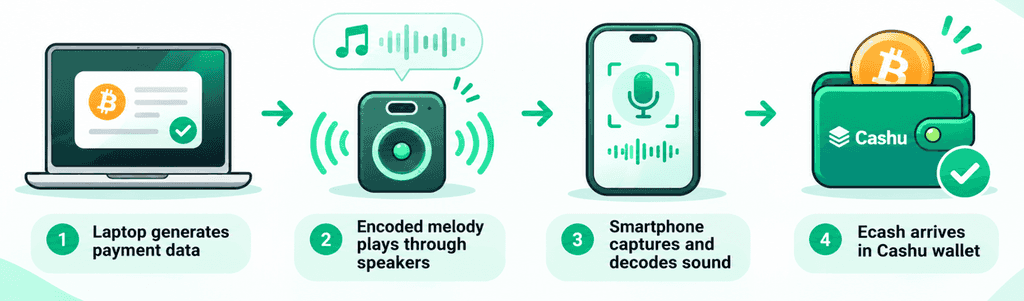
When a user initiates a transfer, Hush Money generates a unique bell-like melody containing the payment information. The melody follows a pentatonic scale, a musical scale built around five notes, and carries 17 bytes of encoded data.
Rather than transmitting Bitcoin directly over the blockchain, the tool uses sound to communicate the data representing Bitcoin-backed ecash. The laptop plays the generated melody through its speakers, allowing a nearby smartphone to capture the payment information.
This approach turns an ordinary audio signal into a way of sharing digital value. Each payment generates a distinct melody, making the transfer process different from conventional methods that rely on displaying and scanning payment codes.
How Does a Smartphone Receive Bitcoin Ecash Through Sound?
The receiving smartphone captures the melody through its microphone and decodes the information embedded in the audio. The recovered payment data can then be received into a Cashu wallet, where the user can access the transferred ecash.
The process follows a simple sequence:
Hush Money is also exploring support for Lightning addresses, which could make it easier for users to send and receive payments through familiar Bitcoin payment identifiers. However, this remains a potential expansion rather than a confirmed feature of the current launch.
The approach demonstrates how Bitcoin-backed ecash can move between devices without requiring every transfer to be recorded as an individual blockchain transaction. Understanding how this works requires looking at the Cashu protocol that powers the electronic cash.
What Is Bitcoin Ecash and How Does the Cashu Protocol Work?
Bitcoin ecash is a way to hold and transfer Bitcoin-denominated value using digital tokens instead of making a separate blockchain transaction for every payment. Cashu makes this possible through an open-source protocol that connects Bitcoin to electronic cash, allowing users to receive, store and exchange tokens backed by Bitcoin held by a mint.
Understanding how these tokens work, how Cashu protects transaction privacy and why transfers do not require individual onchain transactions explains the technology behind Hush Money.
What Is Bitcoin-Backed Ecash and How Does It Work?
Ecash is a digital payment system originally developed by cryptographer David Chaum in 1983. It uses cryptography to create digital tokens that users can hold and transfer, similar to how physical cash changes hands. In Bitcoin-based systems such as Cashu, these tokens represent satoshis backed by Bitcoin deposited with a mint.
A mint is a service that holds the underlying Bitcoin and issues corresponding ecash tokens to users. These tokens act as digital bearer assets, meaning whoever holds a valid token can spend or transfer it. Unlike conventional bank transfers, users do not need individual accounts with the mint to exchange ecash.
Ecash also differs from regular Bitcoin and Lightning transactions. Onchain Bitcoin payments are recorded on the Bitcoin blockchain, while Lightning payments move funds through payment channels. Ecash transfers instead use tokens issued by a mint, allowing users to exchange Bitcoin-denominated value without recording every payment on either network.
Why Can Cashu Transfer Bitcoin Ecash Without Onchain Transactions?
Cashu separates the transfer of digital cash from the movement of Bitcoin on the blockchain. Once a user has obtained ecash, they can send the token to another person without creating a new Bitcoin transaction for every payment.
The receiving wallet can submit the token to the mint for verification. The mint invalidates the previously issued token and provides valid ecash to the recipient. This process is known as a swap in Cashu terminology.
Users can also convert their ecash back into Bitcoin through the mint, typically using the Lightning Network. The mint verifies and invalidates the tokens before sending the corresponding Bitcoin value to the user's wallet.
This makes Cashu transfers fast and flexible, but it also introduces a custody trade-off: users depend on the mint to safeguard the underlying Bitcoin and honour valid redemption requests.
Why Is Hush Money Using Sound Instead of QR Codes or Bluetooth?
Bitcoin ecash does not depend on a single method of transferring payments. Because Cashu tokens are stored as digital data, users can share them through different communication channels, including QR codes, text messages and Bluetooth.
Hush Money introduces sound as another option, raising questions about its convenience, offline capabilities and how it compares with existing transfer methods.
How Does Sound Compare With QR Codes for Bitcoin Ecash Payments?
QR codes are one of the simplest ways to transfer Cashu tokens between nearby devices. A sender displays a code containing the ecash token, and the recipient scans it with a wallet to claim the funds. Hush Money uses a different approach: the sending device plays an encoded melody, which the receiving smartphone captures and decodes.
Both methods allow users to transfer ecash without manually copying payment data. However, QR codes require a camera and a visible display, while sound-based transfers rely on speakers and microphones. The latter could offer an alternative when displaying or scanning a code is inconvenient, although background noise and audio quality may affect its reliability.
Can Bitcoin Ecash Be Transferred Without an Internet Connection?
Yes. Cashu tokens can be transferred between devices without an active internet connection because the transfer happens directly between wallets rather than through the mint. However, the recipient must eventually connect to the mint to verify and redeem the tokens.
This distinction matters because an offline recipient cannot immediately confirm whether a token has already been spent. Cashu's documentation identifies this as a double-spending risk, meaning offline receipt should not automatically be treated as final payment confirmation.
What Other Ways Can Users Transfer Bitcoin Ecash?
Beyond sound and QR codes, Cashu supports other ways to share tokens:
-
Text messages: Users can copy and paste ecash tokens through email, SMS or messaging applications.
-
Bluetooth: Nearby devices can exchange tokens wirelessly without requiring an internet connection, although the Bitcoin Design Guide notes that more comprehensive Bluetooth functionality varies across wallets and lacks universal standardization.
-
QR codes: Wallets encode ecash tokens directly into scannable codes for in-person transfers.
-
Sound: Hush Money uses audio to carry payment data between devices.
These methods offer different ways to move the same Bitcoin-backed digital cash. The choice depends on device compatibility, convenience and the conditions under which users want to transfer their tokens.
Is Hush Money Secure? Understanding Bitcoin Ecash Privacy and Risks
Hush Money uses Cashu to transfer Bitcoin-backed ecash, but the privacy features of the protocol do not eliminate every security risk. While Cashu uses cryptography to make transactions harder to trace, users still depend on mints to safeguard their funds and verify payments.
Understanding these protections and limitations is important before treating ecash as a secure alternative to conventional Bitcoin transfers.
How Does Cashu Protect Bitcoin Ecash Transaction Privacy?
Cashu protects transaction privacy through blind signatures, which make it difficult for a mint to connect the creation of an ecash token to its subsequent use. The protocol also operates without conventional user accounts, so users do not need to register personal information or maintain an account balance with a mint.
However, this does not make every transaction completely anonymous. A mint may still see network information, including a user's IP address and connection time. It may also identify the recipient of certain Lightning payments passing through its infrastructure. Users therefore receive stronger privacy at the protocol level, but their network activity can still reveal information about them.
Can Bitcoin Ecash Be Lost or Double-Spent?
Yes. Cashu tokens are bearer assets, meaning the token data stored in a wallet represents the money itself. If a user loses their wallet storage without a usable backup, they may permanently lose access to their ecash.
Double-spending is another risk. Since a token can be transferred as data, someone could attempt to send the same token to multiple recipients. Cashu prevents this by requiring the mint to check whether a token has already been spent before accepting it and issuing replacement tokens.
This verification is particularly important for offline transfers, where a recipient may receive a token before the mint confirms its validity.
What Risks Should Users Consider Before Using a Cashu Wallet?
The biggest consideration is that Cashu is a custodial system. Although users hold ecash tokens in their wallets, the underlying Bitcoin remains under the mint's control. If the mint becomes unavailable, acts maliciously or cannot honour redemption requests, users could lose their funds.
Cashu's documentation also warns that the protocol and associated wallets are still in early development, meaning software bugs could result in permanent losses. Users should also protect their wallet backups and use secure, preferably end-to-end encrypted channels when sharing tokens.
The Cashu documentation recommends using small amounts and choosing mints whose operators users trust. These precautions are particularly important because Bitcoin ecash offers a different balance of privacy and custody from holding Bitcoin directly in a self-custodial wallet.
Could Sound-Based Payments Change the Future of Bitcoin Transactions?
Sound-based payments introduce another way to transfer Bitcoin-backed ecash between devices. By allowing users to exchange tokens through different communication methods, Cashu creates opportunities for more flexible peer-to-peer payments. However, wider adoption will depend on how reliably these methods work and whether they offer practical advantages over existing payment options.
How Could Sound-Based Bitcoin Payments Expand Peer-to-Peer Transactions?
Sound-based transfers could make in-person Bitcoin payments more flexible, particularly when displaying a QR code is inconvenient. Two people with compatible devices could exchange ecash through a speaker and microphone without manually sharing payment information.
This could offer an alternative for small, in-person transfers, although background noise, device compatibility and audio reliability remain important considerations. These are potential applications rather than confirmed Hush Money use cases.
Can Bitcoin Ecash Become an Alternative to Lightning Payments?
Cashu allows users to exchange tokens without routing every payment through the Lightning Network. It also offers additional transaction privacy through blind signatures. However, users must trust the mint holding the underlying Bitcoin, unlike self-custodial Lightning arrangements.
Wider adoption will depend on reliable wallets, secure recovery options and trustworthy mint operators.
What Could Lightning Address Support Mean for Hush Money?
Lightning address support could make receiving payments easier by allowing users to share familiar, email-like identifiers instead of lengthy payment invoices. Hush Money is reportedly exploring this integration, but it is not yet a confirmed feature.
Ultimately, Hush Money demonstrates how Bitcoin ecash can move beyond conventional payment interfaces. Its practical adoption will depend on reliability, wallet compatibility and whether users find sound more convenient than established alternatives.
Conclusion
Hush Money introduces an unconventional way to transfer Bitcoin-backed ecash by turning payment data into sound. Built around the Cashu protocol, it demonstrates how digital tokens can move between devices without requiring individual blockchain transactions. Its approach also highlights the flexibility of ecash, which can be shared through QR codes, text messages, Bluetooth and now audio.
However, sound-based transfers still face practical considerations around reliability, device compatibility and payment verification. Cashu also requires users to trust the mint holding their underlying Bitcoin. Whether Hush Money gains wider adoption will depend on how effectively it addresses these limitations and makes Bitcoin ecash easier to use.
FAQs
What is Hush Money in Bitcoin?
Hush Money is a tool that transfers Bitcoin-backed ecash between devices using sound. It encodes payment data into a melody that a smartphone can capture and decode.
How does Cashu work with Bitcoin?
Cashu is an open-source ecash protocol that represents Bitcoin value through digital tokens issued by a mint. Users can transfer these tokens without making individual blockchain transactions.
Can you send Bitcoin ecash without an internet connection?
Yes. Cashu tokens can be transferred between devices offline. However, recipients must eventually connect to the mint to verify and redeem tokens.
Is Cashu ecash anonymous and secure?
Cashu uses blind signatures to improve transaction privacy, but it does not guarantee complete anonymity. Users also face mint custody, token loss and double-spending risks.
What is the difference between Cashu and the Lightning Network?
Cashu transfers Bitcoin-backed ecash tokens issued by a mint, while Lightning processes payments through payment channels. Cashu offers additional privacy but requires trust in the mint.
Disclaimer
This general market information, possibly from third-party, commercial, or sponsored sources, is provided for reference and educational purposes only and does not constitute financial or investment advice, an offer, solicitation, or guarantee. We disclaim liability for its accuracy, completeness, reliability, and any resulting losses. Investments/trading are risky; past performance doesn’t guarantee future results. Users should research, judge prudently, and take full responsibility. For further details, please consult KuCoin’s Terms of Use and Risk Disclosure.