

FIL Issuance Drops 75% in October 2026 as Filecoin Paid Onchain Demand Grows
Introduction
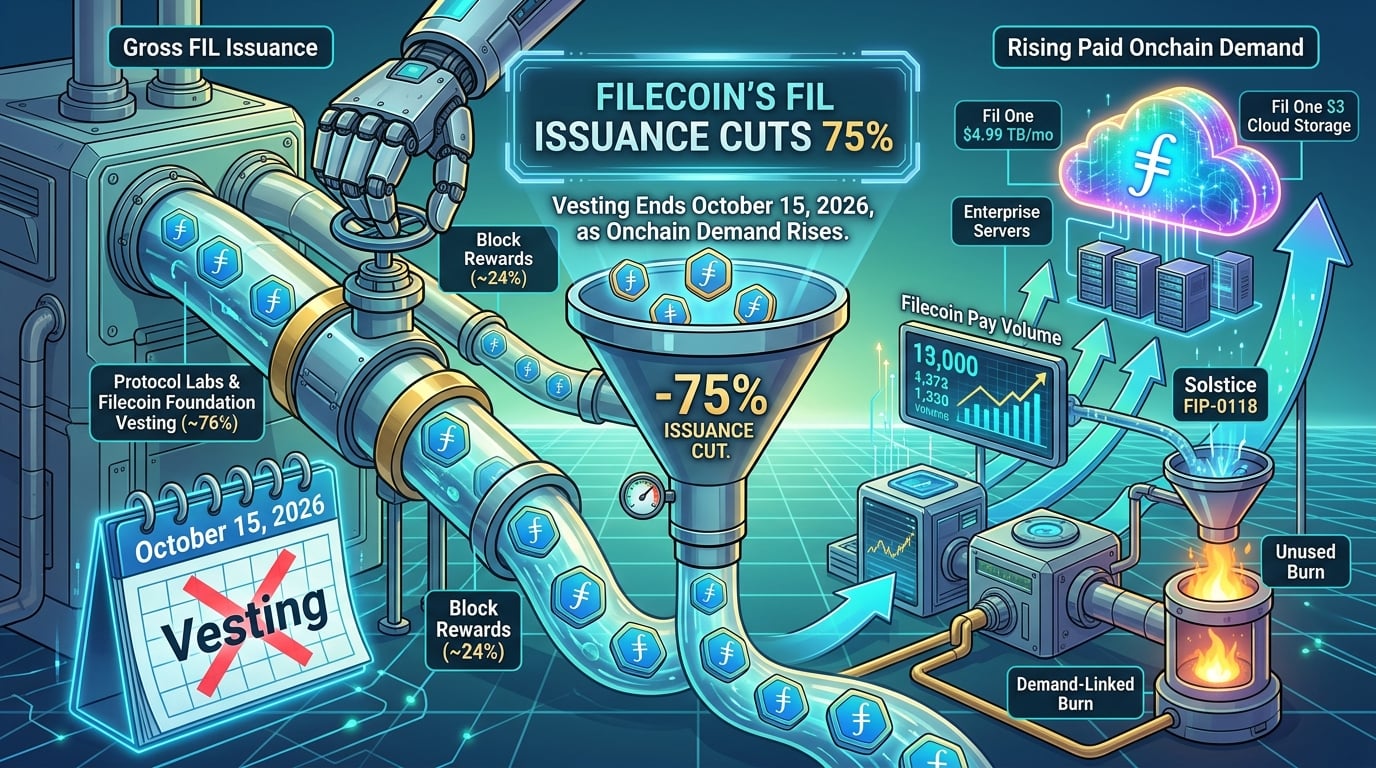
On October 15, 2026, Protocol Labs and Filecoin Foundation vesting stops — and that single scheduled event cuts Filecoin’s gross FIL issuance by roughly 75%, the largest supply change since mainnet launch. According to Filecoin’s September 4, 2026 network update, vesting has been adding about 66.7 million FIL a year against roughly 21.7 million FIL from block rewards. After that date, new issuance is limited to block rewards of about 22 million FIL a year, or a little over 2% of circulating supply.
The timing matters because paid onchain demand is no longer theoretical. Filecoin Onchain Cloud and Fil One are live, Filecoin Pay settlements are measurable, and FIP-0118 (Solstice) is designed to tie more of the remaining reward stream to actual paid usage. This article explains what the October cut does, how demand is showing up onchain, and what token holders should watch next.
Why Does FIL Issuance Drop 75% in October 2026?
Gross FIL issuance drops about 75% on October 15, 2026 because the largest source of new tokens — Protocol Labs and Filecoin Foundation vesting — ends, leaving block rewards as the only scheduled inflow.
According to FilecoinTLDR, new FIL has been entering circulation at close to 10% of supply a year. Of that flow, PL and FF vesting contributed about 66.7 million FIL annually, while block rewards contributed about 21.7 million FIL. Remove the vesting stream and the remaining issuance is about 22 million FIL a year.
That is a gross-issuance change, not an automatic collapse in circulating supply. Burns, collateral locking, sector pledge, and later reward-design changes still decide whether net supply rises, flattens, or turns negative. The October date simply removes the largest predictable unlock.
The Filecoin official account described the same event on September 4, 2026: vesting ends on October 15 and cuts gross issuance by roughly 75%, coinciding with Filecoin Onchain Cloud and Fil One bringing paid demand onchain.
How Does Filecoin Circulating Supply Work After Vesting Ends?
After vesting ends, circulating supply is driven by block rewards on one side and by burns plus collateral locking on the other.
Filecoin circulating supply is not a single faucet. New FIL still enters through miner rewards. FIL leaves liquid circulation when storage providers lock collateral and when fees or unused reward shares are burned. According to Filecoin docs, the network also uses dual minting — baseline minting tied to network growth and simple minting on a long half-life schedule — so reward size is not a flat coupon.
Simulations on the FIL Tokenomics Simulator, cited by FilecoinTLDR in September 2026, suggest daily net supply growth could fall by roughly 86% to 119% from August 2026 levels by the end of 2027, depending on demand, rewards, collateral, and burns. At the upper end of that range, the daily supply delta turns negative and FIL becomes net deflationary.
Those figures are modeled scenarios, not forecasts. Weak onboarding or low renewal can keep net supply expanding even after vesting ends. Strong paid usage and higher locking can do the opposite.
Based on CoinMarketCap data around mid-September 2026, FIL circulating supply stood near 827.8 million FIL, with total supply near 1.95 billion FIL. That snapshot is the base against which the October issuance cut should be compared.
What Is Solstice (FIP-0118) and How Does It Change FIL Rewards?
Solstice (FIP-0118) redesigns Filecoin rewards so a growing share of block rewards funds services that generate paid usage — and burns that share if onchain payment targets are missed.
According to the official Filecoin Solstice post (July 17, 2026) and FilecoinTLDR’s September update, Fil+ currently uses DataCap and human review to grant verified deals a 10x quality-adjusted power multiplier. Under Solstice, every new sector would onboard at 10x quality-adjusted power with no verification step. A separate service stream would pay registered orchestrators only if aggregated Filecoin Pay volume clears quarterly USD targets.
If those targets are not met, the unearned service share is burned rather than distributed. FilecoinTLDR notes FIP-0118 was accepted in September 2026 and awaits scheduling into a network upgrade, with implementation details still able to change until it ships.
The economic loop is simple. Stronger paid settlement supports more service funding. Weaker settlement reduces net new supply. Token holders should treat Solstice as a demand-linked issuance valve, not as a guaranteed burn event.
What Is Fil One and Why Does S3 Pricing Matter for FIL Demand?
Fil One is Filecoin’s S3-compatible object storage product, priced at $4.99 per TB-month with no egress fees, and it is the clearest first-party path from enterprise object storage into paid Filecoin usage.
According to FilecoinTLDR and Fil One product details cited in the September 2026 update, Fil One launched in June 2026. Existing S3 SDKs and CLIs can connect by changing an endpoint and credentials. Objects receive a content identifier at upload and are re-checked about every 24 hours. Stated durability is 11 nines. Regions include the US and EU, with more planned. Terms include pay-as-you-go plus 1-, 3-, and 5-year reserved capacity, and a 1 TB free trial for 30 days with no card required.
Price is the adoption wedge. Enterprise object storage is sold in exabytes. If Fil One wins even a thin slice of that market, those accounts become paid, onchain storage the protocol can measure. Roadmap items in early access include Bucket Intelligence and an AI Agent Toolkit.
Fil One does not by itself change FIL issuance. It changes the demand side that burns, locking, and Solstice targets depend on.
How Do Onramps Such as Akave Translate Enterprise Workloads Onto Filecoin?
Onramps convert enterprise contracts into Filecoin-backed storage, so their product and client progress is an early read on paid demand.
According to FilecoinTLDR, Akave Cloud is an S3-compatible, compute-agnostic storage platform that uses Filecoin as its storage layer. Akave raised $6.65 million in March 2026 and pushed O3 from PDP integration and a trustless GUI at v1.2 to multipart uploads, IAM, and Object Lock by v1.7. Protocol-layer updates added per-file encryption keys and faster erasure reconstruction.
FilecoinTLDR also cites Intuizi reporting more than 50% lower storage costs and 60% faster analytics after moving to Akave, with integrations spanning Snowflake, Akash, and Hugging Face. Those integrations put Filecoin-stored data next to GPU compute and mainstream AI tooling.
Onramps matter because large buyers rarely talk to the base protocol first. They buy managed storage, compliance, and SLAs. If those layers settle or prove data on Filecoin, paid demand can scale without every enterprise becoming a native FIL user on day one.
What Could Supply and Demand Convergence Mean for FIL Holders?
The October vesting cut reduces scheduled issuance; paid usage, burns, and collateral then decide whether circulating supply keeps growing.
FilecoinTLDR frames Q4 2026 as a convergence: demand is becoming measurable while FIL supply hits its largest scheduled change since launch. After October 15, block rewards of about 22 million FIL a year are the remaining gross source. Net supply still depends on how much FIL is locked as pledge and how much is burned — including any unearned Solstice service share.
Holders should separate three clocks. First, the dated vesting end on October 15, 2026. Second, the slower path of Fil One and onramp enterprise sales. Third, FIP-0118 implementation timing in a future network upgrade. Confusing those clocks leads to over-reading a single date as a price catalyst.
Market price is a separate variable. Based on CoinMarketCap around mid-September 2026, FIL traded well below its April 2021 all-time high, with circulating supply near 828 million FIL. Issuance math does not determine price by itself.
Beyond the Headlines: What KuCoin 5.0 Means for You
Market news moves fast — but where you act on it matters just as much. This October, KuCoin launches KuCoin 5.0, transforming KuCoin into a rebuilt platform. Here's what actually changes for you:
-
One account for everything. Older platforms split your money across separate "spot," "margin," and "futures" accounts and expected you to understand why. KuCoin 5.0's unified account removes that entirely — deposit once, and everything is simply there.
-
Stocks, indices, and commodities. KuCoin 5.0 expands beyond crypto into global markets. When crypto chops sideways and equities rally (or the reverse), you rotate in minutes instead of opening a brokerage account and waiting days for fiat rails.
-
Real-world assets (RWA). Tokenized exposure to traditional assets like commodities, right inside your crypto account. One of the fastest-growing segments in global finance is no longer reserved for institutions — you access it from the same balance you trade with.
-
Earn while you learn. Not ready to trade? KCUSD lets your stablecoins earn daily, auto-compounding interest. The lowest-stress way to put your idle deposit to work for 4% yield.
-
An AI assistant in plain language. Ask questions, get market context, understand what you're looking at — built into the platform, no jargon required.
-
An app that doesn't overwhelm. Faster, cleaner, and consistent — intuitive from the first tap, not after a tutorial.
-
Safety you can check, not just trust. A MiCAR-licensed EU entity, Proof of Reserves you can verify yourself, and internationally certified security (SOC 2 Type II, ISO 27001:2022).
Create your account in minutes — and start on the platform built for where crypto is going, not where it's been.
Conclusion
Filecoin’s October 15, 2026 vesting completion removes about 66.7 million FIL a year of Protocol Labs and Filecoin Foundation unlocks and cuts gross issuance by roughly 75%, according to FilecoinTLDR. What remains is about 22 million FIL a year in block rewards — a little over 2% of circulating supply.
That is the supply headline. The demand headline is smaller but newly measurable: Filecoin Pay’s annualized run-rate rose from $663 in January 2026 to $59,327 by the end of August, with active payers up from 73 to 119. Fil One puts S3-compatible storage on Filecoin at $4.99 per TB-month with no egress. Solstice (FIP-0118) would go further by burning unearned service rewards when payment gates are missed.
Net circulating supply after October still depends on burns and collateral, not the vesting date alone. Simulator ranges cited in September 2026 show daily net supply growth could fall 86% to 119% from August 2026 levels by end-2027 under different conditions. Those are models.
For market participants, the practical sequence is simple: mark the October issuance cut, track Filecoin Pay and Fil One adoption, and treat Solstice as a pending demand-linked reward redesign. Trade FIL only after independent research and with a clear risk limit.
FAQs
Does the 75% figure mean FIL circulating supply falls 75% in October?
No. The 75% cut applies to gross issuance — new FIL entering from vesting plus rewards — not to the existing circulating stock. According to FilecoinTLDR, vesting of about 66.7 million FIL a year stops, leaving about 22 million FIL a year in block rewards.
Will FIL become deflationary immediately after October 15, 2026?
Not automatically. FilecoinTLDR’s simulator scenarios say daily net supply growth could fall 86% to 119% from August 2026 levels by end-2027, and only the upper end turns the daily delta negative. Burns and collateral decide the outcome.
Is Filecoin Pay revenue large enough to support FIL’s market cap today?
Not yet. FilecoinTLDR reported a $59,327 annualized Filecoin Pay run-rate at the end of August 2026. That series shows growth and measurability from a small base, not current revenue parity with market capitalization.
Disclaimer: This article is for informational purposes only and does not constitute financial, legal, or investment advice. Always conduct your own research before interacting with digital assets.