

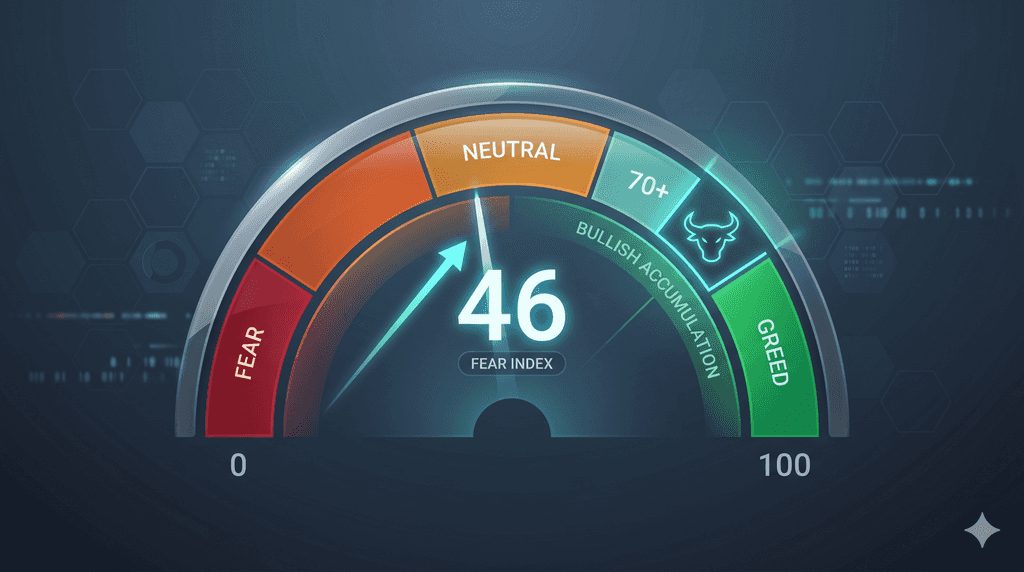
Fear Index Jumps to 46: Is Market Sentiment Quietly Turning Bullish?
Thesis Statement
This article explores the mechanics behind the recent 14-point surge in the Fear and Greed Index, analyzing how a massive short squeeze, record institutional ETF inflows, and easing geopolitical tensions have combined to push market sentiment from Fear toward Neutral. By examining real-time data from April 2026, we provide a deep dive into whether this psychological shift represents a temporary relief bounce or the beginning of a sustained bullish trend for digital assets.
The 14-Point Leap That Caught Global Traders Off Guard
The digital asset market woke up to a startling shift this week as the Crypto Fear and Greed Index executed a 14-point vertical climb, moving from a reading of 32 deep in Fear territory to 46, hovering just below the neutral midline. This move represents the largest single-day sentiment improvement since early January 2026, signaling that the suffocating blanket of pessimism that defined Q1 is finally beginning to lift. Historically, the index acts as a contrarian indicator, and the recent bottoming near 11, a level of extreme fear seen just 30 days ago, seems to have provided the psychological floor necessary for this violent rebound.
Traders who were positioned for a breakdown below $60,000 are now finding themselves on the wrong side of a rapidly changing narrative as the market absorbs selling pressure with surprising resilience. According to recent data from a real-time sentiment tracker, this transition to 46 suggests that trading activity is stabilizing and coin prices are entering a phase of lower volatility compared to the chaotic liquidations seen earlier this month. The jump is not merely a statistical anomaly but a reflection of a fundamental change in how participants perceive risk in the current environment. While a reading of 46 is not yet Greed, it indicates that the blood in the streets phase has transitioned into a wait-and-see period, where buyers are no longer afraid to provide a bid.
Why the $541 Million Short Squeeze Forced a Psychology Reset
Sentiment shifts in crypto are rarely polite; they are usually forced by the brutal mechanics of the futures market, and the move to 46 is no exception. Over a frantic 24-hour window, the market witnessed approximately $541 million in total liquidations, with a staggering $440 million of that total coming from short sellers who were betting on a continued decline. As Bitcoin pushed past the $75,000 resistance level, these bearish positions were forcibly closed, creating a buy-back loop that accelerated the price upward and shattered the prevailing bearish thesis. This event, as reported by Miles Harding on SmallworldFS, served as a massive positioning shock that cleared out crowded bearish bets.
For 46 consecutive days leading up to this event, perpetual futures funding rates had remained stubbornly negative, indicating that the majority of leveraged traders were betting against the market even as spot demand improved. When the squeeze finally triggered, it didn't just move the price; it broke the psychological back of the bear camp. This mechanical flushing of leverage is a prerequisite for any shift toward a bullish sentiment, as it removes the dead wood of speculative bets that often cap upside potential. The sudden absence of aggressive sellers has allowed the Fear and Greed Index to climb because the immediate threat of a cascade to zero has been replaced by a price floor supported by forced liquidations.
Giants Are Quietly Buying the Fearful Dips
While retail traders were paralyzed by Extreme Fear just weeks ago, institutional investors appear to have been using the 2026 drawdown as a massive accumulation zone. Data from CoinShares recently revealed a massive $1.1 billion inflow into digital asset investment products for the week of April 13, the strongest weekly performance in months. As highlighted by Business Insider's coverage of the MoneyFlare launch, nearly 95% of these inflows originated from the United States, suggesting that Wall Street's appetite for Bitcoin remains insatiable despite the rocky start to the year.
This institutional backstop is a primary reason why the sentiment index is recovering so quickly. Large-scale buyers operate on longer time horizons and are less susceptible to the daily noise that drives the Fear and Greed Index’s volatility components. The presence of these diamond hands in the spot market provides a cushion that prevents the index from staying in the Extreme Fear zone for too long. When BlackRock or Fidelity-backed products see billion-dollar inflows, it sends a signal to the broader market that the smart money views the current prices as a bargain. This divergence between retail panic and institutional conviction is a classic hallmark of a market bottom, and the jump to 46 suggests that retail sentiment is finally starting to play catch-up with the institutional reality.
Easing Geopolitical Tensions Provides a Much-Needed Risk-On Spark
Global macro events have acted as a heavy anchor on crypto sentiment throughout 2026, but a slight easing in international tensions has allowed risk assets to catch a breath. Earlier this week, signals that the Strait of Hormuz remained open despite ongoing US-Iran tensions led to a cooling in crude oil prices, which in turn lifted global risk sentiment. As Bitcoin Magazine reported, Bitcoin was able to retake the $76,500 level precisely as these geopolitical fears began to subside from their peak. The Fear and Greed Index incorporates market volatility as 25% of its total score, and the reduction in macro-panic has directly led to lower realized volatility for Bitcoin.
When the world feels slightly more stable, investors are more willing to move further out on the risk curve, shifting capital from defensive assets like gold back into high-beta plays like crypto. This risk-on rotation is visible in the way the index has moved away from the 30s. The relationship between energy prices and crypto is particularly tight in 2026, as mining costs and inflation expectations are heavily influenced by oil. By removing the immediate threat of a major supply chain disruption in the Middle East, the market has removed one of the primary drivers of Extreme Fear, allowing the natural demand for digital scarcity to reassert itself in the pricing models.
Analyzing the 9-Day Ethereum Inflow Streak as a Leading Indicator
Bitcoin isn't the only asset driving the sentiment recovery; Ethereum is showing signs of a major institutional pivot that is bolstering the entire ecosystem. For the first time in 2026, Ethereum ETFs have recorded nine consecutive days of net inflows, with daily figures hitting $43.3 million on April 21. According to analysis on Investing.com, this streak is far more significant than a single-day spike because it demonstrates a sustained growth in conviction among institutional allocators. BlackRock’s ETHA fund alone attracted $37 million in a single session, signaling that the flight to quality is expanding beyond just Bitcoin.
When the second-largest cryptocurrency begins to show signs of life, it often leads to a broader "altcoin season" sentiment, which is a major component of the Greed side of the index. The Fear and Greed Index tracks market momentum and social media volume, both of which have been trending upward as Ethereum holders move from a state of capitulation to one of cautious optimism. This consistent inflow into ETH products suggests that the market is beginning to price in future network upgrades, such as the Glamsterdam release mentioned in recent developer roadmaps. As the utility narrative gains steam alongside the store of value narrative, the overall sentiment score has a much higher floor than it did during previous cycles.
The Case Study of the $71,200 Realized Price Support Level
To understand why sentiment turned at 46, we must look at the Realized Price for the 2025-2026 investor cohort, which currently sits at approximately $71,200. Throughout the recent dip into Extreme Fear, Bitcoin spent significant time underwater relative to this metric, which often triggers a final wave of capitulation followed by a sharp recovery. The psychological $70,000 level became a battleground where the 200-day moving average (sitting at $68,450) provided the structural support necessary for a bounce. This case study in on-chain support explains why the Fear and Greed Index didn't collapse to zero. Buyers recognized that Bitcoin was trading below its fair value relative to the cost basis of recent participants.
When the price successfully held these levels and reclaimed $75,000, it proved that the market was not in a structural breakdown but rather a healthy mid-cycle correction. This technical confirmation is what allowed the sentiment score to jump 14 points in a day. Traders who were waiting for a confirmation of the bottom finally got their signal when the $71,200 level was defended and then left in the rearview mirror. This defense of the realized price has transformed the market’s collective anxiety into a renewed sense of stability, which is exactly what a reading of 46 represents.
Social Media Volume and the Decline of Bitcoin is Dead Narratives
A significant portion of the Fear and Greed Index is derived from social media sentiment analysis, which tracks the frequency and tone of crypto-related discussions on platforms like X (formerly Twitter) and Reddit. In the last 30 days, the Bitcoin is dead or The top is in narratives have seen a sharp decline in engagement, replaced by discussions of consolidation and accumulation. According to some index methodology, social media activity accounts for roughly 15% of the total sentiment score. As the price climbed back toward $77,000, the volume of bearish posts plummeted, while the engagement on bullish technical analysis surged.
This shift in the social zeitgeist is often a leading indicator for retail participation. When the Fear was at 11, the social media landscape was a ghost town or a place of intense mourning. Now, at 46, the hope factor is returning. This doesn't mean the market is euphoric, far from it, but the noise is becoming more balanced. The jump to 46 reflects a normalization of the conversation. Instead of panicking over every $500 move, the community is now focused on the $8.2 billion in Bitcoin options set to expire this week, indicating a move back toward rational market analysis rather than purely emotional reactions to red candles.
Bitcoin Dominance at 56.8% Suggests a Flight to Safety Within Crypto
Interestingly, while overall sentiment is improving, Bitcoin dominance remains high at 56.8%, up over 2% in the last fortnight. This suggests that the move to a sentiment of 46 is being driven primarily by a flight to safety within the digital asset space. Investors are moving back into the market, but they are doing so cautiously, favoring the proven liquidity of Bitcoin over the high-risk potential of smaller altcoins. This dominance creep is a classic risk-off rotation that actually helps stabilize the Fear and Greed Index. When money flows into the index leader, it reduces overall market volatility and provides a more stable foundation for the rest of the market.
A reading of 46 with high Bitcoin dominance is generally healthier than a reading of 46 driven by a meme coin frenzy, as it indicates that the recovery is built on solid institutional-grade assets rather than speculative bubbles. This internal market structure gives the current sentiment jump more credibility. It suggests that the participants pushing the index higher are looking for long-term stability rather than a quick pump and dump exit. As long as Bitcoin maintains its market share, the path toward a Greedy reading of 60+ will likely be a slow, sustainable climb rather than a volatile spike.
Why Prediction Markets Are More Skeptical Than the Fear Index
Despite the 14-point jump in the sentiment index, prediction markets like Polymarket remain surprisingly cautious about a rapid Bitcoin rally to new all-time highs. Currently, the odds of Bitcoin hitting $88,000 by the end of April sit at a lowly 1.1%, despite the price trading comfortably above $76,000. This sentiment gap is a fascinating insight into the current market state. While the Fear and Greed Index has moved to 46 (Neutral), the smart money in prediction markets is not yet betting on a moonshot. As Crypto Briefing reported, this discrepancy suggests that the recent move is being viewed by professional traders as a relief bounce rather than the start of a sustained parabolic run.
This skepticism is actually a bullish sign in itself; markets often climb a wall of worry. If everyone were already bullish, there would be no one left to buy. The fact that prediction markets are under-pricing a major breakout while the Fear and Greed Index is recovering suggests that there is still significant sideline capital waiting for even more confirmation. The jump to 46 has removed the immediate fear of a crash, but it has not yet sparked the Fear of Missing Out (FOMO) that drives the index into the 70s and 80s.
The 200-Week Moving Average and the Never Broken Support Line
Technical analysts often look at the 200-week moving average as the ultimate "line in the sand" for Bitcoin’s long-term health. In the recent April 2026 correction, Bitcoin never closed a week below this level, which currently sits around the $65,000-$70,000 range. This historical precedent, that Bitcoin has never finished a full market cycle below this average, has been a major contributor to the sentiment recovery. The relationship between these long-term averages suggests that the 2026 price action is a correction within a bull market rather than a structural breakdown into a multi-year winter. When the Fear and Greed Index was at 11, many feared this historical support would finally break.
The fact that it held has provided a massive psychological boost to the market. The jump to 46 is essentially the market exhaling a sigh of relief that the worst-case scenario did not manifest. For many veteran investors, the 200-week moving average is the North Star of sentiment; as long as the price stays above it, the underlying mood remains one of long-term accumulation. The current reading of 46 reflects a market that has rediscovered its footing and is now looking toward the next technical resistances at $79,000 and $82,000.
Bitcoin Options Expiry and the $75,000 Pivot Zone
A critical factor for the coming week is the expiration of roughly $7.9 billion in Bitcoin options, with a heavy concentration of open interest around the $75,000 strike price. In the options world, these max pain levels often act as magnets for the price as market makers hedge their positions. The jump in the Fear and Greed Index to 46 coincides perfectly with Bitcoin’s successful defense of this $75,000 pivot. This level is serving as a neutrality floor. If the price stays above this zone through the options expiry, it will likely provide the final bit of confidence needed to push the Fear and Greed Index into the 50s (official Neutral territory).
Options traders are currently pricing in a period of contained volatility, which matches the definition of a Neutral sentiment reading. The index is essentially catching up to the reality that the gamma squeeze potential to the downside has been significantly mitigated by the recent spot buying. This stabilization around the $75,000 strike indicates that the market has found its temporary equilibrium, moving away from the "panic selling" of early April and toward a more calculated, professionalized trading environment that characterizes the 2026 market.
Is 46 the Launchpad for a Bullish Q3 2026?
As we look toward the second half of 2026, many top-tier analysts are viewing the current sentiment recovery as the precursor to a massive Q4 breakout. Standard Chartered, JPMorgan, and Bernstein all maintain year-end targets ranging from $100,000 to $170,000, citing the convergence of several macro catalysts. Factors such as the potential expansion of the ISM Manufacturing PMI, new leadership at the Federal Reserve, and the possible passage of the CLARITY Act are all expected to hit the market simultaneously in late 2026.
The jump to 46 is just the first step in this journey. It represents the healing phase of the market cycle where the extreme emotions are purged to make room for a more fundamental-driven rally. If history repeats, this period of neutrality is often the quiet before the storm. The 2026 slow bull phase is designed to override the traditional four-year cycle, turning Bitcoin into a macro asset more comparable to gold. By moving the sentiment index out of the Fear zone, the market has cleared the psychological path for these future catalysts to have their full impact. A neutral reading of 46 is not the end of the story; it is the beginning of the next chapter in the most resilient financial asset of the 21st century.
Frequently Asked Questions
What does a reading of 46 on the Crypto Fear and Greed Index actually mean for a regular investor?
A reading of 46 indicates that the market is in a Neutral state, though it technically leans slightly toward the fearful side of the midline. For a regular investor, this means that the extreme panic and irrational selling seen when the index was at 11 or 20 has largely subsided. It suggests that the market is currently in a state of equilibrium where buyers and sellers are more evenly matched, and the extreme price swings caused by pure emotion are less likely to occur in the immediate short term.
How can the index jump so significantly in just one day without the price of Bitcoin doubling?
The Fear and Greed Index is a composite score that includes much more than just the current price of an asset. It factors in market volatility, trading volume, social media sentiment, Bitcoin’s dominance over other coins, and search engine trends. A 14-point jump can happen if several of these factors improve simultaneously.
Is it a good time to buy when the index is at 46 or should I wait for Greed?
Historically, the best time to buy has been when the index is in Extreme Fear (below 20), as this often marks a market bottom. A reading of 46 is considered neutral territory, which means you have missed the absolute bottom but are also not buying into a bubble or overheated market (which happens when the index is above 75).
Why do liquidations have such a huge impact on the sentiment index?
Liquidations are a measure of forced activity in the market. When $440 million in short positions are liquidated, it means hundreds of traders were forced to buy back Bitcoin at higher prices against their will. This creates a price floor and proves that the bearish momentum has been broken. The Fear and Greed Index views this as a reduction in downside risk. When bears are liquidated, the fear of a further crash diminishes because the people betting on that crash have been removed from the equation.
What role does institutional money play in moving the index from Fear to Neutral?
Institutional investors, such as those buying through spot ETFs like BlackRock's IBIT, tend to be non-emotional buyers. They operate on long-term schedules and buy based on value rather than fear. When these institutions pour billions into the market during a dip, they provide "liquidity" that stops the price from falling further. This steady buying pressure eventually shows up in the Volume and Dominance components of the Fear and Greed Index.
Should I expect the index to keep climbing into Greed immediately?
Not necessarily. The move from Fear to Neutral (46) is a sign of recovery, but the market often consolidates in the neutral zone for several weeks before making a push into "Greed." Factors like upcoming options expiries, geopolitical news, or economic data from the Federal Reserve can cause the index to bounce around the 40-50 range for a while.
What should investors look for?
Investors should look for the index to stay above 40 as a sign that the new "floor" is holding. A sustained climb into the 60s and 70s usually requires a major new bullish catalyst, such as a large corporate Bitcoin purchase or a favorable change in interest rate policy.
Disclaimer : This content is for informational purposes only and does not constitute investment advice. Cryptocurrency investments carry risk. Please do your own research (DYOR).