

DeSci, AI, or Meme: Where Crypto Capital Flows in Mid-2026
Thesis Statement
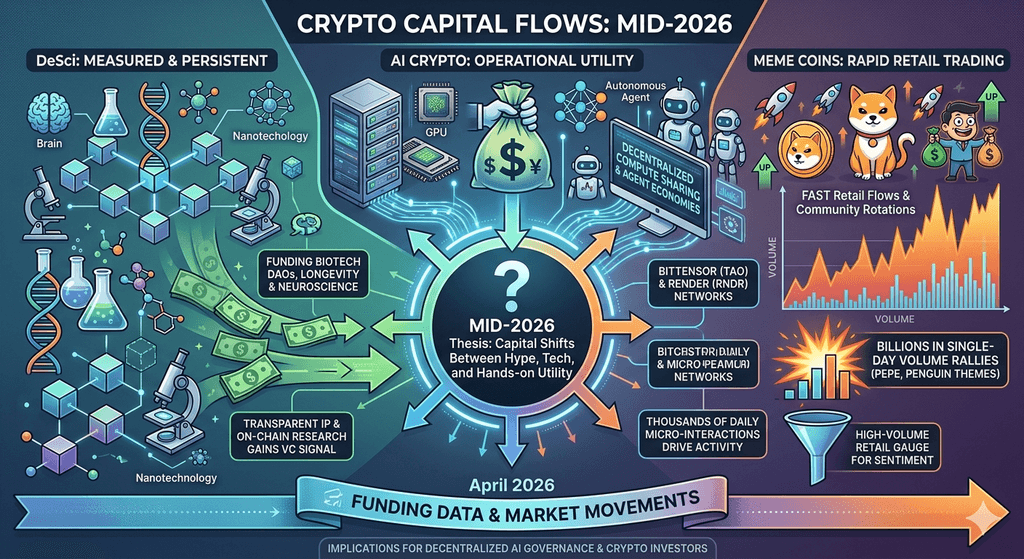
Capital in crypto shifts between hype cycles, technical infrastructure, and hands-on utility. In mid-April 2026, DeSci initiatives draw focused venture money, and community raises aimed at scientific progress, AI-related tokens benefit from ongoing demand for compute power and autonomous systems with notable network growth, and meme coins generate rapid retail trading bursts amid volatile price action. Recent numbers point to measured interest in areas with verifiable activity in science and intelligence, while viral tokens continue to pull short-term liquidity.
How DeSci Funding Quietly Builds Momentum This Spring
NanoVita completed a Series A funding round in early April 2026 with a post-money valuation of $20 million. Investors included K24 Ventures, LandScape Capital, and WestLabs. The protocol combines nanotechnology, AI-driven biological intelligence, and on-chain health data so individuals can take part in personalized research while retaining control over their information. Participants upload data or findings, communities vote on proposals through governance mechanisms, and successful efforts create shared intellectual property that can deliver returns.
Across the space, around 50 active DeSci efforts cover funding DAOs, open publishing platforms, and tools for managing intellectual property, with cumulative historical raises surpassing $60 million and consistent activity carrying into 2026. VitaDAO has directed more than $4 million into longevity-focused studies via community decisions and keeps reserves available for upcoming initiatives.
HairDAO supports independent lab work on hair loss, and AthenaDAO directs resources toward women’s health topics. Bio Protocol saw its token rise sharply as traders tracked growing interest in DAO-style biotech funding. Recent price surges in BIO reached 31.5% to 90% in short periods amid broader DeSci attention. Bio Protocol also secured $6.9 million in earlier funding backed by Maelstrom Fund to develop AI-native tools for on-chain fundraising and autonomous BioAgents.
These developments show capital entering setups that address delays in research funding and improve transparency in how discoveries move forward. Transparent proposal tracking turns abstract science into visible processes that hold participant attention over time. As April 2026 progresses, ongoing token activity and proposal submissions reflect building confidence that blockchain structures can channel resources directly toward promising experiments.
Inside VitaDAO’s Real Research Wins and Community Backing
VitaDAO maintains its position through historical raises totaling around $4.6 million, including participation from Pfizer Ventures. The DAO channels funds into longevity research through university partnerships and independent lab efforts focused on aging processes. Token holders submit and vote on funding proposals, then monitor outcomes via on-chain records. Funded work includes studies on cellular senescence with results released for open community input. Contributors earn governance rights and exposure to any intellectual property that emerges.
Regular progress updates keep engagement steady even during market fluctuations. By early 2026, VitaDAO held liquid assets positioned for new rounds, sustaining activity across cycles. The associated token trades at a modest market cap near $13 million, tied more closely to utility than broad speculation. Parallel efforts appear in AxonDAO, which applies transaction fees toward neuroscience projects on brain interfaces and related conditions. Holders connect token participation directly to funded experiments, fostering commitment that lasts beyond price movements.
These models create feedback loops where research milestones strengthen project credibility and attract further resources. In April 2026, proposal volumes and voting rates remain steady, indicating dedicated groups maintain funding streams during quieter phases. Researchers share data dashboards and outcome summaries that transform technical work into accessible updates. Such transparency helps communities stay involved for extended periods while capital supports incremental scientific steps.
AI Crypto Projects Capture Huge Compute and Agent Interest
Bittensor (TAO) leads decentralized AI discussions with a market cap ranging from roughly $2.3 billion to $3.5 billion in early April 2026. The network operates subnets dedicated to model training, validation, and related tasks, distributing rewards to those who supply compute or intelligence. Subnet capacity has expanded significantly, reaching higher numbers with features like serverless AI using trusted execution environments. Render Network provides decentralized GPU resources for rendering workloads and AI training, recording volume increases linked to compute needs.
NEAR Protocol advanced collaborations that enhance privacy-focused AI tools. The Artificial Superintelligence Alliance emphasizes autonomous agents capable of handling coordination, trading, or supply tasks directly on-chain. Virtuals Protocol, built on Base, enables users to create and tokenize AI agents that operate independently and generate revenue through transactions. These projects align with global AI investment trends, where related companies attracted substantial sums in recent quarters.
Crypto layers emphasize open participation and incentive structures that reward contribution. Developers integrate subnets for specific intelligence services, creating measurable activity that supports network value. Grayscale explored potential TAO-related filings, reflecting institutional curiosity around infrastructure plays. In mid-April 2026, trading volumes and subnet metrics point to continued focus on protocols delivering functional intelligence services through live usage rather than conceptual designs. Capital targets areas with expanding capacity for compute sharing and agent execution.
Fresh AI Agent Economies Drive On-Chain Activity
Autonomous AI agents now manage tasks ranging from data coordination to automated processes across blockchains, forming new activity loops. Solana has hosted notable agent-related payment volumes in prior windows, with expectations for agent-driven interactions scaling over time. Protocols such as Fetch.ai support agents that execute logistics or DeFi steps with reduced manual oversight. Users deploy customized agents that adapt to preferences and perform actions, occasionally generating fees returned to the ecosystem. Render and comparable DePIN networks supply distributed GPU capacity for training, converting available hardware into participant earnings.
Hardware demand reports from major chip producers underscore sustained interest in AI resources, positioning crypto alternatives as accessible distribution channels. In April 2026, subnet growth and agent integration updates maintain activity levels directed at protocols showing real transaction counts and capacity utilization. Builders experiment with agents that review literature or optimize simple workflows, accelerating certain research steps.
Interoperability features allow agents to function across chains, broadening possible applications. Capital supports teams delivering operational tools that produce on-chain revenue through usage or resource sharing. These networks illustrate how AI crypto evolves toward systems where incentives align with delivered services. Daily metrics reflect thousands of micro-interactions that reward contributors and sustain token dynamics.
Meme Coins Deliver Fast Retail Volume Spikes
Meme coins continue to spark rapid capital movements through community coordination and cultural narratives. In early 2026, the category experienced periods of billions in added market value during concentrated rallies. Tokens such as PEPE recorded notable percentage gains, with daily volumes reaching multi-billion-dollar figures at peaks. Solana launch platforms like Pump.fun facilitate thousands of new token creations when interest rises. One penguin-themed launch generated among the highest single-day volumes early in the year, driving related trading above $180 million in sessions.
Retail participants engage for social interaction and fast position opportunities, often prompted by group discussions or shared content. Established names like Dogecoin and Shiba Inu hold large market caps in the tens of billions, serving as gateways during optimistic phases. Trading volumes in the meme sector frequently exceed those in other categories during active windows, providing liquidity that rotates based on sentiment.
Platforms earn fees from creation activity regardless of individual token outcomes. In April 2026, fresh launches and periodic volume records demonstrate the format’s ongoing role in channeling speculative capital seeking immediate engagement. Community efforts sometimes include coordinated promotions or side initiatives that add layers of participation beyond price action. These flows create attention that occasionally extends to adjacent experimental projects.
Retail Sentiment Fuels Meme Rotations Across Chains
Meme activity moves swiftly between Solana, Base, and additional fast networks as participants seek emerging stories. Tools that simplify multi-chain launches compress timelines, allowing capital to test concepts rapidly. On-chain observers track early accumulation signals that can precede broader moves. Volumes expand when the overall market mood improves, reactivating sidelined traders. Platforms report consistent fee generation from high creation rates.
In 2026, increased focus on distribution practices appears as lessons from previous periods influence behavior. Meme strength often serves as an early gauge of broader risk willingness, with activity sometimes preceding flows into other segments. Groups form around shared creative efforts, jokes, and temporary goals that generate intense but short-lived involvement. April 2026 observations capture intermittent volume highs connected to specific themes, sustaining sector energy despite contractions from earlier highs in total market capitalization. The space supplies liquidity and visibility that builders sometimes leverage for hybrid experiments combining cultural appeal with basic functions.
DeSci Meets AI in Emerging Biotech Protocols
NanoVita integrates DeSci elements with AI for analyzing health metrics and guiding research directions. The setup creates on-chain systems where users contribute secure biometric information, and models identify patterns to inform potential studies. Communities vote on funding priorities using incentive structures. Early involvement highlights quicker cycles enabled by transparent yet protected data handling. Bio Protocol tokenizes aspects of scientific intellectual property, allowing DAOs to oversee and share rewards from discoveries.
Recent BIO token movements reflected heightened sector visibility. Capital enters these combinations seeking both knowledge advancement and economic frameworks that compensate active roles. As April 2026 continues, proposal activity and token volumes are tied to narrative developments around biotech intersections. AI components assist in processing public datasets or literature summaries, supporting faster hypothesis exploration within community settings. These projects position capital toward dual-purpose infrastructure that links research output with sustainable participation models.
VC Signals in the DeSci Space
Institutional allocations to DeSci remain targeted, with examples including the Sei Foundation’s $65 million Sapien Capital vehicle directed at builders in the longevity, neurotech, and related fields on its network. Such funds emphasize tools for data collaboration, IP handling, and joint research efforts. Interest centers on solutions that improve experiment reproducibility and accelerate practical application of findings.
Deal activity stays measured, focusing on infrastructure that supports modular BioDAO launches. In April 2026, updates indicate ongoing quiet engagement rather than high-profile announcements, pointing to deliberate evaluation of long-horizon potential. Founders release lab-related summaries or milestone trackers that connect capital to visible progress. These approaches appeal to resources allocated with patience for measurable scientific steps over rapid cycles. Overall flows in the niche stay smaller relative to other areas but demonstrate persistence that contributes to sector foundation.
Compute Demand Links AI Crypto to Hardware Trends
AI crypto protocols gain from distributed approaches to GPU workloads as networks like Render and Bittensor allocate resources for training and rendering. Node operators earn through contribution or staking when demand rises. Broader hardware reports highlight continued AI-related spending, creating opportunities for decentralized capacity. Developers build applications that access shared compute for efficiency compared to traditional providers.
Projects optimize tasks such as scientific image processing while controlling costs. In mid-2026, expansions in subnets and agent features sustain focus on protocols with active usage indicators. These layers capture portions of technology expansion value by enabling wider access to necessary resources without centralized dependencies. Capital is directed toward capacity growth that matches real compute requirements.
Volatility Patterns Define Meme Capital Cycles
Meme coins see concentrated inflows followed by adjustments as sentiment and news drive rotations. Early 2026 featured quick advances that later moderated, underscoring liquidity considerations. Volume peaks still occur during breakout phases, confirming appeal for fast-action participation. Groups shift themes promptly, maintaining fluid capital movement. Analysts track indicators for renewed activity when conditions align.
These cycles function as visible measures of retail involvement in the larger market environment. In April 2026, periodic surges tied to narratives keep the category dynamic within its risk profile.
Agent Interoperability Expands AI Crypto Reach
Updates in protocols allow AI agents to coordinate across chains, raising transaction counts and practical applications. Features for cross-chain operations enable agents to manage tasks such as resource payments autonomously. Teams test agents for data handling or workflow support in research contexts.
Capital backs operational integrations that demonstrate live functionality. These steps position AI crypto for expanded roles beyond initial concepts. In 2026, interoperability improvements correlate with usage metrics that attract further development resources.
Sentiment Shifts Signal Broader Capital Rotations
Participants observe meme activity as one indicator of risk sentiment before shifts toward infrastructure areas. DeSci and AI segments record steadier engagement when utility data advances. April 2026 combines targeted project funding with variable retail volumes, creating a mixed flow landscape across categories.
Traders balance short-term opportunities with holdings in areas showing consistent progress. Capital allocation reflects an ongoing search for equilibrium between engagement and functional delivery in DeSci, AI, and meme spaces.
FAQs
-
How does DeSci funding work compared with standard research grants?
DeSci platforms enable communities to vote on proposals using tokens and direct resources quickly to selected work, with on-chain records providing visibility into spending and outcomes that many traditional processes do not match in speed or transparency.
-
What sets Bittensor apart in the current AI crypto landscape?
Bittensor operates subnets where participants earn rewards for contributing intelligence or compute resources, focusing on marketplace dynamics for machine learning tasks that generate measurable network activity and capacity growth.
-
Why do meme coins maintain strong trading interest in 2026?
Meme coins provide accessible social participation and rapid liquidity events that attract retail traders during favorable sentiment windows, supported by easy launch tools and community-driven promotion across fast networks.
-
Do DeSci projects deliver concrete research outputs?
Initiatives have supported lab experiments and studies in longevity, neuroscience, and health areas through DAO voting, with public data sharing and progress tracking that allow participants to follow results directly.
-
How do AI agents add value inside crypto networks?
AI agents automate coordination, data tasks, or transactions across chains, producing fees or efficiencies that contribute to ecosystem activity and support incentive structures for contributors.
-
What factors matter when considering positions across DeSci, AI, and meme categories?
Review current usage metrics, participation levels, recent volume or funding updates, and alignment with personal time horizons to evaluate how each area fits within a broader approach to market conditions.
Disclaimer
This content is for informational purposes only and does not constitute investment advice. Cryptocurrency investments carry risk. Please do your own research (DYOR).