

Circle Stock Outlook 2026: Why Morgan Stanley Sees $38 While TD Cowen Targets $82
2026/08/06 15:29:00
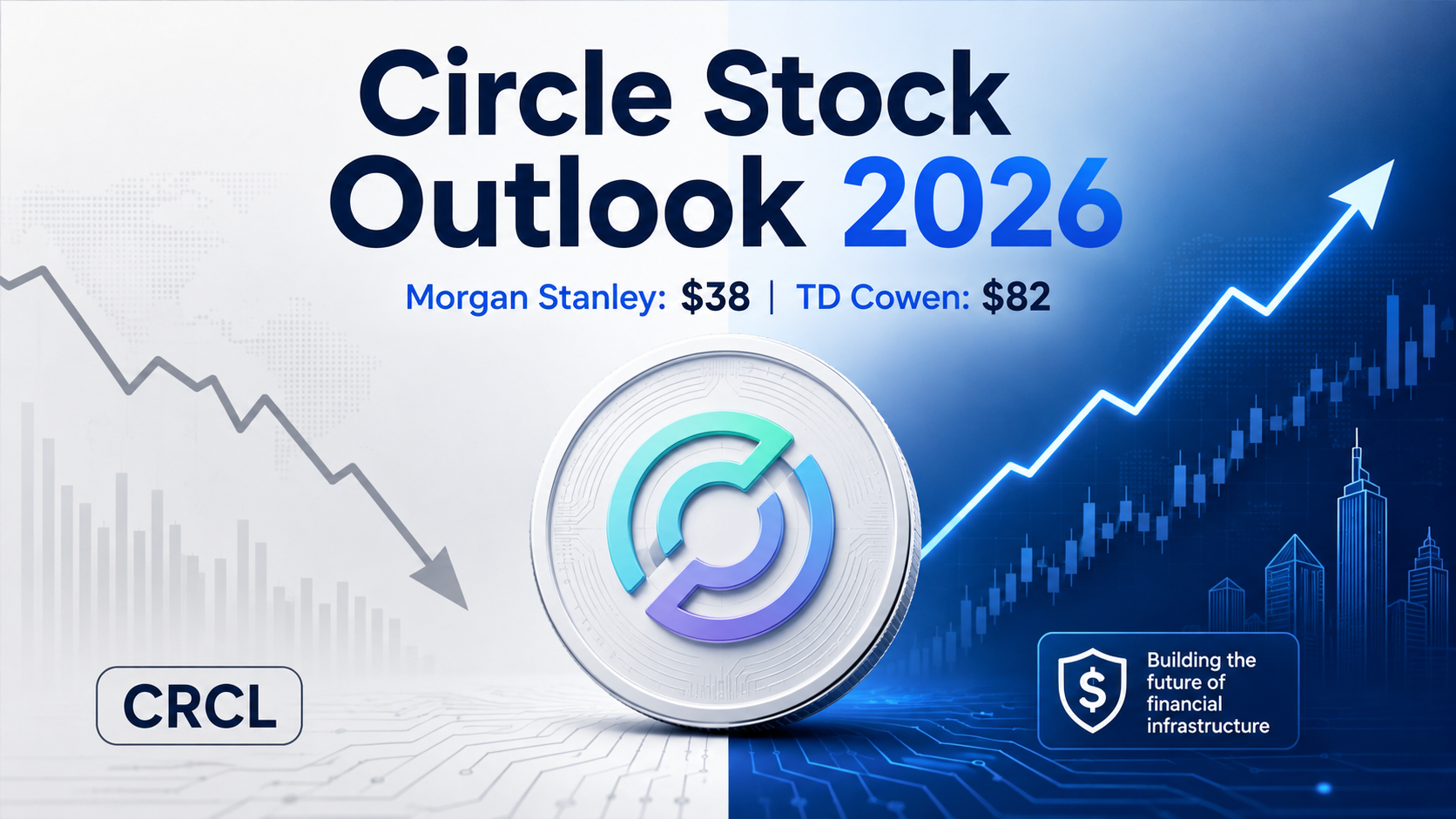
Circle Internet Group has become one of the most closely watched publicly traded companies connected to dollar-backed stablecoins, but Wall Street remains sharply divided over the CRCL stock outlook for 2026. Morgan Stanley’s $38 price target reflects concerns about slower USDC growth, declining reserve yields and pressure from distribution costs, while TD Cowen’s $82 target assumes Circle can expand beyond reserve income into payments, developer services and blockchain infrastructure. The difference between these forecasts highlights the central question facing investors: whether Circle will remain primarily an interest-sensitive stablecoin issuer or develop into a broader global financial-technology platform. This article examines the competing analyst views, the role of USDC circulation and Federal Reserve policy, and the key catalysts that could shape the Circle stock forecast during 2026.
Why Morgan Stanley Targets Circle Stock at $38 While TD Cowen Sees $82
The unusually wide gap between Morgan Stanley’s and TD Cowen’s Circle stock forecasts shows how divided Wall Street remains over the company’s future. Morgan Stanley has assigned CRCL a bearish $38 price target, while TD Cowen believes the shares could reach $82. These are 12-month analyst estimates rather than guaranteed prices, and the disagreement largely comes down to whether Circle should be valued mainly as an interest-sensitive USDC issuer or as an emerging global payments and blockchain-infrastructure platform.
Morgan Stanley’s $38 CRCL Price Target Reflects Slower USDC Growth Concerns
Morgan Stanley downgraded Circle Internet Group from Equal Weight to Underweight and cut its CRCL price target sharply from $106 to $38. The firm’s cautious outlook centres on the possibility that USDC circulation may expand more slowly than Circle expects. Morgan Stanley reportedly lowered its USDC supply forecasts by approximately 33% for 2027 and 44% for 2028, challenging Circle’s longer-term expectation of roughly 40% average annual circulation growth across market cycles. The bank also questioned whether headline stablecoin transaction volumes accurately represent lasting commercial demand, noting that much activity still comes from crypto trading, transfers between platforms and other blockchain-native uses rather than everyday payments.
The concern is understandable because reserve income remains Circle’s main financial engine. According to Circle’s Q1 2026 results, the company generated $653 million in reserve income out of $694 million in total revenue and reserve income. Reserve income increased 17% year over year as average USDC circulation grew 39%, but the reserve return rate declined by 66 basis points. Circle also incurred approximately $407 million in distribution, transaction and other costs, showing that a substantial part of the revenue connected to USDC must be shared with distribution partners or used to support the network. Morgan Stanley’s $38 bear case becomes more plausible if USDC growth slows, interest rates decline and competition forces Circle to spend more to attract or retain circulating balances.
Why TD Cowen Values Circle Stock at $82
TD Cowen sees a different version of Circle’s future. Analyst Bryan Bergin initiated coverage with a Buy rating and an $82 Circle stock price target, arguing that the market may be placing too much emphasis on reserve income while overlooking Circle’s expansion into payments, developer services and cross-chain financial infrastructure. From this perspective, USDC is not simply a stablecoin that produces interest income. It is also the settlement asset supporting a wider ecosystem of payment products, institutional services and blockchain applications. TD Cowen therefore views CRCL as a way to gain exposure to the institutional adoption of stablecoins and the gradual modernisation of global financial infrastructure.
Circle’s latest available operating figures offer some support for that bullish argument. Other revenue reached $42 million in Q1 2026, doubling from the previous year as subscription, services and transaction revenue expanded. Circle Payments Network recorded $8.3 billion in annualised transaction volume based on activity during the 30 days ending March 31, while the company continued developing Arc, cross-chain transfer technology and services that allow financial institutions to introduce stablecoin payments without directly managing digital assets. More recent developments include final approval to establish Circle National Trust Bank, expanded USDC services with Standard Chartered and BNY, and the acquisition of an IBM blockchain patent portfolio. These initiatives do not guarantee profitable growth, but they strengthen the argument that Circle is building a broader financial platform rather than relying entirely on interest earned from reserves.
What the $38–$82 Analyst Split Means for the Circle Stock Outlook
The $44 difference between the two CRCL targets ultimately reflects two competing assumptions about Circle’s business model. Morgan Stanley’s valuation is more convincing if Circle remains heavily dependent on reserve income, USDC circulation loses momentum and tokenised money-market funds, bank-issued digital deposits or rival stablecoins capture a larger share of demand. TD Cowen’s $82 target becomes more realistic if USDC continues expanding while payments, developer tools, cross-chain transfers and other platform services begin generating meaningful recurring revenue. The debate is therefore not simply about whether stablecoins will grow; it is about how much of that growth Circle can monetise after distribution costs and competitive pressures are considered.
Circle’s Q2 2026 earnings report on August 5 at 8 a.m. ET is the next major test for both analyst forecasts. Investors will be watching quarter-end and average USDC circulation, reserve yields, distribution costs, other revenue and updated guidance. Progress at Circle Payments Network and Arc could also indicate whether the company is moving towards TD Cowen’s diversified infrastructure thesis. Until those results are released, the latest complete financial baseline remains Circle’s Q1 report. The new figures may not settle the Circle stock outlook immediately, but they should provide clearer evidence about whether the company is moving closer to Morgan Stanley’s cautious scenario or TD Cowen’s more optimistic view.
How USDC Growth, Reserve Income and Interest Rates Could Shape CRCL Stock in 2026
Circle’s 2026 stock performance may depend less on short-term crypto market excitement and more on three connected variables: how much USDC remains in circulation, what return Circle earns on the assets backing it, and how much reserve income the company retains after distribution costs. Investors following the CRCL stock outlook should consider these factors together because strong growth in one area may offset weakness in another.
USDC Circulation Is the Core Volume Driver for Circle’s Revenue
USDC circulation determines the size of the reserve pool from which Circle can earn interest, making both average and quarter-end supply important indicators for CRCL investors. Circle ended March 2026 with approximately $77.05 billion of USDC in circulation, while its official European disclosure recorded an outstanding supply of $73 billion on July 6. Stablecoin supply can move quickly as institutions, exchanges and blockchain users mint or redeem tokens, so a decline between two dates does not automatically establish a lasting negative trend. However, sustained circulation below the first-quarter level could limit reserve-income growth unless higher yields or stronger fee revenue compensate for the smaller reserve base. Renewed demand for USDC as a digital dollar, whether for payments, settlements, trading liquidity or international transfers, would give Circle a larger pool of assets capable of generating earnings and could strengthen confidence in the Circle stock forecast for 2026.
Reserve Yield Matters, but Gross Income Does Not Tell the Whole Story
Circle’s reserve income is generated mainly from cash and highly liquid securities held to back USDC, including assets in the Circle Reserve Fund. The basic relationship is straightforward: more USDC creates a larger reserve balance, while higher short-term yields increase the return earned on that balance. What ultimately matters for shareholders, however, is how much income remains after Circle pays distribution and transaction costs. Circle reported a 3.5% reserve return rate in Q1 2026, alongside $287 million in revenue after distribution costs and a 41% margin on that measure. Rising reserve income may look impressive at the top line while producing a smaller benefit for shareholders if partner payments and network incentives increase at a similar pace. Investors may therefore place greater weight on retained revenue and margins than on reserve income alone.
Federal Reserve Policy Could Create Both Risks and Offsetting Effects for CRCL
The Federal Reserve’s July decision kept the federal-funds target range at 3.5% to 3.75%, leaving short-term rates at levels that remain supportive of Circle’s reserve yield for now. Circle’s own sensitivity model estimated that a 100-basis-point rate decline, assuming USDC supply and other conditions remained unchanged, could reduce annual reserve income by about $773 million while also lowering distribution and transaction costs by approximately $384 million. The model shows why future rate cuts could pressure CRCL earnings, but the real outcome may be less mechanical: lower rates could also reduce the opportunity cost of holding non-yielding USDC, encourage risk activity and support demand for stablecoin payments or blockchain liquidity. For the Circle stock outlook in 2026, the most favourable scenario may not simply be higher rates; it may be a combination of resilient USDC circulation, manageable distribution costs and enough reserve yield to protect earnings as monetary policy evolves.
Circle Stock Forecast 2026: CRCL Bull Case, Bear Case and Key Catalysts
The Circle stock outlook for 2026 remains finely balanced because CRCL is exposed to both the expanding stablecoin economy and the financial risks that come with an interest-sensitive business model. A stronger outlook would require Circle to demonstrate that USDC can maintain healthy circulation across different market conditions while newer products generate revenue beyond reserve earnings. The bearish scenario would gain weight if stablecoin competition intensifies, distribution expenses absorb a larger share of income or commercial adoption develops more slowly than expected. This makes Circle different from a conventional cryptocurrency investment: CRCL investors must assess stablecoin demand, Federal Reserve policy, operating margins and Circle’s ability to turn its payments infrastructure into a scalable business.
What Could Move CRCL Stock Next in 2026?
Circle’s official Q2 2026 earnings announcement confirms that the results will be released on August 5, followed by a webcast at 8 a.m. ET. Investors should look beyond headline revenue and examine average USDC circulation, revenue retained after distribution costs, non-reserve income and management’s updated growth expectations. Commercial progress across Circle Payments Network, cross-chain services and Arc could support the view that Circle is becoming a diversified financial-infrastructure platform, while weak monetisation would reinforce concerns that its valuation remains too dependent on reserve yields. For now, the CRCL stock forecast is best viewed as a range of possible outcomes rather than a single price prediction: stronger USDC adoption and improving fee-based revenue could support a recovery, but weaker circulation, margin pressure or slower product adoption could keep Circle stock volatile throughout 2026.
Conclusion: What the Circle Stock Outlook Means for CRCL Investors
The wide gap between Morgan Stanley’s $38 target and TD Cowen’s $82 forecast reflects genuine uncertainty about how Circle should be valued in 2026. The company has a recognised stablecoin brand, growing institutional relationships and exposure to rising demand for blockchain-based payments, but its earnings remain closely connected to USDC circulation, short-term interest rates and costly distribution arrangements. Circle will need to show that growth in payments, subscriptions, cross-chain services and infrastructure can eventually reduce this dependence without weakening margins.
For investors researching whether Circle stock is a buy in 2026, the most useful approach is to follow operating evidence rather than rely on a single analyst target. Average USDC circulation, revenue after distribution costs, non-reserve revenue and adoption of Circle Payments Network and Arc will provide a clearer picture of the company’s progress. CRCL could benefit if Circle turns USDC into the foundation of a broader financial network, but slower circulation growth, declining yields or weak product monetisation could keep the shares under pressure. The Circle stock forecast therefore remains highly sensitive to execution, regulatory developments and changing monetary conditions.
|
KuCoin is celebrating its 9th anniversary with a special platform campaign filled with exclusive rewards, trading activities, and limited-time offers. Don’t miss the chance to participate and enjoy the benefits as the exchange marks nine years of growth and innovation. Visit the official campaign page now:
|

Frequently Asked Questions
Is CRCL stock the same as investing in USDC?
No. Buying CRCL stock gives investors an ownership interest in Circle Internet Group, while USDC is a dollar-backed stablecoin designed to maintain a value close to $1. CRCL can rise or fall with Circle’s revenue, expenses, valuation and investor expectations, whereas USDC is intended for payments, settlement and digital-dollar transfers rather than capital appreciation. Holding CRCL also does not provide ownership of the assets held in USDC reserve accounts.
Does higher USDC circulation automatically increase Circle’s profit?
Not necessarily. Higher average USDC circulation gives Circle a larger reserve base from which it can earn interest, but profit also depends on the reserve return rate, operating expenses and payments made to distribution partners. Circle’s filings explain that reserve income is primarily influenced by USDC circulation and reserve yields, while distribution costs can also rise as reserve income and partner-held balances increase. Investors should therefore examine revenue after distribution costs, not USDC supply alone.
Why Is Average USDC Circulation More Useful Than a Single-Day Balance?
A quarter-end USDC figure only shows how much was outstanding on one date, while average circulation provides a better indication of the reserve assets available to generate income throughout the reporting period. A late-quarter increase can make the closing balance appear strong even when circulation was lower for much of the quarter. For this reason, investors assessing Circle earnings should compare average supply, quarter-end supply and the most recent balance published by Circle.
What Is Circle’s Revenue Less Distribution Costs?
Revenue less distribution costs shows what remains after subtracting distribution, transaction and related costs from Circle’s total revenue and reserve income. It can offer a clearer view of the economics retained by Circle because part of the income generated from USDC reserves is paid to partners that help distribute and support the stablecoin. A company can report strong top-line growth while producing a more modest improvement in retained revenue if partner payments rise at a similar rate.
How Does Circle’s Relationship With Distribution Partners Affect CRCL?
Distribution partners help make USDC available across trading platforms, wallets and financial applications, but these relationships can be expensive. Circle’s filings state that distribution and transaction costs are affected by reserve income and by where USDC is held, including balances connected to major partners. If Circle must share a larger portion of reserve economics to protect USDC adoption, its circulation may grow without delivering an equal increase in earnings for CRCL shareholders.
Can USDC Transaction Volume Measure Real-World Adoption?
Transaction volume is useful, but it should not be treated as a direct measure of consumer or business payments. The same USDC can move between wallets, exchanges and decentralized finance applications multiple times, creating substantial transfer volume without representing new economic demand. Analysts may therefore separate payment activity from trading, remittances, liquidity movements and transfers within the wider crypto market.
Disclaimer: This article is for informational purposes only and does not constitute investment advice. Market forecasts, company plans and technology adoption may change, so readers should conduct their own research before making financial decisions.