

BitMEX to Shutdown in September 2026: What Happens to Its $270M Insurance Fund?
Introduction
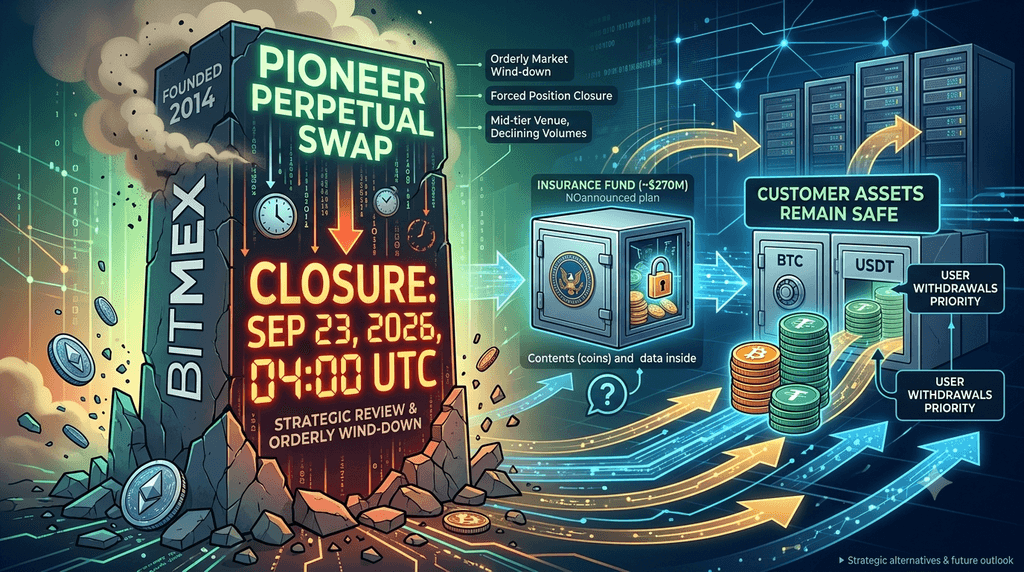
BitMEX, the pioneering crypto derivatives exchange that introduced the 100x leverage perpetual swap, will permanently shut down operations on September 23, 2026, at 04:00 UTC. The decision by owner HDR Global Trading Limited follows a strategic review of the business and the broader crypto industry. Users must close positions and withdraw funds promptly, as remaining balances face monthly fees after the deadline. The exchange holds substantial customer assets and an insurance fund valued near $270 million—comprising roughly 3,694 BTC and over $30 million in USDT—yet has offered no public details on the fund’s fate after closure.
This development marks the end of an 11-year run for a platform that once dominated leveraged crypto trading. According to BitMEX’s official announcement and recent Proof of Reserves data, customer assets remain safe and under user control, with the platform ranking as a mid-tier derivatives venue amid declining volumes. The unanswered question around the insurance fund has drawn significant attention from traders and analysts.
Why Is BitMEX Shutting Down in September 2026?
BitMEX is closing because its parent company completed a strategic review that concluded the exchange should wind down operations amid changing market conditions and industry dynamics. The official statement from HDR Global Trading Limited, published on July 23, 2026, cites this review without detailing further operational failures or insolvency.
The platform once led the market it helped create. Founded in 2014 by Arthur Hayes, Ben Delo, and Samuel Reed, BitMEX popularized the perpetual swap with high leverage. At its peak, it processed massive daily volumes. Market share later eroded as larger competitors captured liquidity. Recent data shows daily trading volumes frequently stayed below $1 million in 2026, with overall rankings placing it far from the top derivatives venues.
Legal history also factored into the trajectory. Founders previously pleaded guilty to Bank Secrecy Act and anti-money laundering violations, resulting in substantial fines for both individuals and the company. A later presidential pardon occurred, yet residual regulatory overhang and reduced competitiveness made a clean sale difficult, according to industry observers following the firm.
The orderly nature of the wind-down distinguishes this event from abrupt failures seen elsewhere in crypto. BitMEX emphasizes zero funds lost to hacks over more than 11 years and maintains that reserves exceed liabilities.
What Happens to User Funds and Positions During the BitMEX Closure?
User funds remain fully accessible for withdrawal, and open positions will be managed toward an orderly wind-down before the final closure. BitMEX has already halted new account registrations. From August 26, 2026, at 04:00 UTC, risk limits prevent new position openings, allowing only reductions. Any remaining open positions face forced closure by or at the September 23 deadline.
After the Closure Time, the platform continues to support withdrawals and account access for balance and transaction history viewing. KYC-verified users who leave assets on the platform incur a monthly account fee of USD 50 equivalent or 1% per annum (whichever is greater). The fee applies to remaining balances and may increase with advance notice. All previously staked BMEX tokens have been unstaked and returned to user accounts for withdrawal.
BitMEX stresses that assets stay safe, with Proof of Reserves showing reserves exceeding liabilities. As of late July 2026 data, the exchange held over $739 million in customer assets at the time of the announcement. Users should act early because network confirmation times, particularly for Bitcoin, can extend during high-volume periods. The exchange also warns against phishing attempts that exploit the news by promising priority or accelerated withdrawals—no such services exist.
Early settlement applies to contracts with limited liquidity, with standard notice provided. The process prioritizes an orderly market wind-down rather than abrupt liquidation of all activity.
What Is the BitMEX Insurance Fund and How Large Is It Now?
The BitMEX insurance fund is a reserve pool designed to cover losses from liquidations that cannot be fully settled at or above the bankruptcy price, thereby reducing the need for auto-deleveraging of profitable traders. It accumulates primarily from residual margin after successful liquidations and certain trading-related profits.
As of recent Proof of Reserves data updated in late July 2026, the fund holds approximately 3,694.6 BTC and about 30.84 million USDT. At prevailing Bitcoin prices near $64,000 in late July 2026, this equates to roughly $270 million in total value. Earlier figures cited around the announcement aligned with $239 million in BTC and $31 million in USDT.
The fund previously reached much higher levels. On-chain and historical records show a peak near 37,795 BTC in October 2021. In November 2025, BitMEX announced a rebalancing to approximately 3,600 BTC and just over 30 million USDT. The company stated the adjustment better matched then-current market risks while still providing substantially higher coverage relative to open interest than many peers—reportedly around 0.88x versus significantly lower ratios at larger platforms.
The fund has demonstrated resilience. During major market events, including significant liquidation waves, drawdowns remained limited relative to the overall size. BitMEX has described the mechanism as proven over more than a decade of operations.
How Does the BitMEX Closure Affect the Broader Crypto Derivatives Market?
The BitMEX shutdown has limited direct market impact because of the exchange’s reduced market share in recent years. Larger platforms already dominate perpetual futures and leveraged trading volumes. Perpetual swaps, the product BitMEX pioneered, remain the industry standard and continue to trade heavily elsewhere.
The event highlights ongoing consolidation in crypto derivatives. Smaller or specialized venues face pressure from liquidity concentration, regulatory requirements, and competition from both centralized giants and growing on-chain perpetual platforms. Declining volumes at mid-tier exchanges have become more common amid broader market conditions in 2026.
Traders shifting activity can find deep liquidity and similar high-leverage products on established alternatives. The orderly wind-down, combined with transparent reserves reporting, provides a contrast to past disorderly exits and may reinforce preferences for platforms with clear proof-of-reserves practices and robust insurance mechanisms.
Security history also stands out. BitMEX reported zero customer funds lost to hacks across its full operating period, a record that supported user confidence even as volumes declined.
Should You Trade Crypto Derivatives on KuCoin?
KuCoin offers a comprehensive suite of crypto derivatives products, including perpetual futures with competitive leverage options, deep liquidity across major pairs, and robust risk management tools. Users seeking alternatives after the BitMEX wind-down can explore high-volume markets, flexible margin modes, and ongoing product innovation on the platform.
Regulatory compliance has become a defining factor for the long-term viability of crypto exchanges. KuCoin holds multiple licenses and registrations across key jurisdictions, including a MiCA authorization as a Crypto-Asset Service Provider through the Austrian Financial Market Authority, enabling regulated services across the European Economic Area. Additional approvals and registrations cover other regions, such as VASP status with India’s FIU-IND, AUSTRAC registration in Australia, and a Thai SEC license for regulated operations in Thailand. These credentials position KuCoin as a platform that prioritizes adherence to evolving global standards.
The future of crypto exchanges increasingly depends on strong compliance frameworks. Platforms that secure and maintain licenses in major markets reduce operational risks for users and demonstrate commitment to asset protection, AML/CFT controls, and transparent practices. KuCoin’s multi-region licensing advantage supports this direction, offering traders a more regulated environment compared with venues facing wind-downs or limited oversight.
Registration is straightforward, and the exchange supports a wide range of trading pairs alongside spot markets, staking, and other services. Always conduct independent research, understand leverage risks, and only trade with capital you can afford to lose. KuCoin prioritizes security features and regular transparency measures to support user confidence in a competitive derivatives landscape.
Join KuCoin 9th Anniversary Trading Campaign
KuCoin is celebrating its 9th anniversary with a special platform campaign filled with exclusive rewards, trading activities, and limited-time offers. Don’t miss the chance to participate and enjoy the benefits as the exchange marks nine years of growth and innovation. Visit the official campaign page now:

Conclusion
BitMEX will cease exchange operations on September 23, 2026, at 04:00 UTC following a strategic review by its owner. Users must close positions and withdraw assets before the deadline to avoid monthly maintenance fees on remaining balances. Customer funds stay secure according to the exchange’s statements and Proof of Reserves data showing reserves above liabilities.
The insurance fund, currently valued near $270 million with approximately 3,694 BTC and over $30 million USDT, has no announced post-closure plan. The fund belongs to the exchange and was built primarily through liquidation residuals and operational accumulation. Its size once provided strong coverage relative to open interest, yet the lack of clarity on its future disposition remains the primary open question.
The platform leaves a lasting legacy as the originator of the widely adopted perpetual swap. Its orderly exit, security record, and transparent reserves process offer a measured conclusion to more than a decade of operations. Traders should prioritize timely withdrawals, remain alert to phishing risks, and evaluate established alternatives that continue to support leveraged crypto trading with strong liquidity and risk controls. The episode underscores the importance of platform resilience, clear asset ownership rules, and proactive user management during industry transitions.
FAQs
Will BitMEX users lose their funds after the September 2026 shutdown?
No. BitMEX states that user assets remain safe and under user control. Withdrawals continue after the Closure Time, though remaining balances for KYC users incur monthly fees.
Is the BitMEX insurance fund customer money?
No. The insurance fund is owned and controlled by the exchange. It accumulates mainly from residual margins after liquidations and related profits rather than direct customer deposits.
When do new positions stop on BitMEX?
From August 26, 2026, at 04:00 UTC, users can no longer open new positions and may only reduce existing ones. Remaining positions face forced closure by or at the September 23 deadline.