

House Committee Advances American Reserve Modernization Act (H.R. 8957) to Codify Trump’s Strategic Bitcoin Reserve
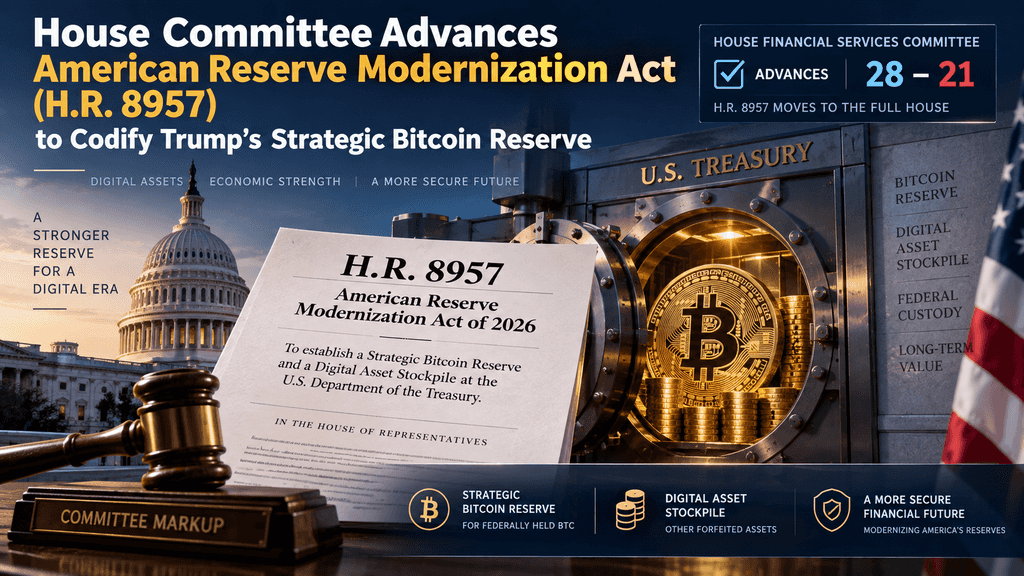
The American Reserve Modernization Act of 2026, or H.R. 8957, has moved forward in Congress as lawmakers consider putting the U.S. Strategic Bitcoin Reserve into federal law. The House Financial Services Committee advanced the legislation in a 28–21 vote on September 16, 2026, bringing new attention to how the United States could manage government-controlled Bitcoin over the long term. The proposal builds on the Strategic Bitcoin Reserve framework created through President Donald Trump’s 2025 executive order while adding statutory rules covering Bitcoin custody, reserve transparency, federal digital asset transfers and long-term holding requirements.
The legislation could have important implications for U.S. Bitcoin policy and government digital asset management, but it does not mean the federal government is preparing to immediately purchase large amounts of BTC. Instead, H.R. 8957 focuses primarily on formalizing the existing reserve, establishing a 20-year minimum holding period for reserve Bitcoin, introducing annual proof-of-reserve reporting and studying possible budget-neutral ways to acquire additional BTC. Understanding these provisions and what still needs to happen before the bill can become law is essential for following the next stage of the U.S. Strategic Bitcoin Reserve debate.
House Committee Advances H.R. 8957 in 28–21 Vote to Codify the Strategic Bitcoin Reserve
The U.S. House Financial Services Committee advanced H.R. 8957, the American Reserve Modernization Act of 2026, by a 28–21 vote on September 16, 2026, moving the proposal to codify the Strategic Bitcoin Reserve further through the legislative process. The committee ordered the bill, as amended, to be reported favorably after adopting an amendment in the nature of a substitute offered by Rep. Bryan Steil. The legislation focuses on establishing a statutory framework for the federal government's Bitcoin reserve and setting clearer rules for the custody, reporting and long-term management of government-controlled digital assets. The vote has drawn attention across the crypto market because H.R. 8957 could determine how the U.S. Strategic Bitcoin Reserve operates under federal law rather than relying primarily on the executive framework established in 2025. The official House committee record confirms both the vote and adoption of the substitute amendment.
H.R. 8957 Advances After 28–21 House Committee Vote
The 28–21 vote represents committee approval of H.R. 8957, not final passage by the full U.S. House of Representatives. According to the official House committee record, the Financial Services Committee voted to report the American Reserve Modernization Act favorably after considering the amended version of the bill. Rep. Bryan Steil's substitute amendment was also adopted by voice vote before the final recorded vote, making the amended text the version that now moves forward for further congressional consideration.
This distinction is important for readers following the Strategic Bitcoin Reserve bill because committee approval is only one stage of the federal legislative process. The proposal would still need additional action in Congress before it could become law. For investors and crypto-market observers tracking Bitcoin market data, the committee vote nevertheless represents a significant development because it moves the debate over federal Bitcoin reserves from an executive-policy framework toward potential legislation with specific rules governing how reserve assets could be held and managed.
American Reserve Modernization Act Could Put the Strategic Bitcoin Reserve Into Federal Law
The central purpose of the American Reserve Modernization Act is to place the U.S. Strategic Bitcoin Reserve on a clearer statutory foundation. President Donald Trump established the federal reserve framework through an executive order in March 2025, creating a Strategic Bitcoin Reserve for qualifying government-owned Bitcoin and a separate Digital Asset Stockpile for certain other digital assets. H.R. 8957 seeks to build on that framework by setting out requirements in legislation rather than leaving the reserve dependent mainly on executive action.
Codifying the reserve would create a more defined legal structure around areas such as Bitcoin custody, federal asset transfers, reserve transparency, reporting requirements and long-term asset management. That makes H.R. 8957 broader than a simple statement that the government should hold Bitcoin. The legislation is designed to establish rules for how qualifying federal digital assets are identified, transferred and maintained, giving lawmakers a larger role in shaping how a U.S. Bitcoin reserve operates over time.
What H.R. 8957 Means for US Bitcoin Policy and Government BTC Holdings
The committee's decision also puts renewed focus on U.S. government Bitcoin holdings and federal digital asset policy. If H.R. 8957 eventually becomes law, the reserve would operate under detailed statutory requirements covering how eligible government-controlled Bitcoin is handled and how Treasury reports reserve assets. The legislation therefore connects several high-interest issues in the crypto sector, including government Bitcoin custody, proof-of-reserve transparency, digital asset regulation and the question of whether the United States could acquire additional BTC in the future.
The amended bill includes provisions that go well beyond the September committee vote itself, including a 20-year minimum holding period for reserve Bitcoin, annual proof-of-reserve reporting and a study of budget-neutral methods for potentially acquiring additional Bitcoin. These provisions are likely to remain central to the debate as H.R. 8957 moves through Congress because they could determine how restrictive, transparent and long-term the Strategic Bitcoin Reserve becomes. The next stages of the legislative process will therefore be closely watched by policymakers, Bitcoin investors and the broader digital asset industry.
What the American Reserve Modernization Act Means for the US Strategic Bitcoin Reserve
The American Reserve Modernization Act would create a more detailed legal framework for the U.S. Strategic Bitcoin Reserve, defining how qualifying government-controlled Bitcoin is transferred, held, reported and managed over the long term. H.R. 8957 also keeps Bitcoin separate from other federally controlled digital assets through a distinct Digital Asset Stockpile, giving the Treasury Department a central role in administering both structures. The amended H.R. 8957 text therefore goes beyond simply recognizing Bitcoin as a reserve asset by setting rules for custody, transparency, federal asset transfers and long-term reserve management.
Treasury Would Establish the Strategic Bitcoin Reserve Within 180 Days
If H.R. 8957 becomes law, the U.S. Treasury would have 180 days to establish the Strategic Bitcoin Reserve and the separate Digital Asset Stockpile, while federal agencies would be required to provide an accounting of qualifying Bitcoin and other digital assets within 60 days of enactment and continue reporting those holdings annually. Eligible BTC controlled by federal agencies would then be transferred into the Strategic Bitcoin Reserve, while qualifying non-Bitcoin digital assets would be directed to the Digital Asset Stockpile. This framework is designed to create a more centralized system for federal digital asset holdings and provide clearer information about which assets the government controls, where they are held and how they are managed.
Bitcoin in the Reserve Would Face a 20-Year Holding Requirement
One of the most significant provisions in the American Reserve Modernization Act is a 20-year minimum holding period for Bitcoin placed in the reserve. During that period, reserve BTC generally could not be sold, swapped, auctioned, encumbered or otherwise disposed of, reinforcing the idea that the Strategic Bitcoin Reserve would function as a long-term sovereign asset rather than a short-term source of government liquidity. After the holding period expires, the Treasury could make recommendations to Congress on whether Bitcoin should continue to be retained or released under a more controlled framework, including recommendations involving limited sales of up to 10% during a two-year period.
Annual Bitcoin Proof of Reserves Would Improve Transparency
The amended H.R. 8957 would require annual proof-of-reserve reporting supported by an independent third-party auditor, providing a clearer way to verify the Bitcoin held within the Strategic Bitcoin Reserve. This is an important change from the original version of the bill, which called for quarterly reporting. A formal audit and reporting structure could reduce reliance on outside blockchain-tracking estimates and give Congress and the public a more authoritative view of federal Bitcoin holdings, helping distinguish confirmed reserve assets from broader estimates of government-linked BTC wallets.
States Could Hold Bitcoin in Segregated Federal Reserve Accounts
H.R. 8957 would also allow U.S. states to place Bitcoin in segregated accounts within the federal reserve framework while retaining legal ownership of their assets. The provision would be voluntary and could give states that already hold, or later choose to acquire, Bitcoin access to federal custody infrastructure without transferring title to the federal government. This creates a potential bridge between federal and state-level Bitcoin reserve policies and could become increasingly relevant if more states explore strategic Bitcoin reserves, digital asset treasuries or similar public-sector initiatives.
Does H.R. 8957 Require the US Government to Buy More Bitcoin?
No. H.R. 8957 does not require the U.S. government to immediately buy Bitcoin on the open market or establish a fixed BTC purchase target. Instead, the American Reserve Modernization Act directs the Treasury and Commerce departments to study lawful, budget-neutral ways the federal government could potentially acquire additional Bitcoin. The study would have to examine the costs, risks and possible benefits of different acquisition methods while staying within existing fiscal constraints. This is an important distinction because the bill focuses primarily on establishing and managing the U.S. Strategic Bitcoin Reserve, rather than launching a government-funded Bitcoin accumulation program.
How the US Could Acquire Additional Bitcoin Under H.R. 8957
The amended bill gives Treasury and Commerce 180 days to evaluate budget-neutral Bitcoin acquisition strategies, including possible transactions involving non-Bitcoin assets in the Digital Asset Stockpile, Bitcoin obtained through forfeitures or settlements, and cooperative arrangements permitted under federal law. The legislation also makes clear that this study does not itself authorize new federal borrowing, additional taxes, deficit spending or the use of federal assets as collateral to purchase Bitcoin. That separates H.R. 8957 from earlier proposals built around specific Bitcoin accumulation targets and means any future expansion of the Strategic Bitcoin Reserve would depend on additional legal authority, available government-held assets or other budget-neutral mechanisms.
20-Year Bitcoin Hold, Annual Audits and What Happens Next for H.R. 8957
The amended H.R. 8957 sets out some of the clearest long-term rules yet proposed for the U.S. Strategic Bitcoin Reserve, particularly around how long federal Bitcoin should be held, how reserve balances should be verified and what legislative steps still remain. These provisions are important because they help define whether the reserve would operate as a long-term sovereign asset framework or simply as another category of government-controlled digital assets.
H.R. 8957 Sets a 20-Year Minimum Bitcoin Holding Period
Under the American Reserve Modernization Act, Bitcoin placed in the Strategic Bitcoin Reserve would generally be subject to a 20-year minimum holding period. During that time, reserve BTC could not normally be sold, swapped, auctioned, encumbered or otherwise disposed of. The provision is designed to limit short-term liquidation of federal Bitcoin holdings and give the reserve a long-term structure rather than allowing the government to treat BTC as an asset that can be routinely sold in response to changing fiscal or market conditions.
Once the 20-year period is approaching its end, the bill provides a process for reviewing what should happen next. Treasury could make recommendations to Congress on whether the government should continue holding the Bitcoin or allow limited releases, including recommendations involving sales of up to 10% during a two-year period. This makes the holding rule one of the most consequential parts of H.R. 8957 because it could shape how the United States manages reserve Bitcoin for decades if the legislation becomes law.
Annual Bitcoin Audits and Proof-of-Reserve Reporting
H.R. 8957 would also introduce annual proof-of-reserve reporting backed by an independent third-party auditor, creating a formal transparency mechanism for the Strategic Bitcoin Reserve. The reporting requirement is intended to provide Congress and the public with clearer information about how much Bitcoin is held, how reserve assets are custodied and whether reported balances can be independently verified. This could reduce reliance on external blockchain analytics estimates, which can identify government-linked wallets but do not provide the same certainty as an official audited reserve statement.
The annual reporting provision is also notable because it differs from the earlier version of the bill, which proposed quarterly disclosures. The amended framework moves to annual reporting while retaining independent verification, potentially balancing transparency with the operational demands of managing a federal reserve. For SEO and public-interest searches, this creates an important distinction between government Bitcoin holdings, audited Strategic Bitcoin Reserve balances and third-party wallet estimates.
What Happens Next for the Strategic Bitcoin Reserve Bill
The September committee vote moved H.R. 8957 forward, but the American Reserve Modernization Act has not yet become federal law. The legislation would still need to advance through the remaining stages of the congressional process, including consideration by the full House and Senate, before it could be presented to the president. Additional amendments could also change parts of the bill as lawmakers continue debating federal Bitcoin policy, custody rules, reporting standards and potential acquisition mechanisms. The official House committee record lists the September 16 action as an order to report H.R. 8957, as amended, favorably.
The next major developments to watch include whether H.R. 8957 receives a full House vote, whether a companion or related measure advances in the Senate and whether lawmakers make further changes to the 20-year Bitcoin holding requirement, annual audits or budget-neutral acquisition provisions. Until those steps are completed, the Strategic Bitcoin Reserve continues to operate under the existing executive framework, while H.R. 8957 remains the legislative effort aimed at giving that framework a more permanent statutory structure.
🔥 Beyond the Headlines: What KuCoin 5.0 Means for You
Market news moves fast — but where you act on it matters just as much. This October, KuCoin launches KuCoin 5.0, transforming KuCoin into a rebuilt platform. Here's what actually changes for you:
-
One account for everything. Older platforms split your money across separate "spot," "margin," and "futures" accounts and expected you to understand why. KuCoin 5.0's unified account removes that entirely — deposit once, and everything is simply there.
-
Stocks, indices, and commodities. KuCoin 5.0 expands beyond crypto into global markets. When crypto chops sideways and equities rally (or the reverse), you rotate in minutes instead of opening a brokerage account and waiting days for fiat rails.
-
Real-world assets (RWA). Tokenized exposure to traditional assets like commodities, right inside your crypto account. One of the fastest-growing segments in global finance is no longer reserved for institutions — you access it from the same balance you trade with.
-
Earn while you learn. Not ready to trade? KCUSD lets your stablecoins earn daily, auto-compounding interest. The lowest-stress way to put your idle deposit to work for 4% yield.
-
An AI assistant in plain language. Ask questions, get market context, understand what you're looking at — built into the platform, no jargon required.
-
An app that doesn't overwhelm. Faster, cleaner, and consistent — intuitive from the first tap, not after a tutorial.
-
Safety you can check, not just trust. A MiCAR-licensed EU entity, Proof of Reserves you can verify yourself, and internationally certified security (SOC 2 Type II, ISO 27001:2022).
Create your account in minutes — and start on the platform built for where crypto is going, not where it's been.
Conclusion
The American Reserve Modernization Act could significantly reshape the legal framework surrounding the U.S. Strategic Bitcoin Reserve by turning key elements of the existing executive policy into federal statute. H.R. 8957 combines long-term Bitcoin holding requirements with annual reserve audits, centralized Treasury oversight and a process for examining budget-neutral ways to potentially increase government BTC holdings. At the same time, the legislation stops short of ordering large-scale Bitcoin purchases, making the distinction between reserve management and active government accumulation particularly important.
The September 16 committee vote moves the Strategic Bitcoin Reserve bill further into the congressional process, but H.R. 8957 still faces additional legislative steps before it could become law. Future House and Senate action, possible amendments and decisions about Bitcoin acquisition policy will determine the final shape of the proposal. For the crypto market and investors following Bitcoin market cycles, legislation remains an important test of how the United States may integrate Bitcoin into long-term federal asset management while balancing custody, transparency and fiscal constraints.
FAQs
Who introduced H.R. 8957, the American Reserve Modernization Act?
H.R. 8957, known as the American Reserve Modernization Act of 2026, was introduced by Rep. Nick Begich of Alaska. The House Financial Services Committee later considered the bill during its September 16, 2026 markup, where lawmakers adopted an amended substitute before advancing the legislation.
Is the Strategic Bitcoin Reserve different from the US Digital Asset Stockpile?
Yes. The Strategic Bitcoin Reserve is specifically for Bitcoin, while the U.S. Digital Asset Stockpile covers qualifying government-owned digital assets other than BTC. The distinction originated in President Trump’s March 6, 2025 executive order, which established separate federal structures for Bitcoin and other digital assets.
Would H.R. 8957 affect Bitcoin owned by private investors?
The legislation is focused on government-controlled Bitcoin and federal reserve management, not Bitcoin held by individual investors, companies or ordinary crypto users. Its provisions address federal custody, reporting and management of qualifying government digital assets rather than transferring privately owned BTC into the reserve. The amended text also states that the Act does not authorize the federal government to seize or impair lawfully acquired private Bitcoin or other digital asset holdings.
Where would the Bitcoin in the Strategic Bitcoin Reserve come from?
The existing executive-order framework initially capitalizes the reserve with qualifying Bitcoin already owned by the federal government, particularly BTC obtained through criminal or civil asset forfeiture proceedings. It also allows Treasury and Commerce to develop budget-neutral strategies for potentially acquiring additional Bitcoin, subject to applicable law.
Could seized Bitcoin always be transferred into the Strategic Bitcoin Reserve?
Not necessarily. Federal forfeiture laws can require digital assets or their proceeds to be used for other purposes, including returning assets to verified crime victims or satisfying statutory forfeiture requirements. The existing executive order and amended legislation preserve applicable legal obligations governing those assets.
Disclaimer: This article is for informational purposes only and does not constitute investment advice. Crypto assets can be highly volatile, and market conditions, token liquidity and project developments may change rapidly. Readers should conduct their own research and assess their risk tolerance before making financial decisions.