

How to Transfer Cryptocurrency Abroad from Russia Starting September 1, 2026: Rules, Limits, and Bank Controls
2026/08/24 11:13:00
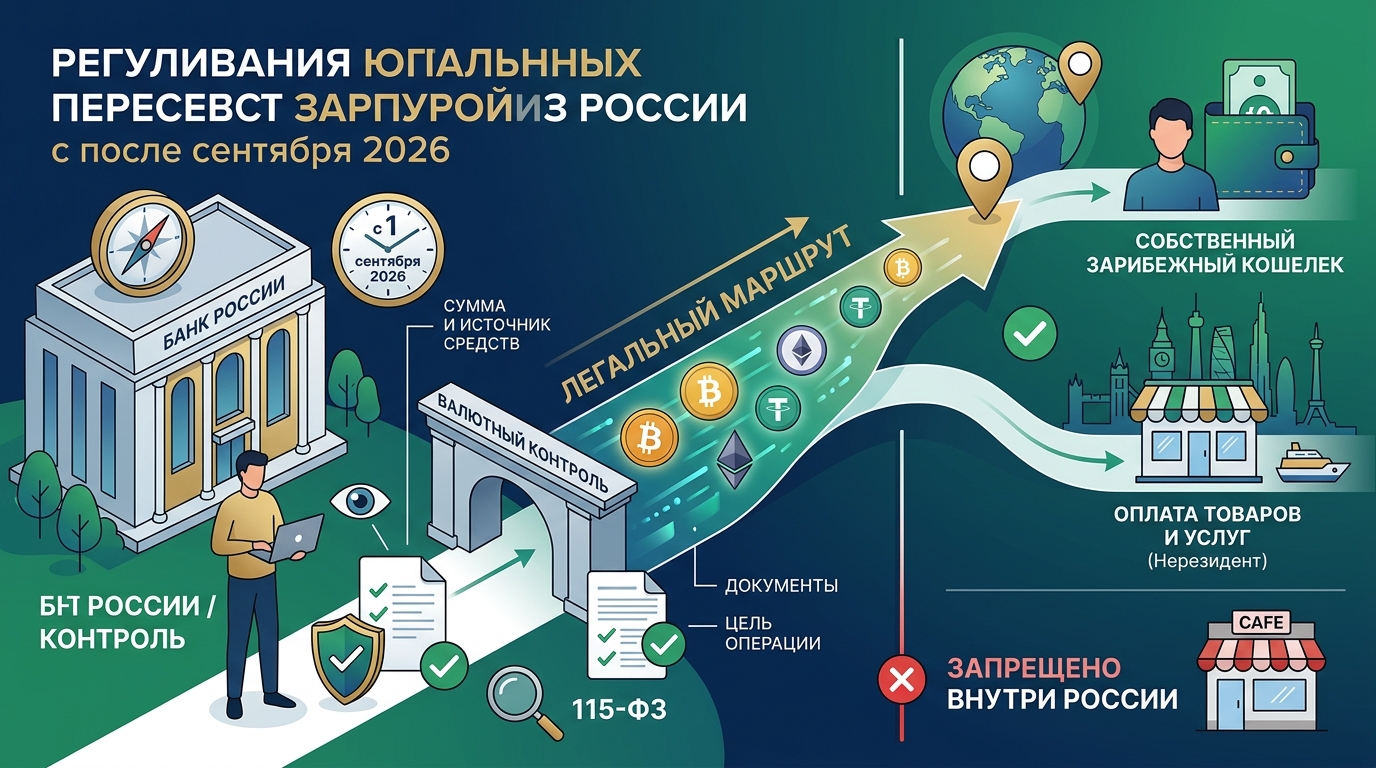
Starting September 1, 2026, Russians will be able to legally transfer cryptocurrency abroad — to their own foreign wallets or to non-residents as payment for goods and services. The core restriction remains fundamental: this regime applies to cross-border transactions and foreign economic activity, not to settlements within Russia. On August 22, the Bank of Russia stated directly that such transactions will be subject to currency-control and anti-money-laundering procedures.
The new framework does not make cryptocurrency a universal means of payment or remove bank checks. It creates a regulated route for buying, holding, and transferring permitted digital assets, where the purpose of the transaction, the source of funds, and supporting documents matter. The sections below explain who can use cryptocurrency abroad, which assets are available to different investors, when a bank may refuse a transaction, and how taxes should be considered.
What Exactly Is Permitted from September 1, 2026
From September 1, not every crypto payment will be permitted. The approved transactions are specific cross-border operations: transferring digital currencies and stablecoins to one’s own wallet abroad, sending them to a non-resident for goods and services, and settlements by participants in foreign trade activity under foreign trade contracts. The Bank of Russia outlined this framework in comments to RIA Novosti on August 22, 2026.
The practical meaning of the rule is straightforward. An individual may purchase a digital asset available to them through an appropriate regulated channel and send it to the address of a wallet opened or used outside Russia. They may also pay a foreign seller if that seller is a non-resident and the purchase of the good or service is cross-border in nature. Individual entrepreneurs and companies have a comparable option for settlements under foreign economic contracts.
However, permission does not mean that a transfer may be sent without explaining its purpose. For a currency transaction, residents and non-residents will submit supporting documents to authorized banks under a procedure to be established by a Bank of Russia regulation. The regulator said through RIA Novosti that the draft procedure has already passed regulatory impact assessment. Therefore, before completing a transaction, the user needs to understand not only the recipient address, but also the legal basis for the transfer.
Which Transactions Fall Within the New Framework
The new framework covers the foreign leg of a transaction. It includes transfers to one’s own foreign hardware or software wallet, provided the user can substantiate their connection to that wallet and follows the platform’s and bank’s procedures. It also includes payment to a foreign store when the recipient is a non-resident and the goods or services are purchased abroad.
For businesses, the key basis will be a foreign trade contract. Cryptocurrency or a stablecoin may be used for settlement under such a contract, but the digital transfer itself does not replace the contract, invoice, completion certificate, shipping document, or other record. The clearer the chain of “counterparty — contract — delivery — payment,” the easier it is for a bank to match the transaction to currency-control and Federal Law No. 115-FZ requirements.
It is important not to substitute a permitted transfer for an investment or consumer transaction within Russia. The law regulates the circulation of digital currencies; it does not create a separate domestic crypto market without intermediaries. Federal Law No. 282-FZ of August 4, 2026, establishes a general framework for the circulation of digital currencies and expressly defines a digital currency as property represented by a set of electronic data.
Can You Pay for Goods and Services in Russia with Cryptocurrency
No. Starting September 1, it will still be prohibited to pay for goods and services within Russia using cryptocurrency or stablecoins. On August 22, the Bank of Russia stressed that domestic crypto payments will be treated as illegal currency transactions.
This distinction is the central answer to a common misconception. The ability to send an asset to a foreign wallet does not create a right to pay a Russian café, marketplace, freelancer, landlord, or local service provider in BTC, ETH, USDT, or another digital currency. Within Russia, both the subject of payment and the recipient remain in the domestic sphere, so the cross-border exception does not apply.
According to the Bank of Russia’s comments to RIA Novosti, current regulation provides for a fine of up to 40% of the transaction amount for illegal currency transactions. Users therefore should not disguise a domestic payment as a transfer to a personal wallet, especially where the actual recipient is a Russian seller. The legal characterization depends on the substance of the transaction, not solely on what appears in the blockchain record.
Payment to a foreign non-resident for a foreign good or service is permitted because it is classified as foreign economic activity. This distinction between a foreign and a Russian recipient is what defines the scope of the new rules. Vedomosti, citing a market participant, likewise noted that domestic payments are not allowed, while payment for goods and services abroad is part of foreign economic activity.
Which Cryptocurrencies Are Available to Qualified and Non-Qualified Investors
Access to cryptocurrencies will depend on an investor’s status and the Bank of Russia’s criteria, not simply on a coin’s popularity. Non-qualified investors will be allowed to work only with assets that meet regulatory conditions; qualified investors will have a materially broader selection, but not complete freedom from future restrictions.
Bitcoin, Ethereum, and Tether USDT have been named in reports on the new framework for non-qualified investors. On August 23, Vedomosti stated that, at that time, these criteria were met by assets with the highest market capitalization and average daily trading volume of at least RUB 1 trillion. This is an important but not permanent guide: the Bank of Russia determines the list and the criteria, so users should check the current rules and list on the date of the transaction before purchasing an asset.
A qualified investor has access to a wider range of cryptocurrencies. At the same time, the Bank of Russia may separately restrict privacy coins, such as assets designed to conceal information about the sender, recipient, or transaction amount. The absence of a general restriction should not be treated as a guarantee that every token will be available. Eligibility depends on future regulations, the platform, investor status, and financial-monitoring requirements.
|
Category
|
What Is Available Under the Current Framework
|
What to Consider
|
|
Non-qualified investor
|
Only cryptocurrencies and stablecoins that meet Bank of Russia criteria; reports of August 23 named BTC, ETH, and USDT
|
The list should not be regarded as permanent; current criteria and intermediary conditions should be checked before a trade
|
|
Qualified investor
|
A broader range of digital assets
|
The Bank of Russia may restrict specific categories, including privacy coins; platform, currency-control, and AML/CFT requirements apply
|
According to an explanation cited by Vedomosti, the law also expressly prohibits exchanging cryptocurrency for securities.[4] Users should therefore not build a strategy on the assumption that every digital asset can be freely converted into shares, bonds, or other instruments through the same service. The new framework regulates the circulation of digital currencies; it does not override securities-market rules.
How Banks and the Bank of Russia Will Control Cryptocurrency Transfers Abroad
Banks will become a key compliance checkpoint, and cryptocurrency transactions will not be completely anonymous for participants using the regulated route. An authorized bank will compare the purpose of a transfer against the documentation and may reject a transaction that does not meet legal requirements. This was reported by Vedomosti on August 23, citing Cifra Markets Executive Director Alexey Korolenko.
The control framework rests on two familiar foundations for foreign economic activity: currency control and anti-money-laundering measures. The Bank of Russia stated that settlements under foreign trade contracts in digital currencies and stablecoins will be processed through standard currency-control mechanisms and anti-money-laundering procedures. This means that a blockchain address by itself does not explain either the economic purpose of a transaction or the origin of the funds.
For a payment to a foreign seller, it is sensible to prepare the order, invoice, contract, bill, or another document showing who the counterparty is, what is being purchased, and why the recipient is abroad. Business transactions will require a foreign trade contract and documents confirming the delivery of goods or services, such as an invoice, specification, transport document, completion certificate, or customs records — depending on the transaction. The exact set of materials is determined by the applicable bank rules and the Bank of Russia’s regulation.
Can a Bank Freeze a Transfer Without Cause
No. The new framework does not give a bank the right to arbitrarily freeze every crypto transaction. However, the bank must review the transaction under currency-control and Federal Law No. 115-FZ requirements. If documents are missing, the purpose does not match, or risk indicators are present, it may request explanations, suspend processing, or refuse to execute the transfer. For the user, the outcome may look like a restriction, but the legal reason should be tied to compliance rules, not an employee’s personal preference.
The best way to reduce the risk of refusal is to avoid artificially splitting a transfer, avoid stating a fictitious purpose, and avoid sending funds before the documentation is prepared. If the transaction pays for a foreign purchase, retain correspondence with the seller, the order, and proof of the seller’s non-resident status. If the transfer is sent to a personal wallet, be prepared to explain ownership of the address, the source of the cryptoasset, and the intended use.
How to Legally Transfer Cryptocurrency Abroad: A Step-by-Step Approach
A legal cross-border transfer begins with verifying investor status, asset availability, and the purpose of the transaction — not with finding the cheapest way to send funds. The user should choose a cryptocurrency they are permitted to use, confirm that the recipient is outside Russia, and collect documents before creating the transaction.
First, establish whether the intended transaction falls within the permitted categories. A personal foreign wallet and settlement with a foreign store fall within the framework identified by the Bank of Russia; a payment to a Russian seller does not. Next, determine whether the user is a qualified investor and verify whether the intended token is allowed for that category. A non-qualified investor should not assume that every large-cap asset is automatically available.
Next, coordinate the route with the platform and the authorized bank. In a regulated system, the bank reviews documents, so preparing a contract, invoice, or order confirmation in advance reduces the risk of delay. Users should verify the non-resident’s details, the transfer network, and the wallet address: a blockchain transaction usually cannot be reversed after confirmation, and a technical error does not make a transfer legally valid.
After the transaction is executed, retain records of the digital-asset purchase, exchange rate or ruble value, fee, recipient address, payment basis, and transfer result. These materials are useful not only if a bank asks questions. They also help support tax accounting and reconstruct the transaction history if information is requested by a financial institution or tax authority.
How Cryptocurrency Is Taxed and Why Transaction Transparency Will Increase
A digital currency is defined as property under the new law. As a result, buying, selling, and using it within a regulated framework require tax accounting, not merely a technical entry in a wallet. Recognition as property does not turn cryptocurrency into rubles or remove the obligation to track income: tax consequences depend on the type of transaction, the individual’s tax status, and the applicable tax regime.
For an individual, income received from the disposal or other realization of digital assets must be assessed under the applicable personal income tax rules. Practical guidance for residents commonly refers to a 13%–15% range depending on the tax base and tax conditions; a company accounts for the relevant result under corporate income tax. The precise tax base, deductible expenses, income date, supporting documents, and rate should be verified against the current Tax Code and with a qualified tax adviser, particularly where there is a complex sequence of exchanges.
The new banking route increases the visibility of transactions for compliance purposes. When a transfer passes through a regulated intermediary with documents and a purpose check, concealing its economic outcome becomes more difficult than in fully informal circulation. This does not mean that tax is automatically charged on every transaction: tax is determined under the rules for the specific transaction. However, the absence of records, acquisition history, or proof of expenses can make it more difficult for a taxpayer to defend their position.
In practical terms, it is useful to keep a separate register showing the purchase date, asset quantity, ruble value, fee, transfer date and purpose, documents for the foreign counterparty, and transaction result. This approach helps distinguish a technical transfer to a personal wallet, payment for a foreign purchase, and disposal of an asset, since their economic and tax treatment may differ.
Should You Use KuCoin for Cryptocurrency Transactions Abroad
KuCoin can be a tool for buying, holding, and transferring digital assets, but feature availability does not release a user from Russian rules. Before using the platform, users should verify whether the selected asset is appropriate for their investor status, whether the intended transaction is permitted as cross-border activity, and whether they can demonstrate its economic purpose to an authorized bank.
For transfers to a personal foreign wallet or payments to a non-resident, the decisive factor is not the name of the platform but adherence to the route: a correct recipient, a permitted purpose, proper documentation, and adequate recordkeeping. The service should not be used to pay within Russia, bypass currency controls, or disguise the recipient. Such actions fall outside the permission effective from September 1.
If a user understands the risks of volatility, fees, selecting the wrong network, and compliance checks, they may register with KuCoin, complete available verification procedures, and consider digital assets only within the limits of applicable law. For large, recurring, or commercial transactions, it is prudent to obtain professional legal and tax advice in advance.
KuCoin Offers A More Stable Option in A Volatile Market
If you worry about the frequent ups and downs in the market, and pursue a more stable option to earn money passively, KuCoin is the right place to come:
Simple Earn: Deposit and withdraw tokens anytime, earning stable returns.
Kucoin Earn: Earn stable profits with professional asset management.
Hold to Earn: Earn rewards by holding assets in Funding, Trading, Margin, Futures, Mining, and Unified Accounts.
Staking: Unlock the earning potential of on-chain assets.
Advanced Investments: Advanced Investments offer a variety of structured products to help your money grow in any market.
Shark Fin: Principal Protection and Guaranteed Gains
Dual Investment: Buy low and sell high with transparent return calculations.
Snowball: High yields, with price protection.
Discount Buy: Buy crypto at discount prices.
KCS Loyalty: Level up to enjoy exclusive perks by staking ≥ 1 KCS.
KuCoin Wealth: Discover future value and begin your smart investing journey.
KCS Benefits: Hold and stake KCS to access benefits across the platform.
KCS Staking 2.0: Participate in KCS on-chain governance to earn yield.

Conclusion
Starting September 1, 2026, transferring cryptocurrency abroad from Russia will be possible within a clearly limited legal framework. Individuals will be able to send digital assets to their own foreign wallets and to non-residents for foreign goods or services, while businesses will be able to use cryptocurrencies and stablecoins for settlements under foreign trade contracts. This is a significant expansion of lawful use cases, but it is not permission for unrestricted crypto payments.
The central rule remains unchanged: cryptocurrency cannot be used to pay for goods and services within Russia. For non-qualified investors, access is limited to assets that meet Bank of Russia criteria, and the list should be checked before a transaction. Banks will review documentation, the payment purpose, and compliance with currency-control and anti-money-laundering law, making a transparent transaction and a complete set of supporting documents more important than transfer speed. Users should coordinate document procedures with their servicing bank in advance because the requirements for a particular foreign economic transaction depend on its purpose and counterparty.
Because a digital currency is recognized as property, users also need tax accounting and a retained transaction history. The new framework is best understood not as the removal of control, but as a regulated route for lawful cross-border transfers.
FAQs
1. Can I withdraw cryptocurrency to a foreign exchange rather than a personal wallet
Yes, provided the transaction falls within the permitted cross-border framework and satisfies applicable rules, platform requirements, and authorized-bank procedures. However, the user should verify the recipient’s status, asset availability for their investor category, and the documents the bank will require in advance.
2. Do I need separate Bank of Russia permission for every transfer
The explanations published on August 22 do not mention an individual permit for every transaction. However, settlements must pass through currency-control and anti-money-laundering procedures, and supporting documents must be submitted to an authorized bank under the established procedure.
3. Can I send a stablecoin abroad to pay for a subscription to a foreign service
Yes. Payment to a foreign service may fit the permitted scenario if the recipient is a non-resident and the transaction genuinely relates to purchasing a foreign service. Retain the invoice, subscription terms, and payment confirmation to substantiate the economic purpose of the transfer.
4. What happens if I send an asset using the wrong network or to the wrong address
The new legal framework does not change the technical irreversibility of most blockchain transfers. Before confirming a transaction, verify the network, address, and supported asset; if an error occurs, contact the platform or recipient immediately, although recovery is not guaranteed.
5. Does the new law mean foreign crypto platforms are either completely prohibited or completely permitted
No. That is not an accurate framing. The law establishes Russian rules for the circulation of digital currencies and a permitted cross-border scenario, but access to a particular foreign platform also depends on its own terms, the user’s status, intermediary requirements, and compliance with Russian regulation.
Disclaimer : This material is provided for informational purposes only and does not constitute financial, investment, legal, or tax advice. Transactions involving cryptocurrencies and tokenized assets carry substantial risks — including price volatility, limited liquidity, counterparty exposure, and the potential for total loss of invested capital. Readers should conduct their own research and, where appropriate, consult a qualified professional before making any financial decisions.