

How Strategy Makes Money Without Selling Bitcoin: The Treasury Model Explained
Introduction
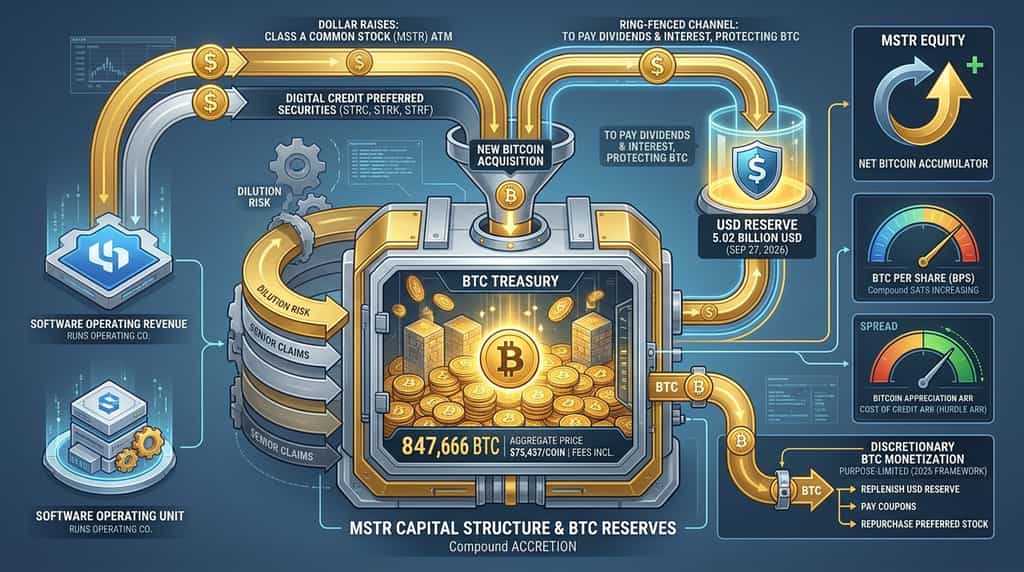
Strategy (MSTR) does not need to sell bitcoin to fund most of its treasury operations. It raises dollars in public markets, parks a cash reserve for dividends and interest, and treats bitcoin as long-duration capital rather than inventory to flip. According to Strategy’s September 28, 2026 Form 8-K and Bitcoin ledger, the company held 847,666 bitcoin at an aggregate purchase price of about $63.95 billion, or $75,437 per coin including fees.
That stack is the core of the model. Software still produces operating revenue, but it is far smaller than the bitcoin reserve. The economic engine is capital-markets issuance — common stock and perpetual preferred securities — plus a ring-fenced USD Reserve that pays preferred dividends and debt interest so the firm can stay a net bitcoin accumulator.
This article explains how that flywheel works, what “BTC Yield” actually measures, when bitcoin sales are now allowed, and where the risks sit.
What Is Strategy’s Bitcoin Treasury Model?
Strategy’s model is a publicly listed capital structure built around bitcoin as the primary treasury reserve asset. The company, formerly MicroStrategy, still sells enterprise analytics software, but according to its Form 10-Q for the quarter ended June 30, 2026 filed with the U.S. Securities and Exchange Commission, it now reports two operating segments: Software and Bitcoin.
The Bitcoin segment does not generate product revenue. Value is created when Strategy increases bitcoin held per assumed diluted share and when bitcoin’s long-run return exceeds the cost of the capital used to buy it.
The Software segment remains a real business. According to the same 10-Q, total revenues were $122.4 million in the second quarter of 2026 and $246.7 million in the first half of 2026. That cash flow helps run the operating company. It does not cover the much larger preferred-dividend and interest load created by Digital Credit.
Strategy’s own description is consistent across recent filings and strategy.com notes: acquire bitcoin in a way management believes is accretive to common stockholders, then offer securities that give different investors different slices of that bitcoin exposure — common equity for amplified upside, preferred stock for income.
How Does Strategy Buy Bitcoin Without Selling Existing Holdings?
Strategy buys new bitcoin with dollars raised from investors, not by liquidating the coins it already owns. The primary channels are at-the-market (ATM) sales of Class A common stock (MSTR) and ATM or underwritten sales of perpetual preferred stock branded as Digital Credit.
According to Strategy’s September 28, 2026 Form 8-K, from September 21 to September 27, 2026 the company issued 1,469,165 MSTR shares for $246.2 million in net proceeds. It allocated $142.7 million of those proceeds to buy 1,665 bitcoin at an average price of $85,681, including fees, and used $103.5 million to repurchase STRC preferred shares.
That week is a clean snapshot of the current playbook. Issue common equity when management accepts the dilution. Deploy part of the cash into bitcoin. Use another part to retire expensive preferred stock. Keep a separate USD pile for coupons.
Preferred issuance works the same way at larger scale. STRC (Stretch) is a variable-rate perpetual preferred. STRK (Strike) is an 8% convertible preferred. STRF (Strife) is a 10% preferred. STRD and the euro-denominated STRE complete the suite, according to Strategy’s product pages on strategy.com.
Historically, convertible notes also funded purchases. Those notes still sit on the balance sheet, but recent activity has emphasized common ATM issuance, preferred issuance, preferred repurchases, and cash already on hand.
USD Cash is the flexible bucket. USD Reserve is the restricted bucket. According to Strategy’s September 28, 2026 update, USD Reserve stood at $5.02 billion and USD Cash at $1.00 billion as of September 27, 2026, for about $6.02 billion of USD assets. Cash can buy bitcoin. The Reserve is designed to pay preferred dividends and interest so those obligations do not automatically force a bitcoin sale.
How Does Strategy Generate Value If It Does Not Sell Bitcoin?
Strategy generates shareholder value by growing bitcoin per share and by earning a spread between bitcoin’s long-term appreciation and the cost of Digital Credit. It does not rely on realizing gains from the treasury stack as its default profit engine.
Think of three layers.
First, software gross profit. According to the June 30, 2026 Form 10-Q, second-quarter software revenue of $122.4 million produced $81.6 million of gross profit. That supports the operating company. It is not the treasury thesis.
Second, balance-sheet accretion. If Strategy issues $100 of capital and buys bitcoin without increasing assumed diluted shares as fast as holdings, bitcoin per share rises. Strategy reports that ratio as Bitcoin Per Share, or BPS, in sats. One sat is one hundred-millionth of a bitcoin.
Third, the credit spread. Preferred holders receive a contractual dividend. Common equity keeps the residual claim on bitcoin after those senior claims. If bitcoin’s annualized return stays above the effective cost of that credit, the residual claim can compound faster than bitcoin itself. Strategy labels the effective cost of credit BTC Hurdle ARR in its mid-2026 metrics framework.
This is why the company can “make money” in an economic sense without selling coins. Paper gains on the reserve accrue to the residual owner. New issuance, if priced well, adds more coins per share. Preferred capital is long duration. There is no scheduled maturity that forces a sale the way a short-term loan would.
The model is not free. Dividends must be paid in dollars. New shares dilute BPS if the stock is cheap relative to net bitcoin value. Credit that is too expensive raises the hurdle rate. Those are the trade-offs, not hidden afterthoughts.
What Is BTC Yield and Why Does It Matter?
BTC Yield is the percentage change in bitcoin per assumed diluted share over a period. It is not an interest rate paid to MSTR holders and not income generated by lending bitcoin.
According to Strategy’s KPI notes on strategy.com, BPS is bitcoin holdings divided by Assumed Diluted Shares Outstanding. Assumed Diluted Shares Outstanding includes basic common shares plus shares that would be issued if convertible notes and convertible preferred stock converted and if options and RSUs settled. BTC Yield is the period change in that ratio. BTC Gain multiplies beginning holdings by that yield. BTC $ Gain converts BTC Gain into dollars at the market price of bitcoin.
The metric answers one question: did capital-markets activity add bitcoin faster than it added fully diluted shares?
The answer changes with issuance. According to Strategy’s Bitcoin ledger as of September 28, 2026, year-to-date BTC Yield was -3.7% and year-to-date BTC Gain was -25,085 bitcoin. That negative print does not mean the company stopped buying. It means assumed diluted shares grew faster than holdings over that window, so each diluted share represented less bitcoin than at the start of the year.
That is the honest use of the KPI. When ATM issuance is heavy and the stock is not expensive relative to bitcoin, BTC Yield can compress even while the raw coin count rises. When preferred capital or discounted debt retirement adds coins without a matching common-share increase, BTC Yield can expand.
Investors who treat BTC Yield like a savings-account rate misunderstand the product. Strategy states in its own notes that BTC Yield is not an operating performance measure, not a liquidity measure, and not equivalent to yield in the traditional financial sense.
How Does Digital Credit Fund the Model?
Digital Credit is Strategy’s name for perpetual preferred securities that convert bitcoin’s volatility into a high-yield income claim. The flagship is STRC.
According to Strategy’s product and media materials updated in September 2026, STRC is variable-rate, cumulative, and perpetual, with a 12.00% dividend rate in recent months. STRK pays a fixed 8% and is convertible into MSTR. STRF pays 10%. None of these instruments is collateralized by a segregated bitcoin vault. Strategy states on its STRK information page that preferred securities have a preferred claim on residual assets, not a direct lien on the coins.
The funding loop has three steps, which Strategy described in its August 30, 2026 investor briefing.
Issue Digital Credit when demand and pricing are attractive. That raises long-duration capital without immediate common-share dilution, but it creates senior claims and ongoing dividends.
Deploy the proceeds. Uses include buying bitcoin, topping up the USD Reserve, refinancing, or retiring more expensive claims.
Earn the spread. If bitcoin’s long-term return exceeds the effective cost of that credit, the residual common equity captures the difference.
The same briefing set a discretionary target of annual Digital Credit sales equal to 10% to 20% of the bitcoin reserve when markets cooperate. That is a capacity target, not a guaranteed issuance calendar.
Preferred stock also created the obligation that later forced more flexible bitcoin policy. Software revenue cannot service billions of dollars of notional preferred. Dollars have to come from equity issuance, existing cash, or — under the 2026 framework — occasional bitcoin monetization.
Repurchases are the other half of credit management. In the week ended September 27, 2026, Strategy used ATM proceeds and cash to buy back STRC. Retiring preferred stock at a discount reduces future dividend dollars. Fewer future dollars owed means less pressure on the USD Reserve and less need to sell bitcoin later.
How Does the USD Reserve Reduce Pressure to Sell Bitcoin?
The USD Reserve is a cash pool ring-fenced to pay preferred dividends and debt interest. It is the main reason Strategy can avoid routine bitcoin sales.
According to Strategy’s September 28, 2026 Form 8-K, the Reserve was $5.02 billion as of September 27, 2026, with another $1.00 billion in unrestricted USD Cash. Company communications in late September 2026 put USD Duration near 3.8 years — a coverage measure of how long current dollar assets can service current preferred-dividend and interest obligations.
The Reserve is funded by common ATM proceeds, preferred issuance, and, when management chooses, bitcoin sales that replenish cash after coupons are paid. The design goal is simple. Pay the coupon in dollars. Leave the bitcoin stack intact.
That design is why the software business still matters even though it is small next to the reserve. Operating cash and interest earned on the Reserve are dollar inflows. They are not large enough to run the whole credit structure, which is why Strategy’s June 30, 2026 Form 10-Q states that software cash flow is not expected to satisfy short-term or long-term liquidity needs on its own.
Liquidity, in this model, is a menu: USD Reserve, USD Cash, new MSTR shares, new preferred shares, and authorized bitcoin sales. The Reserve is the first line so that “do not sell the treasury” can remain the default rather than an accident.
When Can Strategy Sell Bitcoin Under Its Current Framework?
Strategy can sell bitcoin when management decides monetization is more advantageous than issuing common stock or running other capital-markets transactions. The board authorized that option under the BTC Monetization Program inside the Digital Credit Capital Framework.
The program is not a mandate to dump the reserve. Company disclosures describe three primary uses: build or replenish the USD Reserve, fund preferred dividends and interest, and fund accretive repurchases of preferred or common stock. There is no obligation to sell any bitcoin.
Strategy’s Bitcoin ledger on strategy.com shows that 2026 was the year the option was used. The company recorded sales in early June, late June, early July, early August, and mid-August, then returned to net buying. Holdings still stood at 847,666 bitcoin as of September 27, 2026 — higher than the mid-summer trough after those sales.
The practical rule today is “do not be a net seller,” not “never transact.” Small sales can fund coupons or buy back preferred stock trading below par. Larger purchases can follow when ATM or cash capacity is available. The ledger’s week-by-week mix of buys and sells is the model operating in both directions.
That evolution matters for anyone still quoting the old slogan as policy. “Never sell your bitcoin” was the accumulation-era message. The 2026 filings treat bitcoin as capital that can be monetized in size-limited, purpose-limited ways without abandoning the treasury thesis.
What Are the Main Risks of Strategy’s Model?
The model fails if bitcoin’s long-run return stays below the cost of credit and if equity markets stop funding the ATM at acceptable dilution.
Dilution is the first risk. ATM common issuance buys coins today and increases Assumed Diluted Shares Outstanding. If MSTR trades near or below net bitcoin value, new shares can reduce BPS. The September 28, 2026 ledger’s negative year-to-date BTC Yield is the live example.
Senior claims are the second risk. Preferred stock and out-of-the-money convertibles sit above common equity. Strategy’s mid-2026 metrics introduced Net Bitcoin Per Share for that reason. Gross holdings can look large while the residual claim is smaller after subtracting preferred notional and debt, then adding back USD assets.
Coupon risk is the third. STRC’s recent 12% rate is a cash obligation. If the USD Reserve runs down and equity issuance is unattractive, bitcoin sales become the residual funding source. The monetization program exists because that scenario is no longer theoretical.
Asset-price risk is the fourth. The reserve is almost entirely bitcoin. According to Strategy’s ledger, the $63.95 billion cost basis sat against a $71.21 billion BTC Reserve value as of September 28, 2026. That spread can reverse. Fair-value accounting flows through earnings, which is why the Software segment can be modestly profitable while consolidated net income swings by billions.
Custody and key-management risk is real but operational. The June 30, 2026 Form 10-Q listed Coinbase Custody, Anchorage Digital Bank, and Fidelity Digital Assets as bitcoin custodians as of the July 2026 holdings update in that filing. Concentration at regulated custodians reduces some operational risk and introduces counterparty and venue risk.
Software transition risk is smaller but not zero. The same 10-Q describes a shift from perpetual licenses to cloud subscriptions, with license and support revenue declining as subscription services grow. That mix change affects reported revenue timing. It does not replace the treasury’s need for capital markets.
None of these risks mean the model is broken. They mean the model is a leveraged bitcoin balance sheet with a credit wrapper, not a software compounder that happens to own coins.
Beyond the Headlines: What KuCoin 5.0 Means for You
Market news moves fast — but where you act on it matters just as much. This October, KuCoin launches KuCoin 5.0, transforming KuCoin into a rebuilt platform. Here's what actually changes for you:
-
One account for everything. Older platforms split your money across separate "spot," "margin," and "futures" accounts and expected you to understand why. KuCoin 5.0's unified account removes that entirely — deposit once, and everything is simply there (only available to VIPs for now).
-
Stocks, indices, and commodities. KuCoin 5.0 expands beyond crypto into global markets. When crypto chops sideways and equities rally (or the reverse), you rotate in minutes instead of opening a brokerage account and waiting days for fiat rails.
-
Real-world assets (RWA). Tokenized exposure to traditional assets like commodities, right inside your crypto account. One of the fastest-growing segments in global finance is no longer reserved for institutions — you access it from the same balance you trade with.
-
Earn while you learn. Not ready to trade? KCUSD lets your stablecoins earn daily, auto-compounding interest. The lowest-stress way to put your idle deposit to work for 4% yield.
-
An AI assistant in plain language. Ask questions, get market context, understand what you're looking at — built into the platform, no jargon required.
-
An app that doesn't overwhelm. Faster, cleaner, and consistent — intuitive from the first tap, not after a tutorial.
-
Safety you can check, not just trust. A MiCAR-licensed EU entity, Proof of Reserves you can verify yourself, and internationally certified security (SOC 2 Type II, ISO 27001:2022).
Create your account in minutes — and start on the platform built for where crypto is going, not where it's been.
Conclusion
Strategy’s treasury model makes money by treating bitcoin as capital and public markets as the dollar printer that funds more of it. Common ATM issuance and Digital Credit preferreds bring in cash. The USD Reserve pays coupons. Bitcoin stays on the balance sheet so residual owners can capture appreciation above the cost of that capital.
The operating software business still exists and, according to the June 30, 2026 Form 10-Q, produced $122.4 million of second-quarter revenue. It does not pay for the preferred stack. BTC Yield tracks whether issuance added coins faster than diluted shares. It is a per-share accretion gauge, not a coupon.
The 2026 Digital Credit Capital Framework added an explicit bitcoin-sale option for reserve building, dividends, and buybacks. Strategy has used that option in modest size and has also kept buying. As of September 27, 2026, according to the company’s Form 8-K, holdings were 847,666 bitcoin with about $6.02 billion of USD assets.
The model works when bitcoin compounds faster than credit costs and when equity can be issued without wrecking bitcoin per share. It strains when mNAV is tight, preferred yields are high, and the Reserve is the only buffer. That is the full mechanism — accumulation first, monetization as a tool, net ownership as the goal.
FAQs
Does Strategy still operate a software company?
Yes. According to Strategy’s Form 10-Q for the quarter ended June 30, 2026, Software is a separate reportable segment and generated $122.4 million of revenue in that quarter.
Is BTC Yield a dividend paid to MSTR shareholders?
No. According to Strategy’s KPI notes, BTC Yield is the percentage change in bitcoin per assumed diluted share and is not traditional yield, operating income, or a cash distribution.
Do STRC holders have a direct claim on Strategy’s bitcoin?
No. Strategy states that its preferred securities are not collateralized by bitcoin holdings and have a preferred claim on residual company assets.
How much bitcoin does Strategy hold right now?
According to Strategy’s September 28, 2026 Form 8-K, the company held 847,666 bitcoin as of September 27, 2026, purchased for about $63.95 billion at an average price of $75,437 including fees.
Why did Strategy authorize bitcoin sales if the model is “don’t sell”?
The BTC Monetization Program lets management sell bitcoin to fund the USD Reserve, preferred dividends and interest, or accretive buybacks when that path is better than issuing common stock. It does not require any sale.
Disclaimer: This article is for informational purposes only and does not constitute financial, legal, or investment advice. Always conduct your own research before interacting with digital assets.