

How Macroeconomics and Institutional Players Are Rewriting Blockchain Revenue Models
Introduction
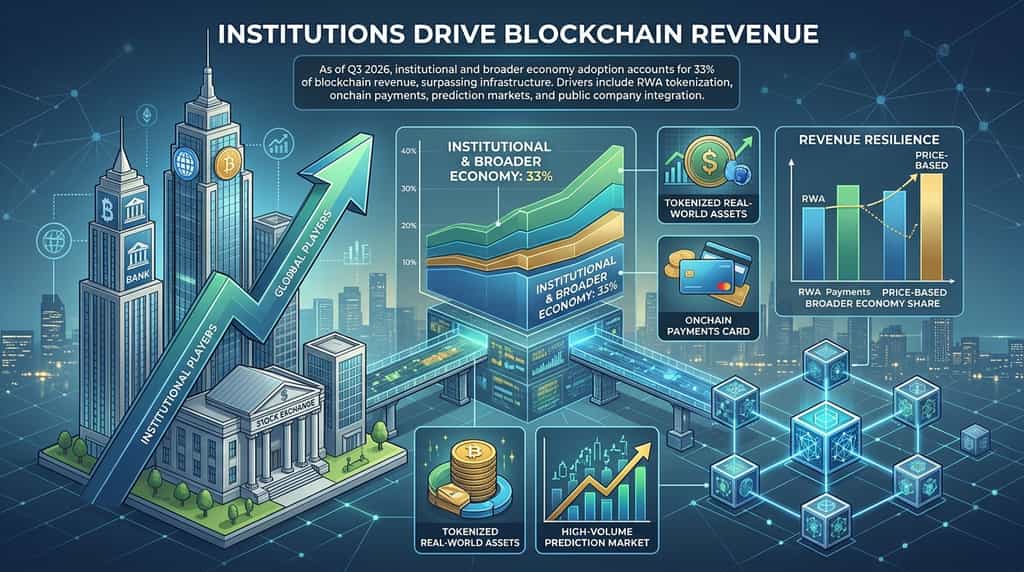
Blockchain technology has long been perceived as a decentralized, community-driven ecosystem operating outside traditional financial boundaries. According to the second annual 1kx Blockchain Revenue Report released in October 2026, institutional activity and broader-economy adoption now account for 33% of total blockchain revenue, fundamentally altering how value flows through digital asset networks. Understanding these revenue mechanics is vital for navigating modern crypto markets.
How Much Revenue Do Institutions and the Broader Economy Generate in Blockchain?
Institutional adoption and broader-economy integrations now generate one-third of total blockchain revenue, proving that traditional enterprise participation has become a foundational pillar of web3 monetization. According to the October 2026 1kx Blockchain Revenue Report, institutional and broader-economy revenues reached 33% of total blockchain revenue in the third quarter, with full-year projections holding steady at 30%.
This milestone reflects a structural shift away from pure retail speculation toward utility-driven financial infrastructure. Institutional engagement—encompassing ETF operations, card network integration, chain fees, and specialized institutional client services—accounted for 12% of total blockchain revenue through the first three quarters of 2026. Meanwhile, broader-economy use cases like real-world asset (RWA) tokenization, onchain payments, and prediction markets expanded rapidly, capturing 22% of blockchain revenues in Q3 2026 to officially surpass foundational blockchain infrastructure for the first time.
What Drives the Growth of Broader-Economy Adoption Over Infrastructure?
Broader-economy adoption overtook infrastructure revenue because consumer-facing financial products, tokenized assets, and event-based prediction markets scaled faster than foundational network layers. According to data from the 1kx October 2026 report, revenues from broader-economy adoption grew 58% year-over-year in the first half of 2026, driven primarily by high-frequency activity in prediction markets and tokenized real-world assets.
Prediction markets emerged as a massive revenue engine, with fees surging 19-fold year-over-year to exceed $1.5 billion in Q3 2026 on roughly $55 billion in settled volume, concentrated heavily in platforms like Polymarket and Kalshi. Simultaneously, spending on digital asset payment cards tripled year-over-year to $3.4 billion in Q3 2026, anchored almost exclusively by Visa's processing network. Tokenized stocks also experienced exponential demand, with Robinhood Chain surpassing $13 billion in Q3 2026 volume—over 70% of which occurred while traditional U.S. stock exchanges were closed.
How Are Public Companies Expanding Their Footprint in Blockchain Ecosystems?
Publicly traded corporations now capture 16% of total blockchain revenue, doubling their market share from 7% in 2022 as traditional financial heavyweights aggressively build onchain capabilities. According to the October 2026 1kx analysis, the six largest public entities account for approximately 60% of total public-company blockchain revenue.
Traditional banking and finance incumbents that generated negligible onchain revenue three years ago are on track to earn $1 billion from digital asset initiatives. Rather than building every protocol from scratch, major financial institutions are executing strategic acquisitions to secure market share. Recent high-profile examples highlighted in the industry include Mastercard's acquisition of BVNK, S&P Global acquiring OpenZeppelin, SBI acquiring bitbank, and Standard Chartered expanding Zodia Custody.
| Metric Category | 2022 Benchmark | 2026 Report Data | Key Growth Driver |
| Public Company Share | 7% of total revenue | 16% of total revenue | Traditional finance entries and strategic fintech acquisitions |
| Institutional Revenue Share | 6% (2021 baseline) | 12% (Q3 YTD) | ETF structures, network fees, and institutional custody services |
| Broader Economy Share | N/A (Minor segment) | 22% (Q3 peak) | RWA tokenization, event prediction markets, and card spend |
Why Are Institutional and Broader-Economy Revenues Resilient Amid Market Drawdowns?
Institutional and broader-economy revenue streams demonstrate resilience because they derive value from transaction volume, asset servicing, and tokenized utility rather than raw token price appreciation alone. While full-year 2026 blockchain revenues are expected to settle near $100 billion—representing a 28% decline from roughly $140 billion in 2025 in tandem with digital asset price corrections—relative revenue efficiency against total market capitalization remained completely flat.
Even as price-sensitive asset management, custody, and staking fees experienced minor contractions, institutional owners generated $1.7 billion (up 10% year-over-year). The diversification of income sources ensures that blockchain networks function increasingly like traditional corporate ecosystems, where sustained operational utility offsets cyclical volatility in token valuations.
How Do Dividend-Paying Tokens Compare to Traditional Cryptocurrencies?
Protocols that distribute revenue directly to token holders have outperformed traditional non-yielding assets during market consolidations, challenging long-held assumptions about crypto portfolio allocation. According to backtested data from the 1kx dividend-token index, protocols sharing value with token holders delivered an 82% return through September 30, 2026, significantly outpacing Bitcoin's 5% decline over the same timeframe.
This performance divergence stems from a record 283 protocols successfully distributing protocol-generated cash flows to token holders in Q3 2026. As institutional investors demand predictable yield and fundamental backing rather than purely speculative upside, token economics are shifting toward sustainable, revenue-backed models.
Conclusion
The evolution of blockchain revenue from a closed-loop retail phenomenon into a diversified, institutionally supported financial layer marks a mature turning point for the industry. With public companies capturing 16% of total revenue, prediction markets scaling past billions in volume, and traditional financial giants integrating network infrastructure, digital assets are deeply entwined with the broader macroeconomy. While total revenues fluctuate alongside asset prices, the underlying growth of real-world use cases guarantees that blockchain technology is no longer an isolated experiment, but a permanent pillar of modern global finance.
FAQs
What constitutes institutional revenue in blockchain ecosystems?
Institutional revenue includes earnings generated by financial institutions acting as network owners—such as ETF management fees, card network settlement fees, and validator rewards—alongside fees collected from institutional clients utilizing custody, brokerage, and structured staking services.
Why did broader-economy adoption overtake blockchain infrastructure revenue in 2026?
Broader-economy revenue surpassed infrastructure because consumer-facing applications like real-world asset tokenization, payment card spending, and event prediction markets expanded faster than base-layer network capacity, capturing 22% of total blockchain revenue in Q3 2026.
How do prediction markets generate blockchain revenue without direct onchain tracking?
Prediction markets generate substantial offchain and matching-engine fees from high-volume event contracts—such as those on Polymarket and Kalshi—which aggregate billions in quarterly settlement volume and are quantified using specialized analytics providers like Allium.
What is a dividend-paying token index?
A dividend-paying token index tracks decentralized protocols that automatically distribute a portion of their fee revenue or protocol earnings back to token holders, functioning similarly to corporate stock dividends rather than relying solely on capital appreciation.
How are traditional financial institutions entering the blockchain revenue space?
Traditional banks and financial incumbents are capturing blockchain revenue both organically through internal digital asset desks and inorganically via major corporate acquisitions, such as acquiring prominent custody providers, tokenization firms, and compliance infrastructure developers.
Disclaimer
This general market information, possibly from third-party, commercial, or sponsored sources, is provided for reference and educational purposes only and does not constitute financial or investment advice, an offer, solicitation, or guarantee. We disclaim liability for its accuracy, completeness, reliability, and any resulting losses. Investments/trading are risky; past performance doesn’t guarantee future results. Users should research, judge prudently, and take full responsibility. For further details, please consult KuCoin’s Terms of Use and Risk Disclosure.