

How Fed Hawkish Signals and Rising Capital Costs Are Reshaping Bitcoin and Risk Assets
Introduction
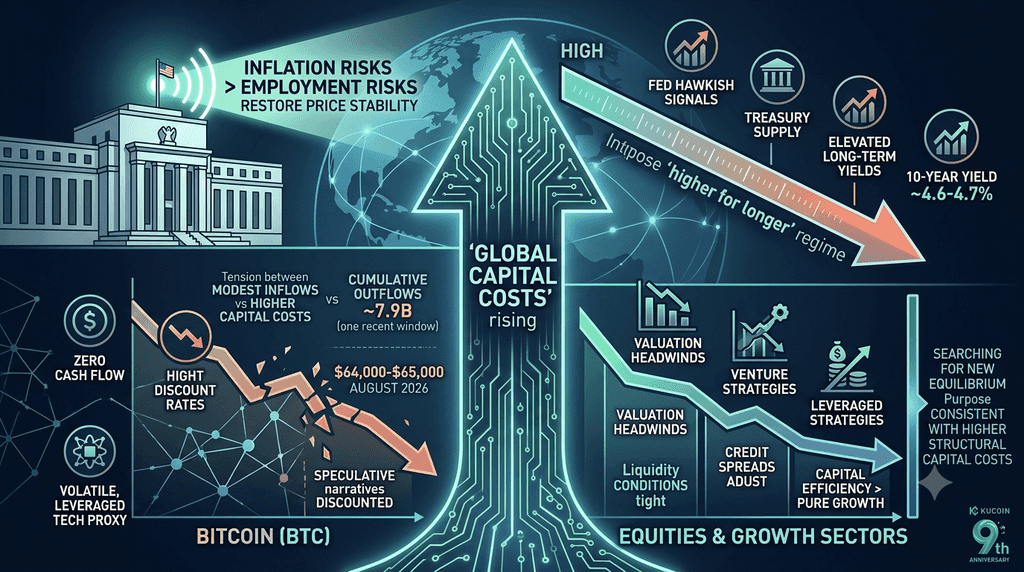
Did cooler July private payrolls of just 44,000 jobs signal an imminent Fed pivot? Far from it. Federal Reserve officials including Neel Kashkari, Lisa Cook, and others have doubled down on hawkish rhetoric, stressing that inflation still sits well above the 2% target and further rate hikes remain on the table if progress stalls. This stance, combined with steady U.S. Treasury issuance and elevated long-term yields, is driving up global capital costs and forcing a sharp repricing of Bitcoin and other risk assets.
Higher discount rates reduce the present value of future cash flows, pull capital toward safer yielding Treasuries, and keep liquidity conditions tight—directly pressuring non-yielding speculative assets. Bitcoin, trading near $64,000–$65,000 in early August 2026, continues to track these macro forces more than pure crypto-native catalysts.
What Do Recent Fed Hawkish Signals Actually Mean for Markets?
Fed officials are signaling that cooling labor data does not equal easier policy. Minneapolis Fed President Neel Kashkari dissented in favor of a 25-basis-point hike at the late-July FOMC meeting and later reiterated that incremental tightening now is preferable to risking entrenched inflation later. Governor Lisa Cook stated on August 5 that inflation risks outweigh employment risks and that she is prepared to raise rates if necessary to restore price stability. These comments arrived even as July ADP private payrolls rose only 44,000—the weakest reading in months and well below expectations—highlighting the Fed’s focus on sticky inflation over softening jobs data.
The policy rate remains in the 3.50–3.75% range after successive holds. Markets have repriced the path higher, with meaningful odds of a September hike still live. The removal of earlier forward-guidance bias and the emphasis on a hard 2% inflation target under Chair Kevin Warsh reinforce a higher-for-longer regime. This environment raises the opportunity cost of holding risk assets: investors can earn attractive real yields on short- and intermediate-term Treasuries without taking volatility risk.
How Are Rising Global Capital Costs Transmitting to Asset Prices?
Elevated capital costs work through multiple channels. Long-term Treasury yields have stayed firm, with the 10-year yield hovering near 4.6–4.7% in early August 2026. Persistent government financing needs and unchanged Treasury buyback and issuance schedules force the market to absorb large volumes of supply, keeping term premiums elevated. Higher discount rates compress valuations across equities, private credit, and crypto.
Bitcoin feels the effect acutely because it generates no cash flow. When the risk-free rate rises, the relative attractiveness of a volatile, zero-yield asset declines. Historical patterns show Bitcoin often underperforms during periods of rising real yields and a stronger dollar. The same dynamic pressures high-valuation technology stocks and leveraged strategies. Global capital now prioritizes cash-flow quality and capital efficiency over pure growth narratives, especially amid concurrent AI infrastructure spending and residual energy-supply uncertainties.
Why Is Bitcoin Particularly Sensitive to These Macro Forces?
Bitcoin sits at the far end of the risk spectrum and has functioned as a high-beta liquidity proxy in 2026. Spot Bitcoin ETF flows illustrate the push-pull. Short-term institutional activity has shown net inflows of roughly $475 million over one recent week and about $922 million over the past month, according to market trackers. Yet the broader quarterly picture remains negative, with cumulative outflows near $7.9 billion in one recent three-month window. This pattern indicates tactical buying rather than a decisive risk-on rotation.
Price action reflects the tension. Bitcoin has hovered in the low-to-mid $60,000s through early August, well below 2025 peaks, as traders weigh modest ETF inflows against the higher cost of capital. Correlation with equities has remained elevated at times, while safe-haven behavior relative to gold has weakened. In an environment of rising global capital costs, Bitcoin trades more like a leveraged tech proxy than digital gold.
What Role Do Treasury Supply and Geopolitical Residual Risks Play?
U.S. fiscal dynamics amplify the capital-cost pressure. The Treasury’s decision to maintain its current issuance and buyback cadence means markets must continue digesting substantial supply. This keeps long-end yields supported even if short-term rates stay on hold, tightening financial conditions through market mechanisms rather than explicit Fed hikes.
Geopolitical factors add another layer. Temporary arrangements around key energy transit routes have reduced immediate supply-disruption fears, yet residual uncertainty over long-term control and pricing power continues to influence energy markets. Oil-price volatility can feed back into inflation expectations, reinforcing the Fed’s cautious stance and supporting higher real rates. Together these forces create an environment where capital allocation becomes more selective: assets with strong free-cash-flow generation or clear utility retain support, while high-multiple, high-leverage names face greater discounting pressure.
How Are Risk Assets Beyond Bitcoin Being Reshaped?
Equities, particularly growth and technology sectors, face similar valuation headwinds. Higher discount rates lower the present value of distant earnings, while elevated financing costs pressure leveraged balance sheets. Private markets and venture strategies that thrived on cheap capital now confront tighter conditions. Credit spreads and equity risk premiums have adjusted accordingly, reflecting greater demand for compensation.
In crypto, the impact extends beyond Bitcoin. Altcoins with weaker liquidity or more speculative narratives typically suffer larger drawdowns when global risk appetite contracts. Institutional allocators increasingly emphasize capital efficiency—favoring assets that can demonstrate durable demand or yield-generating mechanisms—over pure narrative plays. The net result is a market that is no longer pricing broad liquidity expansion but is instead searching for a new equilibrium consistent with higher structural capital costs.
Should You Trade Bitcoin and Risk Assets on KuCoin?
KuCoin provides a direct, efficient platform for navigating this macro-driven environment. Traders can access deep liquidity in Bitcoin and major pairs, utilize advanced order types, and employ risk-management tools such as stop-loss and take-profit orders to handle volatility stemming from Fed commentary or yield moves. Spot trading, futures, and margin products allow both directional and hedging strategies.
With competitive fees, a broad selection of risk assets, and robust security infrastructure, KuCoin enables users to respond quickly to shifts in global capital costs and Fed signals. Registering and verifying an account positions traders to execute precisely when liquidity or sentiment changes.
Conclusion
Fed hawkish signals from officials such as Kashkari and Cook, combined with firm long-term yields near 4.6–4.7% and ongoing Treasury supply, have raised global capital costs and forced a recalibration of Bitcoin and risk assets. Cooling July ADP payrolls of 44,000 jobs have not prompted an easing bias; instead, the focus remains on bringing inflation sustainably to 2%. Bitcoin’s short-term ETF inflows coexist with larger quarterly outflows, underscoring selective rather than broad risk appetite.
Higher discount rates and opportunity costs continue to favor cash-flow quality over speculative growth. Markets are not in a classic risk-on regime but are actively seeking a new pricing balance. Monitoring Fed communication, yield moves, and institutional flow data remains essential for positioning in this higher-capital-cost landscape.
FAQs
What is the current Fed funds rate target range?
The Federal Reserve has held the target range at 3.50–3.75% through successive meetings in 2026.
How do higher Treasury yields affect Bitcoin specifically?
Higher yields increase the opportunity cost of holding a non-yielding asset and raise the discount rate applied to future value, typically pressuring Bitcoin prices in the near term.
Have Bitcoin ETF flows turned consistently positive?
No. Recent weekly and monthly net inflows have appeared, yet cumulative flows over the past quarter remain negative according to available tracker data.
Why did the Fed stay hawkish despite weaker July ADP data?
Officials view inflation as still too high relative to the 2% target and prioritize price stability over short-term labor-market softening.
Does rising capital cost only hurt crypto or broader risk assets too?
It affects the entire risk spectrum—equities, private credit, and crypto—by compressing valuations and raising financing costs for leveraged strategies.