

How Can US Data Center Restrictions Give Bitcoin Miners an Edge in Artificial Intelligence?
Introduction
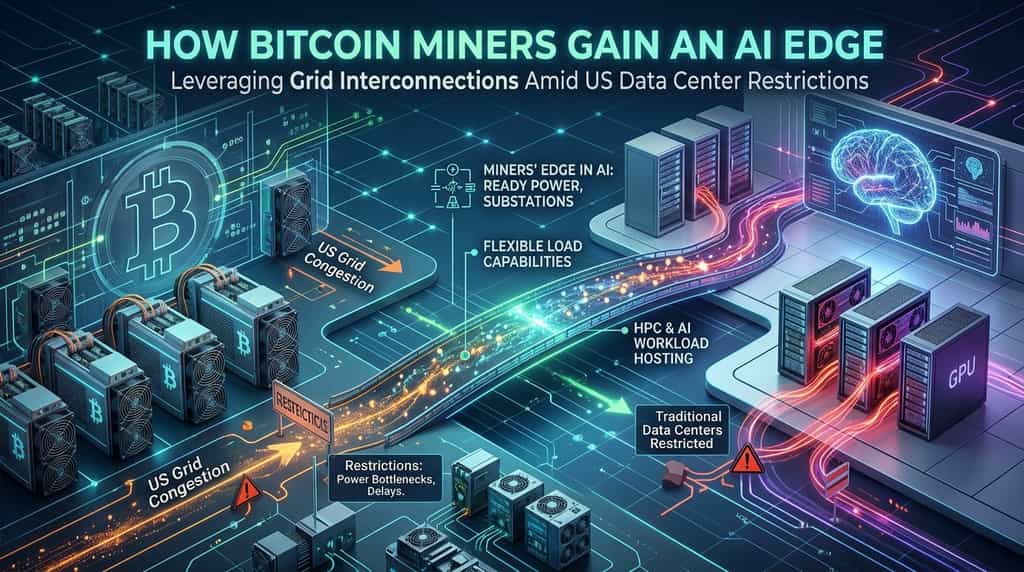
The rapid expansion of artificial intelligence (AI) has created unprecedented demand for specialized computing infrastructure. As major technology firms race to scale large language models and neural networks, traditional data centers face severe power constraints, grid congestion, and extended permitting delays across key metropolitan and suburban markets. In response to these bottlenecks, industry analysts and energy markets are increasingly examining an alternative infrastructure provider: Bitcoin mining operators. Equipped with high-voltage electrical interconnections, substantial land parcels, and flexible load capabilities, Bitcoin mining facilities are uniquely positioned to pivot toward high-performance computing (HPC) and artificial intelligence workloads. Understanding how physical and regulatory limits on standard data centers create opportunities for cryptocurrency miners illuminates a broader convergence between digital asset infrastructure and enterprise computing.
Key Takeaways
US data center restrictions and power grid bottlenecks provide Bitcoin miners with a distinct competitive advantage in the artificial intelligence sector by offering ready-to-use electrical capacity and pre-approved real estate.
-
Grid Interconnection Advantages: Bitcoin mining facilities often possess multi-megawatt or gigawatt-scale electrical interconnections that bypass years of utility queue delays facing greenfield AI data centers.
-
Power Availability and Flexibility: Miners operate in regions with stranded energy or surplus generation, and their flexible load profiles allow them to curtail operations instantly to balance grid demands.
-
Infrastructure Adaptability: While mining facilities require significant retrofitting—including liquid cooling installation and high-bandwidth fiber optic integration—their existing substations and transformers reduce time-to-market.
-
Economic Diversification: Transitioning a portion of hash rate capacity to HPC and artificial intelligence hosting provides miners with counter-cyclical revenue streams independent of cryptocurrency market volatility.
What Caused the Capacity Crisis in Traditional Data Center Markets?
Traditional data center hubs, such as Northern Virginia's "Data Center Alley," have encountered severe physical and regulatory limitations driven by exponential demand from cloud providers and artificial intelligence developers. As facility power densities escalate from historical averages of 5 to 10 kilowatts per rack to over 100 kilowatts per rack for advanced AI clusters, local electrical grids have struggled to keep pace.
Regional transmission organizations and local utility providers have responded to this strain by implementing moratoriums, tightening environmental reviews, and extending connection queues. In major US submarkets, securing a new utility interconnection agreement can take anywhere from three to seven years. Furthermore, municipal zoning boards and state regulators are increasingly imposing restrictions on noise pollution, water consumption for cooling towers, and fossil fuel generation tie-ins. These friction points have forced technology conglomerates to look beyond traditional real estate corridors for alternative sites capable of housing dense computing hardware without multi-year deployment delays.
Why Are Bitcoin Mining Facilities Uniquely Positioned for AI Workloads?
Bitcoin mining operations were built to solve a fundamentally similar logistical challenge as enterprise AI training: securing massive, continuous blocks of electrical power at competitive industrial rates. Over the past decade, mining companies acquired real estate adjacent to power generation plants, wind farms, and hydroelectric dams, constructing robust electrical substations and high-capacity step-down transformers.
Unlike standard commercial real estate, mining sites are engineered for heavy industrial loads rather than office occupancy or basic server hosting. Their core structural features include:
-
Direct Power Access: Many facilities interconnect directly with transmission lines or high-voltage sub-transmission networks, avoiding residential distribution bottlenecks.
-
Geographic Dispersion: Miners often establish operations in remote or rural areas with underutilized grid capacity, bypassing congested urban submarkets.
-
Operational Agility: Mining operators possess extensive experience in thermal management, electrical maintenance, and load balancing, skills that transfer directly to managing high-density server racks.
What Operational and Technical Challenges Must Miners Overcome?
Despite possessing favorable power access, converting a Bitcoin mining facility into an artificial intelligence data center requires substantial capital expenditure and engineering modifications. The computational architecture required for cryptographic hashing differs significantly from the hardware architecture utilized in machine learning training and inference.
Bitcoin application-specific integrated circuit (ASIC) rigs operate on specialized, single-purpose logic. In contrast, artificial intelligence workloads rely heavily on graphics processing units (GPUs) and tensor processing units (TPUs) that require low-latency networking, massive data throughput, and advanced cooling systems. Most mining facilities utilize air-cooled or basic immersion setups designed for high ambient temperatures and high airflow tolerances. AI clusters, however, demand precise temperature and humidity regulation, often necessitating a complete overhaul to direct-to-chip liquid cooling systems. Additionally, miners must secure high-speed, low-latency fiber-optic backhauls to connect their rural or suburban sites into major enterprise data networks, a requirement largely absent in standard mining operations.
How Does Revenue Diversification Impact the Digital Asset Mining Sector?
The integration of artificial intelligence and high-performance computing hosting fundamentally alters the financial profile of publicly traded and private digital asset mining enterprises. Historically, a miner's top-line revenue depended almost entirely on the spot price of mined tokens and the global network difficulty rate. This exposure introduced high revenue volatility, particularly during bear market cycles or following the quadrennial block reward halvings.
By leasing excess electrical capacity and physical floor space to cloud providers or artificial intelligence laboratories, miners establish predictable, long-term contracted cash flows. According to financial disclosures analyzed by industry researchers, several major digital asset infrastructure firms have secured multi-year hosting agreements yielding stable dollar-denominated revenues. This structural shift allows operators to smooth out crypto-asset cyclicality, lower their weighted average cost of capital, and allocate resources more efficiently across both business segments based on prevailing market returns.
FAQs
Can all Bitcoin mining facilities easily convert to artificial intelligence data centers?
No. While many sites possess adequate power capacity, successful conversion depends on access to high-speed fiber-optic telecommunications networks, adequate water or liquid cooling infrastructure, and zoning permits that permit commercial computing operations.
Do AI companies own the mining facilities they use, or do they lease space?
Arrangements vary. Some technology firms acquire mining sites outright to secure immediate power rights, while others enter into long-term co-location and hosting agreements where the mining operator manages facility maintenance and power delivery.
How do power consumption patterns differ between Bitcoin mining and AI training?
Both sectors consume substantial electricity, but AI training clusters demand continuous, uninterrupted power with strict uptime SLAs (Service Level Agreements), whereas Bitcoin miners can curtail operations within seconds during peak grid pricing events.
What happens to the underlying Bitcoin hash rate when miners pivot to AI?
When a mining operator allocates a portion of its electrical capacity and facility space to high-performance computing, it typically decommissions a corresponding number of mining rigs, which can result in a localized reduction in hash rate contribution unless offset by new hardware deployments elsewhere.
Are regulatory restrictions on data centers expected to ease in the near future?
Industry analysts indicate that grid congestion and environmental scrutiny are likely to persist, as the explosive growth of generative models continues to outpace the speed at which utility providers can upgrade transmission lines and generation capacity.
Disclaimer
This general market information, possibly from third-party, commercial, or sponsored sources, is provided for reference and educational purposes only and does not constitute financial or investment advice, an offer, solicitation, or guarantee. We disclaim liability for its accuracy, completeness, reliability, and any resulting losses. Investments/trading are risky; past performance doesn’t guarantee future results. Users should research, judge prudently, and take full responsibility. For further details, please consult KuCoin’s Terms of Use and Risk Disclosure.