

Zcash Flips Dogecoin as $20 Billion ZEC Rally Reshuffles Crypto Top 10
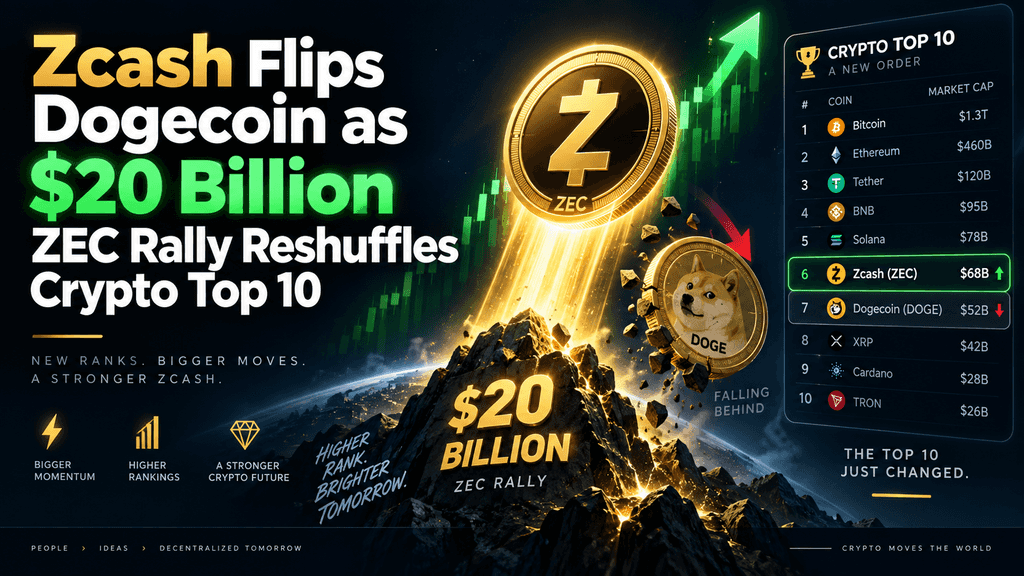
Zcash has returned to crypto’s top tier after one of the strongest rallies among major digital assets in 2026. On September 7, ZEC’s market capitalization climbed above $20 billion, while Dogecoin remained near $14 billion. CoinGecko ranked Zcash among the world’s ten largest cryptocurrencies and placed Dogecoin at No. 11, marking a dramatic reversal for a privacy-focused asset that had spent years outside the market’s dominant narratives.
The change is especially notable because Dogecoin has not suffered a major collapse. DOGE has also posted gains, but ZEC has risen much faster, powered by a combination of ETF access, renewed interest in financial privacy, technical improvements and increasingly aggressive derivatives trading.
That raises a bigger question than simply who holds the higher ranking today: why is the market suddenly assigning a larger valuation to Zcash than Dogecoin, and can ZEC remain ahead once the current rally loses momentum?
What Happened to Zcash and Dogecoin?
The most visible change has been Zcash’s rapid expansion in market value. CoinGecko’s historical data showed ZEC with a market capitalization of about $13.8 billion on September 3. By September 7, that figure had climbed above $20.7 billion. Over the same period, Dogecoin’s market capitalization remained around the $13 billion to $14 billion range.
| Metric | Zcash | Dogecoin |
| Recent market cap | About $20.7B | About $13.9B |
| Crypto ranking | Top 10 | Around No. 11 |
| Main narrative | Privacy and scarcity | Meme and community |
| Maximum supply | 21 million ZEC | No fixed maximum |
| Ledger model | Transparent and shielded | Public |
It is important to understand what a $20 billion market cap means. It does not mean investors deposited $20 billion of new money into Zcash. Market capitalization is calculated by multiplying the current token price by circulating supply. A sharp rise in the Zcash price therefore increases the implied value of all circulating ZEC, even though the amount of fresh capital entering the market may be far smaller than the change in market capitalization.
When Did ZEC Flip DOGE?
The ranking change began to appear around August 25. CoinGecko’s daily historical snapshots show that on August 24, Zcash had a market capitalization of about $14.404 billion while Dogecoin stood at roughly $14.531 billion. One day later, Zcash was valued at approximately $14.024 billion compared with about $14.015 billion for Dogecoin, giving ZEC a narrow lead.
Because cryptocurrencies trade around the clock, rankings can change multiple times within a day. It is therefore more accurate to say that ZEC began moving above DOGE in market capitalization around August 25 rather than treating one specific minute as the definitive flip.
The timing is also important because August 25 was when Grayscale expected shares of its Zcash product to begin trading on NYSE Arca under the ticker ZCSH after the trust was renamed The Zcash ETF. The SEC filing announcing the change was submitted days earlier, while the fund’s registration became effective on August 24.
Why Is ZEC Rallying So Fast?
There is no single explanation for Zcash’s surge. The move combines structural catalysts with market momentum. The launch of an exchange-traded investment vehicle created a new access route for investors. Zcash’s privacy-focused technology has also become more relevant as markets reconsider the role of financial confidentiality on public blockchains. At the same time, ZEC broke through major psychological price levels, attracting momentum traders.
The derivatives market then amplified the move. CoinGlass recently showed ZEC futures open interest around $2.82 billion, with approximately $10.5 billion in 24-hour futures volume, compared with about $1.06 billion in spot trading volume. That imbalance indicates that leveraged markets are playing a substantial role in short-term price discovery.
The simplest way to describe the rally is this: fundamentals and narrative created the story, while leverage accelerated it. That distinction matters because leverage can magnify gains far beyond the pace at which underlying adoption changes.
How the Zcash ETF Changed the Story
The Zcash ETF may be one of the most important structural changes behind the current repricing. An SEC filing dated August 21 said Grayscale expected shares of Grayscale Zcash Trust to begin trading on NYSE Arca around August 25 under the ticker ZCSH, while also changing the product’s name to The Zcash ETF. The registration became effective on August 24.
Before this development, investors seeking ZEC exposure generally needed to use cryptocurrency exchanges, wallets or specialized custody arrangements. An exchange-traded product creates another route through conventional brokerage infrastructure. That is especially significant for a privacy coin because privacy-focused assets have historically faced more questions around exchange accessibility and regulatory treatment than Bitcoin and many large Layer 1 tokens.
Initial flows also provided evidence that investors were using the new vehicle. The Block reported that ZCSH had attracted at least $34.4 million in net inflows from its August 25 debut through September 4, including $12.6 million on September 2. Still, $34 million of ETF inflows cannot directly explain a $20 billion market capitalization. The more important effect may be that regulated access changed how the market perceived ZEC’s investability.
Did a Short Squeeze Push ZEC Even Higher?
The move above $1,000 appears to have introduced a second stage of the rally. Once a heavily traded asset breaks through a major resistance level, traders betting against it may begin closing short positions. Closing a short normally involves buying the asset back, which can add further upward pressure.
The cycle can become self-reinforcing: ZEC rises, short sellers cover, forced buying pushes ZEC higher, new momentum traders enter, and additional shorts are liquidated. The extremely large futures volume now surrounding ZEC suggests that derivatives are no longer a secondary part of the story.
But the same mechanism creates downside risk. If bullish leveraged positions become overcrowded and ZEC begins falling, long liquidations can produce forced selling. A market that accelerates upward because of leverage can also fall faster when leverage unwinds. That is why ZEC’s current valuation should not be interpreted as purely a slow-moving fundamental repricing.
Why Privacy Is Back in the Crypto Spotlight
Zcash’s comeback is also reviving a much older crypto debate: how transparent should digital money be? Public blockchains make transactions auditable, but they can also expose balances, payment relationships and long-term transaction histories. As blockchain analytics improve, it becomes increasingly possible to study how wallets interact and potentially connect on-chain activity with off-chain identities.
That issue could become more important as stablecoins, tokenized assets and other forms of traditional finance move onchain. Businesses generally do not want competitors to inspect every supplier payment, and consumers do not normally publish complete bank histories. Zcash attempts to address that tension by supporting shielded transactions built around zero-knowledge technology, allowing transaction validity to be demonstrated without revealing all underlying information.
If privacy remains only a trading narrative, the current ZEC rally may eventually fade like many previous sector rotations. But if financial confidentiality becomes a genuine requirement for broader on-chain adoption, then privacy-focused networks could receive a more durable strategic valuation.
Zcash vs Dogecoin: Two Very Different Crypto Narratives
Zcash and Dogecoin may now sit close to each other in market-cap rankings, but they represent almost opposite crypto investment stories.
| Feature | Zcash | Dogecoin |
| Core narrative | Private digital money | Meme and community money |
| Consensus | Proof of Work | Proof of Work |
| Maximum supply | 21 million | No fixed maximum |
| Privacy model | Shielded transactions available | Public ledger |
| Main strength | Privacy technology and scarcity | Brand recognition and community |
| Current institutional story | ZCSH ETF access | Retail-led ecosystem |
Zcash emphasizes limited monetary supply, zero-knowledge cryptography and the possibility of confidential transactions. Its maximum supply is fixed at 21 million ZEC, and Zcash documentation notes that its monetary design inherited important scarcity characteristics from Bitcoin.
Dogecoin derives value from a different source. Its strengths are cultural recognition, widespread retail familiarity, deep exchange availability and one of the strongest communities in the meme-coin sector. ZEC moving above DOGE therefore does not mean privacy has permanently defeated meme coins. It shows that, at this moment, the market is assigning a much stronger marginal valuation to Zcash’s combination of privacy, scarcity and new investment access.
Does ZEC’s 21 Million Supply Really Matter?
Zcash’s fixed maximum supply is one of the easiest reasons for investors to compare it with Bitcoin. Only 21 million ZEC can ultimately exist, while Dogecoin does not have a fixed maximum supply.
That does not automatically mean ZEC deserves a higher valuation. Scarcity matters only when demand exists. An asset can have extremely limited supply and still be worth very little if few people want it. What scarcity can do is make price more sensitive to incremental demand. If ETF buying, privacy demand and long-term holding increase while available ZEC remains constrained, relatively modest capital flows can move price significantly.
The correct relationship is therefore not “low supply equals high value.” It is scarcity plus demand equals stronger pricing power. That distinction is central to understanding why ZEC’s tokenomics can amplify a rally without guaranteeing that the rally will persist.
Why the Ironwood Upgrade Matters
The current ZEC story is not only about markets. Zcash also activated the NU6.3 “Ironwood” network upgrade in July 2026. The upgrade introduced the Ironwood shielded pool and a new transaction format, adding another layer to the network’s efforts to strengthen privacy and monetary integrity.
Ironwood is especially relevant because privacy-focused monetary systems face a difficult integrity question. If some transaction values are hidden, users still need assurance that no additional coins have been created outside the rules. Zcash’s migration toward Ironwood was designed in part to strengthen the ability to verify shielded supply following a previously identified soundness issue.
This type of upgrade is less visible than a $1,000 price breakout, but it matters more to the long-term credibility of the network. For Zcash to remain a large monetary asset, privacy, security and verifiable supply integrity all need to work together.
Does Flipping Dogecoin Mean a “Privacy Season” Has Started?
The temptation is to interpret ZEC’s rally as the beginning of a broad privacy-coin cycle. That conclusion is still premature. Zcash has several project-specific catalysts—including its new ETF structure, the Ironwood upgrade and unusually strong derivatives momentum—that other privacy assets may not share.
A genuine “privacy season” would likely require broader evidence. Monero and other privacy-oriented assets would need to show sustained relative strength, sector trading volumes would need to rise, and actual usage of privacy technologies would ideally increase alongside speculative demand.
Until those conditions become clearer, the safer interpretation is that markets are experiencing a Zcash-specific repricing with a broader privacy narrative attached to it. If the strength eventually spreads across privacy infrastructure and survives a cooling of ZEC leverage, the sector-wide thesis would become more convincing.
Can Zcash Stay Above Dogecoin?
Zcash has several factors that could help sustain its new ranking. Continued ETF demand would provide evidence that regulated access has attracted more than short-term curiosity. Stronger spot buying would reduce dependence on leveraged derivatives. Continued improvements in shielded wallets, network security and actual privacy usage could also strengthen the fundamental case.
Dogecoin, however, retains advantages that are difficult to replicate. It has enormous brand recognition, long-standing retail participation and a deeply established position as the leading meme coin. DOGE also has broad exchange liquidity and tends to benefit disproportionately when speculative appetite returns to meme assets. A renewed rally in the Dogecoin price could therefore narrow the market-cap gap quickly, particularly if ZEC momentum cools at the same time.
The most reasonable conclusion is therefore that Zcash has outperformed Dogecoin rather than permanently displaced it. Market-cap rankings are snapshots. ZEC can stay ahead only if its current narrative develops into durable demand after the most aggressive part of the rally subsides.
What Could Reverse the ZEC Rally?
The largest immediate risk is a leverage unwind. With billions of dollars in futures open interest and futures turnover far exceeding spot turnover, ZEC has become highly sensitive to derivatives positioning. A rapid reversal could trigger long liquidations and magnify losses just as short liquidations have helped magnify gains.
ETF flows could also slow, reducing one of the most visible catalysts behind the institutional-access story. Regulatory pressure remains another structural risk because privacy assets can face additional scrutiny around anti-money-laundering rules, exchange listings and sanctions compliance.
Finally, crypto narratives rotate quickly. Capital that is currently chasing privacy could shift back toward Bitcoin, meme coins, AI-related tokens or Layer 1 ecosystems. Top-10 status should therefore be viewed as evidence of current market demand—not as permanent certification of a project’s long-term value.
What ZEC’s Top-10 Return Really Means
Zcash’s return to the top of the market is meaningful because it demonstrates that an older crypto project can be revalued when technology, access and market narratives change. ZEC spent years outside the center of crypto attention, yet a combination of privacy demand, fixed supply, network development and ETF accessibility has pushed it back into the conversation.
The deeper question is whether privacy can become a durable category alongside Bitcoin’s digital-scarcity narrative, Ethereum’s smart-contract ecosystem and Dogecoin’s meme-driven network effect.
If it can, Zcash may have a reason to remain relevant even after the current rally ends. If not, the flip of Dogecoin could ultimately be remembered as another dramatic but temporary market rotation.
Conclusion: Flipping DOGE Is Only the First Test
Zcash overtaking Dogecoin and climbing toward a $20 billion-plus market capitalization marks one of the most notable crypto ranking changes of 2026. The move has been supported by ETF access, renewed interest in financial privacy, limited supply, network upgrades and powerful derivatives momentum.
But the ranking itself is not the real test.
The harder question is whether Zcash can turn those catalysts into persistent demand once short squeezes and speculative momentum fade. Dogecoin still has one of crypto’s strongest communities, while ZEC remains exposed to regulatory, liquidity and leverage risks.
Zcash has already shown that it can return to crypto’s top tier. Staying there will require the privacy narrative to become more than a rally.
FAQs
Can Zcash overtake XRP or Ethereum next?
Market-cap rankings become progressively harder to climb because the valuation gaps between major assets can be enormous. ZEC would need substantially more market value to challenge larger cryptocurrencies, so recent percentage gains should not be projected forward in a straight line. Future rankings will depend on ZEC demand as well as the prices of competing assets.
Does a $20 billion market cap mean $20 billion entered Zcash?
No. Market capitalization is calculated by multiplying the current ZEC price by circulating supply. A relatively small amount of incremental buying can raise the marginal trading price, which then increases the implied value of every circulating ZEC. Market cap is therefore not the same as cumulative cash inflows.
Can ZEC be used for payments?
Yes. ZEC is the native currency of the Zcash network and can be transferred between users. Zcash also supports shielded transactions designed to protect financial information. Practical payment adoption, however, depends on wallet support, merchant acceptance, exchange availability and whether users choose privacy-enabled transaction types.
Is Dogecoin still the largest meme coin?
Dogecoin remains the best-known and historically dominant meme cryptocurrency by market capitalization and brand recognition. Its position within the meme-coin category is separate from its ranking among all cryptocurrencies, so falling below Zcash in the overall market-cap table does not automatically remove DOGE’s leadership within the meme sector.
How often do crypto Top-10 rankings change?
There is no fixed schedule. Rankings can change rapidly during volatile markets because they are based on current token prices and circulating supply. New narratives, major listings, ETF flows, token issuance, leverage and broader market cycles can all cause assets near the bottom of the top 10 to exchange places frequently.
🔥 KuCoin Offers A More Stable Option in A Volatile Market
If you worry about the frequent ups and downs in the market, and pursue a more stable option to earn money passively, KuCoin is the right place to come:
Simple Earn: Deposit and withdraw tokens anytime, earning stable returns.
Kucoin Earn: Earn stable profits with professional asset management.
Hold to Earn: Earn rewards by holding assets in Funding, Trading, Margin, Futures, Mining, and Unified Accounts.
Staking: Unlock the earning potential of on-chain assets.
Advanced Investments: Advanced Investments offer a variety of structured products to help your money grow in any market.
Shark Fin: Principal Protection and Guaranteed Gains
Dual Investment: Buy low and sell high with transparent return calculations.
Snowball: High yields, with price protection.
Discount Buy: Buy crypto at discount prices.
KCS Loyalty: Level up to enjoy exclusive perks by staking ≥ 1 KCS.
KuCoin Wealth: Discover future value and begin your smart investing journey.
KCS Benefits: Hold and stake KCS to access benefits across the platform.
KCS Staking 2.0: Participate in KCS on-chain governance to earn yield.
Disclaimer: This content is for informational purposes only and does not constitute investment advice. Cryptocurrency investments carry risk. Please do your own research (DYOR).