

WLFI Governance Proposal Explained: 62.2 Billion Tokens Locked for 2 Years + Up to 4.5B Burned
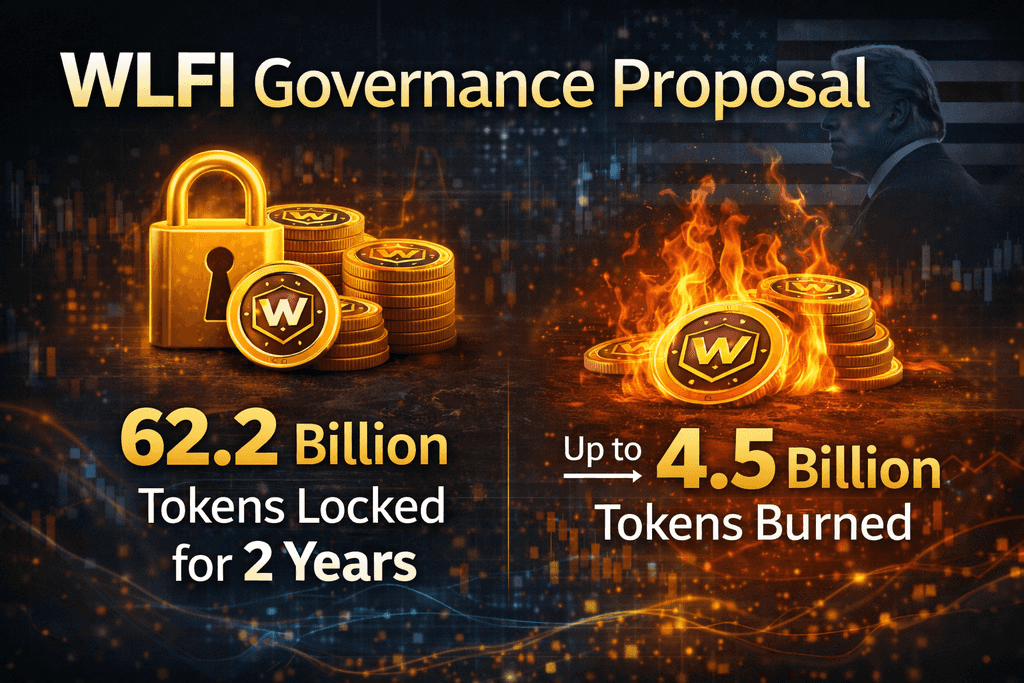
The World Liberty Financial ecosystem is undergoing a seismic shift as the WLFI Governance Proposal introduces a drastic overhaul of its tokenomics to stabilize the protocol’s future. Amidst a turbulent 2026 market, this initiative seeks to address circulating supply concerns by locking billions of tokens and initiating a massive burn to restore investor confidence in the Trump-backed DeFi venture.
This deep dive into the WLFI Governance Proposal Explained explores the strategic implications of the 62.2 billion token lockup and the 4.5 billion token burn on the long-term price action of WLFI.
Key Takeaways:
The April 2026 WLFI Governance Proposal is more than a simple technical update; it is a fundamental pivot in how the project manages its treasury and stakeholder incentives. At its core, the proposal mandates that 62.2 billion WLFI tokens—a staggering portion of the total supply—be moved into a restrictive vesting schedule. Furthermore, it introduces a "tax on commitment," requiring core team members and insiders to immediately burn 10% of their holdings, totaling up to 4.5 billion WLFI tokens. This aggressive contraction of supply is designed to pivot the project from a high-FDV (Fully Diluted Valuation) speculative asset to a scarcity-driven governance token.
This "Commitment Move" comes at a critical juncture. Following a period where critics and high-profile figures like Justin Sun questioned the project's long-term viability, the team is forcing a 5-year roadmap. By locking the majority of tokens until at least 2028, World Liberty Financial is effectively silencing "rug pull" accusations and aligning the interests of the founders with the success of the protocol's flagship product, the USD1 stablecoin. It is a bold gamble: sacrificing short-term liquidity to build a "fortress" balance sheet that can survive multiple market cycles.
The Deep Dive: WLFI Governance Proposal Explained
To understand the magnitude of this change, we must look at the granular details of the distribution. The WLFI Governance Proposal does not treat all holders equally, creating a tiered system of accountability that distinguishes between those who built the platform and those who funded its early stages.
Locking the 62.2 Billion: Who is Affected and for How Long?
The lockup strategy is divided into two primary categories to ensure a staggered entry of tokens into the market, preventing a massive "dump" event in the future:
-
Insiders & Founders: This group, which includes the Trump family, core developers, and advisors, holds the largest share (45.2 billion tokens). They are subject to a 2-year cliff, followed by a 3-year linear vesting period. This means zero liquidity until 2028, with full access only granted by 2031.
-
Early Supporters: Institutional backers and seed investors holding 17.04 billion tokens face a 2-year cliff followed by a 2-year linear vesting schedule. This shorter duration rewards early risk-takers while still ensuring they cannot exit the market during the project's current rebuilding phase.
A controversial aspect of the WLFI Governance Proposal Explained is the "Opt-in or Stay Locked" ultimatum. Existing holders must actively sign a smart contract agreement to participate in this new roadmap. Failure to "opt-in" results in their tokens remaining in a permanent state of non-transferability, essentially rendering them "zombie tokens" that cannot be sold on exchanges.
The Burn Mechanism: Trimming 4.5 Billion Tokens from the Supply
The burn is perhaps the most "bullish" technical aspect of the proposal. Unlike many projects that burn tokens from an unallocated treasury, this proposal requires a 10% immediate burn from the actual holdings of the core team.
By removing 4.5 billion WLFI tokens from existence, the protocol is tackling the "Low Float, High FDV" problem that has plagued many 2024-2025 DeFi launches. Lowering the FDV makes the token more attractive to institutional analysts who use total supply as a primary metric for "fair value" assessments. This reduction directly counters inflation, as these tokens will never enter the circulating supply, theoretically increasing the value of every remaining token in a supply-and-demand equilibrium.
Price Prediction: How Will This Proposal Impact WLFI Value?
The market's reaction to the WLFI Governance Proposal has been a mix of cautious optimism and strategic re-accumulation. When the news broke, WLFI was trading near its 2026 lows of $0.08, a significant drop from its launch-era highs. However, the structural changes proposed here have fundamentally altered the price floor.
The Bull Case: Artificially Engineered Scarcity
The primary driver for a price surge is the "Supply Shock." By removing 62.2 billion tokens from the table, the circulating supply remains tight. If demand for the World Liberty Financial platform grows—specifically through its lending markets—the lack of available tokens on exchanges could lead to a parabolic price recovery.
Furthermore, the WLFI Governance Proposal Explained serves as a signal for a "Confidence Rebound." Long-term lockups are the industry standard for proving a team's intent. As the 2nd anniversary of the project approaches, seeing the founders commit to another 5 years provides the psychological support needed for retail investors to return to the asset, potentially pushing the price back toward the $0.15 - $0.20 range in the mid-term.
The Bear Case: Liquidity Concerns and Regulatory Scrutiny
Conversely, some analysts warn of "Exit Liquidity" fears. Critics argue that by forcing an "opt-in" for locking, the team is merely delaying an inevitable sell-off. There is also the "Justin Sun Factor." The Tron founder has been vocal about the project's centralized governance. If major "whales" or industry leaders continue to distance themselves from WLFI due to its restrictive nature, the token may suffer from low trading volume, making it susceptible to price manipulation or stagnation. Additionally, the heavy involvement of political figures ensures that WLFI remains in the crosshairs of regulators, adding a "political risk premium" that might suppress the price regardless of how many tokens are burned.
Strategic Analysis: Is WLFI Still a Viable DeFi Investment?
Evaluating WLFI as an investment requires looking beyond the WLFI Governance Proposal and into the utility of the ecosystem. The protocol's success is intrinsically linked to the USD1 stablecoin. If USD1 becomes a dominant medium of exchange within the Trump-backed DeFi ecosystem, the WLFI token—as the primary governance and fee-accrual vehicle—gains intrinsic value. The proposal ensures that the governance of this stablecoin remains in the hands of committed stakeholders rather than short-term speculators.
Furthermore, we must consider the 2028 Political Horizon. The 5-year vesting period is not accidental; it aligns perfectly with the conclusion of the current US political cycle. This suggests that the project is positioning itself to be the "financial legacy" of its founders. For investors, this means WLFI is no longer a "meme coin" or a short-term trade; it is a long-term play on the intersection of decentralized finance and political influence. While the risks are high, the structural guardrails put in place by the WLFI Governance Proposal make it one of the most uniquely structured assets in the current crypto landscape.
Conclusion: The Impact of the WLFI Governance Proposal
In summary, the WLFI Governance Proposal represents a massive undertaking to stabilize a project that has often been at the center of controversy. By locking 62.2 billion tokens and committing to a 4.5 billion token burn, World Liberty Financial is effectively resetting its economic clock. While the "opt-in" requirement and long vesting periods may alienate those seeking quick profits, they provide the necessary framework for institutional-grade growth. If the protocol can leverage this period of reduced supply to increase its total value locked (TVL) and stablecoin adoption, the WLFI Governance Proposal Explained will likely be remembered as the moment the project transitioned from a speculative experiment into a mature DeFi powerhouse.
FAQ:
What is the core goal of the WLFI Governance Proposal Explained?
The primary objective of the WLFI Governance Proposal is to stabilize the token's economy by reducing circulating supply and extending the vesting periods for insiders. This move is intended to prove long-term commitment to the project and prevent sudden market crashes caused by large-scale token unlocks.
When will the 4.5 billion WLFI tokens be officially burned?
The burn is scheduled to occur immediately following the successful passage and implementation of the governance vote. Core team members who opt-in to the new 5-year roadmap will have 10% of their holdings permanently removed from the blockchain to lower the FDV.
How does the 2-year cliff affect current secondary market traders?
For retail traders buying on exchanges, the 2-year cliff is a positive indicator. It ensures that 62.2 billion tokens held by founders and early backers cannot be sold on the open market until at least April 2028, significantly reducing the risk of being "dumped" on by insiders.
Will the WLFI price recover to its $0.33 all-time high following this proposal?
While the WLFI Governance Proposal creates the scarcity needed for a rally, reaching the $0.33 mark depends on broader market conditions and the adoption of the USD1 stablecoin. The proposal provides a strong foundation for recovery, but a 300% gain requires sustained demand.