

Will SpaceX and Tesla Merge? Latest Updates on Elon Musk's Potential $3.5 Trillion Deal
Introduction
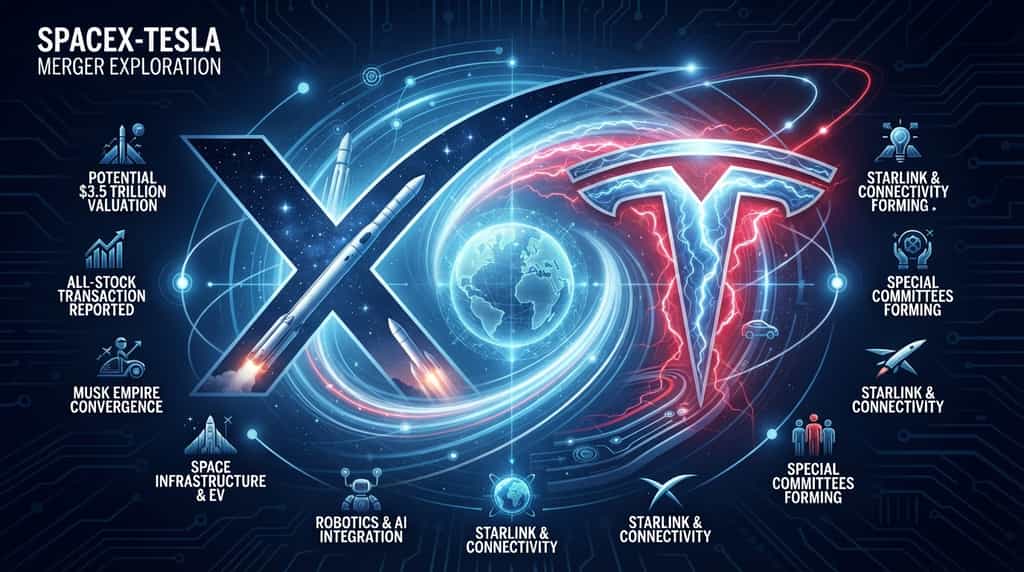
The possibility of a merger between SpaceX and Tesla has drawn attention to Elon Musk’s expanding business empire. A combination could bring electric vehicles, satellite connectivity, artificial intelligence (AI), and space infrastructure under one corporate structure, potentially creating a company valued at around $3.5 trillion.
However, the proposed deal remains under evaluation. Both companies have established special committees to explore a potential combination, but neither has announced a definitive agreement, exchange ratio, or transaction timetable. Here is what is known about the discussions, the strategic rationale, and the obstacles that could determine whether the merger proceeds.
Quick Answer: Are SpaceX and Tesla Going to Merge?
SpaceX and Tesla are exploring a potential business combination, but a merger has not been finalized.
-
Current status: Both companies have formed special committees to evaluate a possible transaction.
-
Potential valuation: Media reports have discussed a combined valuation of approximately $3.5 trillion, based on reported company valuations rather than an agreed transaction price.
-
Possible structure: An all-stock transaction has been reported as one option under discussion.
-
Key obstacles: Shareholder approval, valuation negotiations, corporate governance, and regulatory scrutiny.
-
Timeline: Reports have suggested a possible announcement by the end of 2026 or in early 2027, but no official timetable has been confirmed.
What Is the Latest on the SpaceX-Tesla Merger?
The strongest confirmation of the discussions comes from the companies’ regulatory filings. In their third-quarter 2026 filings, both SpaceX and Tesla disclosed that their boards had established special committees to evaluate a potential combination. SpaceX said its committee had not reached a determination, while Tesla described its committee as comprising disinterested directors.
Neither filing confirmed that the companies had reached an agreement. Both also made clear that any transaction would remain subject to further approvals:
According to media reports, discussions have included a potential all-stock merger, with the companies assessing valuation and the exchange ratio. The reported $3.5 trillion figure represents an estimate of the combined value, not a confirmed deal price.
The distinction matters: forming special committees is a formal step toward evaluating a transaction, but it does not mean that either board has approved a merger.
Why Would Elon Musk Consider Combining SpaceX and Tesla?
A merger could connect several businesses that increasingly overlap in technology, infrastructure, and capital requirements. Three areas are particularly relevant.
-
AI Infrastructure and Computing
AI development requires substantial computing capacity, advanced chips, and reliable energy infrastructure. Tesla has been expanding its AI and autonomous-driving capabilities, while SpaceX has invested in computing infrastructure and related technologies.
Combining the companies could potentially create opportunities to coordinate hardware development, computing resources, and long-term infrastructure investment.
However, the commercial value of such integration remains uncertain. The companies would need to demonstrate that shared resources could generate measurable benefits beyond what they could achieve independently.
-
Robotics and Autonomous Systems
Tesla's work on autonomous driving and humanoid robotics could complement SpaceX's engineering capabilities in automation, manufacturing, and complex systems.
A combined organization might share research, engineering talent, and manufacturing expertise. Yet the extent of these potential synergies would depend on how the businesses are structured and whether their respective operations could be integrated efficiently.
-
Space-Based Connectivity and Infrastructure
SpaceX operates Starlink, its satellite internet business, while Tesla develops electric vehicles and energy products.
A closer relationship could create opportunities in connectivity, vehicle communications, and energy infrastructure. For example, satellite connectivity could become relevant to transportation and remote operations.
These possibilities are strategic arguments for exploring a combination, not evidence that a merger would automatically improve either company's products or financial performance.
How Much Could the Combined SpaceX and Tesla Company Be Worth?
Reports have put the potential combined valuation at approximately $3.5 trillion. This estimate is broadly consistent with reported valuations of roughly $1.9 trillion for SpaceX and $1.55 trillion for Tesla around mid-November 2026. These figures should be treated as market-based estimates, not as an agreed valuation for a transaction.
If the companies pursue an all-stock merger, shareholders would receive shares in the combined entity based on an agreed exchange ratio. Determining that ratio would be one of the most consequential parts of negotiations.
Several factors could complicate the process:
-
Different business models: Tesla operates in automotive and energy markets, while SpaceX generates revenue from launch services, satellite connectivity, and other space-related activities.
-
Different financial profiles: Their growth rates, capital requirements, and risk exposures are not directly comparable.
-
Valuation uncertainty: Private-company valuation and public-market valuation may rely on different assumptions.
-
Shareholder interests: Each company's shareholders would need to assess whether the proposed exchange ratio fairly reflects their interests.
A $3.5 trillion combined valuation therefore should not be interpreted as a guaranteed market value after a merger.
What Could the Merger Mean for Investors?
For investors, the potential combination raises questions beyond the headline valuation.
Tesla shareholders would need to assess how much exposure they would gain to SpaceX's launch, satellite, and AI businesses, as well as how much of Tesla's existing business they would own in the combined company.
SpaceX shareholders, in turn, would need to consider whether gaining exposure to Tesla's automotive and energy operations would offer attractive value relative to retaining their current ownership.
The proposed structure would also matter. An all-stock transaction could avoid a large cash payment, but it would not eliminate valuation risk or the possibility of shareholder dilution.
Until the companies disclose definitive terms, investors should distinguish between confirmed corporate actions and speculation about the transaction's eventual structure and value.
Conclusion
A potential SpaceX-Tesla merger would bring together two of Elon Musk's most prominent businesses and could create a major company spanning automotive technology, energy, satellite connectivity, AI, and space infrastructure. The strategic overlap is significant, particularly in computing, robotics, and advanced engineering.
However, the discussions remain at an exploratory stage. Both companies have established special committees, but neither has confirmed a definitive agreement or disclosed the terms of a transaction. The reported $3.5 trillion valuation and possible all-stock structure should therefore be viewed as estimates and reported negotiation scenarios, not settled deal details.
The outcome will depend on whether the companies can agree on valuation, demonstrate credible long-term synergies, secure shareholder support, and address regulatory and governance concerns. Until more formal disclosures emerge, the proposed combination remains a possibility rather than a completed corporate transaction.
FAQs
-
Are SpaceX and Tesla officially merging?
No. Both companies have established special committees to evaluate a potential business combination, but neither has announced a definitive merger agreement.
-
What is the estimated value of a combined SpaceX and Tesla?
Media reports have discussed a combined valuation of approximately $3.5 trillion. This is an estimate based on reported company valuations, not an agreed transaction price.
-
Would the merger be an all-stock deal?
An all-stock transaction has been reported as a possible structure. However, neither company has officially confirmed the transaction structure or an exchange ratio.
-
Why would Elon Musk want to combine SpaceX and Tesla?
Potential reasons include closer coordination in AI infrastructure, robotics, advanced engineering, satellite connectivity, and computing. Whether these synergies would create additional shareholder value remains uncertain.
-
When could the SpaceX-Tesla merger be completed?
Some reports have suggested a possible announcement by the end of 2026 or in early 2027. No official timetable has been confirmed, and the process would still require the relevant corporate and regulatory approvals.
Disclaimer: This general market information may come from third-party, commercial, or sponsored sources and is provided for informational and educational purposes only. It does not constitute financial or investment advice, an offer, a solicitation, or a guarantee. We assume no responsibility for the accuracy, completeness, or reliability of this information or for any losses arising from its use.
Investing and trading involve risks. Past performance does not guarantee future results. Users should conduct their own research, exercise sound judgment, and take full responsibility for their decisions. For more information, please refer to KuCoin's Terms of Use and Risk Disclosure.