

Why Does Grayscale Expect Crypto Growth to Continue After the 2026 US Midterm Elections?
Introduction
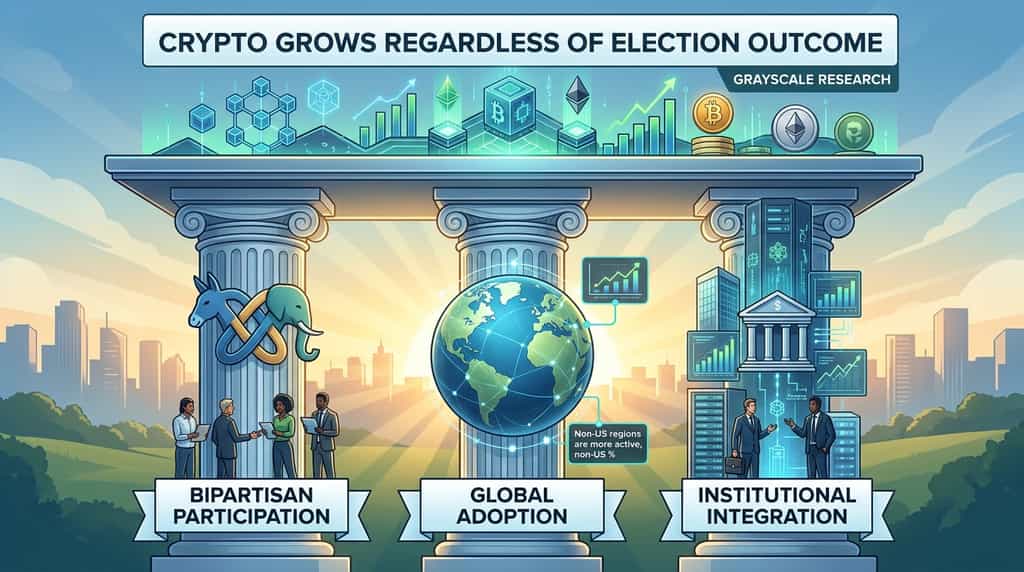
The 2026 US midterm elections have changed the political landscape in Washington, but Grayscale believes the long-term development of the cryptocurrency industry is unlikely to depend on which party controls Congress. Following the Democratic Party’s victories in both chambers, concerns have emerged that US digital asset legislation could face additional delays. However, Grayscale argues that three structural forces—bipartisan participation, international adoption, and institutional integration—will continue supporting the industry.
This distinction is important: a change in congressional control could affect the pace of US regulatory reform without reversing developments already taking place across global markets. The outlook therefore depends on more than election results or the progress of individual bills.
Quick Answer: Why Does Grayscale Expect Crypto Growth to Continue?
Grayscale's October 28, 2026 research argues that cryptocurrency adoption can continue regardless of the US midterm election outcome for three main reasons:
-
Bipartisan participation: Cryptocurrency ownership and use are not confined to one political party, creating a broader constituency for digital asset development.
-
Global adoption: Grayscale estimates that approximately 80%–85% of global crypto activity takes place outside the United States.
-
Institutional integration: Asset managers, payment companies, and financial institutions are increasingly incorporating digital assets, stablecoins, and blockchain infrastructure into their businesses.
A Democratic-controlled Congress could make some new US crypto legislation more difficult to advance. However, existing regulatory frameworks, international demand, and private-sector investment provide other sources of momentum.
What Is Grayscale's Argument About Crypto Growth After the Midterms?
Grayscale's central argument is that the cryptocurrency industry has developed beyond the influence of any single US administration or Congress. In its October 28 research note, Crypto Will Move Forward Regardless of Outcome of US Midterms, Grayscale Head of Research Zach Pandl identified three characteristics that underpin this outlook: cryptocurrency is bipartisan, global, and increasingly institutional.
These characteristics help explain why political changes in Washington may influence the industry's direction without determining its overall trajectory.
First, cryptocurrency has support across the political spectrum. Digital asset ownership and participation are not exclusive to Republican voters or Democratic voters. Grayscale points to research from Pew Research and The Harris Poll indicating broadly similar levels of crypto ownership and use among the two groups. The bipartisan passage of the GENIUS Act also demonstrates that at least some digital asset legislation can attract support from both parties.
Second, cryptocurrency adoption extends well beyond the United States. Users and businesses in other regions continue to explore digital assets for payments, access to dollar-denominated value, and financial services. Regulatory developments in other jurisdictions also influence where companies build products and expand operations.
Third, institutional adoption has connected blockchain technology with traditional financial infrastructure. Asset managers are developing tokenized investment products, payment providers are exploring stablecoin settlement, and exchange-traded products have made digital asset exposure more accessible through established financial markets.
Grayscale's argument is not that elections have no effect on crypto. Rather, political decisions are one influence among several, and the industry's broader foundations are no longer exclusively dependent on Washington.
Why Does BlackRock Also Expect Limited Disruption to Its Crypto Business?
BlackRock's institutional perspective provides another angle on why the cryptocurrency industry may continue developing despite political changes in Washington. The asset manager has increasingly incorporated digital assets into its research and investment strategies, particularly in relation to Bitcoin, Ethereum, and tokenization.
In its August 17, 2026 research report, Re-Underwriting Bitcoin: Still a Portfolio Diversifier, BlackRock examined Bitcoin's potential role in diversified portfolios. The report highlighted Bitcoin's distinctive long-term risk and return characteristics, while acknowledging its volatility and changing correlations with traditional financial assets.
BlackRock has also published research on the convergence of blockchain technology and institutional finance. Its October 5, 2026 report, The Machine-Native Economy: AI and Digital Assets, discusses how stablecoins and blockchain-based payment infrastructure could support machine-to-machine transactions as AI adoption expands. This illustrates that BlackRock's digital asset research extends beyond Bitcoin investment products into potential financial infrastructure applications.
Regarding the election itself, Robert Mitchnick, BlackRock's Head of Digital Assets, reportedly said at the November 3 ETF Investor Forum that the results would have limited influence on the firm's crypto product launches and investment flows. He argued that Bitcoin and Ethereum already have much of the regulatory clarity needed for investment products. This specific statement was reported by CoinDesk, rather than published in a BlackRock announcement.
The distinction matters: established Bitcoin and Ethereum investment products operate in a more developed regulatory environment than emerging areas such as decentralized finance and tokenized securities. Consequently, political changes may have different implications across different segments of the digital asset industry.
Which Parts of the Crypto Industry Could Be More Exposed to Political Changes?
The impact of the election is likely to vary by sector. Established products and activities operating under existing rules may be less immediately affected than businesses that depend on new legislation or regulatory approvals.
| Crypto sector | Potential impact of the election | Key consideration |
| Bitcoin and Ethereum investment products | Potentially more limited near-term disruption | Existing product frameworks and regulatory precedents |
| Payment stablecoins | Existing federal framework remains relevant | Implementation, issuer requirements, and supervisory rules |
| Tokenized securities | Continued development, but regulatory uncertainty remains | Securities laws and agency guidance |
| Crypto trading platforms | Greater uncertainty around comprehensive market rules | Market structure, custody, and regulatory responsibilities |
| DeFi and emerging digital assets | Potentially greater exposure to legislative delays | Classification, oversight, and consumer protection |
These are qualitative distinctions, not predictions that one sector will necessarily outperform another. Regulatory developments can also affect businesses differently depending on their products, jurisdictions, and operating structures.
Institutional custody is one example of an area where regulatory implementation may matter even without a new market-structure law. On October 1, 2026, the SEC proposed changes addressing the custody of certain crypto assets by registered investment advisers and regulated funds. KuCoin has examined the implications in its article, SEC Proposes Crypto Custody Rules.
The proposal illustrates why the regulatory outlook should not be reduced to congressional election results alone. Agency rulemaking and the implementation of existing laws can also shape institutional participation.
What Should Market Participants Watch After the 2026 Midterm Elections?
The most useful way to assess the post-election crypto environment is to monitor concrete policy and market developments rather than treating the election result as a standalone indicator.
Five areas deserve particular attention:
-
CLARITY Act negotiations: Watch whether lawmakers introduce a revised proposal, build bipartisan support, or postpone further consideration. The legislation's progress will provide a clearer indication of the US market-structure outlook.
-
GENIUS Act implementation: Monitor federal rulemaking, issuer requirements, reserve standards, and supervisory arrangements. These developments will influence how the payment stablecoin framework operates in practice.
-
SEC and CFTC activity: Agency proposals, final rules, interpretive guidance, and enforcement priorities can affect the operating environment for digital asset businesses. Their actions should be evaluated separately from congressional legislation.
-
Institutional product development: Track new investment products, fund flows, custody services, and tokenization initiatives. These indicators can help show whether institutional participation is expanding or becoming more selective.
-
International adoption: Examine stablecoin payment activity, regional regulatory frameworks, and blockchain-based financial services outside the United States. These developments are particularly relevant to Grayscale's argument that global adoption provides an independent source of growth.
Together, these indicators offer a more complete picture than simply asking whether the election was positive or negative for cryptocurrency.
Conclusion
Grayscale's expectation that crypto growth can continue after the 2026 US midterm elections rests on a structural argument: the industry is no longer dependent on the political direction of one country. Bipartisan participation, international demand, and institutional integration have created sources of development that extend beyond Washington.
However, this outlook should not be interpreted as evidence that US politics has become irrelevant. Democratic control of Congress could complicate the passage of the CLARITY Act and delay the creation of a more comprehensive market-structure framework. Regulatory uncertainty may therefore remain a meaningful consideration for businesses operating in the United States, particularly in emerging areas of digital finance.
BlackRock's comments offer a complementary perspective, suggesting that established Bitcoin and Ethereum investment products may be less exposed to immediate political changes than sectors still awaiting clearer rules. Ultimately, the industry's direction will depend on the interaction between legislation, regulatory implementation, institutional investment, and international adoption—not on election results alone.
FAQs
-
Why does Grayscale believe crypto growth will continue after the 2026 US midterm elections?
Grayscale identifies three structural drivers: bipartisan participation, global adoption, and institutional integration. It argues that these factors have deeper foundations than the policy priorities of any single US administration or Congress.
-
Why does BlackRock expect limited disruption to its crypto business?
BlackRock's Head of Digital Assets, Robert Mitchnick, reportedly said before the election results were known that the outcome was unlikely to materially affect the firm's product launches or investment flows. He pointed to the regulatory clarity already available for Bitcoin and Ethereum investment products.
-
Does Grayscale's outlook mean Bitcoin and other cryptocurrencies will rise in price?
No. Grayscale's argument concerns the long-term development of the cryptocurrency industry, not a prediction of short-term market prices. Digital asset valuations remain subject to market liquidity, investor demand, macroeconomic conditions, regulation, and asset-specific risks.
Disclaimer
This general market information, possibly from third-party, commercial, or sponsored sources, is provided for reference and educational purposes only and does not constitute financial or investment advice, an offer, solicitation, or guarantee. We disclaim liability for its accuracy, completeness, reliability, and any resulting losses. Investments/trading are risky; past performance doesn’t guarantee future results. Users should research, judge prudently, and take full responsibility. For further details, please consult KuCoin’s Terms of Use and Risk Disclosure."