

J.P. Morgan Assesses Treasury Yield Stickiness Driven by AI Capex Borrowing and QT
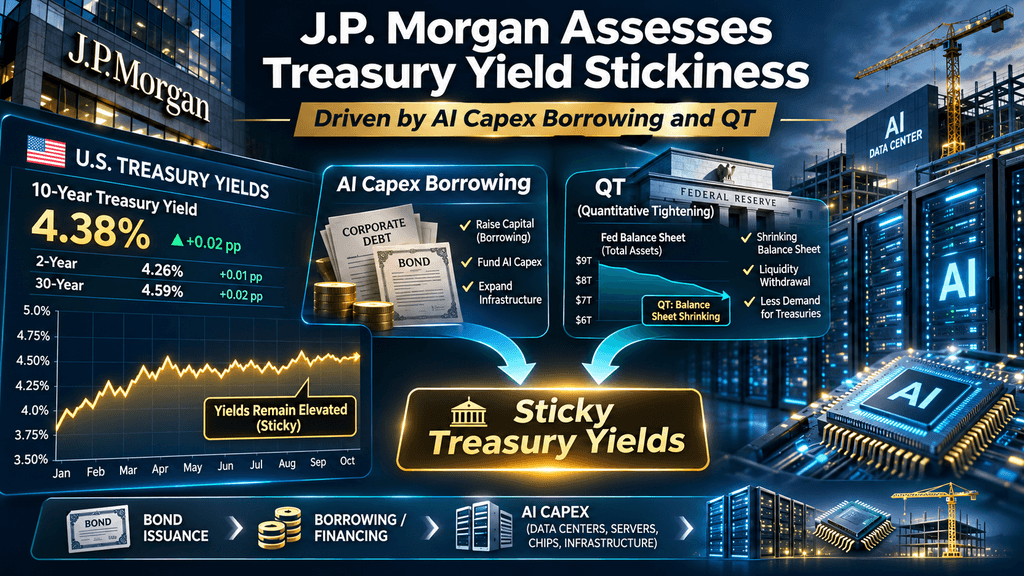
Sovereign bond yields continue to face structural pressures that make significant declines difficult, even as some inflationary concerns begin to ease. Seamus Mac Gorain, head of global rates at J.P. Morgan Asset Management, explains that heavy government debt issuance, increased corporate borrowing to finance the growing infrastructure needs of artificial intelligence, and ongoing quantitative tightening have changed the balance between supply and demand in fixed-income markets. The 10-year U.S. Treasury yield has notably reached the 5% mark for only the second time since 2007. J.P. Morgan Asset Management views this level as strategically attractive, although several factors continue to limit the potential for yields to fall further.
This analysis examines how rising investment in artificial intelligence infrastructure is adding to the supply of long-term debt, while central banks continue to reduce their balance sheets and governments maintain substantial borrowing programmes. Together, these developments are keeping long-term yields elevated, with wider implications for financial markets and investors. Their combined effect creates a more challenging environment for sovereign bonds, making it important for market participants to look beyond inflation trends when assessing the direction of yields.
Key Takeaways
-
AI hyperscaler bond issuance competes directly with Treasuries for long-duration capital, supporting elevated yields.
-
Quantitative tightening forces private markets to absorb more bonds as central banks shrink crisis-era portfolios.
-
Heavy sovereign issuance, projected at record levels by the OECD, adds persistent supply pressure.
-
The 10-year Treasury is expected to trade in a 4.5%–5.25% range until AI-related borrowing slows after 2027.
-
Productivity gains from AI have yet to offset the near-term demand and inflation effects of the buildout.
-
Cash-flow improvement at major tech firms could eventually reduce external funding needs and ease the supply overhang.
Why Are Treasury Yields Remaining Sticky Despite Some Inflation Cooling
Long-term yields are influenced by more than expectations about where interest rates are heading. They also reflect the additional return investors demand for holding longer-term bonds, the amount of debt governments and companies issue, and competition for available capital. At present, three major factors are putting pressure on bond markets: heavy government borrowing, corporate debt raised to fund data centers and other AI infrastructure, and the continued reduction of bond holdings by central banks.
Mac Gorain has described the current period as one in which pressure from AI-related borrowing on bond markets is approaching its peak. Lower energy prices can help bring down headline inflation and trigger modest rallies in bonds. However, any sustained decline in yields faces a significant obstacle: the sheer volume of new debt entering the market. Governments have shown little willingness to rein in borrowing, with earlier OECD projections pointing to around $18 trillion in sovereign bond issuance in 2026. At the same time, hyperscalers and other companies involved in AI infrastructure are issuing more corporate debt to finance their expansion. Much of this borrowing is concentrated in longer-dated bonds, putting them in direct competition with government debt at the longer end of the yield curve.
Central banks are adding to this pressure through quantitative tightening, which gradually reduces the amount of bonds they hold and leaves private investors, pension funds, insurers, asset managers, and foreign buyers to absorb more of the supply. The Federal Reserve and Bank of England have slowed the pace of this process, while the European Central Bank has continued with its approach. This leaves the bond market facing a growing volume of debt competing for a relatively limited pool of buyers. As a result, yields have struggled to fall significantly, even when economic growth slows or inflation figures begin to ease.
What are the Key Factors Keeping U.S. Treasury Yields Elevated
U.S. Treasury yields remain elevated as several forces continue to put pressure on the bond market. Persistent government borrowing has increased the supply of Treasury securities, while heavy spending on AI infrastructure is adding to corporate demand for financing.
At the same time, the Federal Reserve’s quantitative tightening program has reduced its presence as a major bond buyer. Inflation concerns and uncertainty over future interest rates have also made investors demand higher returns for holding long-term debt. The table below highlights the main factors driving these conditions.
|
Factor
|
Market impact
|
|
AI borrowing
|
More corporate bonds compete with Treasuries.
|
|
Government debt
|
Heavy issuance increases bond supply.
|
|
Quantitative tightening
|
Central banks reduce bond demand.
|
How Is AI Capital Expenditure Driving Corporate Bond Issuance
Major technology companies running large cloud and AI operations have been spending heavily on data centers, advanced chips, power infrastructure, and other facilities needed to support their expansion. However, when the cash generated by their businesses is not enough to cover these investments, they increasingly turn to the bond market for additional funding. Several market analyses show that AI-related borrowing has grown significantly in 2026, making up a considerable share of total U.S. investment-grade corporate bond issuance. Some estimates put that share at 20% or more during certain periods, with an even higher concentration in bonds with longer maturities.
Hyperscalers have collectively issued tens or even hundreds of billions of dollars in bonds this year to finance their infrastructure expansion. Many of these companies have strong credit ratings, making their debt attractive to the same long-term investors who typically buy U.S. Treasuries and high-quality corporate bonds. This creates more competition for available investment capital and can push yields higher across the longer end of the bond market. Much of this borrowing is concentrated in longer maturities, adding to the supply of long-term debt at a time when the U.S. Treasury is also issuing more long-dated bonds to finance government deficits.
Looking further ahead, forecasts suggest that capital spending by major technology companies could keep increasing into 2027. A substantial portion of these investments may still require external financing until the companies begin generating stronger cash flows from their AI operations. Research from J.P. Morgan and related market commentary suggests that free cash flow could improve later in the decade as profit margins expand and the pace of investment begins to moderate. If that happens, companies may become less dependent on borrowing after 2027. For now, however, the steady flow of AI-related bond issuance remains an important source of additional supply in the corporate debt market.
What Role Does Quantitative Tightening Play in Yield Stickiness
Quantitative tightening (QT) takes away a major buyer from the bond market, leaving private investors to absorb more of the available supply. During the years of large-scale asset purchases, central banks bought significant amounts of government and, in some cases, corporate bonds. As these holdings gradually mature or are sold, private investors are left to take their place.
This adds more bonds to the market that need to be absorbed by investors. Although the pace of QT has slowed, its accumulated effects continue to add to the pressure from government and corporate borrowing. Mac Gorain has pointed to QT, alongside government borrowing and AI-related debt issuance, as one of the main reasons significant bond rallies may struggle to gain momentum. In Europe, where the AI investment boom has been less pronounced, the combination of rising borrowing costs and continued QT has attracted particular attention. Possible policy changes under new leadership have also been identified as a potential factor that could alter the outlook.
What makes this particularly important is that QT does not follow the same cycle as private-sector borrowing. It is a deliberate central bank policy that can continue for several years until balance-sheet reduction targets are achieved. This means it can remain a source of pressure on bond markets even when AI-related borrowing begins to slow.
How Does Heavy Government Borrowing Interact With Private AI Financing
Fiscal deficits remain high across many advanced economies, while rising interest rates have made government borrowing more expensive. As yields increase, governments spend more on servicing existing debt, which often means issuing even more bonds to cover their financing needs. This creates a cycle that puts further pressure on bond markets. The OECD’s forecast of record sovereign bond supply highlights the scale of the challenge. In the United States, Treasury issuance also remains substantial, adding to the competition for investor capital as companies seek funding through corporate bonds.
The growing volume of corporate bonds from AI-related issuers adds another layer of pressure, particularly when companies issue large amounts of debt with longer maturities. These bonds can attract investors who might otherwise put their money into US Treasuries. This creates competition for the same pool of long-term fixed-income investors, including insurers, pension funds, and official institutions. The pressure is particularly noticeable at the longer end of the yield curve, where 20- and 30-year Treasury bonds compete with long-dated corporate debt for investors seeking long-term returns.
Mac Gorain has also noted that the fiscal "dam has burst" to some extent, reflecting how governments have become more willing to increase spending. This makes a sharp reduction in government borrowing less likely in the near term, leaving little room for a meaningful drop in sovereign bond supply that could help ease pressure on yields.
What Range Does J.P. Morgan See for the 10-Year Treasury Yield
The firm considers the recent rise in the 10-year Treasury yield to around 5% an attractive opportunity from a strategic standpoint. Mac Gorain expects yields to remain within a range of roughly 4.5% to 5.25% until the balance between bond supply and demand improves. Even if yields move toward the lower end of this range, investors would still earn meaningful returns compared with levels seen in recent years.
This outlook reflects expectations that AI-related borrowing will continue into 2027, although companies may increasingly favour shorter-term debt. At the same time, government bond issuance is expected to remain high, while quantitative tightening (QT) continues. For yields to fall more consistently, several things may need to happen, including slower borrowing by hyperscalers as their cash flows improve, some easing in fiscal deficits, or further changes to central-bank balance-sheet policies. Market volatility could still push yields lower temporarily, particularly during periods of equity market stress. However, the underlying supply pressures could limit both the size and duration of any decline.
How Might AI Productivity Gains Eventually Affect Rates
The current AI investment boom is increasing demand for physical resources, including labour, raw materials, electricity, and construction capacity. This is adding to inflationary pressures in sectors connected to the expansion. However, the productivity gains expected from AI, which could boost potential growth and ease pressure on available resources, have yet to show up widely in economic data. If these benefits become more visible over time, they could support higher equilibrium real interest rates by strengthening economic growth. They could also improve corporate cash flows and reduce companies' reliance on external financing.
For now, the immediate effect is an increase in the supply of long-term debt and upward pressure on borrowing costs. Analysts do not fully agree on how much AI-related borrowing has contributed to recent increases in Treasury yields. While some believe it has played a significant role, others point to broader fiscal and monetary policy factors. Still, there is general agreement that the scale of AI investment is large enough to have an additional impact on long-term interest rates.
What Are the Impacts for Different Market Sectors
Higher and persistent long-term yields increase borrowing costs for capital-intensive industries beyond the main AI sector, as well as businesses and borrowers carrying substantial debt. Companies with stronger balance sheets and direct exposure to AI growth are generally better equipped to handle these conditions and may even benefit from them. Banks could also see an initial boost from higher net interest income, although keeping rates elevated for too long can eventually slow loan demand and reduce activity in capital markets.
For fixed-income investors, higher yields offer more attractive entry points into government and high-quality corporate bonds. However, investors still need to pay close attention to duration and credit risks when making allocation decisions. Differences in how investors value sovereign markets, including European issuers, also reflect variations in fiscal strength and the amount of bonds each government brings to the market.
Equity valuations, especially those of growth companies whose expected earnings lie further in the future, remain highly sensitive to interest rates. Rising Treasury yields make bonds more attractive relative to equities, putting pressure on stock valuations. That pressure may continue until stronger earnings growth or improvements in productivity provide enough support to justify higher valuations.
When Could Supply Pressure From AI Capex Begin to Ease
Corporate bond issuance is the most flexible of the three major factors driving supply. Hyperscalers are likely to remain active in debt markets in 2027, although they may begin issuing shorter-term bonds, with overall borrowing potentially declining once their free cash flow becomes consistently positive. J.P. Morgan's analysis suggests this shift could happen later in the decade as operating margins improve and the most expensive phase of AI infrastructure development begins to wind down.
Government borrowing and quantitative tightening (QT), however, are likely to change more slowly. Significant fiscal consolidation would require policy changes that currently seem unlikely, while QT is expected to continue until central banks achieve their balance-sheet targets. A gradual reduction in external funding needs for AI projects, a possible slowdown in QT, and the longer-term productivity gains from AI could eventually help bring bond supply and demand into better balance, putting downward pressure on yields.
How Should Investors Approach Fixed Income in This Environment
With the 10-year Treasury yield hovering near levels rarely seen over the past two decades, apart from brief spikes, investors are earning more income than they did during the prolonged low-rate period. Several asset managers have pointed to opportunities in intermediate-term, high-quality corporate bonds, selective government debt, and strategies that limit exposure to longer-term bonds. Market volatility driven by equity movements and policy announcements may also create attractive entry points. However, the underlying pressure from heavy bond issuance makes a quick return to the low-yield environment of the 2010s unlikely.
Tradesmen monitoring hyperscalers' free cash flow, Treasury auction results, and central bank balance sheet updates may get the clearest indication of when supply pressures start to ease. Until those trends change, Treasury yields are likely to remain elevated.
FAQs
How do sticky long-term yields affect mortgage rates and housing affordability?
Long-term Treasury yields play an important role in determining 30-year fixed mortgage rates. When 10-year and 30-year yields remain elevated due to heavy government borrowing, AI-related corporate debt issuance, and quantitative tightening, mortgage rates also tend to stay high. This increases monthly payments for new homebuyers and people refinancing existing loans, reduces housing affordability, and can slow home sales and overall market activity until bond market supply pressures begin to ease.
What signals would indicate that the pressure on yields from AI Capex is beginning to fade?
Key indicators include a sustained improvement in free cash flow at major hyperscalers, a clear shift in their bond issuance toward shorter maturities, and a measurable slowdown in the volume of long-dated AI-related corporate debt coming to market. Additional confirmation would come from Treasury auction demand improving at lower yields and any further deceleration in the pace of quantitative tightening by major central banks.
How does the current environment differ from previous periods of rising Treasury yields?
Earlier cycles of higher yields were driven primarily by strong growth, rising inflation expectations, or aggressive monetary tightening. The present episode adds a distinct layer of structural duration supply from large-scale AI infrastructure financing that competes directly with Treasuries for the same long-term investor base, alongside ongoing quantitative tightening and elevated fiscal issuance. This combination creates stickiness that is less purely cyclical than in prior episodes.
What role do foreign investors and official institutions play in absorbing the extra supply?
Foreign buyers, pension funds, insurers, and official institutions remain important sources of demand for both Treasuries and high-quality corporate bonds. When AI-related issuance expands the pool of long-duration paper available, these investors can reallocate between government and corporate securities. Any reduction in their net purchases of Treasuries, or a preference shift toward the higher-yielding AI-linked corporates, reinforces upward pressure on government yields.
Could a sharp slowdown in AI capital expenditure reverse the current yield stickiness quickly?
A quick pullback in AI Capex would reduce one of the three main sources of duration supply and could allow yields to move lower, particularly if it coincides with slower government issuance or further easing of quantitative tightening. However, the other two drivers, fiscal deficits and the runoff of central-bank holdings, would still need to moderate for a durable decline, so the impact would depend on the breadth of the slowdown rather than AI spending alone.
Disclaimer: This general market information, possibly from third-party, commercial, or sponsored sources, is provided for reference and educational purposes only and does not constitute financial or investment advice, an offer, solicitation, or guarantee. We disclaim liability for its accuracy, completeness, reliability, and any resulting losses. Investments/trading are risky; past performance doesn’t guarantee future results. Users should research, judge prudently, and take full responsibility. For further details, please consult KuCoin’s Terms of Use and Risk Disclosure.