

Why Are Space Data Centers Emerging as a Viable Solution for AI Infrastructure?
Introduction
The rapid expansion of artificial intelligence workloads has driven global demand for high-density computing power to unprecedented levels. As data centers consume immense amounts of electricity and face localized grid constraints, alternative energy and location strategies have moved to the forefront of industry discourse. Among these, orbital data centers—proposed to harness uninterrupted solar power in space—have gained attention as a potential long-term architectural shift for high-performance computing. Understanding the technical and economic implications of space-based data processing is essential for stakeholders evaluating the future of global technology infrastructure.
Key Takeaways
-
Core Conclusion: Orbital data centers represent an exploratory concept aimed at bypassing terrestrial power limitations and cooling constraints associated with large-scale artificial intelligence clusters.
-
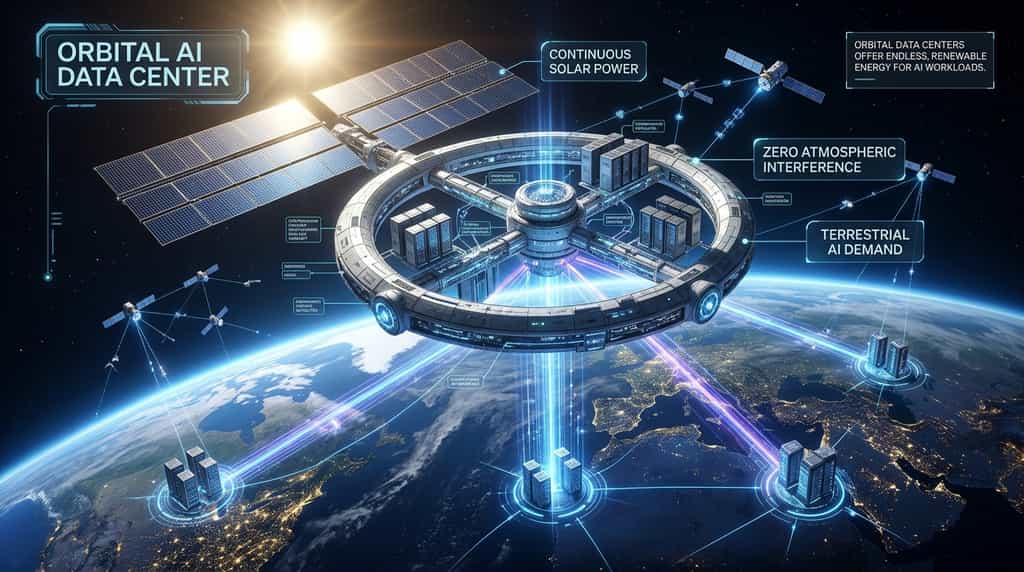
Power Availability: Solar power generation in space operates without atmospheric interference or night-cycle interruptions, offering continuous energy supply for intensive computing tasks.
-
Political Pressures: Recent shifts in Washington, marked by a Democratic legislative majority, have intensified scrutiny on corporate capital expenditures, energy consumption, and environmental footprints related to artificial intelligence expansion.
-
Technical Hurdles: Launch costs, hardware radiation shielding, and thermal dissipation in a vacuum present significant engineering challenges that currently limit commercial viability.
-
Terrestrial Alternatives: Near-term scalability relies on terrestrial innovations, including advanced liquid cooling, small modular nuclear reactors, and decentralized edge computing networks.
What Drives the Proposal for Space-Based Data Centers?
Terrestrial data centers dedicated to training and operating advanced artificial intelligence models require vast amounts of electrical power and sophisticated cooling systems. As local power grids struggle to keep pace with multi-gigawatt facilities, technology leaders are exploring unconventional deployment environments.
As of November 2026, discussions surrounding orbital infrastructure gained momentum following public commentary by industry executives regarding the long-term limits of Earth-bound power grids. Placing server clusters in low Earth orbit or higher orbits offers potential advantages, primarily unobstructed solar exposure. Without atmospheric attenuation or weather disruptions, solar arrays in space can generate power continuously.
Furthermore, the cold vacuum of space offers unique thermodynamic properties for radiative cooling, though managing heat dissipation without conductive mediums like air or liquid presents a complex engineering paradox. Proponents argue that as launch costs decline through reusable rocketry, placing specialized compute nodes in orbit could eventually alleviate strain on terrestrial power grids.
How Do Political Shifts Influence the Artificial Intelligence and Technology Sector?
Government policy and legislative priorities significantly shape capital allocation strategies across the technology sector. Following the recent US elections, a Democratic sweep of congressional authority introduced new variables for artificial intelligence developers and semiconductor manufacturers.
-
Environmental Scrutiny: Lawmakers aligned with environmental protection priorities are increasingly examining the carbon footprint and water usage of hyper-scale computing facilities.
-
Grid Regulation: Federal and state regulators face mounting pressure to prioritize residential and industrial power stability over massive data center consumption, potentially leading to stricter interconnection tariffs.
-
Capital Expenditure Reassessment: Publicly traded technology enterprises are re-evaluating long-term capital deployment as market analysts weigh regulatory compliance costs against projected artificial intelligence monetization timelines.
These regulatory and political pressures encourage technology companies to research unconventional engineering solutions, expanding the theoretical horizon beyond traditional terrestrial zoning and permitting constraints.
What Are the Technical and Economic Barriers to Orbital Computing?
Despite theoretical advantages, implementing orbital data centers involves overcoming formidable physical and economic obstacles. The harsh environment of space introduces severe degradation factors that do not affect terrestrial servers.
-
Radiation Damage: Cosmic rays and solar particle events cause bit flips and degrade semiconductor components, requiring specialized radiation-hardened silicon or redundant error-correction architectures.
-
Latency Constraints: Data transmission between Earth and orbital nodes introduces propagation delay, making space-based clusters unsuitable for latency-sensitive applications like real-time financial trading or interactive consumer AI.
-
Launch and Maintenance Costs: Transporting heavy server racks, power distribution units, and station-keeping propulsion systems into orbit remains capital-intensive, and physical hardware repairs are virtually impossible once deployed.
Consequently, while space data centers capture public imagination as a futuristic engineering frontier, commercial deployment remains speculative compared to terrestrial optimization efforts.
How Are Terrestrial Data Centers Adapting to Energy Constraints?
While orbital concepts represent long-term exploration, data center operators address immediate power bottlenecks through localized innovations. Rather than waiting for space-based solutions, the industry focuses on efficiency gains and alternative terrestrial power sources.
-
Advanced Cooling Technologies: Direct-to-chip liquid cooling and immersion cooling systems significantly reduce the energy required to maintain optimal operating temperatures for high-density graphics processing units (GPUs).
-
Dedicated Power Purchase Agreements: Technology companies increasingly partner with nuclear energy providers, geothermal developers, and wind farms to secure dedicated, carbon-free baseload power.
-
Modular Infrastructure: Prefabricated, containerized data centers deployed near remote energy production sites help bypass congested transmission lines and urban zoning delays.
These strategies allow operators to scale computational capacity while mitigating regulatory and environmental resistance on Earth.
What Should Observers Consider Regarding Future Infrastructure Trends?
Evaluating the trajectory of artificial intelligence infrastructure requires separating near-term engineering realities from long-term speculative proposals. Stakeholders monitoring the sector should focus on several critical developments:
-
Energy Tariffs and Siting: Regulatory decisions regarding grid access and power pricing will dictate the geographic distribution of future data center investments.
-
Hardware Efficiency: Innovations in application-specific integrated circuits (ASICs) and neuromorphic computing could reduce power demands per inference, altering the fundamental scaling equations.
-
Aerospace Advancements: Reductions in orbital launch costs and improvements in satellite servicing technology will gradually redefine the economic feasibility of space-based manufacturing and computing.
Understanding these dynamics provides a clearer perspective on how the technology industry plans to sustain exponential computational growth amidst physical and political boundaries.
FAQs
Why are space data centers being proposed for artificial intelligence workloads?
Space data centers are proposed to access continuous, unobstructed solar power and bypass terrestrial power grid limitations and environmental restrictions associated with massive data center buildouts.
What are the primary technical challenges facing orbital computing?
Key challenges include severe cosmic radiation damage to semiconductors, high launch costs, physical maintenance limitations, and signal latency for data transmission between Earth and space.
How do political shifts in Washington affect the artificial intelligence sector?
A Democratic majority in legislative bodies often brings heightened scrutiny regarding corporate energy consumption, carbon emissions, and capital expenditures, prompting firms to explore alternative infrastructure strategies.
Are space data centers a viable solution for real-time applications?
No. Latency caused by distance and signal propagation makes orbital data centers impractical for real-time, low-latency applications, though they could support asynchronous batch processing.
How are terrestrial data centers addressing power shortages in the near term?
Operators are adopting advanced liquid cooling technologies, securing dedicated clean energy sources like nuclear power, and deploying modular facilities near remote energy generation sites.
Disclaimer
This general market information, possibly from third-party, commercial, or sponsored sources, is provided for reference and educational purposes only and does not constitute financial or investment advice, an offer, solicitation, or guarantee. We disclaim liability for its accuracy, completeness, reliability, and any resulting losses. Investments/trading are risky; past performance doesn’t guarantee future results. Users should research, judge prudently, and take full responsibility. For further details, please consult KuCoin’s Terms of Use and Risk Disclosure.