

Why Are Bitcoin Miners Oversold Following the 35% October Rout, According to VanEck?
Introduction
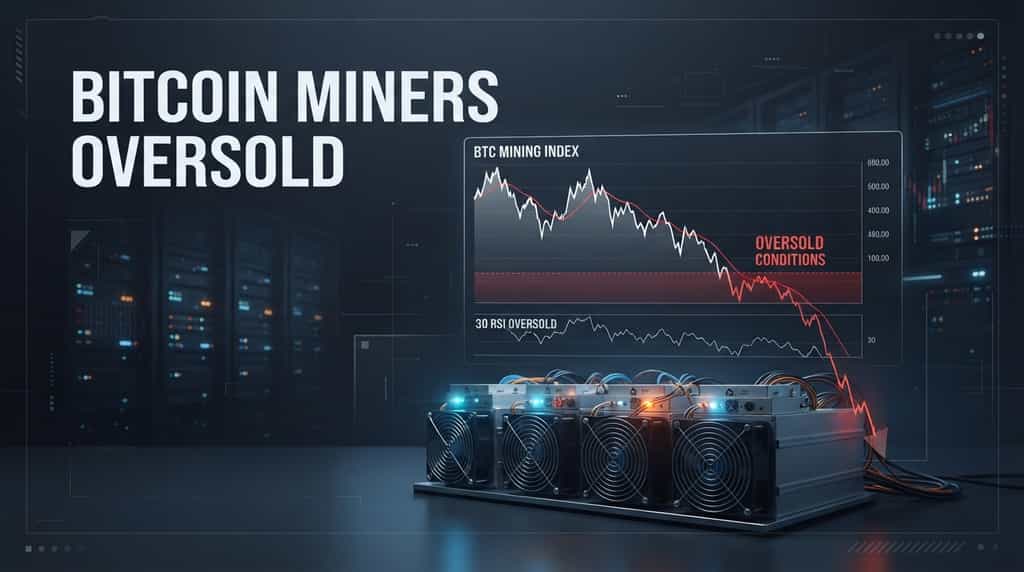
The digital asset mining sector experienced severe downward pressure throughout October, culminating in a significant 35% market correction across major enterprise mining equities. According to recent analysis published by investment management firm VanEck on November 5, 2026, this steep market drawdown has pushed publicly traded mining companies into oversold territory. This contraction reflects a convergence of rising network difficulty, compressed profit margins, and shifting capital allocations among institutional investors. Understanding the underlying drivers of this sector-wide correction provides vital context for evaluating the operational and financial health of proof-of-work infrastructure providers.
Key Takeaways
-
Core Conclusion: Bitcoin miners are considered oversold following a 35% October rout primarily due to compressed mining profitability, surging hash rate difficulty, and broader macroeconomic headwinds that disproportionately impacted high-beta digital asset equities.
-
Profit Margin Compression: Operational costs, driven by rising electricity tariffs and hardware depreciation, intensified as block rewards failed to offset expanding network difficulty.
-
Network Difficulty Growth: The total computational power securing the blockchain continued to scale upward throughout the autumn, driving up the energy and capital required to mine each individual block.
-
Market Sentiment Shifts: Institutional capital reallocations away from capital-intensive infrastructure plays toward liquid tokens amplified the downward price discovery in mining equities.
-
Historical Valuation Baselines: Despite the sharp correction, analysts note that operational efficiency and alternative revenue streams, such as high-performance computing (HPC) hosting, provide downside support for fundamentally robust mining operators.
What Caused the 35% October Rout in Bitcoin Mining Equities?
The 35% contraction in mining stock valuations during October 2026 stems from a combination of protocol-level dynamics, operational overheads, and shifting market liquidity. Unlike direct holders of digital assets, enterprise-grade miners operate as industrial enterprises with fixed overhead expenses, making their equity valuations highly sensitive to changes in operational margins.
According to VanEck’s market assessment, the primary catalyst was the widening gap between operational expenditures—specifically energy costs—and the revenue generated per terahash of computing power. As network hash rates climbed throughout the third quarter, the difficulty adjustment protocol automatically increased the computational effort required to secure the network. For inefficient operators utilizing older-generation ASIC hardware, this dynamic rendered marginal production unprofitable, triggering forced liquidations of treasury holdings to service debt obligations.
Furthermore, broader macroeconomic conditions in October exerted downward pressure on high-beta equity sectors. As traditional fixed-income yields fluctuated and equity markets weighed central bank monetary policies, institutional investors reduced exposure to capital-intensive crypto-adjacent equities. This capital flight accelerated the sell-off, pushing market valuations below estimated net asset values and establishing the oversold conditions highlighted in institutional research reports.
| Factor | Primary Driver | Impact on Mining Operations |
| Hash Rate Expansion | Continuous deployment of next-generation ASICs | Increased network difficulty and reduced individual miner payout shares |
| Energy Input Costs | Seasonal power tariff adjustments and grid demands | Narrowed gross profit margins per minted coin |
| Asset Liquidation | Debt servicing and operational overhead | Increased spot market supply pressure from mining treasuries |
| Institutional Flows | Risk-off sentiment in public equity markets | Depressed equity valuations relative to underlying asset holdings |
How Does Network Difficulty Impact Mining Profitability?
Network difficulty is an algorithmic self-regulating mechanism that ensures blocks are found approximately every ten minutes, regardless of how much total computing power is connected to the blockchain. When aggregate computational power increases, difficulty adjusts upward; conversely, a drop in hash rate leads to a downward adjustment.
During periods of rapid hardware deployment, difficulty rises faster than asset prices can appreciate, squeezing profit margins. Miners must expend more electricity and capital per successfully mined block. When operational costs approach or exceed the market value of the digital asset reward, miners face severe cash flow constraints.
This mechanical reality explains why public mining equities often experience amplified drawdowns during market corrections. When token prices decline simultaneously with rising difficulty, the dual squeeze forces weaker market participants to idle machines or restructure balance sheets, concentrating hash rate among well-capitalized institutional operators.
What Role Do Energy Costs and Infrastructure Play in Valuation?
Energy is the single largest variable expense for any proof-of-work mining enterprise, typically accounting for 70% to 80% of total operational expenditure. The sustainability and valuation of a mining firm depend heavily on its power purchase agreements (PPAs) and geographic location.
During October 2026, seasonal shifts in regional power grids and rising natural gas prices increased wholesale electricity rates in key mining hubs across North America and Scandinavia. Operators without long-term fixed-rate contracts experienced immediate margin compression.
To mitigate these cyclical vulnerabilities, many leading mining firms have diversified their business models by integrating high-performance computing (HPC) and artificial intelligence (AI) data center hosting services. By leasing excess electrical capacity and physical infrastructure to cloud computing providers, these enterprises secure predictable, fiat-denominated revenue streams that buffer against cyclical downturns in blockchain rewards. Analysts evaluating the oversold status of the sector emphasize that enterprises with diversified infrastructure assets possess a structural advantage over single-focus miners.
How Are Market Analysts Evaluating the Recovery Outlook?
Evaluating the recovery potential of the mining sector requires monitoring specific on-chain metrics and macroeconomic indicators. Analysts look at key performance benchmarks to determine whether a market bottom has been established:
-
Hash Price Metrics: Tracking the estimated daily fiat value of 1 TH/s of hashing power provides an immediate gauge of miner profitability.
-
Treasury Balances: Monitoring the aggregate coin holdings of major public mining pools reveals whether miners are actively selling accumulated reserves to cover operational costs.
-
Difficulty Adjustments: Observing consecutive downward or stabilizing difficulty adjustments indicates that inefficient hardware is leaving the network, allowing surviving operators to capture a larger share of block rewards.
-
Capital Expenditure Trends: Assessing whether firms are continuing fleet upgrades or preserving cash liquidity through equipment acquisition delays.
While short-term volatility remains a defining characteristic of the sector, historical market cycles suggest that oversold conditions often precede periods of consolidation, asset rationalization, and eventual operational stabilization for efficient market participants.
Conclusion
The 35% market correction across Bitcoin mining equities in October 2026 highlights the complex interplay between protocol-level mechanics, operational overheads, and public equity sentiment. As detailed in VanEck’s market analysis, rising network difficulty combined with compressed profit margins pushed valuations into oversold territory, prompting a re-evaluation of fundamental asset values across the sector. While near-term headwinds persist for operators with high energy costs and rigid capital structures, diversified firms integrating alternative computing infrastructure continue to navigate cyclical transitions. Understanding these structural dynamics is essential for objective analysis of proof-of-work mining markets.
FAQs
What does it mean when a sector is described as "oversold"?
An oversold condition occurs when an asset or sector experiences a rapid, sustained price decline driven by negative sentiment or selling pressure, pushing its valuation significantly below its historical or fundamental baseline and frequently signaling a potential technical rebound.
Why do mining stocks often fall faster than the underlying digital asset?
Mining equities function as leveraged proxies for the underlying asset. Because miners carry fixed operational expenses, debt obligations, and high capital expenditure requirements, a decline in revenue magnified by rising network difficulty can disproportionately impact their net profitability and equity valuation.
How does the network difficulty adjustment protect the blockchain?
The difficulty adjustment algorithm automatically scales the computational puzzle required to mine a block every 2,016 blocks (approximately two weeks). This ensures steady block generation times regardless of whether miners join or leave the network, maintaining predictable issuance and network security.
What is high-performance computing (HPC) diversification in mining?
HPC diversification involves utilizing existing data center infrastructure, electrical capacity, and cooling systems to host artificial intelligence and cloud computing workloads instead of exclusively running specialized mining hardware, providing a secondary, non-crypto revenue stream.
Where can users find reliable data on network hash rates and mining metrics?
Comprehensive data regarding network hash rates, difficulty adjustments, block rewards, and pool distribution is publicly accessible via blockchain analytics platforms, mempool explorers, and reports published by specialized digital asset research firms.
Disclaimer
This general market information, possibly from third-party, commercial, or sponsored sources, is provided for reference and educational purposes only and does not constitute financial or investment advice, an offer, solicitation, or guarantee. We disclaim liability for its accuracy, completeness, reliability, and any resulting losses. Investments/trading are risky; past performance doesn’t guarantee future results. Users should research, judge prudently, and take full responsibility. For further details, please consult KuCoin’s Terms of Use and Risk Disclosure.