

What Is Niu Lai? How a Viral Chinese Meme Became a BNB Chain Memecoin
2026/08/31 10:56:00
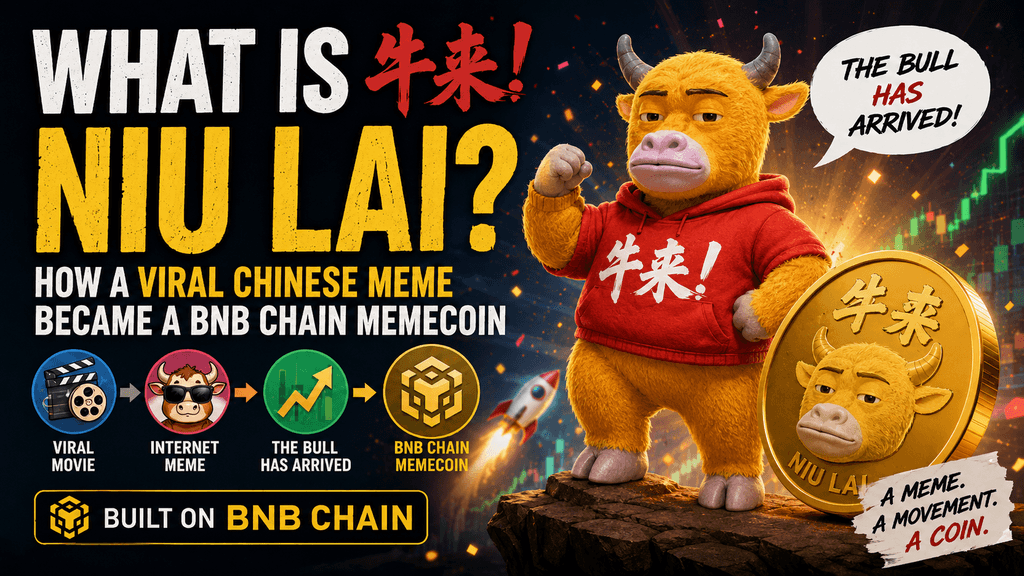
A strange low-budget Chinese animated film about a calf probably did not look like the beginning of the next crypto meme narrative. Yet that is essentially what happened with Niu Lai (牛来). Released in China in August 2026, the independently produced animation initially attracted almost no attention at the box office. Its crude 3D visuals, unusual dialogue, and unconventional storytelling soon became the subject of jokes online—and those jokes transformed the film into a viral cultural phenomenon.
Crypto traders quickly found another meaning in the name. The Chinese character “牛” means ox or bull, while a bull has one of the most recognizable meanings in financial markets: rising prices. “牛来” could therefore be interpreted playfully as “the bull has arrived,” or even “the bull market is coming.” A BNB Chain memecoin inspired by the phenomenon soon emerged, turning a movie meme into a tradable crypto asset.
So what exactly is Niu Lai, why did the meme spread so quickly, and what should users know before interacting with the $NIULAI token?
What Is Niu Lai?
Niu Lai can refer to two closely connected but distinct things. The first is Niu Lai, a Chinese independent animated film released on August 5, 2026. The second is a community-driven memecoin inspired by the viral culture surrounding the movie. This article focuses on the BNB Chain version tracked by CoinMarketCap with the contract address ending in 377777. CoinMarketCap classifies the asset under Memes, Binance Alpha, and the BNB Chain Ecosystem.
The token runs on BNB Chain as a BEP-20 asset. CoinMarketCap lists a total supply, maximum supply, and circulating supply of 1 billion tokens, meaning the full reported supply is already circulating. Recent CoinMarketCap data also showed roughly 48,000 token holders. The project website describes $NIULAI as “community-driven” and explicitly frames the story as a progression in which a movie became a meme, the meme became a movement, and the movement became a coin.
That distinction matters because Niu Lai is not a conventional blockchain project built around a new protocol, decentralized exchange, lending system, or revenue-generating application. Its primary narrative comes from culture. Like most memecoins, its market value depends heavily on attention, community participation, liquidity, and speculative demand rather than traditional financial fundamentals.
Where Did the Niu Lai Meme Come From?
Niu Lai was released in China on August 5, 2026. The film was created by director Xin Yumeng with help from his mother, Sun Lifang, using limited resources and relatively simple animation tools. The story centers on a calf, but the film's unconventional production style quickly became much more important to its public reputation than its plot. Reuters described it as a tiny-budget animation whose rough visuals and awkward storytelling unexpectedly turned into part of its appeal.
Initially, the movie was a commercial failure. Reports indicate that it sold only a few hundred tickets during its earliest release period and earned roughly $1,000 in its first days. Instead of disappearing, however, the film began spreading through Chinese social media. Users shared clips, mocked its animation, created memes, and encouraged others to experience it for themselves. What began as ridicule evolved into an ironic fandom and then into genuine public support. Reuters reported that the film eventually generated millions of dollars at the box office, while other outlets documented sold-out screenings and an expanding international meme audience.
The contrast was the key to the story: box-office failure became internet success, and internet success sent audiences back to cinemas. That reversal gave Niu Lai exactly the type of underdog narrative that internet communities often embrace.
Why Did Niu Lai Go Viral?
Niu Lai benefited from what internet culture sometimes calls the “so bad it’s good” effect. The animation did not resemble the polished productions audiences normally expect from major studios, and that became its defining advantage. Unusual facial animation, long pauses, blunt dialogue, and unexpected scenes gave users endless material for screenshots, remixes, reaction videos, and parody posts. Know Your Meme compared its ironic fandom to other entertainment properties that developed a second life through online jokes rather than conventional critical success.
The meme also became participatory. Watching the movie was no longer simply about deciding whether it was “good.” It became a way to join an online event. People created homemade posters, repeated lines from the film, filmed audience reactions, and circulated clips beyond China. English-language discussions began appearing soon afterward, helping transform a domestic curiosity into a wider internet phenomenon. Meme.com documented how clips and subtitled versions spread rapidly across X, TikTok, YouTube, and other platforms during the middle of August.
This is important for understanding the later crypto connection. Successful memecoins often depend on symbols that are simple enough to recognize instantly but flexible enough for communities to remix continuously. Niu Lai had both qualities. It had a recognizable animal, a bizarre origin story, an underdog narrative, and a name that became even more meaningful once traders connected it with the idea of a bull market.
Why “Niu Lai” Fits Crypto Culture So Well
The wordplay is one of the strongest parts of the token's narrative. In Chinese, “牛” refers to an ox or bull. In financial markets, a bull represents optimism and rising asset prices, while “牛市” means a bull market. That makes “牛来” particularly easy for crypto communities to reinterpret as something close to “the bull has arrived.”
The project's own website makes this connection explicit. It describes the Chinese name as carrying the favorable implication of “牛市来了”—the bull market has arrived—and uses the English phrase “The Bull Has Arrived.” This gives Niu Lai something many memecoins have to manufacture artificially: an existing cultural joke that already overlaps naturally with financial-market language.
The resulting narrative is straightforward:
viral calf movie → bull meme → bull-market symbolism → crypto community → memecoin.
That simplicity matters. Someone does not need to understand a complex blockchain protocol to understand the joke. In speculative markets where social attention can move faster than fundamental analysis, that makes the meme unusually portable.
How Did the Meme Become a BNB Chain Token?
Creating a memecoin is technically much easier than building an entirely new blockchain or decentralized-finance protocol. Once the Niu Lai meme gained enough cultural visibility, a token could be deployed using existing BNB Chain infrastructure without requiring a new consensus system, network, or complicated application.
The $NIULAI project currently describes itself as a BEP-20 community token running on BNB Chain. Its official website lists contract address 0xbeea1d618e533a387d941f58a7d4c9b7bd377777 and directs users toward BNB Chain explorers and decentralized-market tools for verification. CoinMarketCap independently displays the same shortened contract ending in 377777 and categorizes the asset within the BNB Chain ecosystem.
BNB Chain is a natural environment for this kind of launch. The network has relatively low transaction costs compared with some alternatives, a large retail crypto user base, an established decentralized-exchange ecosystem, and a long history of rapid token launches. For a memecoin whose main asset is social momentum rather than technical infrastructure, easy trading and broad accessibility can matter more initially than advanced utility.
What Are Niu Lai’s Tokenomics?
The most important token data should be tied to a contract address rather than a name because anyone can create another token called Niu Lai. The figures below refer specifically to the BNB Chain version discussed in this article.
| Metric | Niu Lai |
| Token | $NIULAI / 牛来 |
| Network | BNB Chain |
| Standard | BEP-20 |
| Total Supply | 1 Billion |
| Maximum Supply | 1 Billion |
| Circulating Supply | 1 Billion |
| Contract | 0xbeea...377777 |
| Main Narrative | “The Bull Has Arrived” / Niu Lai meme |
CoinMarketCap reports the total, maximum, and circulating supply at one billion tokens. The project website additionally states that the supply is fixed, there is no mint authority, there was no presale or team allocation, contract ownership has been renounced, and liquidity-pool tokens were burned. It also lists a 1% buy and 1% sell tax. These are project-reported claims, however, and the site itself tells users to verify relevant data on-chain.
This distinction is important in crypto research. A project's website is useful for understanding what the project claims, but contract permissions, ownership status, liquidity, holder concentration, and supply mechanics are best verified independently through blockchain explorers and other on-chain tools rather than accepted solely from promotional materials.
Why Did Niu Lai Attract Crypto Traders So Quickly?
Timing was arguably the token's biggest advantage. The underlying meme was still spreading when crypto traders discovered it, meaning $NIULAI did not have to revive an old joke or manufacture a new cultural identity from scratch. It arrived while public attention was already accelerating.
The token also had unusually strong symbolic compatibility with crypto markets. Bull imagery is deeply embedded in trading culture, and the phrase “the bull has arrived” can function simultaneously as a movie reference, internet joke, market slogan, and speculative meme. CoinMarketCap's classification of Niu Lai within both the Meme and Binance Alpha categories added another layer of market visibility.
Memecoin adoption can move extraordinarily quickly for this reason. Traditional crypto projects may need users to understand technical architecture, token utility, governance, or application demand. A memecoin primarily needs people to understand and repeat the narrative. When that narrative already exists outside crypto, the path from cultural recognition to speculative attention can become much shorter.
Niu Lai Price and Market Growth Explained
Niu Lai's early price history illustrates how quickly attention can translate into extreme market movement. CoinMarketCap records an all-time low of approximately $0.0003889 on August 14, 2026, followed only one week later by an all-time high of about $0.07684 on August 21. Recent data also showed more than 48,000 holders and tens of millions of dollars in daily trading volume.
Those numbers are notable, but they should not be interpreted as evidence of a stable valuation model. Moving from a fraction of a cent to several cents within days is precisely the type of volatility associated with newly popular memecoins. A rapidly growing holder base can increase liquidity and visibility, but it can also attract momentum traders whose interest may disappear quickly when price action changes.
For that reason, Niu Lai's short trading history is better viewed as evidence of high attention, high speculation, and high volatility than as a basis for long-term price forecasts. Its future market performance will depend heavily on whether cultural attention survives after the initial viral period.
Does Niu Lai Have Real Utility?
At present, Niu Lai is more accurately described as a community-driven memecoin than a utility token. The project website is unusually direct about this point, stating that $NIULAI is a meme coin with no intrinsic value, no guaranteed return, and no expectation of profit. Its roadmap is likewise presented humorously rather than as a promise of major technical development.
That separates Niu Lai from assets whose demand may be connected to network usage, transaction fees, decentralized applications, staking, governance, or cash-generating protocols. A utility-focused crypto asset may have demand linked partly to what users can do with the underlying system. A memecoin's demand is much more dependent on attention, identity, community membership, liquidity, and speculation.
This does not mean memecoins cannot maintain large communities or market values. Dogecoin and other major meme assets demonstrate that cultural networks can persist for years. It simply means investors should evaluate them using a different framework. The relevant question is less “How much revenue does the protocol generate?” and more “Can the community continue producing enough attention and cultural relevance to sustain demand?”
Niu Lai Is Not the Only NIULAI Token
One of the most important practical risks surrounding Niu Lai is that a name does not uniquely identify a cryptocurrency. Blockchain networks are permissionless, so multiple developers can issue tokens using the same ticker, logo, or cultural reference. Searches for Niu Lai or NIULAI already surface different projects and contracts, meaning users can easily confuse one asset with another.
For this article, the relevant version is the BNB Chain token tracked by CoinMarketCap with contract 0xbeea1d618e533a387d941f58a7d4c9b7bd377777. A token on another blockchain or using a different contract address should not automatically be assumed to represent the same project, even if it uses an identical name.
This is why contract verification is fundamental when dealing with new memecoins. Users should confirm the blockchain, contract address, blockchain explorer record, liquidity pool, and official project channels before interacting with a token. Searching only by ticker can be particularly dangerous when a meme becomes popular enough to inspire multiple copycats.
What Are the Biggest Risks of Niu Lai?
Extreme volatility is the most obvious risk. Niu Lai went from its recorded all-time low to its all-time high within roughly one week, demonstrating how quickly pricing can change in either direction. Thin or rapidly changing liquidity can amplify these movements, especially when speculative traders attempt to enter or exit simultaneously. Market capitalization should therefore not be confused with the amount of cash that can necessarily leave a token without affecting its price.
The second major risk is attention decay. Unlike a business with recurring revenue or a blockchain with recurring network demand, a culturally driven memecoin can lose its main source of demand when the underlying meme stops appearing on social media. Niu Lai's rapid rise is closely connected with a movie that became one of August 2026's most unusual viral events. If audiences move on, traders must decide whether the community itself is strong enough to keep the meme alive.
There are also contract, concentration, and imitation risks. Even when a project reports renounced ownership or burned liquidity, users should independently verify those claims and examine holder distribution. The existence of similarly named tokens increases the risk further. The central uncertainty is therefore simple: Niu Lai's cultural momentum may survive much longer—or much shorter—than the market currently expects.
Niu Lai vs. Traditional Memecoins
Niu Lai joins a long tradition of crypto assets whose identity originates more from internet culture than technological innovation. What makes it different is the speed at which the original cultural event and the crypto speculation developed almost simultaneously.
| Token | Meme Origin | Main Narrative |
| Dogecoin | Doge / Shiba Inu meme | The original major crypto meme |
| Shiba Inu | Shiba dog culture | Community and ecosystem expansion |
| PEPE | Pepe the Frog | Internet-native meme culture |
| BONK | Dog meme | Solana community identity |
| Niu Lai | Viral Chinese animated film | “The Bull Has Arrived” |
Dogecoin emerged from a meme that already had broad global recognition. PEPE similarly drew from an internet character with years of cultural history. Niu Lai is different because the cultural source and the token emerged within an extremely compressed time frame. The movie was released on August 5, became a major online phenomenon in the following weeks, and the associated crypto narrative developed while the original meme was still expanding.
That makes Niu Lai a useful example of real-time culture becoming financial speculation. Social platforms can now turn a niche entertainment event into a global meme almost instantly, while permissionless blockchain infrastructure can turn that meme into a tradable asset almost as quickly.
Can Niu Lai Become More Than a Short-Lived Meme?
History shows that viral attention alone does not guarantee long-term survival. Thousands of memecoins have experienced brief bursts of trading activity before disappearing from public discussion. For Niu Lai, longevity will depend on whether the community can continue creating new memes, references, content, and reasons for people to identify with the token after the film's initial novelty fades.
Exchange accessibility and liquidity will matter as well, but neither can replace community retention. A listing can expose the token to more traders, while deeper liquidity can make trading easier, yet those benefits do not automatically create lasting cultural relevance. The strongest memecoins generally evolve beyond a single viral moment and develop communities capable of continuously recreating their own identity.
That makes the most useful long-term question different from the typical “Can Niu Lai go higher?” speculation. The more fundamental question is:
Can Niu Lai continue generating attention after people stop talking about the original movie?
The answer will likely determine whether $NIULAI becomes a recognizable long-term meme asset or remains a snapshot of one extraordinary internet moment.
What Niu Lai Says About Modern Memecoin Culture
Niu Lai demonstrates how dramatically the distance between culture and financial speculation has shortened. A low-budget animated movie can fail at the box office, become an internet joke, turn into a nationwide meme, cross into international social media, acquire a bull-market interpretation, and then appear as a blockchain token—all within a matter of weeks.
That speed is part of what makes modern memecoin markets attractive to some traders and dangerous to others. Crypto infrastructure allows communities to financialize attention almost immediately, but attention is among the least predictable assets in the world. Today's unavoidable meme can become tomorrow's forgotten reference.
Whether Niu Lai ultimately develops into an enduring crypto community or fades alongside the original viral cycle remains uncertain. What its rise has already demonstrated, however, is that in the modern memecoin economy, the path from culture → meme → community → speculation → token can be remarkably short.
FAQs
Is Niu Lai Available on Ethereum or Solana?
The Niu Lai version discussed in this article is a BEP-20 token running on BNB Chain. Other tokens using Niu Lai or NIULAI names may exist on different networks, but they should not automatically be treated as the same project. The blockchain and contract address should always be checked before interacting with any similarly named asset.
What Wallet Can Hold Niu Lai?
Because the token discussed here uses the BEP-20 standard on BNB Chain, it can generally be held in wallets that support BNB Smart Chain assets. Users should make sure they are connected to the correct network and should verify the token's contract address before manually importing it.
Is Niu Lai the Official Token of the Niu Lai Movie?
There is no basis for assuming that a token inspired by a film is automatically an official financial product of the filmmakers. In fact, the $NIULAI project website explicitly states that the token is community-driven, that the studio and director hold no official position in the token, and that it is not affiliated with a studio financial product.
Why Does a Memecoin Contract Address Matter?
A contract address is effectively the unique blockchain identity of a token. Multiple assets can use the same name and ticker, but they cannot share the same deployed smart-contract address. Checking the contract therefore helps users distinguish the intended asset from unrelated tokens, impersonations, or copycats.
Can the Niu Lai Token Supply Increase?
CoinMarketCap currently reports total, maximum, and circulating supply at one billion tokens. The project's website states that the supply is fixed at one billion and that the contract has no mint authority. Because this is a technical claim about the smart contract, users should independently confirm it through a BNB Chain explorer rather than relying exclusively on project materials.
Is Niu Lai an Investment?
Niu Lai is a highly volatile memecoin rather than an asset with conventional corporate earnings or protocol cash flow. The project itself warns that the token has no guaranteed return and that buyers can lose their money. Whether someone chooses to trade or hold any crypto asset is a personal financial decision; information about Niu Lai's history, token structure, or community should not be interpreted as a prediction of future returns.
🔥 KuCoin Offers A More Stable Option in A Volatile Market
If you worry about the frequent ups and downs in the market, and pursue a more stable option to earn money passively, KuCoin is the right place to come:
Simple Earn: Deposit and withdraw tokens anytime, earning stable returns.
Kucoin Earn: Earn stable profits with professional asset management.
Hold to Earn: Earn rewards by holding assets in Funding, Trading, Margin, Futures, Mining, and Unified Accounts.
Staking: Unlock the earning potential of on-chain assets.
Advanced Investments: Advanced Investments offer a variety of structured products to help your money grow in any market.
Shark Fin: Principal Protection and Guaranteed Gains
Dual Investment: Buy low and sell high with transparent return calculations.
Snowball: High yields, with price protection.
Discount Buy: Buy crypto at discount prices.
KCS Loyalty: Level up to enjoy exclusive perks by staking ≥ 1 KCS.
KuCoin Wealth: Discover future value and begin your smart investing journey.
KCS Benefits: Hold and stake KCS to access benefits across the platform.
KCS Staking 2.0: Participate in KCS on-chain governance to earn yield.
Disclaimer: This content is for informational purposes only and does not constitute investment advice. Cryptocurrency investments carry risk. Please do your own research (DYOR).