

Strong US PMI Revives Fed Rate Hike Bets as Nasdaq Slides and Bitcoin Falls Below $85,000
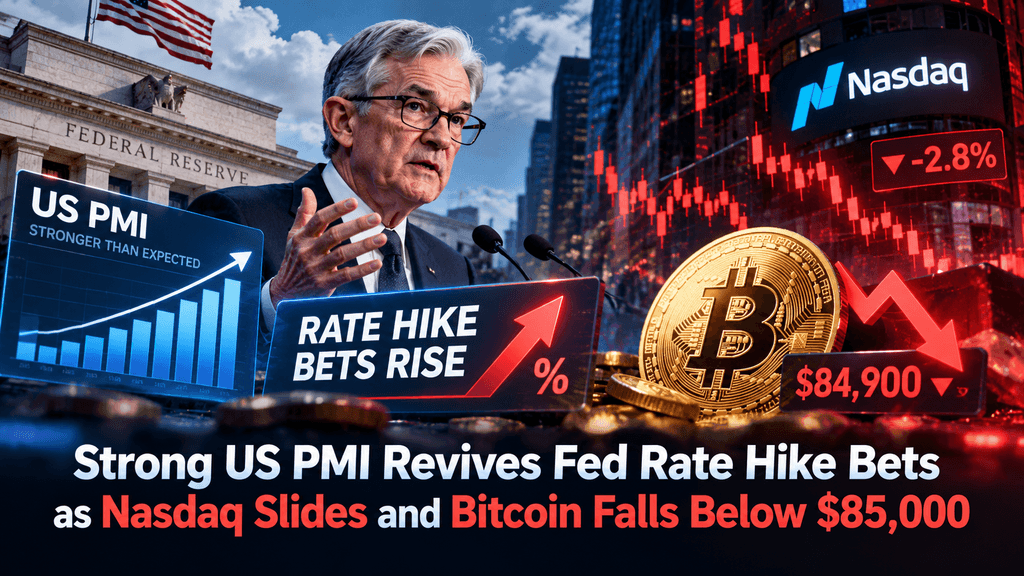
Strong U.S. economic data has reshaped expectations for Federal Reserve policy and triggered fresh volatility across stocks, bonds and cryptocurrencies. The September flash U.S. Composite PMI climbed to 58.4, signaling the strongest pace of business activity in more than five years, while renewed inflation pressures strengthened expectations that interest rates could remain higher for longer. Treasury yields moved sharply higher, the Nasdaq Composite fell 1.13%, and Bitcoin reversed from above $87,000 to trade below $85,000 as investors reassessed the outlook for liquidity and monetary policy. The reaction shows how closely Bitcoin, technology stocks and Treasury markets are now responding to changes in Fed rate expectations, economic growth and inflation data.
Why Strong US PMI Is Increasing Fed Rate Hike Expectations
The latest U.S. economic data strengthened expectations that the Federal Reserve could keep monetary policy tighter for longer. S&P Global’s September flash U.S. Composite PMI rose to 58.4 from 56.0, marking the strongest pace of business activity since July 2021. The report also showed faster employment growth, rising backlogs and continued expansion across the private sector. For investors, the stronger-than-expected PMI suggested that the U.S. economy was still growing rapidly despite elevated borrowing costs, reducing pressure on the Fed to ease financial conditions.
The bigger concern for markets was the renewed sign of inflationary pressure. S&P Global reported that business input costs increased at their fastest pace in nearly four years, while stronger hiring and demand pointed to continued economic resilience. Because the Federal Reserve had already raised its benchmark rate by 25 basis points in the September Fed rate decision, the combination of strong growth and higher costs pushed traders to increase expectations for another rate hike at the October meeting. Reports citing CME FedWatch showed the implied probability of an additional increase rising toward 75%, highlighting how quickly interest-rate expectations shifted after the PMI data.
Why Strong Economic Data Can Pressure Markets
Strong economic growth is normally positive, but it can become a headwind for financial markets when inflation remains elevated. If the economy continues expanding quickly, the Fed has more room to maintain higher interest rates or tighten policy further without immediately risking a sharp slowdown. That prospect can push Treasury yields higher, strengthen the U.S. dollar and increase borrowing costs, creating pressure on rate-sensitive assets such as technology stocks and cryptocurrencies. It can also cause investors to reassess expectations for future liquidity and the amount of risk they are willing to hold in their portfolios. This explains why the strong PMI report became a key catalyst for the simultaneous weakness in the Nasdaq and Bitcoin, even though the underlying economic data pointed to continued U.S. growth.
Why Rising Treasury Yields Are Pushing the Nasdaq Lower
The Nasdaq selloff was closely tied to a sharp repricing in the U.S. bond market, where Treasury yields moved higher as investors adjusted to stronger economic data and tighter monetary-policy expectations. Higher yields matter for technology stocks because they influence both company borrowing costs and equity valuations, especially for growth companies whose expected earnings are concentrated further into the future. As bond yields climbed above key levels, investors began reassessing the relative attractiveness of high-growth equities compared with lower-risk fixed-income assets.
The pressure was also reinforced by weaker demand at a major Treasury auction, which pushed market rates even higher and added to concerns that financial conditions could remain restrictive. Together, these forces created a difficult backdrop for the Nasdaq, particularly after a strong run in technology and AI-related stocks. The shift also increased the importance of bond-market movements for equity investors, as changes in long-term yields can quickly alter valuations across growth sectors. With Treasury yields moving sharply from one session to the next, interest-rate sensitivity has once again become a major driver of Nasdaq performance and technology stock sentiment.
Higher Treasury Yields Put Pressure on Tech Stock Valuations
Rising U.S. Treasury yields have become an important headwind for the Nasdaq because higher bond yields change how investors value growth-oriented technology companies. Official U.S. Treasury data showed the 10-year Treasury yield rising to 5.11% on September 23 from 4.96% a day earlier, while the 20-year yield reached 5.45% and the 30-year climbed to 5.40%. When risk-free government bonds offer yields above 5%, investors have a more attractive alternative to equities, while the higher discount rate used to value future corporate earnings can reduce the present value assigned to companies whose expected profits extend far into the future. This effect tends to be particularly important for the Nasdaq Composite, where technology and other growth stocks have significant influence.
The change in bond-market conditions quickly reached U.S. equities. On September 23, the Nasdaq Composite fell 1.13% to 26,936.04, while the S&P 500 declined 0.75% and the Dow Jones Industrial Average lost 0.68%. The pullback was notable because the Nasdaq had recently returned to record territory as optimism around artificial intelligence, semiconductors and major technology companies supported equity valuations. Higher Treasury yields therefore forced investors to reassess whether elevated growth-stock valuations could be sustained in an environment where borrowing costs remain high and fixed-income assets offer increasingly competitive returns.
Weak Treasury Demand Adds Another Layer of Pressure to the Nasdaq
The rise in yields was reinforced by developments in the Treasury market itself. A $70 billion five-year Treasury note auction on September 23 cleared at a 5.033% yield, while the bid-to-cover ratio came in at 2.21, below the recent average of about 2.33. Indirect bidders, a category that includes many foreign and institutional buyers, took roughly 54.3% of the offering, below their recent average. The softer auction demand indicated that investors required higher yields to absorb new government debt, adding another source of upward pressure on market interest rates at a time when traders were already adjusting expectations for Federal Reserve policy.
For the Nasdaq, this combination matters beyond a single trading session. Persistently high yields can increase corporate financing costs, raise the required return investors demand from equities and make cash flows expected years into the future less valuable in today's terms. It can also encourage portfolio managers to rotate some capital from highly valued technology shares into government bonds or other income-producing assets. The September selloff therefore reflected more than a reaction to one economic report: it showed how Treasury yields, Fed expectations and equity valuations are becoming increasingly connected. If longer-term yields remain around or above 5%, rate-sensitive technology stocks could continue facing valuation pressure even when corporate earnings and AI-related investment remain relatively strong.
Why Bitcoin Fell Below $85,000 After Strong US Economic Data
Bitcoin fell below $85,000 as investors reacted to stronger-than-expected U.S. economic data and a renewed shift toward tighter monetary-policy expectations. The decline came shortly after BTC had traded above $87,000, showing how quickly sentiment changed once markets began pricing in a higher probability of another Federal Reserve rate increase. Strong business activity, persistent inflation pressures and rising bond yields reduced demand for risk-sensitive assets, while a firmer U.S. dollar added another headwind for crypto prices. The move highlighted Bitcoin’s continued sensitivity to interest rates, liquidity conditions and broader macroeconomic expectations, especially when investors are rapidly adjusting their outlook for Federal Reserve policy.
How Higher Rates and Tighter Liquidity Put Pressure on Bitcoin
Bitcoin tends to face greater pressure when markets expect interest rates to remain elevated because higher borrowing costs can reduce liquidity across financial markets and make lower-risk assets more competitive. As Treasury yields moved above 5%, government bonds offered investors increasingly attractive returns without the same volatility associated with cryptocurrencies. That shift can weaken demand for speculative and non-yielding assets, particularly when traders believe the Federal Reserve may continue tightening policy. Bitcoin’s slide below $85,000 therefore reflected a broader rebalancing of risk rather than a crypto-specific shock, with investors reassessing exposure across digital assets, technology stocks and other growth-sensitive markets.
The decline was also amplified by Bitcoin’s rapid rally in the previous sessions, which left the market vulnerable to profit-taking once macro conditions deteriorated. BTC had recently climbed toward the $87,000–$87,500 range, but stronger U.S. data disrupted expectations for easier financial conditions and encouraged short-term traders to reduce exposure. As Bitcoin moved lower, leveraged positions and momentum-driven selling added to the downside pressure, pushing the price toward the $84,000 area and later closer to $83,000. The key issue for the next phase of the Bitcoin price outlook is whether Treasury yields and Fed rate expectations remain elevated or begin to stabilize, as those factors are likely to influence whether BTC can recover its recent highs or face further consolidation.
How Fed Rate Hike Expectations Are Affecting Bitcoin, Nasdaq and Risk Assets
Expectations for additional Federal Reserve tightening are reshaping investor positioning across several major markets at the same time. When traders anticipate higher policy rates, they typically demand greater compensation for holding volatile assets, which can weigh on Bitcoin, technology stocks and other risk-sensitive investments. The effect is not limited to one asset class because interest-rate expectations influence capital flows, funding costs, currency markets and overall investor appetite for risk. As a result, even assets with very different fundamentals can temporarily move in the same direction when markets make a major adjustment to the expected path of U.S. interest rates.
Bitcoin Faces More Macro-Driven Volatility
For Bitcoin, a more hawkish Fed outlook can increase short-term volatility by reducing expectations for easier financial conditions and abundant market liquidity. Crypto investors closely track Fed rate expectations, inflation data and U.S. economic indicators because changes in these variables can quickly alter demand for speculative assets. Broader crypto market performance can therefore remain sensitive to shifts in Treasury yields and the dollar, while any easing in those pressures could improve conditions for a recovery in crypto sentiment. This macro sensitivity means upcoming U.S. economic releases may continue to influence crypto trading even when there are no major Bitcoin-specific developments.
Nasdaq Stocks Become More Sensitive to Interest Rates
The Nasdaq is particularly exposed to changing rate expectations because many of its largest companies are valued partly on earnings expected years into the future. Higher policy rates increase financing costs and raise the return investors can earn from bonds and cash-like assets, making expensive growth stocks less attractive by comparison. This means technology stocks, semiconductor companies and other high-growth sectors can experience sharper price swings whenever new economic data changes expectations for the Fed's next move. Investors may therefore continue monitoring both company fundamentals and macroeconomic indicators when assessing the outlook for the technology-heavy index.
Risk Appetite Depends on the Fed's Next Signals
The wider market reaction will depend increasingly on whether upcoming economic data confirms the case for further tightening or gives the Fed room to hold rates steady. Investors are likely to watch inflation readings, employment data, Treasury yields and Federal Reserve commentary for signs that monetary conditions are becoming more or less restrictive. If rate-hike expectations remain elevated, risk assets could continue facing valuation pressure; if inflation cools and growth moderates, markets may begin pricing a less aggressive policy path, potentially improving sentiment across equities and cryptocurrencies. The speed of any change in expectations may be just as important as the eventual policy decision because rapid repricing can produce stronger short-term volatility across global markets.
🔥 Beyond the Headlines: What KuCoin 5.0 Means for You
Market news moves fast — but where you act on it matters just as much. This October, KuCoin launches KuCoin 5.0, transforming KuCoin into a rebuilt platform. Here's what actually changes for you:
-
One account for everything. Older platforms split your money across separate "spot," "margin," and "futures" accounts and expected you to understand why. KuCoin 5.0's unified account removes that entirely — deposit once, and everything is simply there (only available to VIPs for now).
-
Stocks, indices, and commodities. KuCoin 5.0 expands beyond crypto into global markets. When crypto chops sideways and equities rally (or the reverse), you rotate in minutes instead of opening a brokerage account and waiting days for fiat rails.
-
Real-world assets (RWA). Tokenized exposure to traditional assets like commodities, right inside your crypto account. One of the fastest-growing segments in global finance is no longer reserved for institutions — you access it from the same balance you trade with.
-
Earn while you learn. Not ready to trade? KCUSD lets your stablecoins earn daily, auto-compounding interest. The lowest-stress way to put your idle deposit to work for 4% yield.
-
An AI assistant in plain language. Ask questions, get market context, understand what you're looking at — built into the platform, no jargon required.
-
An app that doesn't overwhelm. Faster, cleaner, and consistent — intuitive from the first tap, not after a tutorial.
-
Safety you can check, not just trust. A MiCAR-licensed EU entity, Proof of Reserves you can verify yourself, and internationally certified security (SOC 2 Type II, ISO 27001:2022).
Create your account in minutes — and start on the platform built for where crypto is going, not where it's been.
In Conclusion
The latest market reaction shows how quickly strong economic data can change the outlook for Federal Reserve interest rates, Treasury yields, Bitcoin and the Nasdaq. September’s stronger PMI reinforced the view that the U.S. economy remains resilient, but persistent cost pressures also raised concerns that the Fed may need to keep monetary policy restrictive for longer. With Bitcoin retreating below $85,000 and technology stocks facing renewed pressure, investors will increasingly focus on upcoming inflation reports, labor-market data, Treasury-market conditions and Fed commentary. These indicators could determine whether the recent risk-asset pullback develops into a deeper correction or whether stabilizing rate expectations allow Bitcoin and the Nasdaq to regain momentum.
FAQs
What is the CME FedWatch Tool and why do investors follow it?
The CME FedWatch Tool estimates the probability of future Federal Reserve rate decisions using pricing in federal funds futures. Investors use it to see how quickly market expectations are changing ahead of FOMC meetings, although its probabilities reflect trader positioning rather than an official Fed forecast.
Why can a weak U.S. Treasury auction affect Bitcoin and stocks?
Weak demand at a Treasury auction can force the government to offer higher yields to attract buyers. If those higher yields spread across the bond market, investors may shift capital toward fixed-income assets and away from more volatile investments such as Bitcoin and growth stocks, tightening financial conditions even without an immediate Fed policy change.
Does a stronger U.S. dollar usually affect Bitcoin prices?
A stronger U.S. dollar can create pressure on Bitcoin because BTC is primarily priced in dollars and competes with dollar-denominated assets for global capital. The relationship is not constant, but sharp increases in the U.S. Dollar Index (DXY) often coincide with tighter financial conditions that can reduce demand for cryptocurrencies and other risk assets.
Do higher interest rates always cause Bitcoin to fall?
No. Bitcoin does not automatically decline whenever interest rates rise. Its price is also influenced by institutional demand, ETF flows, crypto-specific developments, market positioning and broader investor sentiment. Interest rates become especially important when a sudden change in Fed expectations causes liquidity conditions or Treasury yields to move sharply.
Which U.S. economic reports could move Bitcoin and the Nasdaq next?
Markets typically pay close attention to the Consumer Price Index (CPI), Personal Consumption Expenditures (PCE) inflation index, employment reports, retail sales and PMI data. Unexpectedly strong or weak readings can change expectations for future Fed policy and trigger rapid moves in Treasury yields, equities, the dollar and cryptocurrency prices.
What does “risk-off” mean for Bitcoin and technology stocks?
A risk-off market occurs when investors become more cautious and favor assets perceived as safer, such as government bonds or cash, over more volatile investments. Bitcoin and high-growth technology stocks can both come under pressure during these periods because traders reduce exposure to assets that are more sensitive to liquidity, economic uncertainty and changing interest-rate expectations.
Disclaimer: This article is for informational purposes only and does not constitute investment advice. Crypto assets can be highly volatile, and market conditions, token liquidity and project developments may change rapidly. Readers should conduct their own research and assess their risk tolerance before making financial decisions.