

The Unicorn Survival War: A Wave of Tech & Web3 Bankruptcies Under the $3.5T Siphon Effect
2026/06/15 15:10:00
Combination of Big Forces
Tech and Web3 companies that once commanded billion-dollar valuations now navigate an unforgiving ecosystem marked by heightened scrutiny, constrained funding, and structural market shifts. As investor preferences evolve toward more stable, yield-generating assets, many high-profile startups confront operational realities that test their long-term viability. This environment has accelerated a selective consolidation, where only those with robust unit economics and adaptable models endure.
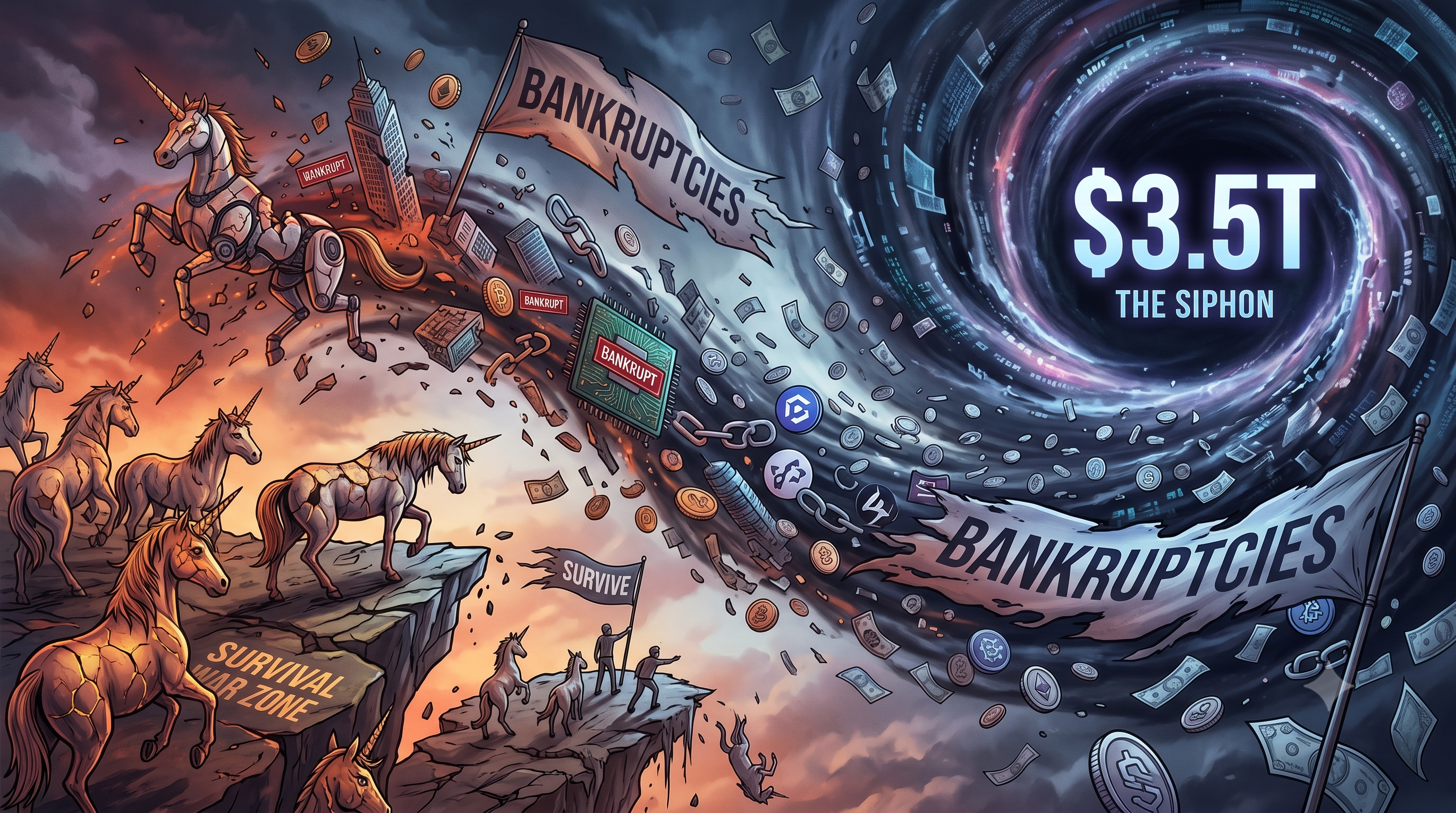
Latest information shows a notable uptick in distress signals across venture-backed firms, particularly in sectors sensitive to interest rate fluctuations and liquidity preferences. The $3.5 trillion private credit market is redirecting capital away from speculative tech and Web3 ventures, intensifying a survival contest among unicorns and contributing to a measured increase in bankruptcies and restructurings that reshape industry dynamics.
Capital Reallocation Pressures Reshape Startup Funding Priorities
Private credit assets, now totaling approximately $3.5 trillion, offer institutional investors predictable yields and lower volatility than early-stage equity bets in technology and decentralized projects. This move diverts resources from high-risk, high-reward unicorns toward established debt instruments backed by tangible cash flows. In practice, venture funds face longer deployment cycles and more conservative due diligence, as limited partners prioritize risk-adjusted returns. For Web3 projects reliant on token liquidity and retail enthusiasm, the reduced inflow of fresh equity has extended runway pressures, prompting cost optimizations and pivot strategies. Industry analyses indicate that this reallocation favors sectors with clear paths to profitability, leaving many 2021-2022 vintage companies to compete for scarcer capital. Examples include mining operations and infrastructure providers adjusting to post-halving economics while contending with elevated borrowing costs. The result is a more disciplined ecosystem where sustainable growth metrics outweigh hype-driven valuations.
Analysts tracking allocation trends note that tokenized real-world assets in decentralized finance are increasingly competing directly with traditional private credit offerings, further illustrating the convergence of yields and accessibility. Market participants observe that companies demonstrating strong treasury management and diversified revenue streams maintain advantages in this environment. The siphon dynamic encourages operational maturity rather than unchecked expansion, fostering resilience among survivors while highlighting vulnerabilities in overleveraged models. This evolution aligns broader capital markets with macroeconomic conditions favoring income stability over speculative appreciation.
Operational Realities Driving Restructuring Decisions in Tech Firms
Many former high-valuation tech entities encounter challenges when scaling infrastructure and talent costs outpace revenue stabilization. Bankruptcy proceedings, such as Chapter 11 filings, provide mechanisms for debt reorganization and strategic refocusing without immediate liquidation. Cases from recent quarters demonstrate how co-working spaces and cybersecurity providers have successfully navigated the emergence from protection, often with reduced debt loads and targeted new financing. These processes allow retention of core assets and intellectual property while renegotiating stakeholder terms. In Web3, similar patterns appear in entities facing liquidity crunches from market volatility or operational incidents like data center disruptions. Restructuring enables continuity for viable business lines amid broader sector adjustments. Verified reports from early 2026 document multiple project shutdowns and maintenance modes, particularly in decentralized applications struggling with user retention and development sustainability. Practical adaptations include workforce streamlining and product simplification to align with current demand.
Companies that entered bankruptcy with substantial prior funding often retain partial operations post-reorganization, preserving ecosystem contributions. This mechanism contrasts with outright failures by offering structured exits or revivals. Data from bankruptcy trackers reveal fluctuations, with certain months showing lower filings but persistent underlying pressures in growth-oriented segments. For unicorns, these realities underscore the importance of scenario planning and conservative cash reserves. Industry observers emphasize that successful restructurings frequently result in leaner, more focused organizations better positioned for subsequent funding rounds or acquisitions. The process itself demands transparent communication with creditors and employees to minimize disruption. In aggregate, such cases contribute to a healthier ecosystem by reallocating resources toward higher-potential survivors.
Market Valuation Adjustments Expose Unicorn Vulnerabilities
Elevated interest rates and selective investor appetites have prompted valuation resets across private markets, affecting unicorn portfolios significantly. PitchBook data as of mid-2026 shows continued activity in new unicorn formations, yet existing ones face down-round risks or stalled exits. Tech segments tied to discretionary spending or experimental technologies experience sharper corrections. Web3 projects, in particular, contend with token price volatility that influences perceived enterprise value. This environment discourages over-optimistic projections, pushing founders toward evidence-based forecasting. Statistics from unicorn trackers indicate global counts exceeding 1,300, with the United States hosting a substantial portion, yet survival depends on demonstrating durable competitive moats. Practical examples involve companies revising growth assumptions and prioritizing near-term profitability.
Capital market conditions amplify scrutiny on burn rates, compelling efficiency gains. Analysts shows that AI-related ventures sometimes fare better due to tangible enterprise adoption, though even these face execution hurdles. The adjustment phase separates entities with strong product-market fit from those reliant on favorable macro tailwinds. Long-term implications include more realistic pricing for future funding events and IPO preparations. Industry context reveals that previous boom periods created inflated benchmarks now being recalibrated. Companies adapting through incremental milestones maintain stakeholder confidence more effectively. This valuation discipline ultimately supports sustainable innovation by grounding ambitions in financial fundamentals. Market participants benefit from clearer signals regarding viable opportunities amid the broader rebalancing.
Liquidity Constraints Challenge Web3 Infrastructure Providers
Decentralized finance and blockchain infrastructure firms encounter tightened liquidity as capital prefers established yield vehicles. Recent filings, including those from entities like Archblock in early 2026, illustrate liabilities exceeding assets in certain crypto-related operations. These situations often stem from exposure to volatile market cycles and operational overheads. Infrastructure projects require substantial upfront investment in security, compliance, and scalability, which becomes harder to sustain without consistent inflows. Practical responses include protocol optimizations and partnership expansions to diversify utility. On-chain metrics from surviving projects show varying adoption levels, with those offering clear value propositions retaining user bases. The $3.5T private credit parallel accelerates interest in tokenized alternatives, yet integration challenges persist. Companies focusing on stablecoin rails or enterprise blockchain solutions demonstrate relative stability.
Industry analyses from Q1 2026 document over twenty project closures or shifts, underscoring selective pressure. Verified examples highlight mining operations impacted by energy costs and reward adjustments, navigating Chapter 11 to preserve assets. The broader context includes regulatory maturation that raises compliance expenses. Successful providers emphasize transparency and risk management to build institutional trust. This segment's evolution reflects maturation from speculative experimentation toward production-grade services. Liquidity management tools and treasury strategies gain prominence as best practices. The effect refines the Web3 ecosystem, favoring projects with resilient architectures and community governance. Market implications extend to enhanced interoperability standards and cross-chain efficiency improvements.
Investor Sentiment Shifts Toward Proven Business Models
Limited partners and venture capitalists increasingly demand clear profitability timelines before committing larger checks. This sentiment influences deal structures, favoring tranched investments tied to performance milestones. Tech unicorns in consumer-facing or infrastructure categories adjust by enhancing monetization frameworks and customer retention tactics. Data from funding trackers show moderated activity compared to peak years, with emphasis on quality over quantity. Web3 ventures benefit when demonstrating real-world utility beyond token incentives. Practical case studies involve entities streamlining offerings to core features that drive recurring revenue. Industry reports note that AI integration provides differentiation for some yet requires substantial compute investments. The siphon toward private credit reinforces a preference for assets with measurable yields and downside protection.
Unicorns that secured large rounds in prior cycles now focus on extending runways through operational leverage. This shift promotes disciplined capital allocation across the board. Stakeholder analyses reveal heightened due diligence on governance and financial controls. Companies excelling in this climate often exhibit strong founder-operator alignment and adaptive cultures. Market context includes global unicorn distributions, with significant concentrations in the US and Asia. Implications for innovation include more targeted R&D spending aligned with customer needs. The environment cultivates enterprises capable of weathering cycles rather than depending on perpetual growth narratives. This maturation benefits end users through more reliable products and services.
Restructuring Success Stories Illuminate Adaptation Pathways
Entities emerging from bankruptcy, such as certain cybersecurity and workspace providers, illustrate viable recovery routes through debt reduction and strategic refinancing. These outcomes often involve new leadership or refined value propositions tailored to current demands. In Web3, analogous processes facilitate asset sales or protocol handovers that preserve technology value. Detailed reviews of recent cases emphasize the role of creditor negotiations in achieving sustainable capital structures. Practical lessons include maintaining detailed financial records and proactive stakeholder engagement. Industry observers track post-restructuring performance to gauge long-term efficacy. Data indicates variable timelines, with some resolutions occurring within months. The broader tech sector benefits from these precedents by normalizing structured resolutions over disorderly wind-downs.
Companies leveraging such mechanisms frequently refocus on high-margin segments. For unicorns, successful navigation enhances credibility with future investors. Context from 2026 filings shows mixed activity, with some months recording declines in total bankruptcies. Yet persistent challenges in specific verticals underscore ongoing selection pressures. Adaptation strategies commonly incorporate technology efficiencies and market expansions. These examples provide blueprints for peers facing similar constraints. The process contributes to ecosystem health by recycling talent and intellectual property. Market implications involve refined risk assessment models among funders. Survivors often emerge with streamlined operations poised for measured growth.
Tokenized Assets Compete Directly with Traditional Credit Markets
Growth in real-world asset tokenization on blockchain platforms introduces yield opportunities that parallel private credit characteristics. Estimates place tokenized Treasuries and related instruments in the billions, attracting capital seeking efficiency and transparency. This development intensifies competition for investor dollars traditionally allocated to venture equity. Web3 projects benefit when bridging these worlds through compliant structures. Practical implementations include platforms offering on-chain representations of debt instruments with improved liquidity features. Industry metrics track holder growth and total value locked as indicators of adoption. Challenges remain around regulatory alignment and scalability.
Companies pioneering these integrations position themselves at the intersection of traditional finance and decentralized technology. The $3.5T siphon dynamic accelerates exploration of hybrid models that combine yield with programmability. Market analysis projects continued expansion as infrastructure matures. For unicorns in adjacent spaces, this creates both opportunities and competitive pressures. Successful entities focus on security audits and user experience enhancements. Broader implications include democratized access to previously illiquid asset classes. This convergence fosters innovation in settlement and custody solutions. Tokenized credit contributes to a more interconnected financial system with diversified risk profiles.
Talent Retention Strategies Amid Funding Volatility
Attracting and keeping skilled professionals becomes critical as compensation expectations adjust to market conditions. Tech and Web3 firms deploy equity incentives, flexible arrangements, and mission alignment to maintain teams. Data on layoffs and shutdowns from recent periods highlight the human dimension of consolidation. Practical approaches involve transparent communication and targeted reskilling initiatives. Companies with strong cultures often retain key talent better during transitions. Industry context reveals heightened competition for expertise in areas like cryptography, AI engineering, and regulatory compliance. Unicorns addressing these dynamics invest in professional development and performance-based rewards.
The survival contest rewards organizations that balance cost management with employee value propositions. Broader economic factors influence mobility, yet specialized skills command premiums. Successful retention supports continuity in product development and customer service. Analyses suggest that talent flows toward entities demonstrating strategic clarity. This dynamic influences innovation velocity across the sector. Practical examples include streamlined hierarchies that empower decision-making closer to operations. Market implications extend to ecosystem knowledge preservation even through restructurings. Effective talent strategies differentiate survivors in the unicorn ecosystem.
Regulatory Maturation Influences Operational Compliance Costs
Evolving oversight frameworks require Web3 and tech firms to allocate resources toward legal and compliance functions. This investment, while necessary for institutional credibility, adds to operational expenses during capital-constrained periods. Recent enforcement actions and policy developments shape strategic planning. Companies prioritizing robust frameworks often gain advantages in partnerships and funding discussions. Practical implementations involve integrated risk management systems and third-party audits. Industry reports document varying impacts across jurisdictions.
For unicorns, compliance maturity signals operational sophistication to stakeholders. The environment encourages standardization that benefits the broader ecosystem. Challenges include balancing innovation speed with adherence to requirements. Successful navigation frequently involves dedicated teams focused on policy engagement. Market context shows that clearer rules can reduce uncertainty over time. Implications include enhanced consumer protections and market stability. Entities adapting proactively position themselves for scaled adoption. This aspect of the survival dynamic underscores the interplay between technology and governance. It contributes to professionalization across tech and decentralized sectors.
Innovation Focus Shifts to Sustainable Value Creation
Amid survival pressures, research and development emphasize features with immediate applicability and revenue potential. AI integrations and efficiency tools gain traction where they deliver measurable improvements. Web3 projects prioritize interoperability and user-centric design over experimental mechanics. Practical outcomes include refined protocols that lower transaction costs and enhance accessibility. Data from surviving entities show a correlation between focused innovation and retention metrics. Industry analyses highlight that boom-era experimentation yields iterative improvements. Unicorns excelling here demonstrate clear roadmaps tied to customer feedback.
The capital siphon encourages allocation toward high-ROI initiatives. Broader context includes cross-sector applications that expand addressable markets. Companies tracking key performance indicators maintain agility in response to trends. This shift supports long-term competitiveness by grounding creativity in economic realities. Market implications involve accelerated adoption curves for mature solutions. The environment cultivates innovation that addresses genuine needs rather than pursuing novelty alone.
Exit Pathways Evolve in a Selective M&A Landscape
Acquisition activity and strategic partnerships provide alternatives to traditional IPOs for many unicorns. Buyers seek proven technologies and teams amid consolidated markets. Recent examples across tech illustrate value realization through integration rather than standalone listings. Web3 assets sometimes transfer via protocol governance or asset sales during restructurings. Practical considerations include valuation negotiations and cultural compatibility. Industry data reflects tempered expectations compared to prior cycles.
Companies preparing for exits focus on clean financials and defensible intellectual property. The survival war rewards those maintaining optionality through diversified strategies. Market context shows increased interest from corporate buyers in specific verticals. Implications include technology diffusion that benefits larger ecosystems. Successful transactions often preserve core innovations while providing liquidity events. This pathway complements bankruptcy mechanisms by offering orderly transitions. Overall, evolving exits contribute to dynamic resource allocation across the industry.
Ecosystem Resilience Builds Through Cycle Adaptation
Collective learning from recent challenges strengthens foundational practices across tech and Web3. Networks of founders, investors, and service providers share insights on risk management and opportunity identification. Practical community initiatives include knowledge hubs and collaborative standards development. Data on new unicorn formations in 2026 indicates continued vitality alongside pruning of weaker entities. The $3.5T dynamic tests, but ultimately refine participant capabilities. Companies investing in transparency and governance enhance sector reputation.
Broader implications encompass diversified innovation pipelines less susceptible to single-cycle shocks. Survivors contribute institutional memory that informs future cohorts. This resilience manifests in more sophisticated treasury operations and scenario modeling. Industry observers note progressive maturation similar to prior technology waves. The environment fosters collaboration on shared infrastructure challenges. The unicorn survival contest drives evolution toward a more durable ecosystem capable of delivering sustained value.
Comparative Performance Metrics Highlight Differentiation Factors
Benchmarking across cohorts reveals patterns distinguishing resilient unicorns from those facing acute distress. Metrics such as gross margins, customer acquisition efficiency, and churn rates provide objective indicators. Web3 projects tracking on-chain activity alongside financials gain clearer performance pictures. Practical application involves regular audits and adjustment protocols. Industry reports compile comparative data that informs strategic decisions.
Companies leveraging these insights optimize resource deployment effectively. The siphon effect amplifies the importance of superior execution. Context from global distributions shows regional variations in resilience factors. Implications include refined investment theses prioritizing operational excellence. This analytical approach supports evidence-based navigation of market conditions. Performance differentiation accelerates positive selection within the unicorn population.
Conclusion
Forward-looking assessments suggest continued selectivity with opportunities for well-positioned entities. Projections incorporate macroeconomic variables and technological advancements that could shift dynamics. Practical preparation involves flexible business architectures and diversified funding sources. Industry context points to potential convergence areas between traditional finance and decentralized systems. Companies monitoring capital flow trends maintain strategic agility.
The survival framework established in recent periods equips participants for subsequent phases. Market implications include innovation in hybrid models and efficiency tools. Broader ecosystem development benefits from lessons on capital discipline and value creation. Stakeholders anticipate measured growth supported by sustainable practices. This outlook reinforces the importance of adaptability in navigating the unicorn ecosystem.
FAQs
How does the growth of private credit markets specifically impact funding availability for early-stage tech and Web3 startups?
Private credit's expansion to around $3.5 trillion provides institutional investors with alternatives offering more predictable returns, which in turn influences venture capital deployment by raising the bar for risk tolerance and expected timelines to profitability. This dynamic encourages startups to demonstrate stronger fundamentals earlier in their lifecycle rather than relying on extended growth narratives.
What common operational adjustments do unicorns make when facing liquidity pressures in 2026?
Many implement workforce optimizations, product simplifications, and enhanced treasury management while pursuing strategic partnerships or revenue diversification to extend operational runway and improve unit economics without compromising core capabilities.
In what ways have recent bankruptcy proceedings benefited certain tech and Web3 companies?
Restructuring allows debt reduction, asset preservation, and strategic refocusing, enabling some former unicorns to emerge with cleaner balance sheets and renewed investor interest, as seen in cases involving workspace and cybersecurity firms.
How are tokenized real-world assets influencing competition within Web3 sectors?
Tokenization brings traditional yield opportunities on-chain, attracting capital that might otherwise flow exclusively to private credit and pushing Web3 projects toward greater efficiency, compliance, and integration with established financial instruments.
What role does talent management play in determining unicorn survival outcomes?
Effective retention through competitive incentives, clear vision, and professional development helps maintain execution capacity during funding volatility, providing a critical edge in product development and market responsiveness.
Are new unicorn formations still occurring despite increased bankruptcy activity?
Yes, data from 2026 shows dozens of new companies achieving billion-dollar valuations, particularly in areas with strong enterprise demand, indicating that while selective pressures exist, innovation and capital continue to support promising ventures in targeted segments.
Which companies are most likely to survive the current market environment?
Companies with strong cash flow, sustainable revenue models, efficient operations, and clear paths to profitability are best positioned to weather the current market challenges. Businesses that prioritize disciplined spending, diversified revenue streams, and effective risk management are generally more resilient.
Are new unicorns still being created despite the downturn?
Yes. Despite increased bankruptcies, funding pressures, and valuation resets across the technology sector, new unicorns continue to emerge. Companies operating in high-growth areas such as artificial intelligence, enterprise software, cybersecurity, fintech, and digital infrastructure are still attracting significant investment.
Disclaimer: This content is for informational purposes only and does not constitute investment advice. Cryptocurrency investments carry risk. Please do your own research (DYOR).