

Why Trump Wanted Jensen Huang Back at the Helm of Nvidia: U.S. AI Leadership and National Security in November 2026
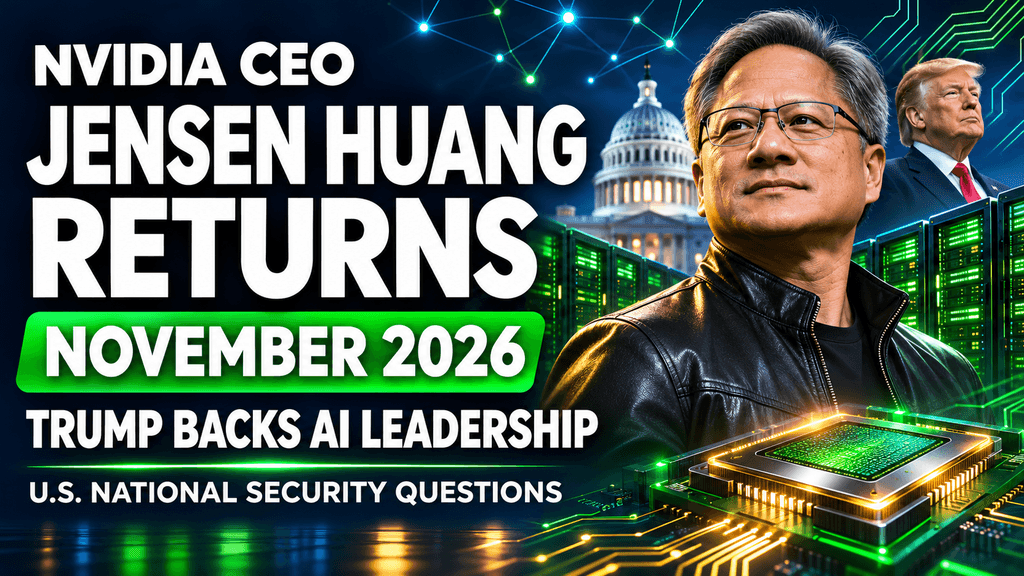
President Donald Trump supported Jensen Huang’s return as Nvidia CEO because the chipmaker plays a central role in U.S. artificial intelligence leadership. Huang resigned on November 12, 2026, amid questions about his conduct and reports of a possible foreign intelligence connection. After Trump pressed for his reinstatement, Nvidia’s board voted on November 22 to bring him back, citing assurances from senior U.S. officials on national security. The decision restored a familiar leader but did not close the company’s independent inquiry or separate investigations into chip exports. For investors and policymakers, the central issues now involve governance, AI competition, and the handling of sensitive technology.
Key Takeaways
-
Nvidia’s board reinstated Jensen Huang on November 22, 2026, after his resignation earlier that month and intervention by President Donald Trump.
-
Trump emphasized Huang’s leadership as the administration pursued U.S. AI competitiveness, technology exports, and national security goals.
-
Nvidia reported $115.8 billion in quarterly revenue, including $107.6 billion from Data Center operations, showing the scale of AI infrastructure demand.
-
Nvidia’s open-weight AI models extend its strategy from powerful data centers to smaller systems that can run AI applications locally.
-
U.S. chip-export inquiries and Nvidia’s independent review continue, despite assurances supporting Huang’s return and new compliance measures at the company.
-
NVDA shares swung sharply after reinstatement, while S&P placed Nvidia’s AA credit rating on negative watch over governance concerns.
Why Trump Backed Jensen Huang’s Return as Nvidia CEO in November 2026
The leadership crisis moved quickly. Nvidia’s board opened an independent investigation on November 8 after reporting suggested Huang had been the target of a foreign intelligence effort. On November 12, he stepped down as president, CEO, and director, leaving Chief Financial Officer Colette Kress to serve temporarily as CEO. Huang then expressed interest in returning, but the board initially rejected that course on November 17. Trump’s public endorsement and subsequent discussions with directors changed the political backdrop to an already difficult corporate decision.
Trump’s AI Competitiveness Case and Nvidia’s Board Reversal
Trump regarded Huang’s experience as valuable to a company supplying the processors, networking systems, and software used to build advanced AI services. The administration’s 2025 AI Action Plan had called for stronger domestic infrastructure and exports of complete American AI technology packages to international partners. Against that policy backdrop, restoring the executive most associated with Nvidia’s expansion offered a way to reduce disruption at a major technology supplier. That was the administration’s strategic argument, not proof that any particular executive was essential to national security.
On November 22, Nvidia’s directors unanimously voted to reinstate Huang as president, CEO, and board member, and the company announced the decision the following day. Board chair Harvey Jones said the directors were satisfied with Huang’s candor after meeting with him and had received input from senior government officials. Trump said he had contacted board members directly and indirectly. The formal appointment nevertheless remained a board decision, and the assurances did not replace the company’s responsibility to examine conduct and compliance concerns.
How Jensen Huang’s Reinstatement Affects Nvidia, Open-Weight AI, and U.S. AI Leadership
Huang’s return restores continuity for Nvidia’s product roadmap, customer relationships, and AI computing strategy, but it does not change the financial results already reported or guarantee a particular policy outcome. The company sells far more than individual graphics chips: its systems combine processors, high-speed networking, development tools, and software used to train and operate AI models. The immediate business question is whether Nvidia can keep delivering that technology at scale while responding to closer scrutiny of its leadership and international sales.
Nvidia’s Financial Results Show the Scale of AI Infrastructure Demand
On November 17, Nvidia reported $115.8 billion in third-quarter fiscal 2027 revenue, up 20% from the previous quarter and 103% from a year earlier. Data Center revenue reached $107.6 billion, an increase of 110% year over year and approximately 92.9% of total sales. The company also reported GAAP net income of $65.3 billion and a GAAP gross margin of 74.8%. These results were achieved during Kress’s interim leadership and show that Nvidia’s commercial momentum continued through the executive transition. They measure past performance, however, rather than the financial effect of Huang’s reinstatement.
Open-Weight Nemotron Models Extend Nvidia’s AI Strategy
Nvidia’s October 15 release of Nemotron 3.5 Super VL added a 120-billion-parameter open model aimed at demanding AI agent tasks, including visual understanding and multistep workflows. The company also introduced Nemotron 3.5 Bolt 74B-A9B, with 74 billion total parameters and approximately 9 billion active at a time, designed to fit a quantized version into 24GB of memory. That makes some local AI tasks possible without sending every request to a large remote data center. Open weights can give developers more control over deployment and customization, although access to model parameters does not automatically make every training dataset or licensing condition fully open.
U.S. AI Leadership Depends on Hardware, Software, and Export Policy
Nvidia’s position matters to U.S. AI policy because advanced chips are only one layer of the technology needed to operate competitive models. Networking, software libraries, reliable power, and deployment capacity also affect whether American AI systems reach domestic users and international partners. The White House’s full-stack export approach seeks to connect these layers, while restrictions on advanced chip sales are intended to protect sensitive capabilities. A related but distinct market involves decentralized AI computing networks, which pool distributed GPU capacity for certain workloads. Their development does not mean they are operated or endorsed by Nvidia.
Nvidia National Security Concerns, Government Assurances, and Ongoing Investigations
The central national security issue is whether sensitive U.S. computing technology or information reached unauthorized parties, and what Nvidia knew about any possible exposure. The board’s November 23 statement said government input gave it confidence that returning Huang to office posed no national security risk. That assessment concerned his reinstatement. It did not resolve every allegation involving people connected to Nvidia, the company’s customers, or the movement of restricted AI hardware.
Government Assurances Do Not End Separate Investigations
Reuters reported on November 25 that the Justice Department had not opened a formal investigation into Huang before Trump urged Nvidia to reinstate him. According to the report, separate federal inquiries involving customers, including Megaspeed and Super Micro Computer, were continuing. Officials cited by Reuters said they had found no evidence that Huang knowingly transferred sensitive technology or acted on behalf of a foreign government. Those findings must be kept distinct from the broader question of whether export rules were breached elsewhere in the supply chain.
In a report published on November 26, Reuters described differing assessments among U.S. officials of the allegations concerning Alice Huang, a former executive at Nvidia customer Megaspeed. People briefed on the intelligence said the FBI did not consider the available material proof that she was a foreign intelligence officer or asset; the CIA reportedly left open the possibility that additional evidence could change the picture. The claims are disputed and should not be treated as established espionage. Nvidia’s independent directors are continuing their own investigation, and the company has established a separate National Security and Export Control Committee and begun seeking a chief compliance officer.
New Export Restrictions and December Congressional Oversight
The Commerce Department’s Bureau of Industry and Security published a rule on November 25, effective November 23, adding seven companies in Malaysia, Singapore, and Thailand to the Entity List. The group includes several businesses using the Megaspeed name. The government cited risks that advanced computing equipment could be diverted to unauthorized users or purposes. Listed entities generally need licenses for goods covered by U.S. export rules, with applications subject to a presumption of denial. The rule concerns identified businesses and transactions; it is not a finding that Nvidia itself committed a violation.
Congress has scheduled further scrutiny. Huang agreed to a transcribed interview with three House committees on December 1, followed by Nvidia general counsel Tim Teter on December 2. The Senate Banking Committee has also listed Huang as the witness for a public hearing on December 3 about U.S. AI export controls. These sessions may clarify how Nvidia checks customers, monitors equipment destinations, and responds to government warnings. Testimony could inform future oversight or policy changes, but the legal consequences of any investigation depend on evidence and separate decisions by the relevant authorities.
Nvidia Stock Reaction, Corporate Governance Risks, and What Comes Next
Nvidia’s share-price swings show how quickly investors adjusted expectations as the leadership story changed. The company’s November 23 reinstatement announcement followed a severe decline in its shares, and the next trading session brought a sharp rebound. The gains then partly faded as questions about government involvement, legal exposure, and board oversight remained in focus. Price movements occurred alongside broader trading conditions, so it would be misleading to attribute every move to a single statement or event.
NVDA Share-Price Moves Following Huang’s Reinstatement
Nvidia shares experienced sharp price swings in November 2026 as investors reacted to Jensen Huang’s reinstatement and continuing leadership concerns. On November 20, NVDA closed at $125.53, down 14.01% from the previous session. The stock rebounded 31.48% on November 23, closing at $165.05, before declining 5.86% to $155.38 on November 24. Selling continued on November 25, when shares fell another 3.91% to $149.30.
Despite these declines, Nvidia shares remained approximately 18.9% above their November 20 closing price, although they had fallen 9.5% from the November 23 close. The movements reflected changing market expectations during a period of leadership and regulatory uncertainty, but no single development can fully explain the fluctuations. These figures represent historical Nasdaq closing prices rather than live market data. Nvidia's market exposure also extends beyond traditional equity trading. On November 18, blockchain-based tokenized Nvidia stock exposure became available through third-party issuance. These digital assets are designed to reflect the economic performance of Nvidia shares but are not equivalent to owning ordinary company stock. Token holders do not automatically receive shareholder voting rights or direct ownership of the underlying shares.
Board Independence, Executive Oversight, and Nvidia’s Credit Rating
The return of a prominent founder can reassure customers who value consistent leadership, but it also tests the independence of directors who must oversee that leader. The board must complete its own inquiry, explain any governance changes it adopts, and show how its new security committee will oversee export compliance. Investors can also examine whether a clear succession plan exists and whether compliance officers can report concerns independently of management. Those questions concern the company’s decision-making systems, not simply Huang’s personal standing.
On November 25, S&P Global Ratings placed Nvidia’s AA issuer credit rating on CreditWatch with negative implications. This was not a rating cut; the AA grade remained in place while the agency reviewed risks tied to management oversight, board independence, and reliance on Huang. A future downgrade could affect some financing arrangements, especially where Nvidia provides financial support for AI infrastructure projects. The scale of any impact would depend on the rating decision and the terms of specific contracts, not on the watch designation alone.
Revenue Guidance and the Events That Could Shape Nvidia’s Outlook
In its November 17 earnings release, Nvidia forecast fourth-quarter fiscal 2027 revenue of $130 billion, plus or minus 3%, equivalent to a range of $126.1 billion to $133.9 billion. Management said the quarter includes an additional reporting week and that its outlook assumes no Data Center compute revenue from China. The extra week matters when comparing results with shorter quarters, while the China assumption shows that management did not depend on those sales to reach its stated forecast. The numbers remain projections until the company reports actual results.
The next tests will come from congressional testimony, the board’s independent findings, any updates to export licensing, and Nvidia’s ability to meet delivery commitments. Watch for concrete changes to compliance procedures, customer checks, or management responsibilities rather than treating political statements as operational results. The share price may also respond to sector-wide AI spending and interest-rate expectations. None of those influences provides a reliable basis for a short-term price prediction.
Conclusion
Trump’s support helped bring Jensen Huang back to Nvidia at a moment when the company’s AI infrastructure business was expanding rapidly and its leadership was under unusual pressure. The board’s November 22 decision restored executive continuity, while government assurances addressed the immediate question of reinstatement. They did not settle the separate issues involving chip exports, intelligence assessments, or the strength of Nvidia’s internal oversight. Strong revenue and a clear product strategy give the company substantial operating resources, but its next phase will be judged partly on how convincingly it handles investigations, implements governance safeguards, and delivers on financial guidance.
FAQs
Did Nvidia shareholders vote to reinstate Jensen Huang as CEO?
No separate shareholder vote was reported. Nvidia’s November 22, 2026, SEC filing said its board unanimously approved Huang’s reinstatement. The appointment was made at board level, although shareholders retain their ordinary voting rights on director elections and other matters that require approval.
What happened to Colette Kress after Jensen Huang returned?
Colette Kress ended her tenure as interim CEO but continued as Nvidia’s executive vice president and chief financial officer. Keeping her in that position preserved continuity in financial management while Huang resumed responsibility for overall strategy and operations.
Are Nvidia’s open-weight AI models the same as open-source AI?
Not necessarily. Making trained model parameters available does not automatically mean the source code, training data, and full development process are open. Developers should review the license for each model to understand commercial permissions and other conditions.
What does key-person risk mean for Nvidia investors?
Key-person risk is a company’s dependence on an executive whose expertise, relationships, or decision-making role may be difficult to replace. For Nvidia, it makes succession planning, delegation of authority, and independent board oversight especially relevant to evaluating business continuity.
Did Nvidia lose its AA credit rating in November 2026?
No. S&P placed Nvidia’s AA rating on CreditWatch with negative implications on November 25, but did not lower the rating that day. The action signaled a possible future change following a review of management and governance risks.
Disclaimer: This general market information may come from third-party, commercial, or sponsored sources and is provided for informational and educational purposes only. It does not constitute financial or investment advice, an offer, a solicitation, or a guarantee. We assume no responsibility for the accuracy, completeness, or reliability of this information or for any losses arising from its use.
Investing and trading involve risks. Past performance does not guarantee future results. Users should conduct their own research, exercise sound judgment, and take full responsibility for their decisions. For more information, please refer to KuCoin's Terms of Use and Risk Disclosure.