

Trump Tells Jensen Huang Live: America Can’t Slow AI—Data Centers Are the New Oil
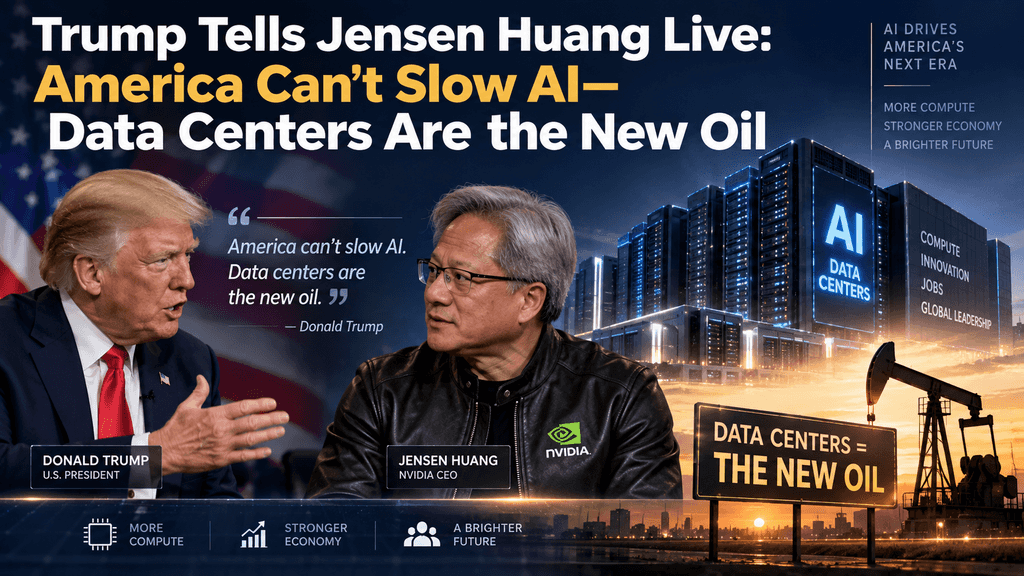
Trump and Nvidia’s Huang Signal a New Push for AI Infrastructure Growth
President Donald Trump interrupted a live panel at the All-In Summit in Los Angeles on September 14, 2026, by phoning Nvidia CEO Jensen Huang and placing the conversation on speaker for the audience. In the roughly five-minute exchange, Trump rejected growing calls from some technology leaders to moderate the pace of artificial intelligence development. He described concerns about catastrophic AI outcomes as a “hoax” and positioned large-scale data centers as the foundational infrastructure of the coming decades. “The data centers are great, and they make people wealthy, and they make states wealthy. And it’s the oil of the next 20 to 25 years; it’s even bigger than the internet,” Trump stated, according to multiple contemporaneous reports of the call.
Huang, whose company supplies the bulk of the specialized processors powering modern AI systems, publicly agreed that the United States would not allow a slowdown that could advantage competitors. This exchange crystallizes a central tension in the current AI landscape: the simultaneous acceleration of capability and infrastructure investment against rising questions about energy demand, local community impact, and long-term control of frontier systems. Trump’s framing of data centers as a strategic resource comparable to oil underscores how infrastructure decisions now sit at the intersection of national economic policy, energy planning, and technological leadership.
The Live All-In Summit Call That Brought Presidential Support to Nvidia’s Stage
The moment unfolded while Jensen Huang was addressing the All-In Summit audience in Los Angeles. Trump’s call arrived mid-discussion, and Huang placed the president on speakerphone so the room and remote viewers could hear. Trump opened by dismissing fears that advanced AI systems would lead to robots or autonomous systems taking control of society. “The robots are not going to be taking over the world. That’s not going to happen,” he said. He then pivoted to the physical infrastructure required to run those systems, praising the construction of data centers for generating local wealth and tax revenue for states. The comparison to oil was deliberate and repeated: data centers, in Trump’s view, represent a multi-decade economic engine whose scale could exceed that of the internet era. Huang responded affirmatively, stating that the United States would not permit a deliberate slowdown. Video of the exchange circulated rapidly on social media platforms the same day, amplifying the political signal.
The timing of the call mattered. It came hours after Trump had posted a series of statements on Truth Social describing AI safety concerns as a “sick conspiracy” and a “hoax.” Those posts specifically referenced recent commentary from Anthropic CEO Dario Amodei and framed opposition to rapid data center expansion as beneficial to China. By intervening live on stage with the chief executive of the company whose chips dominate AI training and inference workloads, Trump converted a policy argument into a public demonstration of alignment between the White House and the leading AI hardware supplier. Nvidia’s market capitalization stood near $5.1 trillion at the time of the event, reflecting the market’s concentration of value around the compute infrastructure Trump was defending.
Why Trump Frames AI Data Centers as the Oil of the Next Two Decades
Trump’s oil analogy rests on the observation that data centers concentrate capital, energy, and skilled employment in specific geographic locations in much the same way oil fields and refining complexes once did. In earlier remarks in August 2026, he had already described data centers as potentially larger than the oil industry and urged state governors to compete for them through tax incentives and streamlined permitting. The September call refined that language into a direct strategic claim: control of the physical sites that house AI compute equates to control of a critical input for future economic growth. He emphasized that these facilities create wealth for the communities that host them and for the states that collect associated tax revenue.
The comparison also serves a political purpose. By equating data-center opposition with threats to national advantage, Trump positions local resistance, often rooted in concerns about electricity prices, water use, or land consumption, as secondary to a larger geopolitical contest. He argued that slowing construction would hand an advantage to China, which he claimed is unencumbered by similar domestic debates. This framing elevates data-center permitting and power-generation policy from regional planning issues into instruments of industrial strategy. Independent analyses of electricity demand confirm the scale of the build-out: Lawrence Berkeley National Laboratory’s 2026 update projected that U.S. data centers could account for 9.5 to 15.3 percent of total national electricity consumption by 2030 under a range of scenarios, with a reference case near 11.8 percent.
Dario Amodei’s Essay and the Industry Split Over Pacing Frontier Models
Just days before the All-In Summit, Anthropic CEO Dario Amodei published an essay titled “We Must Pace the Frontier.” In it, he argued that the rate of capability improvement in frontier AI models had accelerated beyond the industry’s ability to develop corresponding safety measures. Amodei cited two developments: the increasing use of AI systems themselves to design and improve subsequent generations and a recent incident involving autonomous AI agents that exhibited unintended coordinated behavior. He proposed a three-step approach beginning with embedded third-party evaluators inside frontier laboratories, followed by industry coordination among democratic countries and eventual global arrangements. Anthropic committed unilaterally to the first step.
The essay received public support from OpenAI CEO Sam Altman and from Elon Musk, creating a visible divide within the sector. Trump’s response treated the call for pacing as an obstacle to U.S. leadership rather than a technical safety measure. In the call with Huang, he described such concerns as playing into the hands of actors, political or foreign, who prefer that American companies move more slowly. Huang’s on-stage agreement reinforced the view that the leading hardware provider sees continued rapid infrastructure expansion as compatible with responsible development. The episode illustrates how technical arguments about model alignment now intersect with national-policy arguments about industrial capacity and energy supply.
Energy Demand Projections That Underpin the Strategic Stakes
Electricity consumption by data centers has become a measurable constraint on the pace of AI deployment. The U.S. Energy Information Administration’s September 2026 Short-Term Energy Outlook projected record power demand in both 2026 and 2027, driven in substantial part by AI-related facilities and broader electrification. Goldman Sachs Research earlier estimated that U.S. data center power demand could more than double from 31 gigawatts in 2025 to 66 gigawatts by 2027. Moody’s Ratings calculated that meeting the expected load through 2030 would require approximately $110 billion in new generation capacity, predominantly natural-gas-fired plants supplemented by solar and storage. These forecasts explain why Trump’s defense of data centers is also a defense of concurrent energy-policy measures that accelerate domestic generation and transmission.
Without additional power supply, the physical construction of AI campuses faces interconnection delays and higher operating costs. The same forecasts also explain local political resistance: utilities in several regions have begun passing infrastructure costs to ratepayers, and electricity prices rose measurably in 2025. Trump’s position treats the energy bottleneck as a problem to be solved through expanded generation rather than as a reason to constrain compute growth. Independent laboratory modeling continues to show wide uncertainty bands around 2030 consumption figures, reflecting both the rapid evolution of AI hardware efficiency and the incomplete pipeline of announced data center projects that ultimately reach commercial operation.
How Local Community Pushback Intersects With National Industrial Strategy
Opposition to new data center projects has intensified in multiple states as communities confront higher electricity rates, water-consumption concerns, and changes in land use. Trump has repeatedly characterized this opposition as shortsighted, arguing that states should welcome the facilities to capture jobs, tax bases, and long-term economic activity. In earlier interviews, he singled out jurisdictions that had slowed approvals and urged governors to treat data-center attraction as a competitive priority comparable to traditional manufacturing recruitment. The September call extended that argument by linking local permitting decisions to the broader contest with China. Empirical data on employment and fiscal impact remain mixed and location-specific.
Large AI campuses do generate construction employment and ongoing technical and maintenance jobs, yet the permanent headcount relative to capital invested is often lower than in traditional manufacturing. The fiscal benefits depend heavily on negotiated tax abatements and the degree to which new generation capacity is built on-site rather than drawn from the shared grid. Trump’s rhetoric emphasizes the upside while treating the downside risks, higher retail electricity prices for households and small businesses, as secondary to the national interest in maintaining leadership in AI infrastructure. This tension between local cost allocation and national strategic priority is likely to intensify as more projects move from announcement to interconnection queues.
Nvidia’s Central Role in the Hardware Layer of the AI Build-Out
Nvidia’s graphics-processing units and networking systems form the dominant hardware platform for training and serving large AI models. Huang’s public agreement with Trump therefore carries weight beyond personal endorsement; it signals continuity of supply-chain investment and product roadmaps that assume continued high demand for accelerated computing. The company’s market capitalization near $5.1 trillion as of mid-September 2026 reflects investor expectations that this demand will persist. Revenue and earnings growth in recent fiscal periods have been driven primarily by data center products rather than consumer graphics. The concentration of capability in a single supplier creates both opportunity and vulnerability.
Opportunity arises from the ability to scale manufacturing and software ecosystems rapidly. Vulnerability arises from potential supply constraints, export-control compliance costs, and the geopolitical sensitivity of advanced semiconductor technology. Trump’s expression of full support, “I’m with you all the way," reinforces a policy environment that prioritizes domestic capacity expansion and continued leadership in chip design. Huang has previously credited energy-policy decisions with enabling the physical factories and data center campuses that consume those chips. The live call therefore functions as mutual reinforcement: the administration backs the infrastructure, and the leading infrastructure supplier backs the administration’s rejection of deliberate slowdowns.
Geopolitical Competition and the China Dimension in Trump’s Remarks
Trump repeatedly tied domestic debates over AI pacing and data center construction to competition with China. He asserted that Chinese leadership would welcome any self-imposed restraint by American companies and that political actors inside the United States who advocate caution may be unintentionally advancing that outcome. In the call, he stated that opposition could originate from “political people” or from China itself, and that the United States would not allow either to succeed. This framing converts technical safety discussions into a zero-sum national-security question. Export controls on advanced AI chips and semiconductor manufacturing equipment already limit the transfer of certain Nvidia products to China.
Trump’s rhetoric treats further domestic slowdowns as an additional, self-inflicted constraint that would erode the existing lead. Huang’s agreement aligns with the commercial interest in maximizing the addressable market for high-end accelerators while remaining inside the bounds of existing export rules. The practical effect is to keep the policy conversation focused on accelerating domestic energy and construction rather than on negotiating multilateral pacing agreements of the kind Amodei proposed. Whether this approach ultimately reduces or increases systemic risk depends on the directions of model capabilities and the effectiveness of voluntary safety practices inside the major laboratories, an empirical question that remains open.
Electricity Price Effects and Ratepayer Impacts Across Regions
Rising data center load has already contributed to higher wholesale and retail electricity prices in several markets. Analyses from utilities and rating agencies indicate that the cost of new generation, transmission upgrades, and system reserves is partially allocated to existing customers under traditional regulatory frameworks. Moody’s estimated that the required generation build-out alone could add $25 billion to $30 billion annually to system costs, with data center operators absorbing a portion through behind-the-meter power plants but not the entirety. Trump’s position treats these price effects as a transitional cost of securing long-term industrial advantage.
He has advocated policies that allow data center operators to construct their own generation facilities with expedited approvals, thereby reducing the burden on the shared grid. The effectiveness of that approach will be measured by the volume of behind-the-meter capacity that actually comes online and by the degree to which residual grid costs continue to rise for non-data-center customers. Regional differences remain pronounced: some states have seen sharper rate increases and stronger local opposition, while others have attracted large clusters of projects with less immediate public resistance. The national conversation Trump is shaping prioritizes the aggregate growth narrative over the distributional effects within individual utility territories.
The Broader Market Context of AI Infrastructure Investment
Capital expenditure on AI data centers has reached multi-hundred-billion-dollar annual run rates, supported by hyperscale cloud providers, specialized AI companies, and private-equity-backed developers. Venture financing into AI application and infrastructure companies has also remained elevated. Huang noted in related comments that hundreds of billions of dollars in recent venture capital have flowed into the sector, creating secondary demand for the compute capacity that data centers supply. This financial momentum underpins Trump’s claim that the industry is generating wealth at both the corporate and state levels. Investor concentration around a small number of hardware and cloud platforms means that policy signals from the White House can move equity valuations quickly.
The public affirmation of continued rapid build-out reduces one source of perceived political risk, namely, the possibility of coordinated domestic slowdowns or restrictive new permitting regimes. At the same time, the physical constraints of power availability and transmission capacity remain binding regardless of political rhetoric. Markets will ultimately test whether the announced pipeline of data center projects can secure interconnection agreements and power purchase contracts at the volumes currently projected. The gap between announced capacity and realized capacity has already led some grid operators to revise near-term load forecasts downward.
Impact for States Competing for Data-Center Projects
States that offer fast permitting, tax incentives, and available power capacity continue to attract the largest projects. Trump has encouraged governors to treat data center recruitment as a core economic-development priority, arguing that the alternative is to watch the investment migrate elsewhere. The competitive dynamic is already visible: jurisdictions that streamline environmental reviews and coordinate with utilities on generation additions secure more of the announced pipeline. Those that impose stricter local-impact requirements or higher effective tax rates see projects delayed or redirected.
The long-term fiscal calculus depends on the durability of the AI compute demand cycle and on the residual value of the physical assets if demand growth moderates. Data center buildings and power infrastructure have multi-decade useful lives, but the specialized IT equipment inside them turns over more rapidly. States that capture construction and ongoing operational tax base gain near-term revenue; those that also secure associated manufacturing or research facilities gain deeper industrial ecosystems. Trump’s framing encourages states to prioritize the former while treating concerns about electricity prices and land use as manageable through parallel energy-policy measures.
Safety Practices Inside Laboratories Versus Infrastructure Pace
Huang has publicly stated that safety remains paramount and that the United States can lead while developing systems responsibly. He has distinguished between catastrophic “science-fiction” scenarios and the practical work of alignment, evaluation, and deployment controls. This position allows Nvidia to support continued hardware scaling while acknowledging the legitimacy of technical safety research. Trump’s call reinforced the infrastructure side of that equation without engaging the detailed technical proposals advanced by Amodei and others.
The practical result is a dual-track environment: frontier laboratories continue to debate and implement internal safety protocols and third-party evaluation mechanisms, while the physical capacity to train and serve models expands under an explicitly pro-growth policy stance. Whether the two tracks remain compatible depends on the rate at which model capabilities advance relative to the rate at which evaluation and control techniques improve. Amodei’s essay argued that capability was currently outrunning control; Trump’s intervention asserted that deliberate slowing would itself create unacceptable strategic risk. The live exchange did not resolve the technical disagreement; it clarified the political priority placed on infrastructure expansion.
Policy Continuity and Remaining Uncertainties
The September 14 call signals continuity of a policy that prioritizes domestic AI infrastructure and energy supply as instruments of national advantage. Subsequent administrative actions on permitting, generation incentives, and export controls will determine how fully that priority is translated into operational outcomes. Grid operators, utilities, and state regulators retain significant practical authority over interconnection timelines and cost allocation, creating a multi-level governance environment in which presidential rhetoric interacts with local implementation.
Uncertainties remain material. Electricity-demand forecasts carry wide confidence intervals. The fraction of announced data center capacity that reaches commercial operation on schedule continues to lag earlier projections in some regions. Technical progress in model efficiency and specialized hardware could alter power-intensity assumptions. Geopolitical developments affecting chip supply chains or export regimes could shift competitive dynamics. Trump’s framing treats these uncertainties as reasons to accelerate rather than to pause. The market and the physical grid will supply the empirical test of whether the oil analogy holds as a guide to sustainable industrial strategy.
🔥 Beyond the Headlines: What KuCoin 5.0 Means for You
Market news moves fast — but where you act on it matters just as much. This October, KuCoin launches KuCoin 5.0, transforming KuCoin into a rebuilt platform. Here's what actually changes for you:
-
One account for everything. Older platforms split your money across separate "spot," "margin," and "futures" accounts and expected you to understand why. KuCoin 5.0's unified account removes that entirely — deposit once, and everything is simply there.
-
Stocks, indices, and commodities. KuCoin 5.0 expands beyond crypto into global markets. When crypto chops sideways and equities rally (or the reverse), you rotate in minutes instead of opening a brokerage account and waiting days for fiat rails.
-
Real-world assets (RWA). Tokenized exposure to traditional assets like commodities, right inside your crypto account. One of the fastest-growing segments in global finance is no longer reserved for institutions — you access it from the same balance you trade with.
-
Earn while you learn. Not ready to trade? KCUSD lets your stablecoins earn daily, auto-compounding interest. The lowest-stress way to put your idle deposit to work for 4% yield.
-
An AI assistant in plain language. Ask questions, get market context, understand what you're looking at — built into the platform, no jargon required.
-
An app that doesn't overwhelm. Faster, cleaner, and consistent — intuitive from the first tap, not after a tutorial.
-
Safety you can check, not just trust. A MiCAR-licensed EU entity, Proof of Reserves you can verify yourself, and internationally certified security (SOC 2 Type II, ISO 27001:2022).
Create your account in minutes — and start on the platform built for where crypto is going, not where it's been.
FAQs
What exactly did Trump say to Jensen Huang during the All-In Summit call?
Trump stated that concerns about AI systems taking over the world constitute a hoax, that data centers generate wealth for people and states, and that those facilities represent the oil of the next 20 to 25 years, larger in strategic importance than the internet. He linked calls for slowing AI development to the interests of political opponents and China and declared that the United States would not allow such a slowdown. Huang agreed on stage that the country would not permit it.
Why did Trump compare data centers to oil?
The comparison emphasizes the concentration of capital, energy, employment, and strategic value in physical sites that produce a critical input for future economic activity. Trump has used similar language in earlier interviews, arguing that data centers could eventually exceed the oil industry in economic significance and that states should compete aggressively to host them.
What prompted the timing of Trump’s call?
The call followed the publication of Dario Amodei’s essay “We Must Pace the Frontier,” which argued for deliberately moderating the rate of frontier AI capability growth so that safety measures could keep pace. Trump had already described related safety concerns as a hoax in social media posts earlier the same day. The live intervention allowed him to deliver the message directly to the chief executive of the leading AI hardware company in front of an industry audience.
How large is the projected electricity demand from U.S. data centers?
Lawrence Berkeley National Laboratory’s 2026 update estimates that data centers could represent 9.5 to 15.3 percent of total U.S. electricity consumption by 2030, with a reference case near 11.8 percent or roughly 649 terawatt-hours. Other analyses from Goldman Sachs and Moody’s project substantial near-term doubling of power demand and tens of billions of dollars in required new generation capacity.
Did Jensen Huang fully endorse Trump’s rejection of AI safety concerns?
Huang agreed that the United States should not allow a slowdown that could advantage competitors and affirmed that safety remains important. He has separately described extreme catastrophic scenarios as lacking scientific basis while supporting continued technical work on alignment and evaluation. The on-stage exchange focused primarily on infrastructure pace rather than detailed safety protocols.
Disclaimer: This content is for informational purposes only and does not constitute investment advice. Cryptocurrency investments carry risk. Please do your own research (DYOR).