

Pump.fun BOOST Mode Explained: How Buybacks and Burns Target Dead Liquidity
2026/07/22 18:07:00
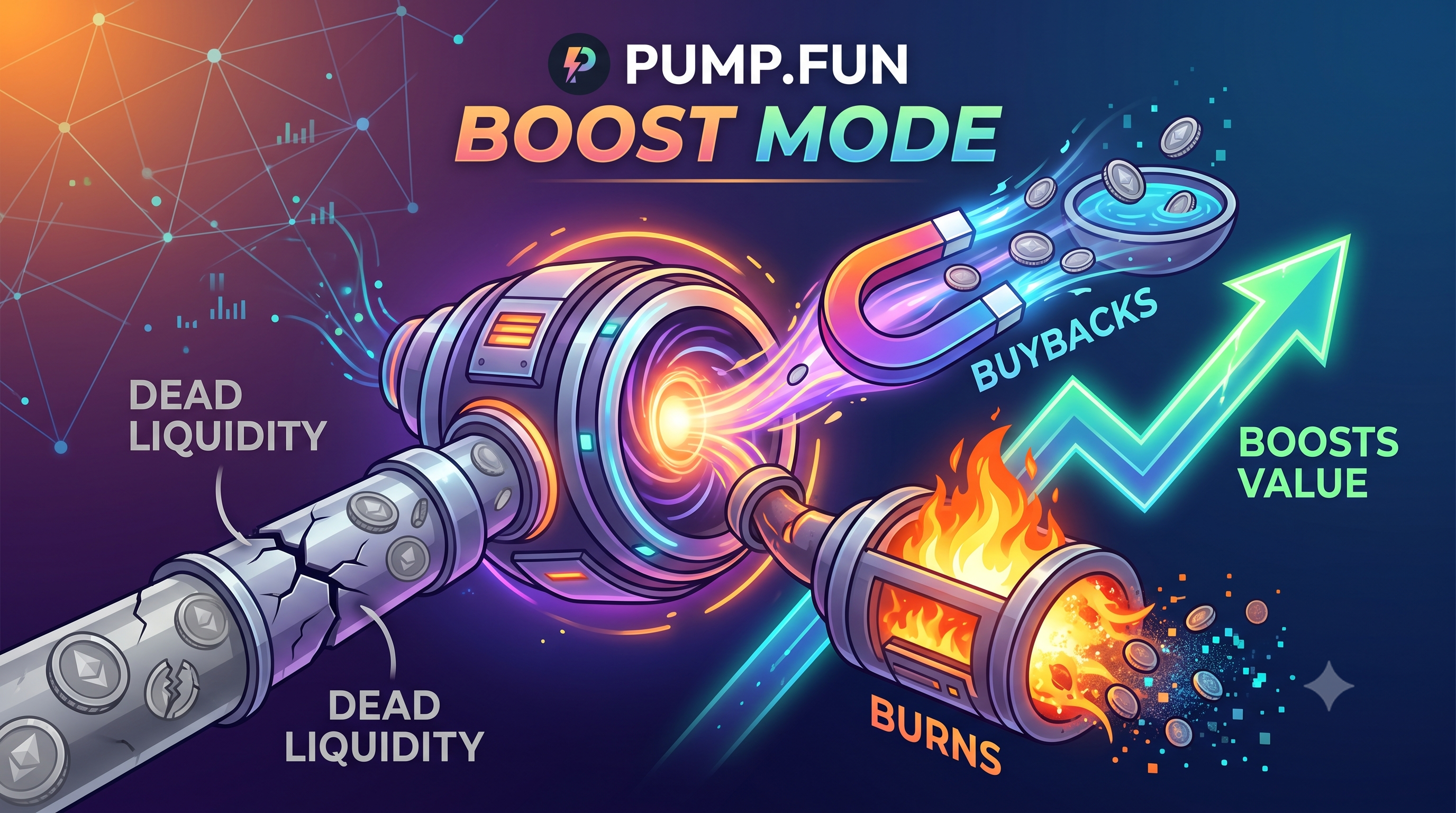
Pump.fun has introduced a major market structure update known as BOOST Mode, aimed directly at newly launched tokens that successfully complete their bonding curve and migrate to PumpSwap. Instead of allowing all migration funds to sit idly as static liquidity, this new mechanism reallocates a portion of that capital to execute automatic token buybacks and burns immediately after migration. Pump.fun explicitly designed this feature to combat what it calls the "dead liquidity" problem in the Solana memecoin liquidity landscape.
But does Pump.fun BOOST Mode actually create a healthier long-term trading environment, or does it simply engineer a temporary, five-minute buying window? This article will break down the exact operational mechanics of BOOST Mode, analyze its potential advantages for creators and traders, explore the inherent trading risks, and evaluate its long-term significance for the broader ecosystem.
Key Takeaways
-
Automatic execution: Pump.fun BOOST Mode triggers automatically for eligible tokens upon migration, requiring no manual activation from creators or traders.
-
Timed buybacks and burns: Automatic token buybacks are executed in intervals over a five-minute window post-migration, with all purchased tokens being permanently burned.
-
Funded by existing capital: The mechanism utilizes the token’s original migration structure funds rather than relying on external subsidies or platform rewards.
-
Short-term relief, long-term uncertainty: While it may absorb early post-migration sell pressure, it cannot artificially manufacture long-term organic market demand.
-
Vulnerable to exploitation: The fixed and public nature of the buyback window means early traders and algorithmic bots can potentially front-run or trade against the protocol.
What Did Pump.fun Announce?
Pump.fun recently rolled out BOOST Mode to fundamentally alter how newly migrated tokens establish their initial market presence. This system specifically applies to new tokens transitioning from the initial bonding curve phase to a live decentralized exchange environment. Upon graduation, the protocol activates an automated agent that executes continuous buybacks during the crucial first five minutes of trading on PumpSwap.
The financial scale of this operation is significant at the micro-level. For the SOL trading pairs, the BOOST agent utilizes approximately 17.6 SOL. For the USDC trading pairs, the mechanism involves around $2,516. The tokens acquired through these automatic token buybacks do not return to circulation; they are permanently sent to a burn address.
Users can independently verify these actions by observing the BOOST agent's on-chain buy and burn records. It is critical to clarify that the BOOST mechanism specifically buys and burns the newly migrated memecoin, not Pump.fun’s own platform token (PUMP). This ensures that the capital directly impacts the specific token undergoing migration rather than serving as a platform-wide tokenomic buyback program.
Why Dead Liquidity Became a Problem
To understand BOOST Mode, one must first understand "dead liquidity." Under the original Pump.fun token migration model, when a token completed its bonding curve, the accumulated SOL or USDC, along with the remaining reserved tokens, were deposited into a new PumpSwap automated market maker (AMM) pool. Because these liquidity pools are strictly controlled by the protocol to prevent rug pulls, the capital cannot be withdrawn or dynamically redeployed like a standard LP position.
If a newly launched memecoin rapidly loses community attention and trading volume drops to zero—a common occurrence in the volatile crypto market—those funds remain perpetually locked in the pool. Pump.fun claims that over $100 million annually is stranded as "dead liquidity" due to this original migration structure. It is important to note that this specific $100 million figure comes directly from Pump.fun's own platform estimates. Furthermore, "dead liquidity" is a descriptive term utilized by the platform rather than a standardized, strict DeFi definition.
These funds are not entirely useless; they theoretically provide depth for existing trades. However, the core issue is capital efficiency—that capital is effectively frozen in inactive markets. Rather than allowing this capital to instantly become a static pool asset, Pump.fun designed BOOST Mode to convert a portion of it into an active, public market buy wall right at the moment of migration.
How Pump.fun Token Migration Worked Before BOOST
To fully grasp the impact of BOOST Mode, it helps to review the baseline mechanics of a Pump.fun token migration. The process traditionally operates in two distinct phases.
The Bonding Curve Stage
Initially, a new token is traded along a virtual bonding curve. During this phase, as buying pressure increases, the token's price programmatically rises along the mathematical curve. Once the token hits a predefined market capitalization and graduation threshold, the bonding curve stage concludes.
The PumpSwap Migration
Following graduation, the protocol automatically creates a new PumpSwap liquidity pool. The real SOL or USDC accumulated during the bonding curve, alongside the allocated tokens, are seeded into this AMM pool. From this moment onward, the token's price is determined by organic supply and demand within the pool rather than a virtual curve. Historically, this exact moment of migration is characterized by intense volatility, rapid profit-taking from early buyers, and aggressive bot activity. Recent on-chain and academic research (such as papers found on arXiv) have extensively documented this two-stage transition, highlighting the chaotic nature of the initial AMM trading environment.
This original model highlighted a distinct gap: while the migration provided secure initial liquidity, it did not generate any active, programmatic buying demand to counter the immediate wave of sellers looking to lock in early profits.
How BOOST Mode Works Step by Step
BOOST Mode restructures the critical moments immediately following graduation. Here is how the token burn mechanism and automated buying process unfold:
-
A token completes its bonding curve: The token hits the required graduation threshold and prepares to transition to PumpSwap.
-
BOOST is automatically activated: Every eligible new token automatically enters the BOOST process. Token creators or holders do not need to apply, pay extra fees, or toggle any settings.
-
Migration funds are reallocated: Instead of depositing 100% of the graduation funds directly into the static liquidity pool, a specific portion (~17.6 SOL or ~$2,516 USDC) is diverted and assigned to the protocol's BOOST agent.
-
The agent executes timed buybacks: Over a strict five-minute window, the agent systematically executes multiple purchase orders for the token, rather than dropping a single, massive market buy order.
-
Purchased tokens are burned: Every token bought by the BOOST agent is permanently removed from the circulating supply by being sent to an unrecoverable burn address or processed through protocol-defined burn mechanisms.
-
The quote asset enters the pool: Ultimately, the SOL or USDC used by the BOOST agent to purchase the tokens ends up inside the PumpSwap liquidity pool, ensuring the capital remains within that specific token's market ecosystem.
| Stage | What Happens | Expected Market Effect |
| Graduation | Token leaves the bonding curve | Trading moves to PumpSwap |
| BOOST activation | Funds are assigned to the buyback agent | A predictable source of demand appears |
| Timed buybacks | Tokens are purchased over five minutes | Early sell pressure may be absorbed |
| Token burn | Purchased tokens are removed | Circulating supply declines |
| Post-BOOST trading | Automatic purchases stop | Price returns to normal supply and demand |
Why Pump.fun Uses Timed Buybacks
The decision to execute the automatic token buybacks over a five-minute window, rather than a single lump-sum transaction, is rooted in market mechanics. A single, instantaneous large order in a newly seeded, low-liquidity pool would cause severe price slippage, artificially spiking the price for a fraction of a second before immediately crashing. By distributing the purchases into smaller, continuous batches, the protocol minimizes the market impact of any single trade.
Furthermore, a sustained buy wall over five minutes is better equipped to absorb the ongoing, heavy sell pressure that typically follows a token's graduation. The buyback price is naturally distributed across multiple blocks, rather than being concentrated at one highly vulnerable price point.
However, this time-weighted approach has distinct limitations. Time dispersion does not eliminate market risk. Algorithmic trading bots and sophisticated actors are fully aware of the buyback's size and its precise five-minute duration. While batching orders reduces instantaneous slippage, it essentially telegraphs to arbitrageurs exactly when protocol-guaranteed buying pressure will exist in the market. Once those five minutes expire, the token must rely entirely on real, organic buyers to sustain its price.
Old Migration Model vs. BOOST Mode
The differences between the traditional migration and the new system are highly specific but significantly impact early trading dynamics.
| Feature | Previous Migration Model | BOOST Mode |
| Use of migration funds | Directly seeded into liquidity | Partly used for automatic buybacks |
| Programmed buying pressure | None | Present for five minutes |
| Token supply | No migration-related reduction | Repurchased tokens are burned |
| Funding source | Bonding curve migration capital | The same migration capital |
| Trader action required | Not applicable | No manual activation required |
| Long-term demand | Not created | Still not guaranteed |
| Main goal | Establish initial liquidity | Improve capital use and early trading conditions |
In summary, BOOST Mode does not magically conjure new money into existence. It simply alters the path that existing capital takes before it settles into the liquidity pool. Therefore, BOOST should be viewed as a restructuring of migration liquidity rather than a new, externally funded subsidy program.
What BOOST Could Mean for Traders and Creators
For everyday traders, BOOST Mode introduces a highly predictable, albeit brief, environment of programmatic buying immediately post-graduation. Because the protocol actively buys the token, some of the heavy sell orders from early adopters taking profits might be comfortably absorbed without severely tanking the price. Additionally, the transparent on-chain records of these buybacks and burns increase the observability of the token's early lifecycle. Consequently, traders navigating Solana memecoin liquidity might pay much closer attention to tokens in their first few minutes of migration, attempting to ride the momentum created by the BOOST agent.
For token creators and community builders, the mechanism provides a brief window of breathing room. Instead of watching a newly migrated token instantly collapse under the weight of immediate profit-taking, the project gains a few critical minutes to attract new users, establish a market narrative, and solidify community sentiment. Furthermore, the token burn mechanism acts as a deflationary event, which communities can leverage in their marketing as a narrative of tightening supply.
However, it is vital to maintain a neutral perspective: BOOST Mode only alters the atmospheric conditions of the migration phase. It cannot, and does not, replace the foundational requirements of a successful project, such as genuine community building, broad holder distribution, transparent operations, and sustained organic demand.
The Biggest Risks Behind BOOST Mode
While the mechanism aims to improve early market conditions, it introduces several complex trading risks and adversarial dynamics.
Bots May Trade Against the Buyback Window
The most immediate risk is exploitation by automated systems. Because the duration (five minutes) and the capital size (17.6 SOL / $2,516 USDC) are universally known, bots can easily strategize around this window. Sophisticated actors may buy aggressively right at the end of the bonding curve phase, exclusively to dump their tokens into the protocol's guaranteed buy wall during the BOOST phase, effectively utilizing the mechanism as their personal exit liquidity.
Prices Could Fall After the Five-Minute Window
BOOST creates an artificial environment of demand. Once the five-minute timer expires, the protocol agent abruptly ceases all purchasing activity. If the token has not managed to attract genuine human buyers or retail interest during that brief window, the price is highly susceptible to a steep and sudden retracement as the market readjusts to a lack of automated support.
Burns Do Not Guarantee Scarcity
While tokens are permanently destroyed, a token burn only impacts price positively if the broader supply dynamics support it. The raw number of tokens burned must be analyzed against the total circulating supply and the concentration of large holders (whales). Burning a fraction of the supply will not yield a meaningful long-term price floor if a few wallets still control the vast majority of the token.
Ultimately, BOOST Mode may succeed in temporarily inflating surface-level trading volume, but this does not equate to an improvement in a token's actual fundamentals. High-frequency trading and coordinated wallet clusters are notoriously active in early-stage Pump.fun markets. Recent academic research (accessible via arXiv) has identified vast swaths of wallet clusters executing coordinated early buys during token launches. While researchers caution that wallet coordination does not automatically equal malicious causation regarding a token's success, the presence of these sophisticated actors means the risk of bots weaponizing the BOOST buybacks cannot be ignored.
Can BOOST Help Memecoins Survive Longer?
Determining whether BOOST Mode extends the lifespan of a memecoin requires strict, objective evaluation criteria rather than simply looking at a green candle in the first five minutes. Its true efficacy can only be judged through extended on-chain data analysis.
| Metric to Track | Why It Matters |
| Price after 5 minutes | Shows the immediate effect of the buyback |
| Price after 1 and 24 hours | Tests whether demand survives after BOOST |
| Trading volume after BOOST | Reveals whether organic activity continues |
| Liquidity depth | Measures whether large trades cause less slippage |
| Holder concentration | Identifies whether supply remains controlled by a few wallets |
| Tokens burned as a share of supply | Shows whether the burn is economically meaningful |
| Bot share of early trades | Indicates who captures the buyback demand |
To contextualize this, it is crucial to recognize that successfully migrating off the bonding curve is already an extreme statistical anomaly. A 2026 academic study tracking 832,941 token launches on Pump.fun estimated that the 24-hour graduation rate was a mere 0.198% (arXiv). This stark data point indicates that the overwhelming majority of created tokens never even reach the stage where BOOST Mode would activate. For those that do, survival depends on passing the metrics outlined above.
What BOOST Means for Pump.fun and Solana
From a macroeconomic and platform-level perspective, BOOST Mode represents a strategic evolution for Pump.fun. By heavily marketing the automatic buybacks and burns, the platform increases the overall spectacle and attention surrounding PumpSwap migration events. If this structural change genuinely extends the active trading lifespan of migrated tokens, PumpSwap stands to capture significantly more sustained trading volume, which directly translates to higher protocol fee revenues.
Furthermore, this mechanism helps Pump.fun sharply differentiate itself in the fiercely competitive Solana token launch ecosystem. It signals a shift in the platform's focus—from merely lowering the technical barriers to token creation, toward actively trying to optimize post-graduation market microstructures.
However, readers must remain clear on one point: BOOST Mode's impact on Pump.fun's native platform token (PUMP) is entirely indirect. While increased platform volume could benefit the broader Pump.fun ecosystem, BOOST Mode's automated funds are explicitly used to buy the newly migrated memecoin, not PUMP. Pump.fun operates separate, distinct buyback and burn schedules for its native PUMP token, and the two mechanisms should be evaluated independently.
Conclusion
Pump.fun BOOST Mode is a tangible, mechanical adjustment to market structure, acting as much more than just a cosmetic interface update. By proactively converting a portion of static migration capital into an aggressive, short-term buy wall, it directly tackles the inefficiency of dead liquidity. The resulting automatic token buybacks and burns do provide a buffer against immediate post-migration sell pressure and introduce early supply contraction.
However, investors must remain realistic: BOOST cannot magically manufacture sustained organic demand, nor does it resolve the systemic issues of incredibly short memecoin lifespans, heavy holder concentration, and rampant bot exploitation. The ultimate success of a token utilizing BOOST can only be measured by its price stability, volume, and liquidity depth long after the protocol stops buying. BOOST Mode may give newly graduated tokens a stronger start, but only organic demand can determine whether they survive beyond the first five minutes.
FAQs
Does BOOST Mode apply to tokens that migrated before the launch?
No. BOOST Mode is not retroactive. It only applies to new tokens graduating and migrating to PumpSwap after the feature's official rollout.
Does BOOST Mode apply to Mayhem Mode tokens?
Typically, no. Alternate events like Mayhem Mode operate under different algorithmic rules. Users should check the specific event documentation to confirm if BOOST is active.
Can token creators opt out of BOOST Mode?
No. The mechanism is hardcoded into the migration sequence and triggers automatically for all eligible tokens to ensure a uniform trading environment.
Are tokens burned by BOOST permanently unrecoverable?
Yes. All tokens purchased by the BOOST agent are sent to a verifiable, cryptographic burn address on the Solana blockchain, permanently removing them from the circulating supply.
Where can traders track BOOST buybacks and burns?
You can monitor activity directly on the token's Pump.fun dashboard or verify the exact transaction hashes on Solana block explorers like Solscan or SolanaFM.
Does BOOST Mode affect the PUMP token supply?
No. The funds are strictly used to buy back and burn the specific newly launched memecoin, not Pump.fun’s native PUMP token.
Disclaimer: This article is for informational purposes only and does not constitute financial, legal or investment advice. Tokenized assets involve market, regulatory, custody and smart-contract risks. Always conduct your own research.