

Polymarket Halts Trading and Relayer Operations Following Third-Party Security Breach
Introduction
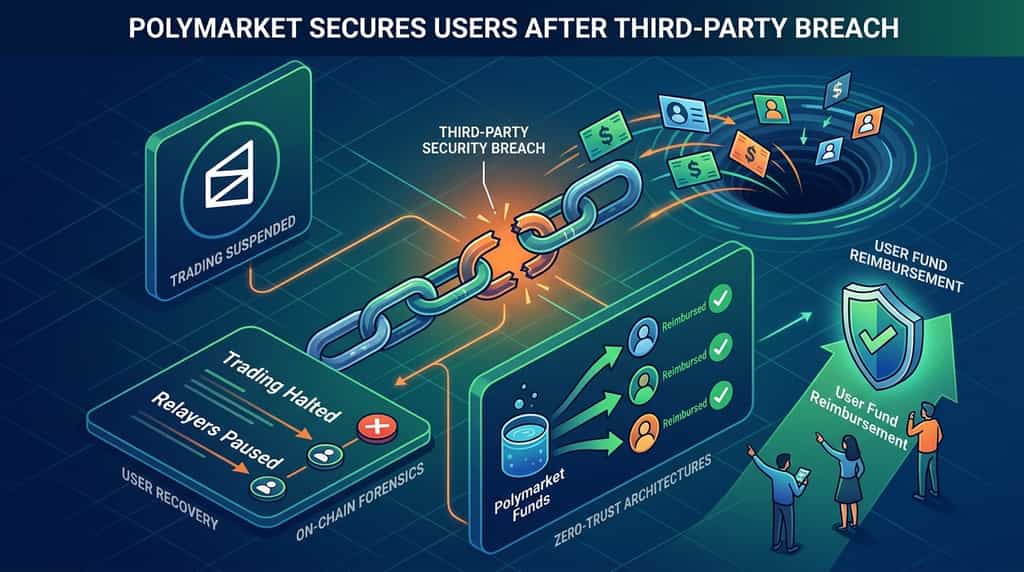
Decentralized applications rely heavily on external software dependencies, yet a single weak link in the supply chain can jeopardize millions of dollars in user assets. Polymarket recently suspended trading and halted relayer operations following a security breach originating from a third-party service provider. According to platform disclosures and on-chain analytics, the security incident resulted in approximately $2.65 million to $2.7 million in unauthorized user fund outflows before the vulnerability was identified and isolated. This event highlights the persistent structural vulnerabilities associated with third-party software integrations in the decentralized finance and prediction market sectors.
What Triggered the Polymarket Trading Suspension and Relayer Halt?
The trading suspension and relayer operations halt were triggered by an external compromise involving a third-party web monitoring and analytics provider, DebugBear. According to blockchain security researchers from Hudson Rock and analytics firms such as Arkham, a malicious script was injected through the third-party vector, targeting logged-in user sessions and redirecting funds to an attacker-controlled address.
The attack compromised roughly 710 user accounts, draining funds before trading activity was locked. In response to the breach, Polymarket immediately placed its international exchange into an "order cancellation only" mode and paused relayer operations to prevent further unauthorized transactions. Platform operators confirmed that the flaw was isolated and fixed, with the incident subsequently referred to law enforcement authorities in the United Kingdom.
How Do Third-Party Vendor Compromises Impact Decentralized Platforms?
Third-party vendor compromises affect decentralized platforms by bypassing core smart contract security layers through trusted frontend or monitoring channels. While underlying blockchain protocols and automated market makers often remain cryptographically secure, auxiliary tools such as analytics scripts, performance monitors, and customer support widgets possess execution privileges within the user's browser environment.
When a vendor provider is breached, malicious actors can weaponize these trusted channels to alter UI behavior, inject transaction-draining payloads, or spoof approvals. According to incident reviews from blockchain intelligence providers, this supply-chain vector represents an increasingly favored methodology for attackers targeting web3 interfaces, as it exploits human trust in official domain names and operational scripts rather than breaking underlying cryptographic primitives.
What Are the Immediate Steps Taken for User Recovery and Compensation?
User recovery and compensation will be fully funded by Polymarket, which has pledged to reimburse all affected traders who suffered losses during the security breach. Following the containment of the exploit, platform representatives confirmed that impacted individuals will be made whole, and a portion of the stolen funds—including approximately $750,000—was successfully frozen or tracked through collaborative on-chain forensics.
Traders attempting to access the platform during the immediate aftermath encountered cancel-only restrictions designed to protect open positions while engineering teams audited connected infrastructure.() Platform executives emphasized that cooperation with international law enforcement agencies and specialized blockchain tracking firms remains active to recover remaining asset flows.
How Does This Incident Affect the Broader Prediction Market Ecosystem?
The broader prediction market ecosystem faces heightened scrutiny regarding software dependency management and vendor vetting following repeated security events. Prediction markets aggregate substantial liquidity, particularly during high-engagement geopolitical and macroeconomic event cycles, making them high-value targets for sophisticated threat actors.
Institutional participants and retail traders alike evaluate platform risk based on historical resilience and incident response efficiency. Industry analysts note that while swift reimbursements mitigate immediate financial harm, repeated frontend or vendor-level vulnerabilities demand a structural shift toward zero-trust architectures, strict Content Security Policies (CSP), and decentralized code-integrity verifications.
What Defensive Measures Can Web3 Protocols Implement Against Supply Chain Attacks?
Web3 protocols can defend against supply chain attacks by implementing strict Content Security Policies (CSP), cryptographic subresource integrity (SRI) hashes, and decentralized frontend verification methods. Relying on third-party JavaScript bundles without localized sandboxing creates an open door for injection vectors.
By enforcing rigorous script-execution boundaries, auditing external software dependencies continuously, and migrating critical operational logic away from vulnerable web-hosted monitoring tools, development teams can drastically minimize exposure to downstream vendor breaches. Hardware wallet integrations and transaction simulation prompts also provide vital final lines of defense, alerting users when unexpected parameter changes occur during contract interactions.
Securing Your Digital Assets in Volatile Markets
As the blockchain ecosystem continues to expand and capture significant economic value—with institutional participation driving substantial revenue growth across blockchain infrastructure, according to industry reports—maintaining robust security hygiene is paramount. Whether navigating prediction markets, decentralized exchanges, or lending protocols, users should employ hardware security keys, revoke unnecessary token approvals regularly, and remain vigilant against sudden platform maintenance or emergency freezes. Staying informed about systemic vendor risks ensures that participants can engage with emerging crypto sectors while proactively managing counterparty exposure.
Conclusion
The temporary suspension of trading and relayer operations on Polymarket underscores the persistent vulnerabilities inherent in modern web3 supply chains and third-party software integrations. While the swift technical response, asset freezing, and comprehensive reimbursement pledge by platform operators helped mitigate the fallout for affected traders, the incident serves as a vital reminder of the risks posed by external dependencies. As decentralized prediction markets mature and attract higher liquidity volumes, establishing rigorous vendor auditing and zero-trust frontend architectures will be essential to safeguarding user capital and sustaining market confidence.
FAQs
Did the Polymarket security breach affect users on the U.S. platform?
No, the security incident and subsequent trading restrictions exclusively impacted the international platform, while the separately structured U.S. platform remained entirely unaffected.
How much total user funds were drained during the security incident?
On-chain forensics and analytics firms estimated that approximately $2.65 million to $2.7 million in user funds were moved without authorization before trading was halted.
What caused the malicious code injection on the platform?
The vulnerability originated from a compromise at a third-party website monitoring and performance provider, DebugBear, which allowed an unauthorized script to target user sessions.
Will affected users receive full financial compensation?
Yes, Polymarket publicly confirmed that all traders impacted by the unauthorized fund transfers will be fully reimbursed by the platform.
What is "cancel-only" mode on a cryptocurrency exchange?
Cancel-only mode is an emergency operational state where users can cancel existing open orders or positions, but are blocked from placing new trades or opening fresh positions.
Disclaimer
This general market information, possibly from third-party, commercial, or sponsored sources, is provided for reference and educational purposes only and does not constitute financial or investment advice, an offer, solicitation, or guarantee. We disclaim liability for its accuracy, completeness, reliability, and any resulting losses. Investments/trading are risky; past performance doesn’t guarantee future results. Users should research, judge prudently, and take full responsibility. For further details, please consult KuCoin’s Terms of Use and Risk Disclosure.