

OpenCover Expands to Solana: On-Chain Risk Coverage Now Live for Kamino, Raydium, Orca, and Jupiter
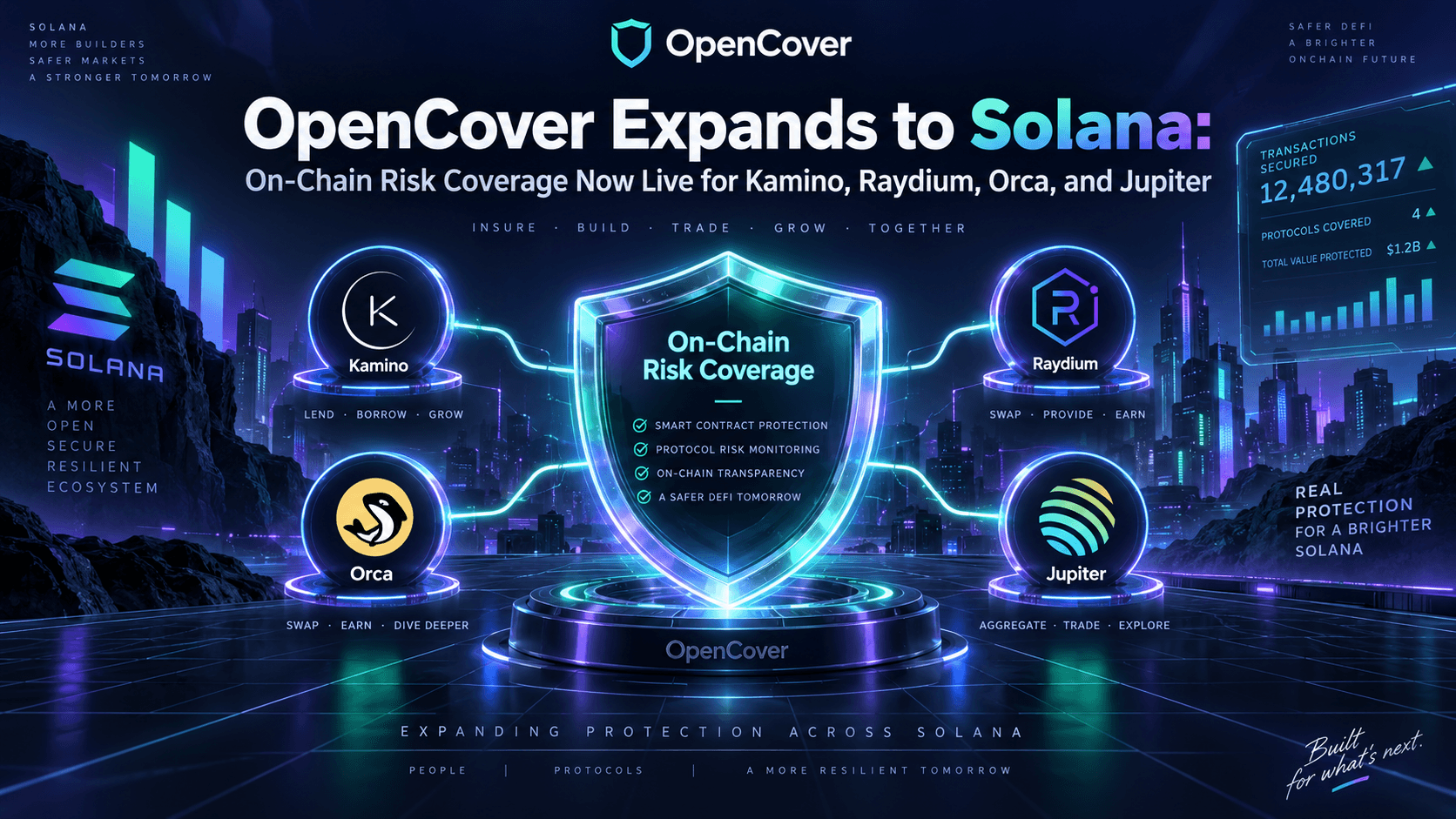
OpenCover Extends On-Chain Risk Protection to Solana’s Leading DeFi Protocols
On September 10, 2026, OpenCover announced it is expanding its institutional-grade on-chain risk protection platform to the Solana network. Eligible positions in four core protocols, Kamino, Raydium, Orca, and Jupiter, can now access coverage for defined technical and operational risks. This development builds directly on Nexus Mutual’s earlier public listings of the same protocols in mid-August 2026, which marked the underwriter’s first non-EVM coverage products. According to the Nexus Mutual announcement, these listings already reach close to 90 percent of Solana’s lending market deposits, with Kamino holding more than $1 billion and Jupiter approximately $925 million at the time of listing.
OpenCover functions as the access layer that connects users to underwriters such as Nexus Mutual, allowing them to purchase protection against smart contract vulnerabilities, oracle failures or manipulation, liquidation failures, and governance attacks. Specific limits, scopes, and terms differ by protocol and position type. The move extends risk-transfer infrastructure beyond EVM chains and positions Solana users to treat residual technical risk as a priced, transferable cost rather than an unhedged exposure. This article examines the launch details, the protocols involved, the underlying market context, and the practical implications for capital allocation on Solana.
How OpenCover and Nexus Mutual Structure Solana Coverage Access
OpenCover operates as a self-custodial aggregator that surfaces coverage from established on-chain underwriters. In the Solana case, the primary capacity comes from Nexus Mutual, which first listed the four protocols publicly on August 13, 2026, after previously underwriting Solana risk only on a private, institutional basis. Coverage is purchased for defined positions; the policy pays when a covered loss event occurs, and the claim is validated according to the published terms. Risks explicitly addressed include smart-contract bugs or exploits, oracle price-feed failures or manipulation, failed liquidations that produce bad debt, and governance attacks that alter protocol parameters in ways that cause financial loss. Limits and premiums vary by the size of the protected position and the specific protocol component. Nexus Mutual’s public data show more than $7 billion in cumulative cover written across its history and a 100 percent payout rate on valid claims.
OpenCover’s role is to present competitive pricing, handle the purchase interface, and support claims processes while remaining non-custodial. Users therefore retain control of their funds while obtaining an independent second layer of protection. The September expansion simply makes these already-live Nexus Mutual products reachable through OpenCover’s interface for Solana-native wallets and positions. Future capacity is expected to grow through additional underwriting partners and expanded position eligibility, according to OpenCover’s statement. This architecture mirrors the firm’s earlier EVM offerings and maintains the same transparent, on-chain underwriting model.
Practical Effects
The practical effect is that a depositor in Kamino Lend or a liquidity provider on Raydium can now purchase a policy that sits alongside the position rather than relying solely on the protocol’s internal risk parameters or insurance funds. Because the cover is underwritten independently, it does not rely on the same smart-contract surface as the underlying protocol. Claims assessment follows Nexus Mutual’s established process, which has already paid out tens of millions of dollars across prior incidents.
For institutions that previously required bespoke arrangements, the public listings remove a material barrier. Retail users gain the same option without needing to negotiate private capacity. The combination therefore lowers the friction of holding sizeable exposures on Solana while keeping the economic cost of risk transfer explicit and competitive. OpenCover has indicated that subsequent phases will involve direct partnerships with protocols, asset managers, and liquidity providers to embed coverage more deeply into deposit and vault flows.
Kamino’s Lending Scale and the Value of Independent Cover
Kamino operates Solana’s largest credit market. At the time of Nexus Mutual’s August listing, the protocol held roughly $1.04 billion in deposits; more recent dashboard data from mid-September 2026 place Kamino Lend near $1.35 billion in total value locked. The platform offers isolated lending markets, automated liquidity vaults, leveraged yield strategies via Multiply, and curated institutional products. Its Scope oracle aggregator combines feeds from multiple providers and applies validation rules before publishing prices, reducing but not eliminating oracle-related risk. Independent cover therefore addresses residual smart-contract risk across the lending engine, vaults, and Multiply strategies, as well as any remaining oracle or liquidation shortfalls.
Because Kamino accounts for a substantial share of Solana’s overall lending deposits, protection on this venue alone covers a meaningful fraction of the chain’s credit activity. Users who supply collateral or borrow can size their cover to match the specific market and position size. The multi-protocol nature of some listings further allows a single policy to span related components when eligible. This modularity is useful for strategies that move capital between lending and vault products inside the same ecosystem. Institutional allocators that already use Kamino for its isolation architecture and zero-bad-debt track record now gain an external hedge that can be marked as a known cost in risk reports. The cover does not replace Kamino’s own risk controls; it sits on top of them.
Expanding DeFi Cover for RWA and Oracle-Related Risks
Recent activity shows continued growth in specialized markets such as RWA and Ethena-related loops, which introduce additional collateral and oracle dependencies. Cover that explicitly includes liquidation failure and oracle events therefore becomes more relevant as these markets scale. OpenCover’s interface allows the purchase to be completed with a Solana wallet and the desired cover amount and duration selected in a single flow.
Premiums are paid in advance for the chosen term, converting an open-ended tail risk into a fixed expense. For larger positions, the ability to obtain capacity through a public listing rather than a private negotiation shortens the time from decision to protection. As Kamino continues to expand vault and institutional offerings, the availability of independent cover supports higher capital utilization by reducing the capital buffer that would otherwise be required against unhedged technical risk.
Raydium’s Multi-Component Listing and Liquidity-Provider Protection
Raydium has operated as one of Solana’s foundational exchanges since 2021. Its listing under Nexus Mutual is structured as Multi Protocol Cover spanning AMM v4, concentrated-liquidity (CLMM), and constant-product (CPMM) pools together with the Raydium Perps venue. At the time of the August announcement, the protocol’s pools held approximately $800 million; more recent figures place Raydium AMM near $1.14 billion in TVL. Liquidity providers therefore face smart-contract risk across several distinct program deployments as well as potential oracle or liquidation issues inside the perpetuals market. A single multi-protocol policy can address these surfaces without requiring separate purchases for each component.
This design is particularly relevant for market makers and automated strategies that allocate across Raydium’s different pool types and the perps venue. Cover limits scale with the protected notional, and terms specify the precise loss events that trigger payout. Because Raydium continues to serve both long-tail token launches and deep major-pair liquidity, the presence of independent cover can influence the willingness of larger LPs to maintain inventory during periods of elevated volatility. The cover does not alter trading fees or pool mechanics; it simply provides a financial backstop for defined failure modes.
On-Chain Protection Enhances Capital Efficiency for Raydium Liquidity Providers
OpenCover’s expansion makes this multi-component product accessible through its standard purchase flow. Users select the Raydium listing and enter the position size to protect, choose duration, and complete the transaction on-chain. The resulting policy is recorded and can be monitored alongside the liquidity position. For protocols and funds that provide liquidity as part of broader market-making programs, the ability to transfer residual technical risk improves capital efficiency.
Historical incidents at other Solana venues have shown that oracle manipulation or program bugs can produce quick losses even when underlying market conditions remain orderly. Independent cover priced against those scenarios allows participants to continue operating while quantifying the cost of protection. As Raydium’s volume and TVL expand, the capacity available under the listing is expected to adjust through Nexus Mutual’s underwriting process, maintaining alignment between protected notional and available capital.
Orca’s Concentrated Liquidity Model and Cover Scope
Orca pioneered concentrated-liquidity pools on Solana with its Whirlpools design and has maintained a multi-year record without reported protocol-level exploits. Deposits across its pools stood near $230 million at the time of the Nexus Mutual listing and have remained in a similar range according to recent ecosystem dashboards. Liquidity providers on Orca select price ranges for their capital, which increases capital efficiency but also concentrates exposure to the specific smart-contract logic that manages those ranges, fee accounting, and position NFTs. Cover, therefore, focuses on the Whirlpool program and related components, addressing smart-contract risk, oracle dependencies used for pricing or range adjustments, and any governance actions that could affect existing positions. Because Orca’s design is used by both retail LPs and larger capital allocators seeking tight spreads on major pairs, the availability of independent protection supports continued depth in those pools.
Users can match cover notional to the value of their active positions, adjusting as ranges are modified or capital is withdrawn. The September OpenCover rollout places this coverage behind the same interface used for the other three protocols. Purchase requires only a Solana wallet and selection of the Orca product, amount, and term. Premiums reflect the assessed risk of the underlying program and the chosen duration. For strategies that rebalance ranges frequently, the ability to renew or adjust cover without leaving the OpenCover interface reduces operational overhead. Orca’s zero-exploit history lowers the baseline probability of a claim, which is reflected in pricing, yet residual risk remains non-zero. Independent cover converts that residual into a known cost rather than an open-ended exposure.
Jupiter’s Aggregator, Lending, and Perpetuals Coverage
Jupiter functions as Solana’s dominant aggregator, routing the majority of swap volume, while also operating lending markets, perpetuals, and additional products. Its Nexus Mutual listing is structured as Multi Protocol Cover across Jupiter Swap v6, Jupiter Lend, Jupiter Perpetuals, and the Offerbook. At listing, Jupiter Lend held approximately $925 million in deposits; more recent figures place it near $1.10 billion. The aggregator itself routes through external venues, so the cover focuses on the Jupiter-controlled components rather than every underlying pool. Users who hold positions in Jupiter Lend or trade perps can therefore protect against failures internal to those programs, including smart-contract issues, oracle problems affecting lending or margin calculations, liquidation shortfalls, and governance changes. Because Jupiter commands a large share of both spot routing and on-chain perpetual activity, coverage on these surfaces reaches a broad set of active users. Multi-protocol design allows a single policy to span several Jupiter products when the user’s exposure crosses those boundaries.
OpenCover’s Solana expansion surfaces the Jupiter listing alongside the other three, enabling a consistent purchase experience. Position size, duration, and the specific product components are selected at the time of purchase. The resulting cover sits independently of Jupiter’s own risk parameters and insurance mechanisms. For funds that use Jupiter Lend as a yield or leverage venue and simultaneously route volume through the aggregator, the ability to obtain unified protection simplifies risk management. Claims follow the same Nexus Mutual process used for the other listings, with transparent on-chain records of underwriting capital and policy terms. As Jupiter continues to expand its product surface, additional components may be added to the multi-protocol cover, further aligning available protection with user activity. The net result is that a larger fraction of Solana’s trading and lending volume can now be paired with independently underwritten risk transfer.
Solana Lending Market Concentration and Coverage Reach
Nexus Mutual’s August announcement stated that the four listings together cover close to 90 percent of Solana’s lending-market deposits, which totaled approximately $2.2 billion at that time. Kamino and Jupiter alone accounted for the large majority of that figure. Subsequent data show Kamino Lend and Jupiter Lend remaining the two largest lending venues, with combined deposits still dominating the category. The concentration means that a relatively small number of listings delivers broad market coverage. Independent risk transfer on these venues therefore has systemic relevance for Solana DeFi: a material share of deposited capital can now be paired with external protection. This reduces the potential for correlated losses arising from a single protocol failure to propagate unchecked through the wider ecosystem. Cover does not eliminate the possibility of loss, but it provides a contractual mechanism for recovery when the defined events occur and claims are validated.
For the broader Solana lending market, the presence of public capacity also signals that underwriters have completed the necessary technical work to support non-EVM proof-of-loss processes. OpenCover’s role is to make that capacity usable by a wider set of participants. Previously, Solana cover was available mainly through private institutional arrangements. The public listings and OpenCover interface remove that restriction. Users of any size can now obtain protection scaled to their positions. As additional protocols request listings and pass Nexus Mutual’s risk-assessment process, which examines code, audits, track record, and team history, the share of covered deposits can expand further. OpenCover has stated that the current launch is only the starting point and that partnerships with protocols, asset managers, and liquidity providers will enlarge the set of eligible positions. The combination of high concentration in the first four listings and a clear path for additional coverage creates a foundation for more resilient capital allocation across Solana’s credit markets.
Oracle and Liquidation Risks Specific to Solana DeFi
Solana DeFi protocols rely on high-frequency price feeds and automated liquidation engines to maintain solvency. Historical incidents, including the 2022 Mango Markets oracle manipulation that resulted in approximately $116 million in losses, illustrate the scale of potential damage when these components fail. Nexus Mutual’s Solana listings explicitly include oracle failure or manipulation and liquidation failures among the covered events. This is material because many of the largest positions on Kamino and Jupiter depend on accurate pricing for collateral valuation and timely liquidations to prevent bad debt. Cover that responds to these specific failure modes provides a backstop that internal protocol mechanisms cannot fully replicate. The underwriting process evaluates the robustness of each protocol’s oracle architecture and liquidation design before setting capacity and premiums. Users therefore receive protection calibrated to the residual risks that remain after the protocol’s own safeguards.
OpenCover presents these cover terms in a standardized interface so that buyers can compare the precise scope against their positions. For strategies that employ leverage or concentrated collateral, the ability to transfer oracle and liquidation risk is particularly valuable. Premiums reflect the assessed probability and severity of the covered events, turning an open-ended exposure into a budgeted cost. Because the cover is underwritten independently, recovery does not depend on the same oracle or liquidation contracts that may have failed. This separation strengthens the overall risk architecture of Solana DeFi. As more capital migrates into leveraged and oracle-dependent strategies, the availability of explicit cover for these risks supports higher utilization rates without a proportional increase in unhedged tail exposure.
Institutional Capital Flows and the Demand for Risk Transfer
Solana has attracted substantial institutional interest, including more than $1 billion of inflows into Solana ETFs since their October 2025 launch and growing tokenized real-world asset activity approaching $2 billion on the chain. Lending and exchange venues that hold large deposits are natural destinations for this capital. Institutional mandates, however, typically require explicit risk-transfer mechanisms before sizeable allocations can be approved. Private underwriting arrangements previously met part of that need; public listings and an accessible purchase interface lower the operational barrier. OpenCover’s expansion therefore arrives at a moment when the infrastructure for risk transfer can directly influence the pace of institutional deployment. Cover that is transparent, on-chain, and independently underwritten fits the reporting and audit requirements of many professional allocators.
The ability to point to a Nexus Mutual policy with defined terms and a track record of claim payments provides a concrete risk-mitigation item that can be included in investment-committee materials. For asset managers and liquidity providers, the same logic applies. Positions that previously required large capital buffers against technical failure can now operate with a smaller buffer plus a known premium expense. The net effect is improved capital efficiency while preserving the ability to recover losses under the covered scenarios. OpenCover has indicated that it will work with protocols and asset managers to expand eligible positions, which should further align available cover with institutional product structures such as vaults and curated strategies. The September launch is therefore not only a retail convenience but also a structural improvement in the risk infrastructure that institutional capital requires before scaling exposure on Solana.
Practical Purchase Flow and Position Eligibility
Eligible positions are those that fall within the published scope of each Nexus Mutual listing. Users connect a Solana wallet through the OpenCover interface, select the relevant protocol product, enter the notional amount to protect, and choose the coverage duration. Premiums are calculated and paid on-chain; the resulting policy is recorded and can be monitored. Terms specify the exact loss events, the maximum recoverable amount, the waiting periods, if any, and the claims process. Because capacity is finite, larger positions may encounter limits that require adjustment of the covered amount or duration. OpenCover aggregates pricing from available underwriters so that users see competitive rates. No KYC is required for purchase in the standard flow, although certain claim scenarios may involve verification steps. The entire process is designed to remain self-custodial, with users retaining control of both the protected assets and the cover policy.
Position eligibility is expected to broaden as OpenCover partners with additional protocols and vault providers. The initial set, Kamino, Raydium, Orca, and Jupiter, already captures the majority of lending deposits and significant exchange activity. Users whose strategies span multiple of these venues can purchase separate policies or, where multi-protocol cover applies, a single policy that addresses several components. Renewals and adjustments are handled through the same interface, allowing cover to track changes in position size. The transparency of on-chain underwriting capital and policy terms enables users to verify solvency and scope before purchase. This combination of accessibility, clear terms, and independent underwriting constitutes the practical implementation of risk transfer for Solana DeFi participants.
Effects for Liquidity Provision and Market Depth
Liquidity providers on Raydium and Orca, as well as lenders on Kamino and Jupiter, face the dual requirement of generating yield while managing technical risk. Independent cover alters the risk-return calculation by allowing the technical component to be transferred at a known cost. LPs who previously limited inventory because of unhedged smart-contract exposure can now increase size while purchasing matching cover. The result is potentially deeper markets and tighter spreads, particularly in periods when volatility would otherwise prompt capital withdrawal. Market makers that operate across multiple venues can coordinate cover purchases to match their aggregate exposure.
Because the cover is independent, it does not introduce additional smart-contract risk into the liquidity provision process itself. Premiums become a normal operating expense analogous to gas or inventory financing costs. Over time, the presence of readily available cover can influence protocol design incentives as well. Protocols that maintain strong audit records, robust oracle architectures, and transparent risk parameters are more likely to attract underwriting capacity and competitive premiums. Users in turn can factor the availability and cost of cover into their choice of venue. The net dynamic supports a more resilient liquidity landscape in which capital remains deployed through market cycles rather than retreating at the first sign of elevated technical uncertainty. OpenCover’s stated intention to expand eligible positions through direct partnerships should reinforce this effect by embedding cover more tightly into the deposit and LP experience.
Expanding the Risk-Transfer Infrastructure Beyond the Initial Four
OpenCover described the September launch as the starting point for broader risk-transfer infrastructure on Solana. Subsequent work will involve collaboration with additional protocols, asset-management firms, and liquidity providers to increase the range of positions that can be covered. Nexus Mutual’s listing process remains open to new protocols that pass its risk assessment. As more venues are added, the share of Solana DeFi activity that can be paired with independent protection will rise. Covered-vault primitives that OpenCover has developed on other chains may also be adapted, allowing depositors to opt into protection at the point of vault entry with premiums streamed from yield. The combination of protocol-level listings and vault-native options would create multiple layers of risk transfer that can be selected according to strategy.
Capacity growth will depend on underwriting capital attracted to Solana risk and on demonstrated claim performance. Early public listings and transparent payout history form the foundation for that growth. The practical outcome for users is a progressively larger menu of protected positions. Strategies that currently leave residual risk unhedged will gain additional options as new listings appear. Institutions that require comprehensive coverage across an entire portfolio will find it easier to assemble the necessary policies. The infrastructure therefore evolves from a narrow set of high-impact venues toward a more complete risk-transfer market. OpenCover’s role as the access and aggregation layer ensures that new capacity remains reachable through a consistent interface rather than fragmented private arrangements.
The Growing Market for On-Chain Risk Protection
On-chain cover remains a small fraction of total DeFi value locked, yet its importance grows with institutional participation and the absolute size of positions. Nexus Mutual’s cumulative $7 billion of cover written and its record of paying valid claims establish a reference standard. OpenCover’s aggregation model and focus on both retail accessibility and institutional primitives position it as a primary distribution channel. The Solana expansion demonstrates that the technical challenges of non-EVM proof-of-loss and underwriting can be solved, removing a previous geographic and chain limitation. Competing risk-transfer solutions may emerge, but the combination of established underwriting capital, public listings of the largest venues, and an accessible purchase interface currently defines the practical standard on Solana.
Users evaluating protection therefore have a concrete, live option rather than a theoretical future product. Pricing, capacity, and claims experience will determine how widely the option is adopted. Early usage data and any subsequent claim events will provide the empirical basis for further capacity allocation. The broader implication is that risk transfer is transitioning from an optional add-on to an expected component of mature DeFi participation. Protocols that facilitate or integrate cover improve their attractiveness to capital that demands explicit risk management. Allocators that treat cover as a standard line item improve their ability to scale positions without proportional increases in unhedged exposure. The September launch on Solana advances both dynamics simultaneously.
Future Capacity Growth and Partnership Pathways
OpenCover has indicated that capacity and eligible positions will expand through partnerships. Protocols can request listings through Nexus Mutual’s process; successful applicants gain public cover that can be distributed via OpenCover. Asset managers and liquidity providers can work with OpenCover to embed cover into their products, potentially creating covered versions of existing vaults or strategies. Underwriting capital can increase, as demonstrated by Solana risk performance attracting additional participants to the mutual. The initial four listings already deliver high market coverage; incremental additions will further reduce the unhedged share of activity. Technical work already completed for proof-of-loss on Solana lowers the marginal cost of supporting new protocols.
The result should be a steadily expanding set of protected positions and a deeper market for risk transfer. Users who begin with the current listings can therefore anticipate a broader menu over time without needing to change platforms or underwriting counterparties. This direction aligns with the overall maturation of Solana DeFi. As absolute capital levels rise and institutional mandates become more demanding, the infrastructure for transferring residual technical risk becomes a competitive necessity rather than a niche feature. OpenCover’s expansion supplies that infrastructure in a form that is immediately usable and designed for further growth.
🔥 Beyond the Headlines: What KuCoin 5.0 Means for You
Market news moves fast — but where you act on it matters just as much. This October, KuCoin launches KuCoin 5.0, transforming KuCoin into a rebuilt platform. Here's what actually changes for you:
-
One account for everything. Older platforms split your money across separate "spot," "margin," and "futures" accounts and expected you to understand why. KuCoin 5.0's unified account removes that entirely — deposit once, and everything is simply there.
-
Stocks, indices, and commodities. KuCoin 5.0 expands beyond crypto into global markets. When crypto chops sideways and equities rally (or the reverse), you rotate in minutes instead of opening a brokerage account and waiting days for fiat rails.
-
Real-world assets (RWA). Tokenized exposure to traditional assets like commodities, right inside your crypto account. One of the fastest-growing segments in global finance is no longer reserved for institutions — you access it from the same balance you trade with.
-
Earn while you learn. Not ready to trade? KCUSD lets your stablecoins earn daily, auto-compounding interest. The lowest-stress way to put your idle deposit to work for 4% yield.
-
An AI assistant in plain language. Ask questions, get market context, understand what you're looking at — built into the platform, no jargon required.
-
An app that doesn't overwhelm. Faster, cleaner, and consistent — intuitive from the first tap, not after a tutorial.
-
Safety you can check, not just trust. A MiCAR-licensed EU entity, Proof of Reserves you can verify yourself, and internationally certified security (SOC 2 Type II, ISO 27001:2022).
Create your account in minutes — and start on the platform built for where crypto is going, not where it's been.
FAQs
What specific risks does the new Solana coverage from OpenCover address for positions in Kamino, Raydium, Orca, and Jupiter?
The coverage, underwritten primarily by Nexus Mutual, protects against losses arising from smart-contract vulnerabilities or exploits, oracle failures or manipulation, liquidation failures that result in bad debt, and governance attacks that alter protocol parameters in a way that causes financial harm. Exact terms, exclusions, and maximum recoverable amounts are set out in each product’s policy documentation and can vary by the specific protocol component and position type. Users should review the published scope before purchasing to confirm that their intended exposure falls within the covered events.
How does OpenCover’s role differ from Nexus Mutual’s underwriting on Solana?
Nexus Mutual supplies the underwriting capital, sets the policy terms, and handles claims assessment and payout for the listed products. OpenCover functions as the access and aggregation layer: it presents the available cover, calculates premiums, facilitates the on-chain purchase through a Solana wallet interface, and supports the claims process while remaining non-custodial. Users therefore interact with OpenCover to obtain the protection that Nexus Mutual underwrites.
Is coverage available for every type of position inside the four protocols?
Coverage applies to eligible positions that fall within the published scope of each listing. For Raydium and Jupiter, the listings are multi-protocol and therefore span several components; for Kamino and Orca, the scope is defined by the core programs and related products. Not every possible vault, sub-market, or strategy is automatically included. Users must verify eligibility against the current product terms. OpenCover has stated that the range of eligible positions will expand through future partnerships.
How are premiums determined and paid?
Premiums are calculated according to the assessed risk of the specific protocol component, the size of the notional being protected, and the chosen coverage duration. Payment is made on-chain at the time of purchase for the full term. Pricing is designed to be competitive across available underwriting capacity. Larger notionals or longer durations increase the premium in proportion to the additional risk transferred.
What happens if a covered loss event occurs?
The policyholder submits a claim through the established process. Nexus Mutual assesses the claim against the policy terms and the evidence of loss. Valid claims are paid according to the mutual’s rules; Nexus Mutual has maintained a 100 percent payout rate on valid claims across its history. The cover is independent of the underlying protocol, so recovery does not depend on the same contracts that may have failed.
Can institutional users obtain larger capacity than the public listings provide?
The public listings already support substantial notionals. Institutions that require capacity beyond the standard limits or specialized structures can still engage Nexus Mutual for bespoke arrangements, as was previously the only option for Solana risk. The public products, however, remove the need for private negotiation for most standard positions and thereby lower operational friction.
Disclaimer: This content is for informational purposes only and does not constitute investment advice. Cryptocurrency investments carry risk. Please do your own research (DYOR).