

OpenAI and Anthropic May Not Be Really Slowing Frontier AI: Why Chip Demand Still Looks Intact
Introduction
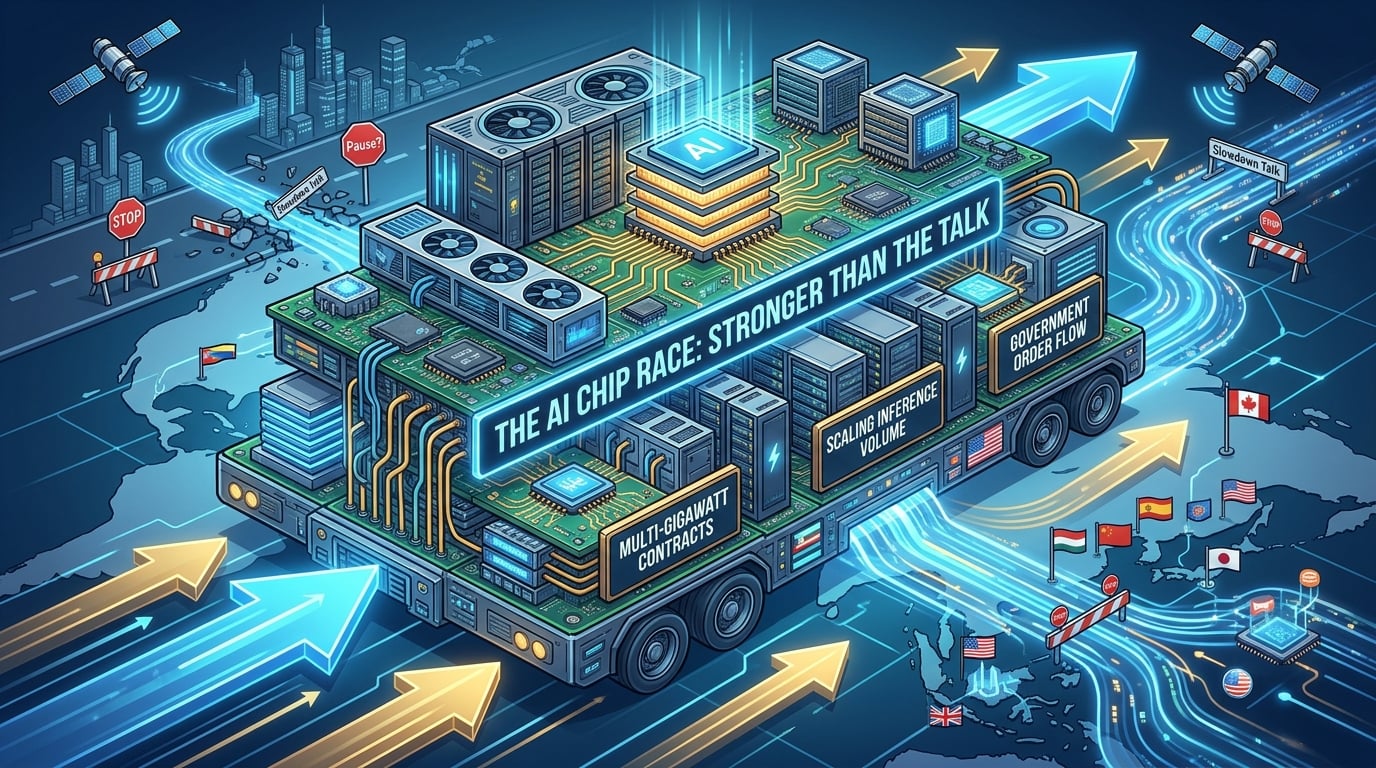
Can OpenAI and Anthropic talking about “slowing down” actually freeze the world’s most expensive hardware race? The short answer may be no. Safety coordination does not cancel training runs, inference growth, or multi-year chip contracts already locked in. Frontier labs still compete with Google, Meta, and xAI, while governments keep treating compute as a strategic asset. That combination keeps AI chip demand intact.
Why Would Safety Comments Even Matter for Chip Demand?
Safety comments matter only if they shrink training budgets or delay data-center buildouts. They have not done that. Dario Amodei argued for more time on alignment and evaluation. Sam Altman backed independent testers and industry standards. Those statements describe process, not a halt.
Training still requires larger clusters. Inference still scales with users. Evaluation itself consumes GPUs. A standards body does not replace a rack of accelerators.
Competition makes a pause even less likely. OpenAI and Anthropic would not hand the lead to Gemini, Meta, or xAI. National AI programs keep adding demand outside any single lab’s talking points.
What Do Official Compute Numbers Show Right Now?
Official company filings still point to rising — not shrinking — AI infrastructure spend. According to NVIDIA’s Form 10-Q for the quarter ended July 26, 2026, total revenue reached $96.2 billion, up 106% year over year. Data Center revenue was $89.0 billion, up 117% year over year and 18% sequentially, driven by Blackwell Ultra. Hyperscale revenue was $48.7 billion. AI Clouds, Industrial, and Enterprise revenue was $40.3 billion.
According to NVIDIA’s fiscal 2026 reporting, Data Center revenue reached about $193.7 billion for the year ended January 25, 2026, up 68% from the prior year. The company also stated visibility into more than $1 trillion in cumulative Blackwell and Rubin revenue from the start of 2025 through 2027.
Those figures predate any “slowdown” narrative and already bake in multi-year customer commitments. Chip demand is a function of contracted capacity, not a single weekend essay.
How Large Are OpenAI and Anthropic Compute Commitments?
The two labs are still expanding capacity, not cutting it. According to OpenAI’s official announcement with AMD, OpenAI agreed to deploy 6 gigawatts of AMD GPUs across multiple generations, with an initial 1 gigawatt of Instinct MI450 systems starting in the second half of 2026.
OpenAI has also described plans that scale into the tens of gigawatts by 2030, including large campus projects. NVIDIA’s later disclosures referenced credit support tied to an OpenAI-affiliate campus measured in gigawatts, which only makes sense if hardware delivery continues.
Anthropic has stacked cloud, TPU, GPU, and lease agreements rather than pausing purchases. Industry tallies of disclosed contracts put Anthropic’s multi-year compute commitments in the hundreds of billions of dollars and well into double-digit gigawatts of potential capacity. Even if some letters of intent slip, the direction is more compute, not less.
According to Epoch AI’s chip-user estimates updated September 9, 2026, OpenAI, Google DeepMind, and Anthropic remain among the largest users of frontier compute. OpenAI and Anthropic still rent most of that capacity from clouds rather than owning every rack. Rental demand is still chip demand. Cloud providers buy NVIDIA, AMD, Broadcom, and custom silicon to fulfill those leases.
Why Does Inference Keep Chip Demand Growing Even If Training Pauses?
Inference is now the volume engine. Training a frontier model is episodic. Serving that model to millions of users is continuous. Every extra token, agent step, and tool call burns accelerators.
Safety testing adds more inference, not less. Red-teaming, independent evaluations, and longer “think” traces all consume chips. A lab that slows capability jumps can still raise serving quality, context length, and product usage.
Custom inference silicon does not erase merchant GPU demand either. OpenAI’s in-house inference chip, developed with Broadcom, targets serving costs inside OpenAI’s own fleet. That is capacity substitution at the margin, not a cancellation of NVIDIA or AMD orders for training and general-purpose clusters.
According to Epoch AI owner and user datasets, most pure-play labs still depend on rented cloud GPUs and TPUs. Diversifying suppliers spreads orders. It does not shrink the total bill.
Who Else Is Buying AI Chips Besides OpenAI and Anthropic?
Chip demand is no longer a two-lab story. Hyperscalers buy for their own models and for rental inventory. Enterprises buy for private deployments. Sovereign programs buy for national stacks.
NVIDIA’s Q2 split shows that diversification. Hyperscale was large, but AI Clouds, Industrial, and Enterprise grew 25% sequentially and 138% year over year, according to the same July 26, 2026 filing. That second bucket includes neoclouds, startups, and sovereign-linked projects.
Google and Amazon sell or allocate custom accelerators as well. That shifts share among vendors. Total accelerator watts still rise because model quality and token volume keep rising.
Memory and packaging sit in the same bottleneck. High-bandwidth memory, advanced substrates, and foundry capacity remain tight when clusters scale from megawatts to gigawatts. A rhetorical pause at two labs does not free those lines overnight.
What Could Still Dent AI Chip Demand?
Demand is intact, not risk-free. Power interconnection delays can slip rack deliveries. Memory shortages can cap shipments. Customer concentration can make one delayed campus look like a demand shock in a single quarter.
Financing structures matter as well. Large leases, vendor guarantees, and equity-for-capacity deals pull future demand forward. If credit tightens, some projects slip. Slippage is a timing issue. It is not proof that frontier AI stopped.
Custom silicon is another share risk for merchant GPU makers, not a collapse in wafers. Foundries still run. HBM still ships. Networking still scales with cluster size.
Beyond the Headlines: What KuCoin 5.0 Means for You
Market news moves fast — but where you act on it matters just as much. This October, KuCoin launches KuCoin 5.0, transforming KuCoin into a rebuilt platform. Here's what actually changes for you:
-
One account for everything. Older platforms split your money across separate "spot," "margin," and "futures" accounts and expected you to understand why. KuCoin 5.0's unified account removes that entirely — deposit once, and everything is simply there.
-
Stocks, indices, and commodities. KuCoin 5.0 expands beyond crypto into global markets. When crypto chops sideways and equities rally (or the reverse), you rotate in minutes instead of opening a brokerage account and waiting days for fiat rails.
-
Real-world assets (RWA). Tokenized exposure to traditional assets like commodities, right inside your crypto account. One of the fastest-growing segments in global finance is no longer reserved for institutions — you access it from the same balance you trade with.
-
Earn while you learn. Not ready to trade? KCUSD lets your stablecoins earn daily, auto-compounding interest. The lowest-stress way to put your idle deposit to work for 4% yield.
-
An AI assistant in plain language. Ask questions, get market context, understand what you're looking at — built into the platform, no jargon required.
-
An app that doesn't overwhelm. Faster, cleaner, and consistent — intuitive from the first tap, not after a tutorial.
-
Safety you can check, not just trust. A MiCAR-licensed EU entity, Proof of Reserves you can verify yourself, and internationally certified security (SOC 2 Type II, ISO 27001:2022).
Create your account in minutes — and start on the platform built for where crypto is going, not where it's been.
Conclusion
OpenAI and Anthropic talking about evaluation and standards is not the same as shutting down frontier development. Official NVIDIA filings still show data-center revenue at $89.0 billion for the July 2026 quarter and about $193.7 billion for fiscal 2026. OpenAI’s disclosed AMD deal alone covers 6 gigawatts over multiple generations. Epoch AI still ranks the major U.S. labs among the largest compute users, mostly via rented cloud capacity.
Inference growth, multi-vendor clusters, hyperscaler rental fleets, and sovereign projects keep the order book full even if two CEOs sound cautious. Custom chips change who captures margin. They do not cancel wafers, HBM, or networking.
Chip demand can slip on power, memory, or financing. That is execution risk. It is not evidence that frontier AI stopped. For crypto traders, the durable story is compute scarcity and AI infrastructure narratives — not a one-week pause in rhetoric.
FAQs
Does a safety slowdown mean NVIDIA will sell fewer GPUs next quarter?
No. Quarterly GPU shipments follow installed power, memory supply, and signed clusters, not a single policy essay.
If OpenAI builds its own inference chip, does merchant GPU demand disappear?
No. Custom inference parts cover a slice of serving. Training, general clusters, and cloud rental fleets still need merchant accelerators.
Why would Anthropic sign huge compute deals if it wants to slow capability?
Because serving users, running evaluations, and staying competitive still require capacity years in advance.
Can governments force a real freeze on frontier training?
They can add rules and export limits. They have not removed national incentives to keep building compute.
Is AI token trading the same as owning chip stocks?
No. Tokens track crypto-market narratives and liquidity. Chip stocks track hardware sales, margins, and capex cycles.
Disclaimer: This article is for informational purposes only and does not constitute financial, legal, or investment advice. Always conduct your own research before interacting with digital assets.