

NBA Joins Pro Sports Leagues in Embracing CFTC-Regulated Prediction Markets Infrastructure
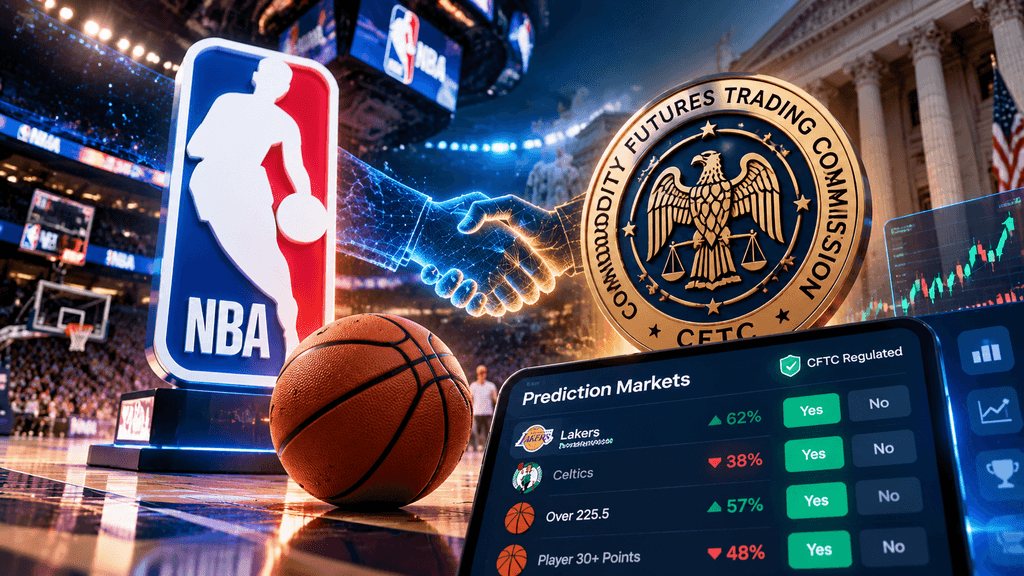
NBA Establishes Formal Partnerships With Kalshi, Polymarket, and the CFTC
The National Basketball Association formalized its entry into regulated prediction markets on October 26, 2026, by signing a memorandum of understanding with the Commodity Futures Trading Commission and designating Kalshi and Polymarket as its preferred prediction market exchanges. The moves establish information-sharing channels, market limitations, personnel trading bans, and official data access through Sportradar while expanding an existing relationship with DraftKings to cover prediction products. These steps position the NBA alongside Major League Baseball and the National Hockey League in cooperating with the federal derivatives regulator that oversees event contracts. The timing coincides with ongoing litigation over whether sports-related contracts fall under CFTC jurisdiction as swaps or under state gambling laws, a dispute the NFL has actively supported by backing Supreme Court review.
Official statements from the league and the CFTC emphasize integrity protections against insider trading and manipulation as trading volume on NBA-related contracts has grown substantially on the major platforms. This development reflects a pragmatic alignment between a major sports property, federally regulated exchanges, and the CFTC that prioritizes structured oversight and commercial participation over outright resistance, creating a template for how professional leagues can engage the expanding event-contract sector while addressing risks that traditional sports betting frameworks have long managed.
CFTC Memorandum Creates Formal Channels for Integrity Monitoring
The memorandum of understanding between the NBA and the CFTC, signed by Chairman Michael Selig and Commissioner Adam Silver, establishes regular communication and information sharing focused on NBA-related prediction markets. According to the CFTC, the arrangement supports fair and transparent markets by enabling discussion of integrity matters and potential misconduct such as insider trading or fraud. Selig described the NBA’s participation as a responsible step that joins earlier agreements with MLB and the NHL, thanking Silver for prioritizing both professional basketball integrity and the broader financial markets.
The MOU is framed as a statement of intent rather than a binding enforcement mechanism, yet it provides the regulator and the league with structured pathways to exchange data on suspicious activity. League executives have stressed that protecting the game remains the top priority, and the agreement gives the NBA a formal voice in how its events appear on CFTC-regulated venues. This cooperative model contrasts with the absence of a similar pact from the NFL and signals that the CFTC continues to build institutional relationships with sports organizations as event-contract volume expands. Official releases confirm the focus remains limited to prediction markets rather than traditional sportsbook products.
Preferred Exchange Status Grants IP Rights and Official Data Access
Under the commercial agreements, Kalshi and Polymarket receive designation as the NBA’s Preferred Prediction Market Exchanges. This status includes rights to use league, team, and event intellectual property, marketing privileges, and promotional activations across United States media channels. Both platforms also gain access to official NBA data supplied by Sportradar, the league’s official data distribution partner, for the purpose of operating and settling authorized markets. In return, the exchanges accept limitations on the types of NBA-related contracts they may list, affirmative prohibitions on trading by league and team personnel, and obligations to share information related to investigations and suspicious trading.
These provisions were described by the NBA as significant integrity protections designed to reduce risks of manipulation. Kalshi publicly noted that the arrangement reinforces existing rules against insider trading. The structure allows the platforms to advertise and promote under official branding while giving the league greater influence over product offerings than existed when the exchanges previously listed NBA markets without formal partnership.
DraftKings Expansion Extends Framework to Authorized Operators
The NBA simultaneously expanded its existing agreement with DraftKings to encompass prediction markets and nationwide promotion. This step positions DraftKings as an authorized prediction market operator alongside the preferred exchanges. The move enables the sportsbook to offer event contracts within a framework that incorporates the same integrity standards applied to Kalshi and Polymarket, including market limitations and information-sharing expectations. League statements indicate that similar expansions with other official sports betting partners are expected in coming weeks.
By folding prediction products into established commercial relationships, the NBA creates continuity between traditional sportsbook offerings and the newer event-contract category. This approach may prove particularly relevant for teams located in jurisdictions that have not fully legalized online sports betting, potentially opening additional promotional avenues. The expansion demonstrates a preference for integrating prediction markets into existing partner ecosystems rather than treating them as entirely separate channels.
Market Limitations: Target Contracts Vulnerable to Manipulation
A core element of the preferred-exchange agreements involves restrictions on permissible NBA-related markets. The league retains influence over which contract types may be offered, with particular attention to those viewed as susceptible to manipulation or insider advantage. Examples drawn from broader industry discussions include certain player prop markets, injury-related outcomes, and officiating-linked events that a single participant or small group could potentially influence. Official data from Sportradar is required for settlement of authorized markets, reducing reliance on unofficial or delayed information sources.
These limitations align with safeguards the NBA has previously sought in public correspondence with the CFTC. By embedding approval rights into commercial partnerships, the league gains a practical mechanism to shape product design without relying solely on regulatory rulemaking. The approach aims to preserve market liquidity on core game outcomes while constraining higher-risk categories that have raised integrity concerns in both prediction markets and traditional sports betting.
Personnel Trading Bans Reinforce Insider Trading Controls
The agreements include explicit prohibitions on trading NBA event contracts by league and team personnel. This ban covers individuals who may possess non-public information about injuries, lineups, strategy, or other material factors. Enforcement relies on the platforms’ existing surveillance systems combined with information-sharing obligations that allow the NBA to flag or investigate potential violations.
Kalshi highlighted the prohibition as reinforcing its rules against insider trading and manipulation. The measure addresses a longstanding vulnerability in sports-related markets where access to privileged information can create unfair advantages. By placing the restriction in commercial contracts rather than depending exclusively on general platform rules, the NBA strengthens its ability to protect competitive integrity. Similar prohibitions appear in agreements reached earlier by other leagues, suggesting an emerging standard for professional sports participation in the event-contract sector.
Information Sharing Supports Investigations of Suspicious Activity
Both preferred exchanges commit to sharing data with the NBA for investigations and to report suspicious trading patterns. This obligation operates alongside the CFTC memorandum, creating multiple channels for integrity-related communication. Platforms must cooperate when the league identifies potential issues, enabling faster detection of coordinated activity or unusual positioning ahead of material news. The arrangement draws on the exchanges’ existing monitoring capabilities while adding league-specific context that pure market surveillance may lack.
Scott Kaufman-Ross, the NBA’s head of media distribution and partnerships, has emphasized that the partnerships form part of a broader framework intended to maintain appropriate safeguards as the category develops. The practical effect is a collaborative monitoring system that combines exchange data, league knowledge of personnel and game operations, and regulatory oversight.
MLB and NHL Precedents Established the Cooperative Template
The NBA’s agreements follow similar arrangements previously reached by Major League Baseball and the National Hockey League. The NHL partnered with Kalshi and Polymarket in late 2025 and later formalized an MOU with the CFTC. MLB entered a relationship with Polymarket and established its own information-sharing framework with the regulator. These earlier deals provided a working model that included preferred or exclusive status, data access, integrity protections, and regulatory cooperation.
CFTC Chairman Selig has repeatedly cited the MLB and NHL agreements when welcoming the NBA, framing the sequence as progressive institutional adoption. The pattern indicates that major leagues are choosing structured engagement over isolation once commercial and integrity terms reach an acceptable threshold. Volume data from the platforms show that sports contracts, including basketball, have become a significant share of overall event-contract activity, increasing the practical value of formal league relationships.
NFL Resistance Highlights Jurisdictional Divide
In contrast to the NBA, MLB, and NHL, the National Football League has declined to enter comparable agreements and has instead supported state efforts to assert regulatory authority. In an October 2026 amicus brief supporting New Jersey’s petition for Supreme Court review, the NFL argued that sports event contracts function as gambling products that should fall under state gaming laws rather than CFTC jurisdiction as swaps. The league expressed concern that federal oversight has been insufficiently rigorous on issues such as easily manipulated contracts, injury-related markets, and age restrictions.
Trading volume figures cited in related reporting showed NFL contracts accounting for a substantial portion of prediction-market activity on peak days. The NFL’s position underscores a fundamental disagreement over whether event contracts on sports outcomes are primarily financial instruments or wagering products. The resulting circuit split among federal appeals courts has elevated the likelihood of Supreme Court intervention.
Event Contract Volume Underscores Commercial Stakes
Available market data illustrate why leagues are formalizing relationships. NBA-related contracts have generated hundreds of millions of dollars in recent turnover across major platforms, with Kalshi and Polymarket accounting for the bulk of activity. Daily and monthly figures show sustained interest in moneylines, spreads, totals, and player props once the regular season begins. Broader sports prediction markets have reached multi-billion-dollar monthly volumes at peak periods, driven heavily by football and basketball.
Official data feeds and branding rights become commercially valuable once trading scale reaches these levels. The preferred-exchange designations allow Kalshi and Polymarket to market themselves with league endorsement while supplying the statistical reliability needed for accurate settlement. For the NBA, the arrangements convert existing informal market activity into a controlled commercial channel that generates promotional value and integrity leverage.
State Litigation Continues Alongside Federal Cooperation
Numerous states persist in their legal challenges against the CFTC’s assertion of exclusive jurisdiction over sports event contracts. They contend that these products fall under the category of illegal gambling as defined by state law. The judicial landscape has become fragmented, with various court decisions reflecting a division of opinion; some circuits lean towards supporting state authority, while others uphold the principle of federal preemption. The NBA’s strategic choice to operate within the CFTC’s regulatory framework does not definitively address these larger legal dilemmas. However, it does illustrate that professional sports leagues can establish practical safeguards and protective measures, even as litigation continues to unfold in the courts.
In its efforts to clarify the legal status of event contracts as swaps, the CFTC has actively engaged in both rulemaking processes and litigation. This dual approach aims to provide a clearer understanding of how these contracts fit within the existing regulatory landscape. The cooperation of professional sports leagues is invaluable, as it offers the regulator institutional partners equipped with specialized knowledge and expertise related to the sports industry. The current environment is characterized by a coexistence of commercial partnerships alongside unresolved jurisdictional disputes, indicating that the regulatory landscape remains in a state of transition and evolution.
Official Data Integration Improves Settlement Reliability
Access to Sportradar data through the preferred-exchange agreements effectively addresses a significant and practical operational requirement that is essential for the smooth functioning of sports betting markets. The provision of accurate and timely official statistics plays a crucial role in reducing disputes over settlement outcomes, thereby supporting consistent pricing across various platforms. In the absence of such reliable data feeds, exchanges have historically relied on a mix of public sources, which could introduce undesirable lag or inconsistency in the information available to traders.
The formal arrangement established under these agreements standardizes the data pipeline specifically for authorized NBA markets, ensuring that the settlement processes are aligned with the same information that the league itself utilizes for its operations. This technical integration not only enhances the efficiency of the data flow but also complements the integrity provisions in place by ensuring that market outcomes are based on verified results rather than contested or unofficial reports that could lead to confusion or disputes. For traders operating in this environment, this change significantly improves their confidence that contracts will resolve according to transparent, league-sanctioned criteria, fostering a more trustworthy and reliable marketplace.
Fan Engagement Opportunities Expand Through Marketing Rights
The preferred status not only emphasizes integrity and data but also provides extensive marketing and promotional rights that empower the exchanges to launch dynamic campaigns across various NBA media channels. This allows for the inclusion of league and team logos in platform interfaces and advertising, thereby creating unique branded experiences that were previously inaccessible to fans. These marketing activations pave the way for innovative pathways for fan interaction with game outcomes, facilitated through regulated event contracts. The NBA has characterized these partnerships as instrumental in creating opportunities to engage fans within a carefully safeguarded framework.
By maintaining control over both the parameters of the product and the surrounding promotional environment, the league ensures it retains significant influence over how its intellectual property is linked to financial trading activities. This strategic combination of commercial rights and integrity controls represents a well-balanced approach that aims to generate revenue and enhance fan engagement while simultaneously preserving oversight and regulatory compliance.
How Event Contracts Could Reshape the Broader Industry
The NBA’s entry accelerates the normalization of CFTC-regulated prediction markets within professional sports. With three of the four major North American leagues now operating under similar cooperative frameworks, the institutional map has shifted toward structured participation. Remaining resistance from the NFL and ongoing state litigation leave open questions about long-term regulatory architecture, yet the commercial and operational templates are becoming clearer.
Platforms gain legitimacy and data quality; leagues gain influence over product design and investigation tools; the CFTC gains additional partners in market surveillance. As volumes continue to grow, the practical value of these arrangements is likely to increase. The October 2026 announcements mark a concrete step in that direction, grounded in specific contractual and regulatory commitments rather than abstract policy statements.
FAQs
What exactly did the NBA announce on October 26, 2026?
The league announced a memorandum of understanding with the CFTC focused on information sharing and integrity for NBA prediction markets, designation of Kalshi and Polymarket as Preferred Prediction Market Exchanges with IP and data rights, limitations on permissible markets, personnel trading bans, and an expansion of its DraftKings relationship to include prediction products.
How does the CFTC memorandum differ from traditional sports betting regulation?
The MOU operates within the federal derivatives framework that treats event contracts as swaps under CFTC jurisdiction. It emphasizes information exchange and market integrity rather than the licensing, taxation, and consumer-protection regimes that states apply to sportsbooks. The arrangement does not create new binding enforcement powers but formalizes cooperation.
Why did the NBA wait longer than the NHL and MLB to formalize partnerships?
League executives indicated that conversations with the industry had been underway for some time and that the NBA preferred to establish an appropriate regulatory and integrity framework before proceeding with commercial designations. Earlier leagues moved on timelines that suited their own assessments of readiness.
What restrictions apply to NBA personnel under the new agreements?
League and team personnel are affirmatively prohibited from trading NBA event contracts on the preferred exchanges. The platforms and the NBA share responsibility for monitoring compliance and investigating potential violations.
How does official Sportradar data change market operations?
Authorized markets will settle using official league data rather than mixed public sources. This improves consistency, reduces settlement disputes, and aligns contract outcomes with the same statistical foundation the NBA uses internally.
What is the NFL’s stated position on prediction markets?
The NFL has not entered similar partnerships. It has supported Supreme Court review of the jurisdictional question and argued that sports event contracts should be treated as gambling products subject to state regulation rather than as CFTC-regulated swaps, citing concerns about oversight rigor and specific contract types.
Disclaimer: This general market information, possibly from third-party, commercial, or sponsored sources, is provided for reference and educational purposes only and does not constitute financial or investment advice, an offer, solicitation, or guarantee. We disclaim liability for its accuracy, completeness, reliability, and any resulting losses. Investments/trading are risky; past performance doesn’t guarantee future results. Users should research, judge prudently, and take full responsibility. For further details, please consult KuCoin’s Terms of Use and Risk Disclosure.