

Navigating Tech Giants AI Capital Expenditure Pressures on Free Cash Flow and Valuations
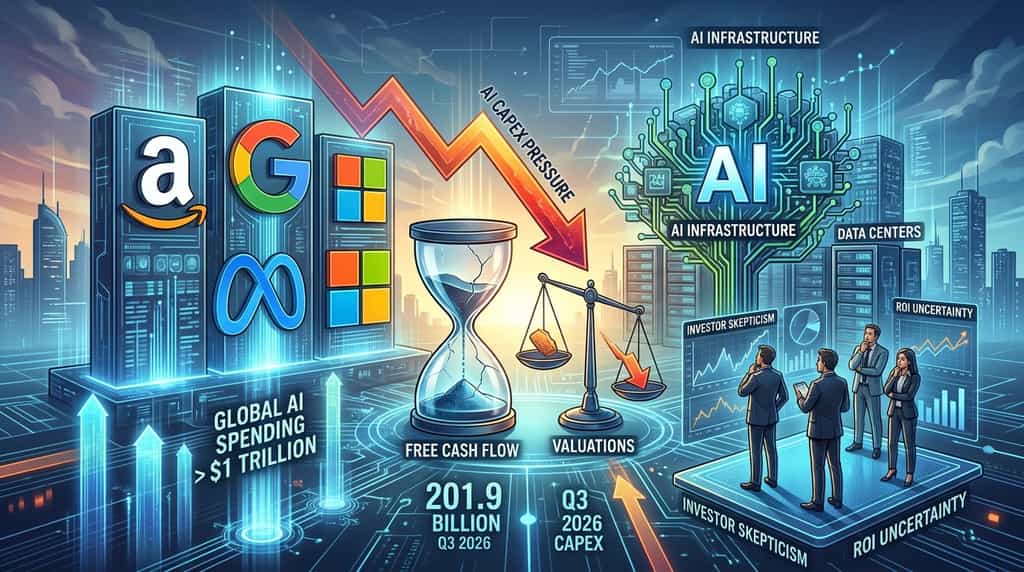
The relentless acceleration of artificial intelligence infrastructure spending has triggered unprecedented financial demands across the technology sector. According to data compiled by The Kobeissi Letter, combined capital expenditures at Amazon, Alphabet, Meta Platforms, and Microsoft reached a record $201.9 billion in the third quarter of 2026, representing a 356% increase since the first quarter of 2024. This historic capital allocation cycle has fundamentally altered corporate balance sheets, introducing intense pressure on free cash flow metrics and forcing equity markets to reevaluate valuation models. As multi-billion-dollar data center developments, specialized hardware acquisitions, and power provisioning requirements scale upward, financial analysts and investors are scrutinizing whether near-term cash burn will be justified by long-term enterprise adoption and productivity gains.
The primary driver behind the contraction of corporate liquidity is the front-loaded nature of physical and digital infrastructure acquisition required for large-scale machine learning models. According to financial disclosures analyzed by Seeking Alpha, combined free cash flow for Amazon, Alphabet, Meta, and Microsoft fell by $33.1 billion to negative $26.4 billion during the third quarter of 2026, marking the lowest level on record.
-
Accelerated Cash Outflows: Hyperscalers are deploying capital at an annualized run rate approaching $740 billion collectively for 2026, outpacing historical organic cash generation patterns.
-
Depreciation and Asset Turnover: Heavy investments in graphics processing units and custom accelerators mean future depreciation expenses will weigh heavily on operating margins over subsequent fiscal cycles.
-
Divergent Liquidity Profiles: While most major operators have seen free cash flow turn negative or contract sharply under the weight of capital expenditures, individual balance sheet management varies, with select firms maintaining positive cushions through existing cash reserves or debt issuance.
This immediate liquidity drain contrasts sharply with traditional software scaling models, which typically enjoy high marginal profitability and low capital intensity. Consequently, the traditional valuation frameworks applied to technology equities are experiencing a stress test as capital expenditure requirements consume substantial portions of operating cash.
Equity valuations for major technology firms are increasingly sensitive to the timeline and certainty of return on investment (ROI) derived from artificial intelligence deployments. According to market updates from financial tracking platforms, the market's patience is thinning as capital expenditure guidance continuously ratchets upward, with Goldman Sachs and other institutional research groups projecting global AI-related investments to surpass $1 trillion.
-
Compression of Valuation Multiples: Markets have periodically punished share prices following earnings releases that reveal larger-than-expected capital expenditure forecasts unaccompanied by immediate revenue acceleration.
-
The Revenue Backlog Buffer: Institutional analysis from J.P. Morgan indicates that early returns are visible in cloud storage and enterprise segments—such as Google Cloud revenue growing 82% year-over-year and Microsoft Azure advancing rapidly—providing foundational support for current valuations.
-
Risk Pricing: Investors are demanding higher risk premiums on technology stocks where capital expenditure growth outstrips the pace of commercial monetization, separating firms with clear enterprise monetization paths from those relying on speculative demand.
Valuation multiples can no longer rely solely on top-line revenue expansion; instead, market participants are calculating capital efficiency ratios to determine how effectively billions of dollars in infrastructure translate into sustainable net earnings.
The trajectory of capital expenditures is no longer constrained solely by corporate willingness to spend, but rather by physical, regulatory, and operational bottlenecks across the global supply chain. According to J.P. Morgan Global Research, several external factors dictate the speed and scale at which data centers can be brought online.
-
Power Availability and Grid Capacity: Securing stable, high-capacity electricity supplies for massive data center clusters has emerged as a primary operational hurdle, forcing tech giants to explore direct energy partnerships and nuclear power procurement.
-
Hardware Supply Chain Lead Times: Specialized semiconductor components, advanced cooling systems, and networking gear remain subject to tight manufacturing capacities, influencing the timing of cash disbursements.
-
Construction and Labor Limitations: Engineering specialized facilities requires skilled labor and specialized construction materials, creating natural speed limits on how fast planned capital expenditure budgets can be executed.
These friction points mean that actual cash outlays sometimes deviate from initial guidance, giving operational executives brief windows to assess the monetization efficiency of existing deployments before committing to subsequent infrastructure tranches.
Navigating capital expenditure pressures requires executive leadership to balance aggressive technological positioning with disciplined capital stewardship. Companies must concurrently fund multi-year infrastructure pipelines while preserving investor confidence through operational efficiency and disciplined cost management outside of core artificial intelligence initiatives.
-
Strategic Capital Prioritization: Firms are increasingly reallocating internal R&D budgets away from legacy projects to concentrate financial firepower exclusively on high-conviction artificial intelligence infrastructure.
-
Alternative Financing Structures: To preserve internal liquidity, select operators utilize structured financing, lease arrangements, and joint ventures to share the capital burden of massive data center developments.
-
Demonstrating Monetization Milestones: Management teams face mounting pressure to provide granular metrics regarding application programming interface (API) call volumes, enterprise seat adoption, and direct monetization of generative tools to justify ongoing cash allocations.
Ultimately, the long-term health of technology valuations depends on whether these capital investments transition from speculative infrastructure builds into foundational utilities that command permanent pricing power across global enterprise markets.
As the artificial intelligence infrastructure cycle continues to evolve, maintaining a disciplined approach to asset allocation and risk management is essential. Whether evaluating individual equities, managing digital portfolios, or assessing broader macroeconomic trends in the technology sector, thorough research and adherence to personal risk parameters remain critical. This article is for informational purposes only and does not constitute financial, legal, or investment advice. Always conduct your own research before interacting with digital assets.
What differentiates capital expenditure (capex) from operating expenditure in AI development?
Capital expenditure involves long-term investments in physical assets such as data center real estate, servers, and specialized processors that are capitalized on the balance sheet and depreciated over time. Operating expenditure covers day-to-day operational costs like cloud maintenance, administrative expenses, and routine software updates that are expensed immediately.
How do rising interest rates affect Big Tech's ability to fund AI infrastructure?
Higher interest rates increase the cost of debt financing, making capital-intensive projects more expensive when internal cash flows turn negative. This forces tech giants to rely more heavily on their existing cash reserves or face increased dilution and borrowing costs.
What are hyperscalers, and why do they dominate AI spending?
Hyperscalers are large cloud computing providers—such as Amazon, Microsoft, and Google—that possess the massive scale, global network infrastructure, and financial resources required to build and maintain the multi-billion-dollar data centers necessary for training modern AI models.
How does accelerated hardware depreciation impact corporate earnings?
Because artificial intelligence hardware and specialized processors advance and cycle out rapidly, companies often depreciate these assets over shorter time horizons. This higher annual depreciation expense directly reduces operating margins and reported net income, even after the initial cash has been spent.
What metrics do institutional investors monitor to gauge AI return on investment?
Institutional investors monitor metrics such as cloud revenue growth rates, remaining performance obligations (contracted revenue backlogs), operating income expansion within cloud segments, and the specific revenue contribution of newly launched generative applications.
This general market information, possibly from third-party, commercial, or sponsored sources, is provided for reference and educational purposes only and does not constitute financial or investment advice, an offer, solicitation, or guarantee. We disclaim liability for its accuracy, completeness, reliability, and any resulting losses. Investments/trading are risky; past performance doesn’t guarantee future results. Users should research, judge prudently, and take full responsibility. For further details, please consult KuCoin’s Terms of Use and Risk Disclosure.