

Global GDP Growth Expected to Ease to 2.7% in 2026, 2.8% in 2027 – Moody’s Analytics
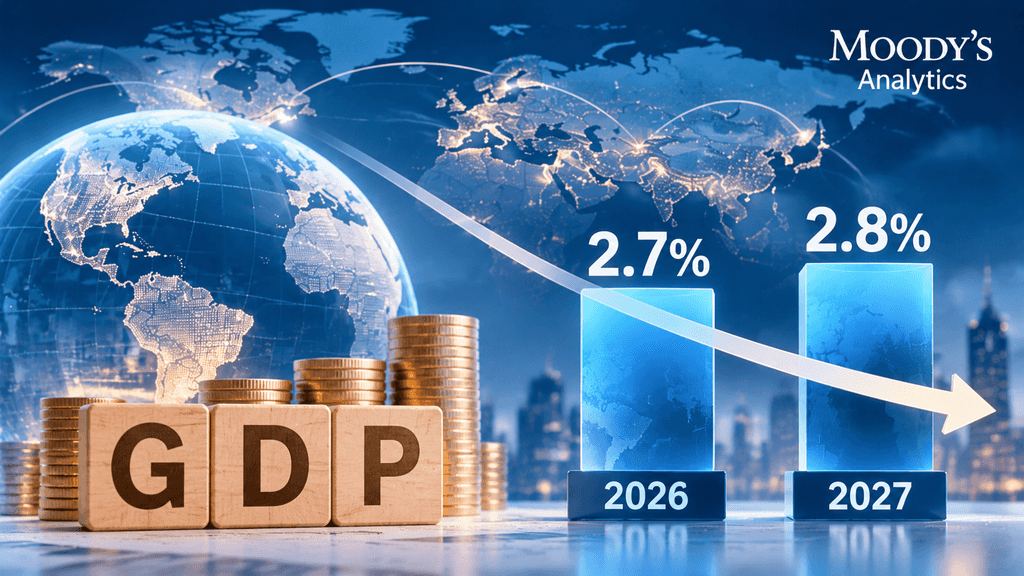
Moody’s Forecasts Slower Global Economic Growth Through 2027
Moody’s Analytics projects that worldwide economic expansion will moderate over the next two years. Global gross domestic product is expected to grow 2.7 percent in 2026 and 2.8 percent in 2027, down from an estimated 3 percent in 2025 and short of the world economy’s potential rate of more than 3 percent. The research firm’s November 2026 Global Outlook describes a baseline scenario of only modest inflation increases and limited additional central bank tightening, yet even under these relatively benign assumptions the global economy is set to run below capacity.
The firm notes that the United States is likely to average a bit more than 2 percent growth while China and other major economies also lose momentum. Financial markets have traded choppily as policy uncertainty raises questions about the durability of the artificial intelligence investment boom and the elevated asset valuations it has supported. Risks remain skewed firmly to the downside.
Key Takeaways
-
Global GDP growth is forecast to slow to 2.7% in 2026 and 2.8% in 2027 from 3% in 2025, remaining below potential.
-
The economy is running at two speeds, with AI-linked sectors and economies outperforming others.
-
US growth is projected to average slightly above 2% in both years.
-
China’s expansion is expected to ease to 4.6% in 2026 and 4.3% in 2027.
-
Eurozone growth is seen at 0.9% in 2026 before rising to 1.6% in 2027.
-
Downside risks include AI investment setbacks, geopolitical flare-ups, and trade friction.
What Does Moody’s Analytics Project for Global GDP Growth in 2026 and 2027
Moody’s Analytics expects the world economy to expand 2.7 percent in 2026 and 2.8 percent in 2027. This marks a mild deceleration from the 3 percent pace estimated for 2025 and leaves growth short of the more than 3 percent rate the global economy is considered capable of sustaining. The projection rests on an assumption that inflation rises only modestly and that central banks implement only limited further tightening.
Even under this relatively constructive baseline, major economies are projected to slow. The United States is expected to average a little more than 2 percent growth across the two years. China and other large economies are also set to lose pace. The firm describes the overall outlook as remaining highly uncertain, with risks tilted firmly to the downside.
Why Is Global Growth Expected to Fall Short of Potential
The shortfall relative to potential stems from a combination of fading cyclical momentum, structural headwinds in several large economies, and the uneven distribution of growth drivers. While the AI investment cycle has provided meaningful support, particularly through capital spending and related supply-chain activity, it has not been broad enough to lift the entire global economy to its estimated capacity.
Higher energy prices linked to geopolitical tensions, elevated borrowing costs in some jurisdictions, and persistent trade frictions have constrained demand in sectors less connected to technology. Moody’s Analytics notes that the global economy has demonstrated resilience so far, yet the margin for error has narrowed. Any material deterioration in financial conditions or a fresh supply shock could push growth further below potential.
How Is the Global Economy Operating at Two Speeds
Moody’s Analytics describes a two-speed or K-shaped global economy. Countries and industries closely integrated into the AI boom have experienced surges in investment, industrial production, and exports. Economies and sectors less connected to this cycle have faced weaker demand, higher costs, and greater exposure to geopolitical and trade disruptions.
This divergence is especially visible in Asia-Pacific, a central node in the semiconductor and electronics supply chains that support AI infrastructure. Taiwan, a leading producer of advanced chips, has recorded average double-digit growth in recent years. Other technology-oriented economies in the region have also outperformed broader averages. In contrast, economies more dependent on traditional manufacturing, energy-intensive industry, or domestic demand have lagged.
What Role Does the AI Boom Play in Supporting Growth
The AI investment wave has been a primary source of resilience. In the United States, AI-related activity is estimated to have contributed roughly 0.5 percentage points to 2025 GDP growth of about 2.3 percent, split between direct investment effects and stock-market wealth effects. Across Asia-Pacific, the contribution has been more direct through manufacturing and export channels.
Hyperscaler capital expenditure remains elevated, supporting data-center construction, power infrastructure, and semiconductor demand. Moody’s Analytics and other analysts caution, however, that the pace of US hyperscaler capex growth is expected to moderate significantly from the extremely high rates seen recently. Questions around financing structures, business-model viability, and equity valuations have grown more prominent, introducing downside risk if investment slows more sharply than anticipated.
How Will US Economic Growth Perform in 2026 and 2027
Moody’s Analytics projects US growth to average slightly above 2 percent in both 2026 and 2027. This pace sits below the higher rates recorded in some recent years and short of longer-run potential in the firm’s assessment. Support continues to come from technology-related investment and resilient household balance sheets, while tighter financial conditions and any moderation in the AI spending cycle act as constraints.
The outlook leaves the US economy expanding but without strong upward momentum. Policy uncertainty, including potential shifts in regulatory scrutiny of data center development or energy infrastructure, could influence the trajectory of AI-related capital expenditure.
What Is the Outlook for China’s GDP Growth
China’s growth is projected to slow to 4.6 percent in 2026 and 4.3 percent in 2027. The deceleration reflects ongoing structural challenges, including weak domestic demand, a prolonged property-sector adjustment, and demographic pressures. Moody’s Analytics no longer anticipates major stimulus measures aimed at boosting domestic consumption.
China continues to pursue a supply-oriented growth strategy that emphasizes manufacturing and exports. This approach has supported industrial output and overseas market share but has intensified competitive pressure on manufacturers in Europe and elsewhere, particularly in machinery, chemicals, and higher-value goods. The firm expects this dynamic to persist, contributing to ongoing trade friction.
How Is the Eurozone Expected to Recover
Eurozone growth is forecast at 0.9 percent in 2026 before improving to 1.6 percent in 2027. The near-term weakness reflects high energy costs, soft consumer confidence, and competitive pressures from Chinese exports. An overly aggressive tightening of monetary or fiscal policy could further dampen activity without resolving underlying supply-side constraints.
The projected improvement in 2027 assumes some easing of energy-price pressures and a gradual recovery in domestic demand. Structural issues around productivity, industrial competitiveness, and fiscal capacity are expected to limit the strength of any rebound.
What Risks Does Moody’s Analytics Highlight for the Global Economy
Risks are described as firmly skewed to the downside. Key threats include policy uncertainty surrounding the AI boom and elevated asset valuations, the possibility of military conflict escalation, disruptions to critical commodity shipping routes, and large global imbalances that sustain trade friction and inflationary pressure.
Financial-market volatility has already reflected these concerns. A sharper-than-expected slowdown in AI-related investment would have spillovers beyond the United States given Asia’s central role in the hardware supply chain. Higher oil prices from a renewed flare-up in West Asia would force central banks into more difficult trade-offs between inflation control and growth support.
How Could Geopolitical Tensions in West Asia Affect Growth
A fresh escalation or prolonged disruption in West Asia could push oil prices higher and interrupt key shipping routes. Moody’s Analytics notes that higher energy costs and the resulting inflation would complicate monetary policy, potentially leading to additional tightening that weighs on investment and consumption. Oil inventories have already been drawn down, reducing the buffer against further shocks.
Such a development would raise the cost of operating energy-intensive AI infrastructure and could force governments to scale back fiscal support that has previously helped contain price pressures. The global economy’s demonstrated resilience would be tested more severely under these conditions.
What Are the Implications of Elevated Asset Valuations and AI Uncertainty
Elevated valuations linked to the AI narrative have supported wealth effects and equity-market strength, particularly in the United States. At the same time, investors have grown more attentive to the financing structures behind AI ventures, the path to sustainable profitability, and the risk of regulatory or political scrutiny. Policy uncertainty following US midterm elections has added to caution around data center permitting and related infrastructure.
A material reassessment of AI-related prospects could trigger equity-market corrections, reverse wealth effects, and slow capital expenditure. Because Asia-Pacific economies are deeply integrated into the supply chain for chips and hardware, the impact would not be confined to the United States.
How Do Moody’s Forecasts Compare With IMF and Other Projections
Moody’s Analytics’ 2.7 percent and 2.8 percent figures for 2026 and 2027 sit below the International Monetary Fund’s October 2026 projections of 3.1 percent and 3.4 percent. The IMF cites resilience supported by technology investment and adaptive responses to energy shocks, while still warning that margins of adjustment are narrowing.
Goldman Sachs Research has projected a similar path to Moody’s, with global growth at 2.7 percent in 2026 and 2.8 percent in 2027, supported by expected moderation in energy prices and continued AI investment. Differences across institutions largely reflect varying assumptions about the duration of energy-market disruptions, the intensity of the AI spending cycle, and the degree of policy tightening.
What Does the Baseline Scenario Assume About Inflation and Monetary Policy
The baseline assumes inflation rises only modestly and that central banks tighten only a little further. This relatively benign monetary backdrop underpins the projection of continued, if sub-potential, growth. Should energy prices or other supply shocks prove more persistent, central banks could face sharper trade-offs, raising the probability of tighter financial conditions and slower growth.
Longer-term bond yields are expected to remain elevated even if policy rates stabilize or ease later. Refinancing pressures for leveraged firms and governments are therefore likely to remain a consideration through 2027.
How Might Trade Frictions and Global Imbalances Influence the Outlook
Large global imbalances continue to generate an undercurrent of trade friction. China’s sustained emphasis on manufacturing and export expansion has increased competitive pressure on producers in Europe and other regions. Moody’s Analytics sees little near-term prospect of a major policy pivot in Beijing toward stronger domestic demand support.
Persistent imbalances can sustain higher inflation in some economies and complicate the path of monetary policy. They also raise the risk that protectionist measures or retaliatory actions could further disrupt trade flows and investment decisions. The global economy has shown resilience to date; the firm concludes it will need more of that resilience in the period ahead.
FAQs
What is the main reason Moody’s Analytics expects global growth to slow in 2026 and 2027?
The firm attributes the moderation to a combination of fading post-pandemic and post-stimulus momentum, structural slowdowns in major economies such as China, and the fact that AI-driven gains, while substantial, remain concentrated rather than economy-wide. Even with only modest inflation and limited further monetary tightening, growth is projected to remain below the more than 3 percent potential rate.
How significant is the AI boom to the current global outlook?
AI-related investment and associated supply-chain activity have been a primary support for growth, particularly in the United States and technology-oriented Asian economies. Estimates suggest AI contributed around half a percentage point to US growth in 2025 through investment and wealth effects. A sharper slowdown in this spending cycle would therefore remove an important source of resilience and transmit quickly through Asian manufacturing hubs.
Why does Moody’s describe the global economy as operating at two speeds?
Countries and industries tightly linked to AI infrastructure, semiconductors, and related investment have recorded stronger activity in production, exports, and capital spending. Economies and sectors more exposed to traditional manufacturing, higher energy costs, or weaker domestic demand have lagged. This K-shaped pattern is especially pronounced in Asia-Pacific, where chip and electronics exporters have outperformed broader regional averages.
What are the key downside risks identified in the November 2026 outlook?
The main risks are policy and regulatory uncertainty surrounding the AI boom, elevated asset valuations that could reverse, potential escalation of conflict in West Asia that raises oil prices and disrupts shipping, and persistent trade friction stemming from global imbalances. Any of these could push growth below the already sub-potential baseline.
How does the US growth forecast compare with recent performance?
Moody’s Analytics expects the United States to average a little more than 2 percent growth in 2026 and 2027. This is slower than some of the stronger years immediately preceding the current period and reflects both the moderation of certain demand drivers and the potential for AI capital expenditure growth rates to decelerate from very high levels.
Disclaimer: This general market information, possibly from third-party, commercial, or sponsored sources, is provided for reference and educational purposes only and does not constitute financial or investment advice, an offer, solicitation, or guarantee. We disclaim liability for its accuracy, completeness, reliability, and any resulting losses. Investments/trading are risky; past performance doesn’t guarantee future results. Users should research, judge prudently, and take full responsibility. For further details, please consult KuCoin’s Terms of Use and Risk Disclosure.