

Memory Chip Stocks Surge on July 30: Bull Market Return or Dead Cat Bounce?
2026/07/31 11:01:00
Introduction
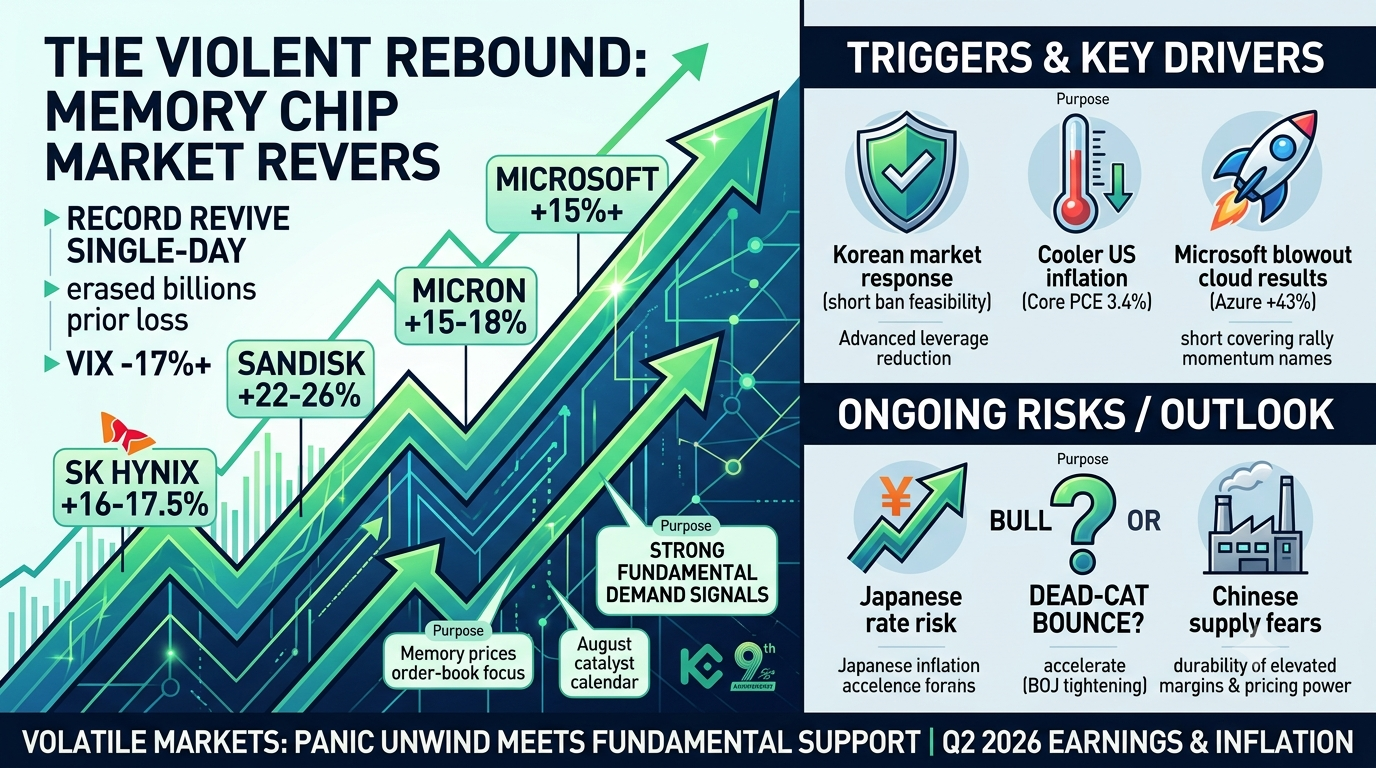
Memory chip stocks staged one of the sharpest single-day reversals in recent market history on July 30, 2026. SK Hynix surged roughly 16-17.5%, SanDisk jumped more than 22-26%, Micron climbed about 15-18%, and Microsoft added more than 15% in a session that erased hundreds of billions in prior losses while the VIX fell over 17%. This violent rebound followed consecutive panic sell-offs driven by leverage unwinds in Korea and supply fears tied to Chinese capacity.
The move answers the immediate question: strong fundamental demand signals from Microsoft’s earnings and cooling U.S. inflation provided real support, yet elevated Japanese rate risks and unresolved supply-cycle questions leave open the possibility of a classic dead-cat bounce rather than a confirmed new bull leg.
What Triggered the Memory Chip Stocks Rebound on July 30?
Korean regulatory signals, cooler U.S. inflation data, and Microsoft’s blowout cloud results combined to reverse heavy selling pressure. According to market reports from late July 2026, SK Hynix, SanDisk, and Micron delivered double-digit gains while Microsoft posted its largest single-day market-value increase on record, adding roughly $450 billion.
In Seoul, the Korea Exchange internally assessed the technical feasibility of a temporary short-selling ban and narrower daily price limits after the KOSPI broke its 50-day, 100-day, and 200-day moving averages. The Ministry of Economy and Finance convened an emergency market-status meeting, maintained the highest alert level, and activated 24-hour cross-agency monitoring. Officials faced acute political pressure because earlier policy encouragement had drawn retail investors into Samsung and SK Hynix AI-chip shares; many of those investors suffered large losses within 48 hours. Leveraged ETF assets that peaked above $50 billion in June had already contracted nearly 70% to about $16 billion, signaling that forced deleveraging had advanced into a late stage even if full clearance remained incomplete.
In the United States, second-quarter core PCE inflation cooled to 3.4% on a quarterly basis and the June core reading held near 3.3%, according to Bureau of Economic Analysis data released around July 30. The softer print reduced near-term rate-hike expectations. Simultaneously, Microsoft reported fiscal 2026 fourth-quarter revenue of approximately $90 billion, up 18% year-over-year. Azure and other cloud services accelerated to 43% growth, and full-year Azure revenue surpassed the $100 billion threshold for the first time at 41% growth. CEO Satya Nadella highlighted sustained AI demand. Prior liquidation by large AI funds had also largely run its course, removing one source of technical supply and enabling a short-covering rally in momentum names.
These factors together produced the exaggerated upside: genuine demand confirmation met a market that had become technically oversold.
How Did Korean Market Measures and Deleveraging Support the Rebound?
Korean authorities’ readiness to constrain short selling and the advanced stage of retail leverage reduction limited immediate downside pressure. Leveraged products tracking chip stocks had amplified both the earlier rally and the subsequent collapse; the sharp contraction in those assets removed a major forced-selling catalyst.
The KOSPI’s decisive break of multiple moving averages and the near-70% drop in leveraged ETF assets from the June peak illustrated how quickly retail leverage can reverse. While full clearance cannot be declared complete, the scale of liquidations and the official emergency response indicated that the most intense phase of deleveraging had already occurred. Market participants interpreted the potential short-sale restrictions and tighter price limits as credible short-term stabilizers that reduced the probability of renewed cascading sales.
Political sensitivity added weight to the measures. Because the government had previously promoted retail participation in the AI-memory theme, officials faced pressure to demonstrate responsiveness after rapid losses. The combination of technical readiness checks and high-level monitoring therefore provided a tangible floor under Korean chip names that quickly transmitted to U.S.-listed peers.
What Role Did Microsoft Earnings and U.S. Inflation Data Play?
Microsoft’s results directly challenged the “AI bubble has burst” narrative by showing accelerating rather than decelerating cloud demand. Azure growth rose from 40% in the prior quarter to 43%, and annual Azure revenue crossed $100 billion for the first time. The company also guided for continued strong capital expenditure in AI infrastructure. This demand-side evidence arrived at the same moment that cooler core PCE data lowered the odds of additional near-term Federal Reserve tightening.
The dual positive surprise triggered short covering across technology and momentum stocks. Microsoft’s 15%-plus advance represented its largest one-day percentage gain in 18 years and the largest single-stock market-value increase in U.S. market history. Memory stocks, which supply the high-bandwidth memory essential to the same AI data-center build-out, participated fully in the squeeze.
Taken together, the earnings and inflation releases shifted the prevailing story from “demand is fading” to “demand is still accelerating,” providing fundamental justification for the size of the rebound.
Why Could This Still Be a Dead Cat Bounce?
Japanese inflation acceleration and unresolved questions about medium-term supply and pricing power introduce material downside risks. Tokyo core CPI rose 1.9% year-over-year in July according to preliminary data, above the 1.8% consensus and marking a second consecutive month of acceleration. Core-core CPI (excluding fresh food and energy) reached 2%. Market expectations currently price the Bank of Japan holding rates steady near 1% at its next meeting while signaling further tightening later. Higher Japanese rates would pressure the yen-carry trade that has supported global risk assets, including technology shares.
On the industry side, Microsoft answered the capital-expenditure continuity question, yet the durability of elevated memory margins remains open. Expanding supply from Chinese producers such as ChangXin Memory Technologies following its recent listing, together with the normal progression of the capacity cycle, could eventually pressure HBM, DRAM, and NAND pricing. Investors therefore need confirmation that recent price and order-book upgrades hold and that Korean shares do not simply retrace the rebound.
Key near-term validation points include the Future of Memory and Storage conference beginning August 4, SK Hynix’s expected HBM4 volume ramp in the third quarter, and Nvidia’s earnings report on August 26. Failure of memory prices or orders to continue rising, or renewed Korean volatility, would increase the probability that the July 30 surge proves temporary.
Join KuCoin 9th Anniversary Trading Campaign
Now you can trade such semiconductor assets on KuCoin, including Microsoft, SK Hynix, MU, SNDK, and others.
KuCoin is celebrating its 9th anniversary with a special platform campaign filled with exclusive rewards, trading activities, and limited-time offers. Don’t miss the chance to participate and enjoy the benefits as the exchange marks nine years of growth and innovation. Visit the official campaign page now:

Conclusion
The July 30, 2026 rebound in memory-chip stocks reflected a genuine confluence of Korean policy support, advanced retail deleveraging, cooler U.S. inflation, and Microsoft’s confirmation of accelerating AI cloud demand. Double-digit gains in SK Hynix, SanDisk, Micron, and Microsoft, alongside a sharp drop in the VIX, demonstrated that panic selling had become overdone relative to near-term fundamentals. At the same time, accelerating Japanese inflation and the still-unresolved supply-cycle questions surrounding HBM, DRAM, and NAND mean the rally has not yet proven itself a durable bull-market resumption.
Investors should treat the move as an important technical and sentiment reset that requires subsequent confirmation from order books, pricing, and the August catalyst calendar. Until memory prices and Korean shares demonstrate the ability to hold gains, the possibility of a dead-cat bounce remains live. Disciplined monitoring of the next few data points will determine whether the violent rebound marks the start of a new uptrend or simply a sharp pause in a larger correction.
FAQs
What is a dead cat bounce in stock markets?
A dead cat bounce is a temporary recovery in a declining asset that ultimately fails and gives way to further losses. It often occurs after extreme oversold conditions and can be driven by short covering rather than a fundamental turn.
How does HBM demand affect memory chip company earnings?
High-bandwidth memory used in AI accelerators currently commands premium pricing and margins. Strong HBM volumes directly lift revenue and profitability for the limited number of producers able to manufacture it at scale.
Why did Korean leveraged ETFs matter for the recent sell-off?
Leveraged products amplified both the earlier AI-memory rally and the subsequent decline. Their roughly 70% contraction in assets under management removed a major source of forced selling once liquidations ran their course.
What upcoming events could confirm or refute the rebound?
The Future of Memory and Storage conference starting August 4, SK Hynix’s HBM4 third-quarter volume ramp, and Nvidia’s August 26 earnings release will provide fresh data on pricing, orders, and AI demand.
How can cooling U.S. inflation support technology stocks?
Lower core PCE readings reduce the likelihood of additional near-term rate hikes, lowering discount rates applied to growth stocks and easing pressure on speculative positioning across the technology sector.