

Lorenzo Protocol (BANK) Analysis: Recovery Rally Incoming or Just a Bull Trap?
2026/07/31 16:08:00
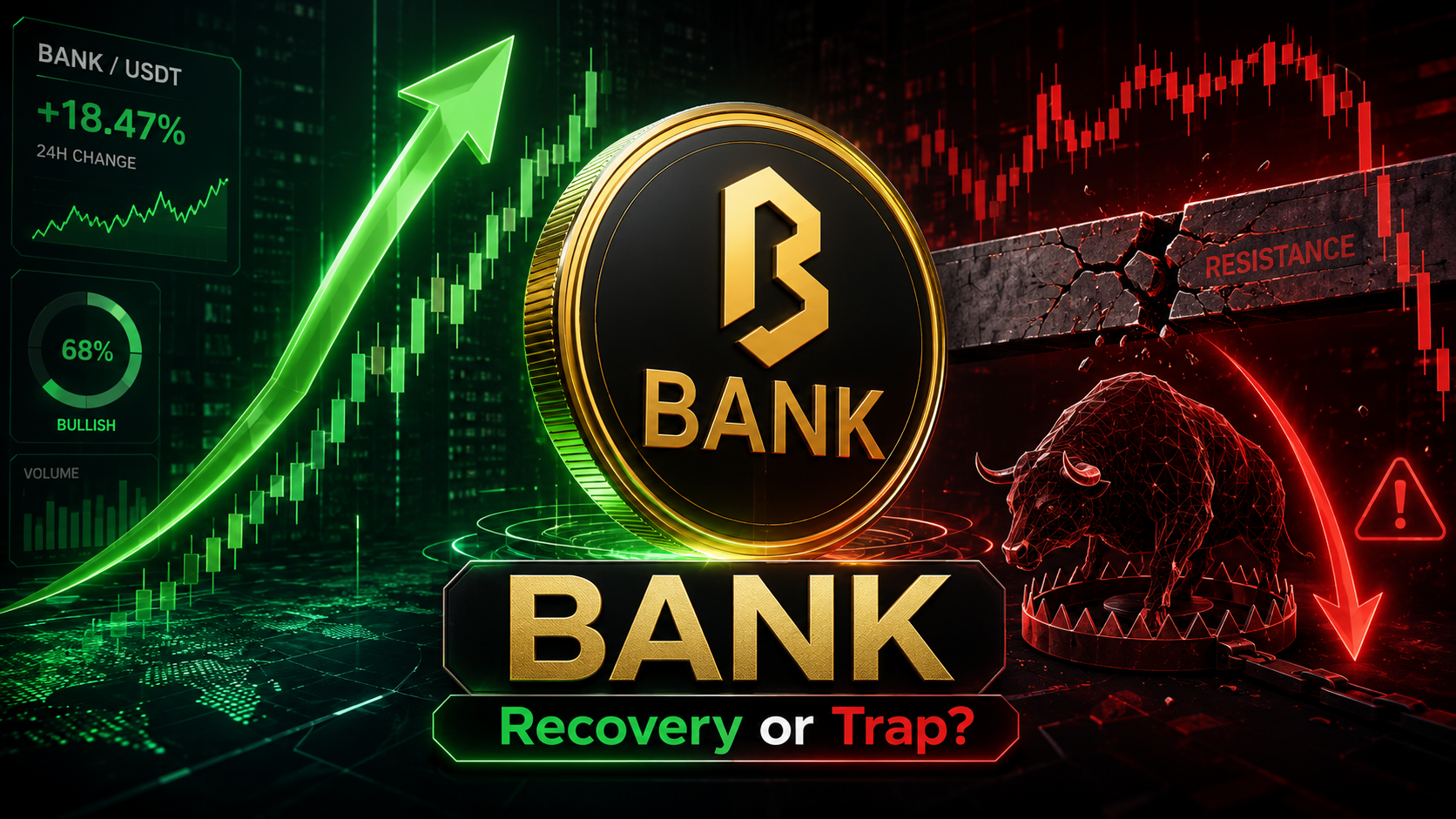
Lorenzo Protocol’s BANK token has fallen sharply after its July 2026 rally, trading near $0.067 at the July 31 research cutoff and almost 88% below its $0.5548 all-time high. Profit-taking, leveraged liquidations, weak spot demand and broken support levels have intensified the BANK price decline.Deeply negative funding could trigger a short squeeze, but token unlocks, concentrated holdings and mixed protocol data increase the risk of a bull trap. This Lorenzo Protocol price analysis examines BANK recovery signals, support and resistance levels, TVL trends and the main risks facing traders.
Why Is Lorenzo Protocol (BANK) Price Falling Today?
The Lorenzo Protocol price is falling primarily because its rapid July rally created conditions for heavy profit-taking and a severe market-structure correction. BANK climbed from the low-cent range to a new all-time high within a relatively short period, attracting momentum traders while giving earlier buyers substantial unrealized gains. Once demand weakened near the peak, selling accelerated and triggered a series of long liquidations. BANK then broke below the support zones that had sustained the original bullish outlook, leaving late buyers with losses and encouraging additional exits. The BANK price correction became especially violent because liquidity accumulated during the rally was not deep enough to absorb synchronized selling from profit-takers, leveraged traders and holders reacting to the loss of support. When a crypto asset rises faster than its underlying liquidity and spot demand, even a relatively small change in sentiment can activate stop-loss orders and liquidation engines across multiple price levels. Oversold conditions may eventually slow the decline, but they do not guarantee an immediate recovery because a token can remain oversold while holders continue selling into weak liquidity.
Recent exchange listings increased BANK’s accessibility without creating enough sustained spot demand to stabilize the token. KuCoin opened BANK/USDT trading on July 22, while additional regional fiat markets were introduced later in the month. New listings can initially increase trading volume, market visibility and access to the asset, but they cannot maintain a higher price unless buyers continue absorbing the available supply after the opening period. The timing resembles a possible sell-the-news pattern because BANK reached its recorded peak around one of these late-July market additions, although no individual listing can be identified as the confirmed cause of the decline. No official Lorenzo Protocol announcement of a hack or exploit had been found at the research cutoff, so the available evidence points more strongly toward a speculative unwind than a confirmed protocol failure. Nevertheless, uncertainty surrounding token vesting, large-address activity and derivatives positioning has made traders less willing to treat the decline as an ordinary correction. The absence of a confirmed security incident reduces one category of risk, but it does not remove the liquidity, supply and leverage pressures affecting the BANK token price.
Lorenzo Protocol Price Analysis: BANK Recovery Rally or Bull Trap?
BANK remains in a bearish market structure, but its derivatives market has created conditions in which a sudden recovery attempt could develop quickly. The central question is whether that move would be driven by buyers accumulating BANK on spot markets or by short sellers closing leveraged positions. A spot-led advance supported by improving market structure could begin a recovery, while a brief derivatives-driven surge that fails at resistance would more closely resemble a bull trap. A credible BANK price reversal would normally include repeated closes above resistance, stronger spot-market participation, controlled volatility and the formation of a higher low after the first pullback. Without those confirmations, a rapid rebound could simply reflect temporary positioning changes inside an unstable market rather than a lasting improvement in demand.
Extreme Negative Funding Could Trigger a BANK Short Squeeze
CoinGlass recorded approximately $2.93 billion in 24-hour BANK futures volume, compared with around $148 million in tracked spot volume. Futures activity was therefore almost 20 times larger than spot trading under CoinGlass’s methodology. Open interest stood near $72.5 million, exceeding BANK’s approximately $53.5 million market capitalization and showing how strongly leveraged contracts were influencing price discovery. A comparison between open interest and market capitalization does not mean every derivatives position is unhedged, but it demonstrates that leveraged exposure was unusually large relative to the token’s reported market value. This structure helped intensify the decline when long positions were liquidated, but it could eventually work in the opposite direction. Perpetual futures funding rates became deeply negative across several exchanges, indicating that short positioning had grown crowded and bearish traders were paying to keep their positions open. If BANK begins rising, voluntary short covering and forced liquidations could produce additional market-buy orders, creating a rapid short squeeze. In a relatively thin market, those orders can move the price quickly because traders must close positions regardless of whether BANK’s fundamental outlook has improved.
A short squeeze, however, is not equivalent to a sustainable BANK recovery. The initial rebound can appear highly bullish because liquidated shorts must buy back their positions regardless of the token’s fundamental outlook. Once that forced demand ends, the price may struggle if ordinary buyers are not participating. A healthier recovery would involve the price rising while open interest stabilizes or declines, demonstrating that the market is reducing leverage rather than building another unstable concentration of positions. Funding rates should also move gradually toward neutral instead of remaining at extreme levels. Traders can compare the rebound with spot volume, liquidation activity, open-interest changes and the difference between futures and spot prices to determine whether demand is becoming more balanced. If BANK rises only because short positions are being closed while spot activity remains weak, the rally may lose momentum as soon as the liquidation pressure disappears.
Spot Demand Must Confirm Any BANK Recovery Rally
Spot activity is important because it reflects direct demand for the token rather than temporary exposure through futures contracts. If BANK begins recovering while spot volume increases relative to derivatives volume, the move would carry more credibility. A gradual rise supported by spot accumulation, controlled open interest and successful support retests would suggest that buyers are absorbing available supply. Improvements in order-book depth and smaller price changes from individual trades would provide additional evidence that liquidity is becoming healthier. This type of recovery may develop more slowly than a short squeeze, but it generally provides a stronger foundation because it does not depend entirely on forced position closures. Consistent spot buying across several trading sessions would be more constructive than one unusually large volume spike followed by immediate selling.
Protocol and on-chain indicators can also help evaluate the quality of a rally. Greater clarity around token vesting, fewer unexplained exchange-bound transfers and stabilization in Lorenzo’s active yield products would strengthen confidence. Traders can also monitor whether large addresses are accumulating, holding or moving BANK toward trading venues, although wallet attribution should be treated cautiously because an address may belong to a custodian, treasury, market maker or smart contract rather than an individual investor. By contrast, a price increase occurring alongside weak product activity or additional supply uncertainty would leave the recovery vulnerable. Rising protocol usage would be more meaningful for the BANK price outlook if it produced recurring fees, stronger token utility or additional reasons for users to hold BANK. Traders should therefore evaluate price action together with spot volume, derivatives positioning, on-chain transfers and protocol usage instead of relying on a single technical indicator.
What Would Expose the BANK Rally as a Bull Trap?
The bull-trap scenario would become more likely if BANK rises rapidly but fails to hold above its first major resistance zones. A sharp spike accompanied by expanding open interest would indicate that traders are adding leverage during the rebound, potentially creating the conditions for another liquidation event. Persistently extreme funding would also suggest that the market remains dominated by short-term positioning rather than balanced demand. Additional warning signs could include repeated long upper candle wicks, declining spot volume during the advance and a breakout that returns below resistance before the daily close. If spot participation stays weak, the rally could end as soon as short sellers complete their forced purchases. A highly leveraged rebound may therefore look convincing on a short-term chart while remaining structurally fragile beneath the surface.
Another warning would be a temporary breakout followed by heavy selling from large addresses or fresh exchange inflows connected to unlocked supply. A recovery should normally produce a higher low after the first pullback, showing that buyers are willing to enter before the price returns to its previous bottom. If BANK instead loses the reclaimed resistance level, returns to its earlier low or creates a new low, the market would be signaling that buyers failed to establish control. Confirmation should ideally appear across more than one time frame because a brief intraday move above resistance can be reversed before the daily or weekly close. Based on the researched market structure, BANK has enough short-side crowding to generate a strong rebound, but it has not yet provided the sustained spot demand, higher-low formation or resistance confirmation required to establish a durable Lorenzo Protocol price reversal.
BANK Price Outlook: Support Levels, Token Unlocks, TVL and Risks
BANK Support and Resistance Levels to Watch
The immediate BANK support zone sits between $0.065 and $0.071, where the token attempted to stabilize following its severe correction. Holding this range and forming a higher low would provide an early constructive signal, while a decisive break below $0.065 could expose historical trading areas around $0.05 and $0.03. On the upside, BANK must first reclaim approximately $0.0788–$0.080 before challenging the more important $0.100–$0.103 resistance area. A sustained move through $0.10 with stronger spot volume would improve the recovery argument and bring the $0.1369–$0.153 zone into focus. The larger $0.20–$0.219 region would remain a major barrier because it previously attracted substantial trading activity. Traders should treat these levels as zones rather than exact prices because order-book depth, volatility and liquidity can cause BANK to move briefly above or below a technical boundary. The quality of a breakout will depend on whether the price closes above resistance, holds that area during a retest and receives confirmation from increasing spot volume. These figures are reference zones rather than guaranteed targets, and they should be refreshed before publication because BANK prices can change rapidly and differ across exchanges.
BANK Token Unlocks and Circulating Supply Pressure
BANK token unlocks have become more relevant because the first-year restriction covering team, investor, advisor and treasury allocations ended after April 2026. The official BANK tokenomics set the maximum supply at 2.1 billion BANK, with major allocations including 25% for investors, 25% for rewards, 15% for the team and 13% for ecosystem development. ChainBroker’s third-party schedule displays vesting tranches beginning July 18 totaling approximately 39.63 million BANK across several categories, equivalent to roughly 5.2% of a widely cited 764.94 million circulating-supply estimate. Scheduled vesting does not prove that tokens were deposited on exchanges or sold, but it expands the potentially transferable supply and can influence market expectations before any visible selling occurs. Unlocked tokens may be held, delegated, used for incentives, supplied to liquidity programs, transferred through private arrangements or moved to trading venues, so unlock data should not automatically be treated as confirmed sell pressure.
Supply reporting also differs considerably: one market-data service lists approximately 764.94 million BANK in circulation and 1.21 billion issued, while other data providers continue to display the 425.25 million genesis amount. The difference should be disclosed because circulating supply depends on how locked, foundation, exchange and market-making addresses are classified. Greater transparency around vesting transactions and wallet labels would make it easier to evaluate whether future BANK token unlocks are increasing active market supply.
Lorenzo Protocol TVL, Revenue and sUSD1+ Trends
DeFiLlama’s Lorenzo Protocol TVL data recorded approximately $544.83 million in total value locked, up about 2.8% over 30 days, with Bitcoin accounting for roughly 84.5% of tracked value. The protocol generated approximately $159,177 in fees and $7,959 in protocol revenue over the same period, producing annualized estimates of about $2.92 million in fees and $155,199 in revenue. These figures illustrate why TVL, fees and protocol revenue should be assessed separately: a large amount of deposited capital does not necessarily produce equally large revenue or direct demand for the BANK token. Dollar-denominated TVL can also change because of asset-price movements rather than new deposits, particularly when Bitcoin represents most of the tracked value.
Lorenzo’s combination of Bitcoin-linked assets and stablecoin products reflects how decentralized finance can combine smart contracts, liquidity and tokenized yield strategies. Individual product data provide a less uniform picture: Lorenzo’s sUSD1+ product held around $84.48 million in TVL after declining 48.8% over 30 days. The product had previously been promoted through a $350,000 reward pool, a targeted 6%–7% base APY plus incentives and wallet-based distribution, with Lorenzo reporting nearly 30,000 depositors. The later decline suggests that some deposits may have been sensitive to incentives, although changes in yield, redemption activity, user preferences and broader stablecoin-market conditions could also have contributed. More detailed withdrawal and user-retention data would be required to identify the cause and determine whether remaining deposits represent sustainable product demand.
Key Risks That Could Shape the BANK Price Outlook
BANK’s longer-term outlook is affected by concentrated address holdings and unresolved supply-flow questions. CertiK reports that the ten largest addresses hold approximately 77% of issued supply, while its major-holder calculation stands near 63.99% after excluding known exchanges and locked addresses. These figures should not be interpreted as proof that ten individual whales control the token because large addresses can represent exchanges, custodians, smart contracts, market makers or project-controlled wallets.
Uncertainty also surrounds the reported movement of 84 million BANK from a wallet suspected of being connected to the foundation to an exchange-linked derivatives deposit address. The purpose of the transfer and the wallet attribution remain unconfirmed, so the transaction could relate to liquidity, incentives, treasury management, market making or potential distribution. Lorenzo’s published contract audits provide useful information about the security assessments performed on specific smart contracts, but audits do not explain treasury transfers, guarantee operational security or eliminate market and liquidity risks. BANK holders must therefore consider smart-contract exposure, strategy-manager risk, custody arrangements, price volatility, supply concentration and governance transparency separately. A stronger outlook would require greater transparency around these flows, sustainable product adoption, clearer token utility and evidence that protocol growth creates recurring demand for BANK.
|
KuCoin is celebrating its 9th anniversary with a special platform campaign filled with exclusive rewards, trading activities, and limited-time offers. Don’t miss the chance to participate and enjoy the benefits as the exchange marks nine years of growth and innovation. Visit the official campaign page now:
|
Conclusion
BANK may be positioned for a sharp short squeeze because bearish derivatives positioning has become crowded, but that possibility should not be confused with a confirmed Lorenzo Protocol recovery. A sustainable reversal would require stronger spot participation, a higher-low price structure, successful resistance reclaims and reduced dependence on leverage. Protocol TVL remains substantial, yet token unlocks, inconsistent supply reporting, sUSD1+ outflows and concentrated address holdings continue to create uncertainty. Until market and fundamental indicators improve together, any BANK rally should be evaluated cautiously for signs that it is a temporary relief move rather than the beginning of a durable uptrend.
Frequently Asked Questions
What is Lorenzo Protocol?
Lorenzo Protocol is an on-chain asset management platform designed to bring institutional-style investment and yield strategies into decentralized finance. Its infrastructure supports products linked to Bitcoin staking, stablecoins, real-world assets and market-neutral trading strategies, allowing users to access different forms of crypto yield through blockchain-based assets.
What are Lorenzo Protocol On-Chain Traded Funds?
On-Chain Traded Funds, or OTFs, are tokenized products that package one or more yield-generating strategies into an on-chain asset. Depending on the product, an OTF may use staking, quantitative trading, decentralized finance or real-world asset strategies. Unlike traditional exchange-traded funds, OTFs operate through blockchain infrastructure and introduce smart-contract, custody, liquidity and strategy risks.
What is the BANK token used for?
BANK is the native governance and utility token of Lorenzo Protocol. Its stated uses include governance participation, ecosystem incentives, staking-related functions and potential fee benefits when using supported products. Token utility does not guarantee price appreciation because BANK’s market value ultimately depends on demand, supply, liquidity and the extent to which users need the token within the protocol.
How is BANK different from stBTC, enzoBTC and sUSD1+?
BANK is the protocol’s governance and utility token, while stBTC, enzoBTC and sUSD1+ represent different financial products within the Lorenzo ecosystem. stBTC and enzoBTC are connected to Bitcoin liquidity and yield use cases, whereas sUSD1+ is designed as a yield-generating stablecoin product. These assets have different underlying strategies, market behavior and risks and should not be treated as interchangeable.
Does higher Lorenzo Protocol TVL automatically increase the BANK price?
No. Total value locked measures assets deposited into tracked protocol contracts, but it does not automatically represent demand for BANK or revenue distributed to token holders. TVL growth becomes more relevant when it generates sustainable fees, strengthens token utility or creates recurring demand for ecosystem participation. Revenue and token-value mechanisms should therefore be evaluated alongside headline TVL.
Which blockchain does BANK use?
BANK is issued as a BEP-20 token on BNB Smart Chain. Users should verify the official token contract through Lorenzo Protocol’s website or a recognized blockchain explorer before transferring funds because unrelated projects may use the same ticker. Deposits sent through an unsupported blockchain or to an incorrect contract may be delayed or permanently lost.
Disclaimer: This article is for informational purposes only and does not constitute financial or investment advice. Cryptocurrency prices are highly volatile, so readers should verify current data and conduct independent research before making financial decisions.