

KuCoin Ventures Weekly Report: Fractures in AI Debt, JPY Fluctuations, and the Battle for Existing Crypto Liquidity
2026/08/04 11:46:00
1. Weekly Market Highlights
Deleveraging of AI Tech Stocks and Liquidity Volatility in Capital Markets
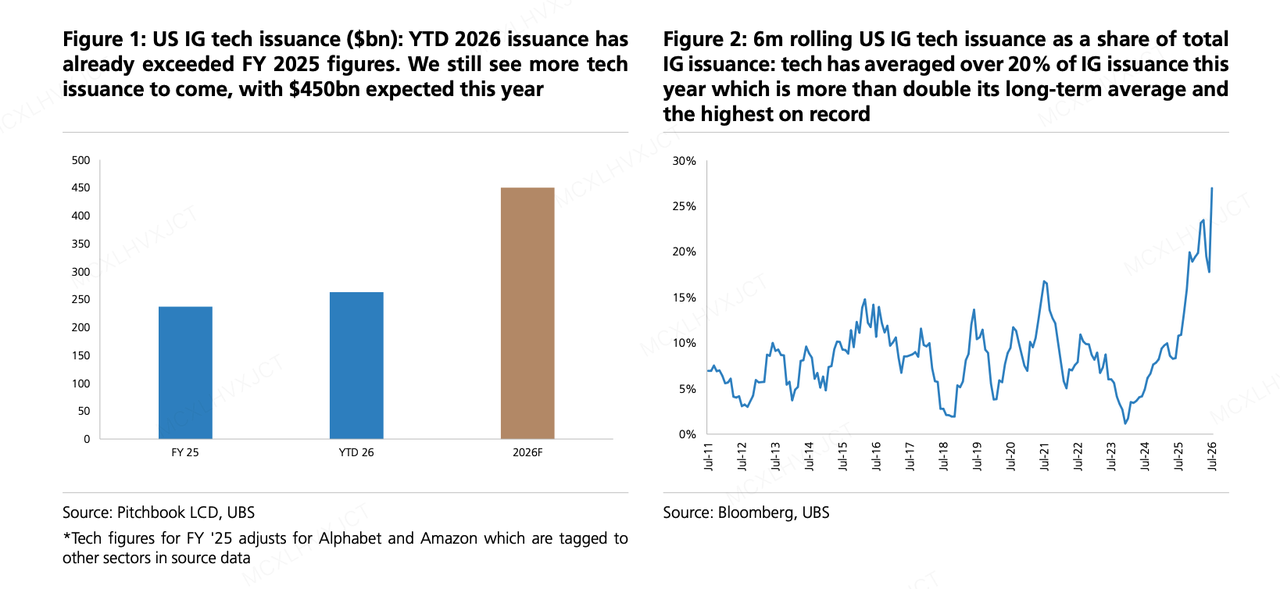
Last week, global tech stocks and the semiconductor sector experienced a highly volatile "deleveraging" trend. On the surface, this stemmed from high-level consolidation and crowded trade liquidations following previous continuous surges. However, from the perspective of underlying credit and debt markets, the debt financing cycle supporting the current AI boom may have started to show signs of fatigue. According to UBS research data, the recent new supply of investment-grade (IG) tech bonds is facing weakening demand and underperforming the broader market in secondary trading. Year-to-date, IG tech bond issuance has surpassed the total for the entire year of 2025, with the total issuance scale for this year expected to reach $450 billion, accounting for over 20% of total IG issuance—hitting a record high.
This round of tech stock volatility reflects that the capital market's pricing logic for the AI supply chain might be undergoing a structural shift, primarily driven by the following core factors:
-
Repricing of Capex Monetization Risks: As the scale of bond issuance by AI enterprises surges, the market's scrutiny of the long-term monetization risks associated with recent massive expenditures has become increasingly strict. Investors are shifting from simply paying for capital expansion to demanding proof of cloud revenue growth, the stickiness of remaining performance obligations (RPO), and uncompressed profit margins.
-
Fundamental Pressures and Cost Inflation: Enterprises are actively engaging in model optimization, intending to route towards cheaper alternatives. This, coupled with storage hardware inflation, poses substantial pressure on AI frontier labs and hyperscalers in the short term.
-
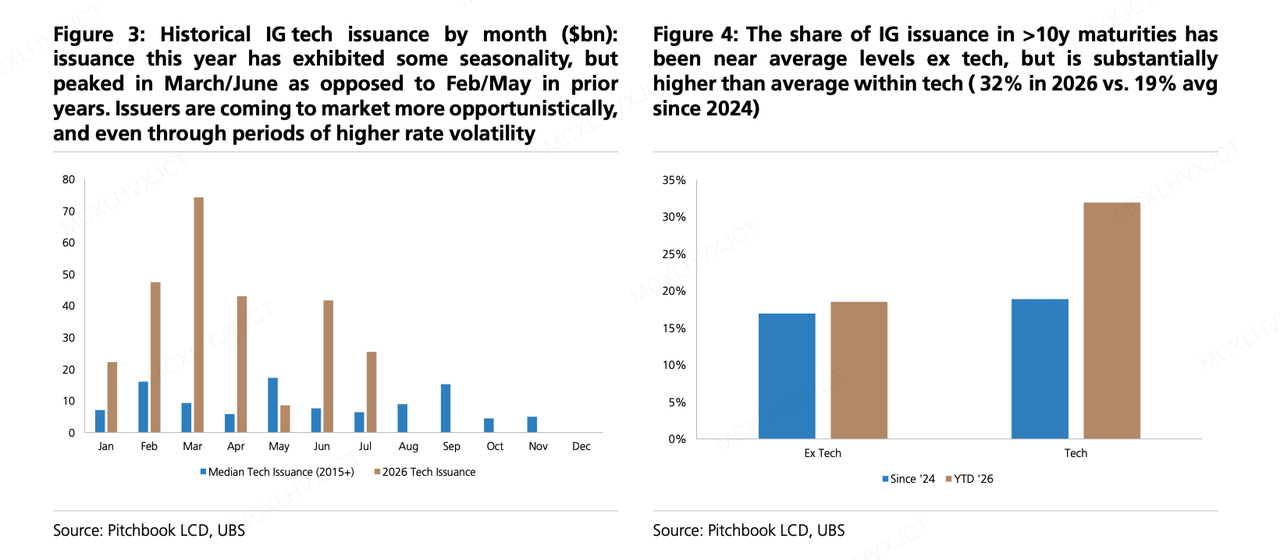
Long-Duration Assets Squeezed by Interest Rate Volatility: Tech bond issuance this year has significantly extended in duration, with the proportion of issuances exceeding 10 years reaching 32% (well above the 19% average of the past two years). Over the past month, the 30-year US Treasury yield has widened by approximately 30 basis points, further amplifying the vulnerability of long-duration IG risk assets.
-
Credit Markets Entering a "Selective" Phase: Market capital is gradually cooling down, even adopting a wait-and-see attitude. For instance, Amazon's IG debt issuance in July was only 1.6x oversubscribed (significantly lower than the 3.4x in March), reflecting that new deals may need to offer larger premium concessions to attract demand.
Regarding the market's focus on whether the "AI sector volatility will prompt capital rotation into the crypto market," looking through the lens of cross-asset liquidity transmission mechanisms, the following phased characteristics are observed:
-
Short-Term Mechanism: Linked Contraction Triggered by Leverage Clearing: During the initial stage of tech stock deleveraging, traditional risk assets and the crypto market often exhibit a high positive correlation. When institutions such as macro hedge funds face margin pressures due to high tech stock volatility, they typically prefer to liquidate highly liquid asset portfolios first. Therefore, in the short term, AI sector volatility is more likely to trigger cross-asset leverage clearing and liquidity contraction, rather than a one-way "seesaw effect" where funds flow directly from US stocks to the crypto market. Consequently, during the AI plunge last week, we did not see an explosive rebound in mainstream crypto assets; instead, there were even instances of slight correlated declines.
-
Medium-Term Mechanism: Risk Capital Rebalancing under Valuation Reshaping: As more long-duration IG tech bonds enter the market at potentially wider spreads, capital may rotate out of other crowded trading sectors. During this valuation reshaping period, some incremental capital seeking high-beta risk exposure might, under the premise of stable macro liquidity expectations, view crypto assets as one of the options for asset allocation rebalancing. However, the establishment of this rotation trend relies on the support of internal liquidity depth within the crypto market.
The volatility in the credit market is currently interpreted by the market as a deceleration signal within the long-term AI debt financing cycle, but it is difficult to directly assert the end of the current AI cycle. The evolution of future trends requires close observation of subsequent changes in the bond market, the practical application and profit generation of AI, and whether internal innovations emerge within the crypto sector.
2. Weekly Selected Market Signals
A Hawkish Fed and Yen Intervention Tighten Liquidity Expectations, Renewed Iran Tensions Reinforce the TACO Trade, and Crypto Flows Remain Structurally Divergent
The July FOMC voted 9–3 to keep the federal funds target range unchanged at 3.50%–3.75%, although three members supported an immediate 25-basis-point rate increase. The meeting did not signal a shift toward monetary easing. Instead, the Federal Reserve chose to hold rates steady while preserving room for further tightening. Markets subsequently raised their expectations for a September rate hike, pushing long-term U.S. Treasury yields higher and weighing on highly valued risk assets.
Data Source: Yahoo Finance
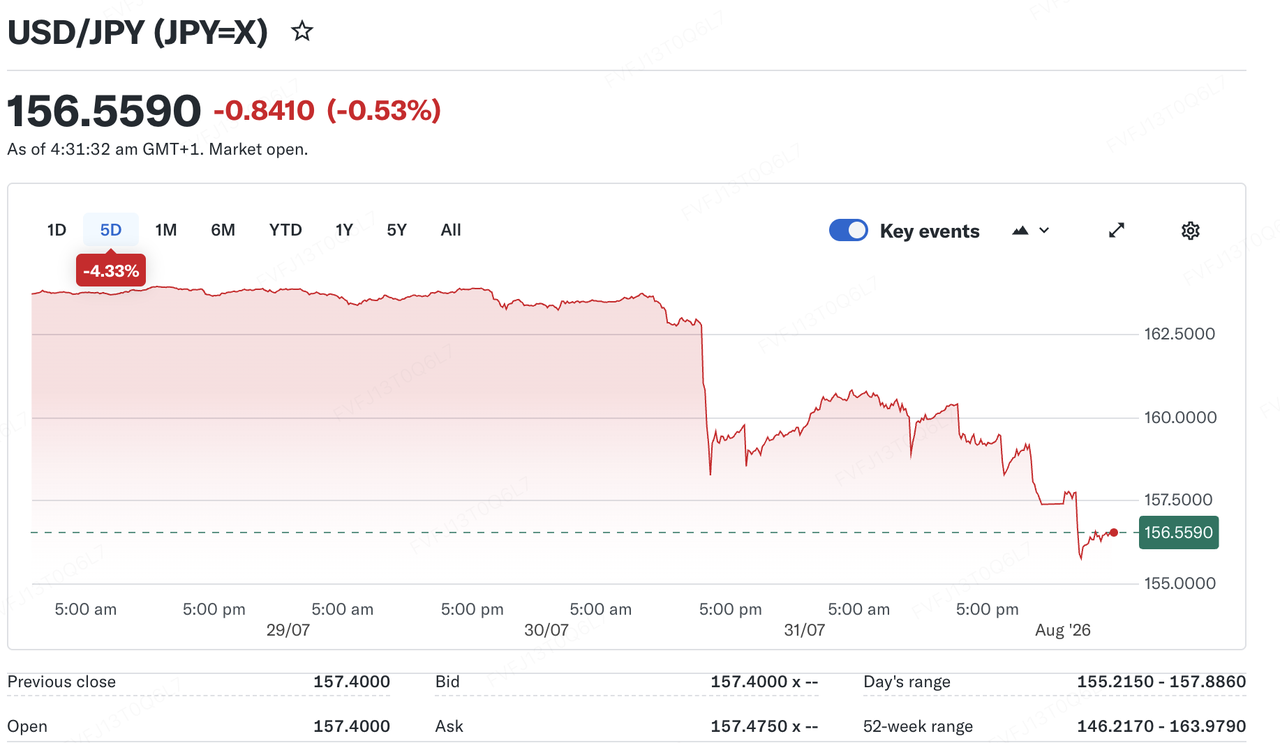
In foreign exchange markets, the yen fell to a multi-year low amid rising energy import costs and a widening U.S.-Japan interest-rate differential. The United States and Japan subsequently took the rare step of jointly supporting the yen, driving USD/JPY rapidly back toward 157.
If coordinated intervention continues, both the funding cost and currency risk associated with yen borrowing will increase, potentially forcing some carry-trade positions to deleverage. Japan may also adjust its holdings of U.S. dollar assets to stabilize the exchange rate, which could affect supply and demand at the long end of the U.S. Treasury market.
The significance of this intervention therefore extends beyond reversing yen depreciation. It also forces global investors to reassess leveraged structures that have long depended on low-cost yen financing. For technology stocks, crypto assets, and other high-volatility investments that previously benefited from the yen carry trade, marginal changes in financing conditions could amplify short-term price movements.
Geopolitical developments continued to dominate crude oil trading. After signaling that the United States could expand its strikes against Iran, President Trump once again postponed military action and pushed for negotiations over Iran’s nuclear program and the reopening of the Strait of Hormuz. The oil risk premium subsequently declined, risk assets rebounded, and markets once again returned to the TACO trade.
However, Iran has not confirmed that the two sides have reached a substantive agreement. Over the past several months, U.S. policy has repeatedly shifted between escalating threats, suspending action, and renewing pressure. Markets may continue to sell oil and rebuild risk exposure when tensions ease, but confidence in the durability of de-escalation has weakened.
The TACO trade therefore remains relevant, but its duration may become shorter, while oil and other risk assets are likely to remain highly sensitive to subsequent policy statements.
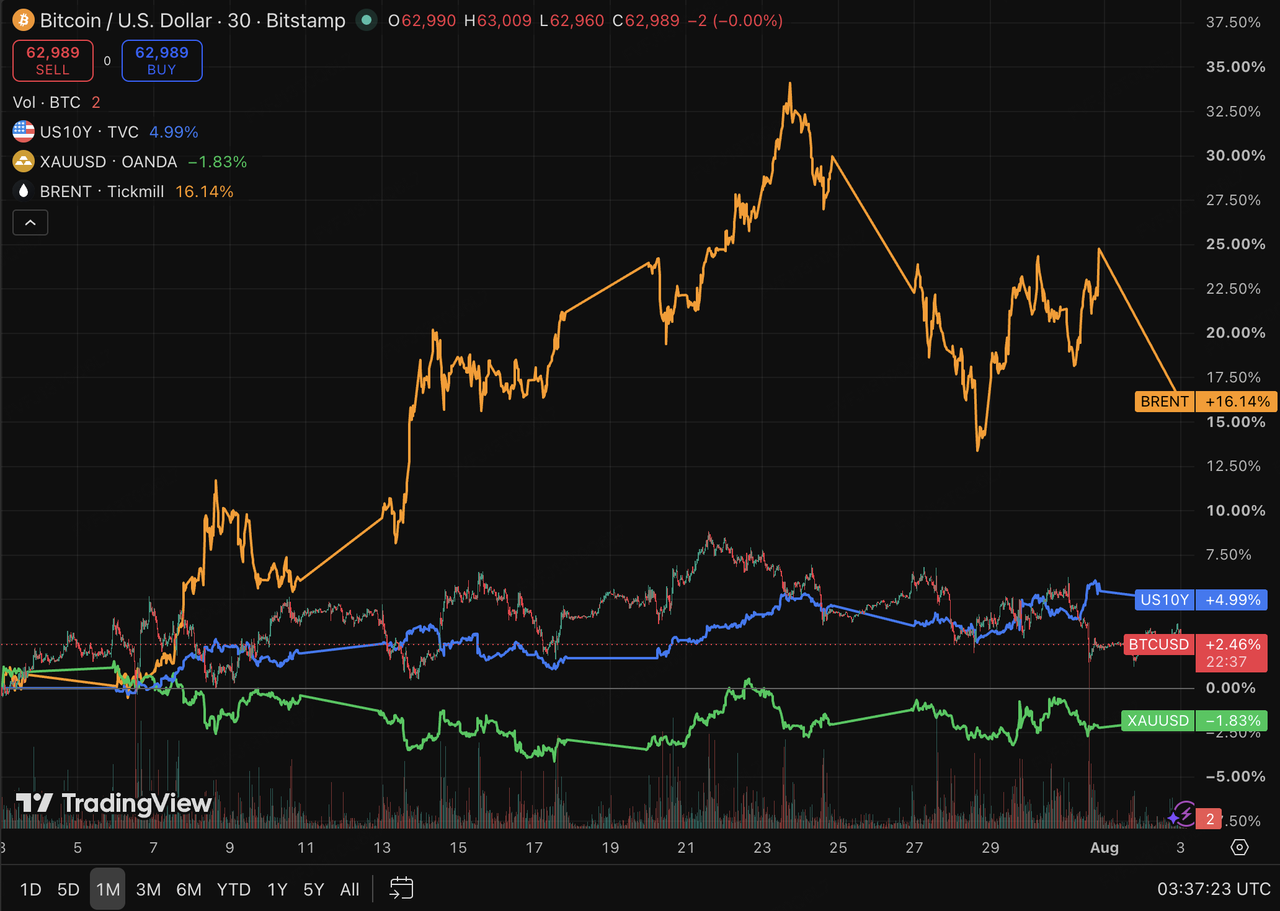
Brent crude rose approximately 23.6% in July, primarily reflecting shipping risks in the Strait of Hormuz and broader supply disruptions in the Middle East. Oil prices fell rapidly after Trump postponed further strikes, while OPEC+’s plan to increase production by approximately 188,000 barrels per day in September also created marginal downward pressure.
Nevertheless, the oil risk premium is unlikely to disappear entirely until stable shipping through the Strait of Hormuz resumes and negotiations produce a clear outcome.
Gold continued to trade between geopolitical safe-haven demand and pressure from elevated real interest rates. Developments in the Middle East supported prices, but the Federal Reserve’s restrictive stance, a stronger dollar, and rising Treasury yields limited performance. Compared with gold, crude oil remained the market’s primary instrument for expressing Middle East supply risk.
U.S. equities declined sharply following the FOMC meeting, but strong cloud and AI-related revenue from major technology companies including Microsoft and Amazon subsequently supported a recovery, allowing all three major indices to finish the week higher.
The AI trade is moving away from broad-based valuation expansion and toward a more rigorous assessment of whether capital expenditure can translate into revenue, earnings, and cash flow. Performance within the technology sector is consequently becoming more differentiated.
Japanese and South Korean equities were simultaneously affected by yen intervention, semiconductor positioning, and changes in carry-trade flows. Yen appreciation creates earnings pressure for Japanese exporters, while the South Korean market remains highly dependent on the memory, AI server, and broader semiconductor cycles. In the near term, volatility in Japanese and South Korean equities may remain higher than in the U.S. market.
Crypto Assets and ETFs: BTC ETFs Turn to Net Outflows While ETH Maintains a Relative Funding Advantage
Data Source: SoSoValue
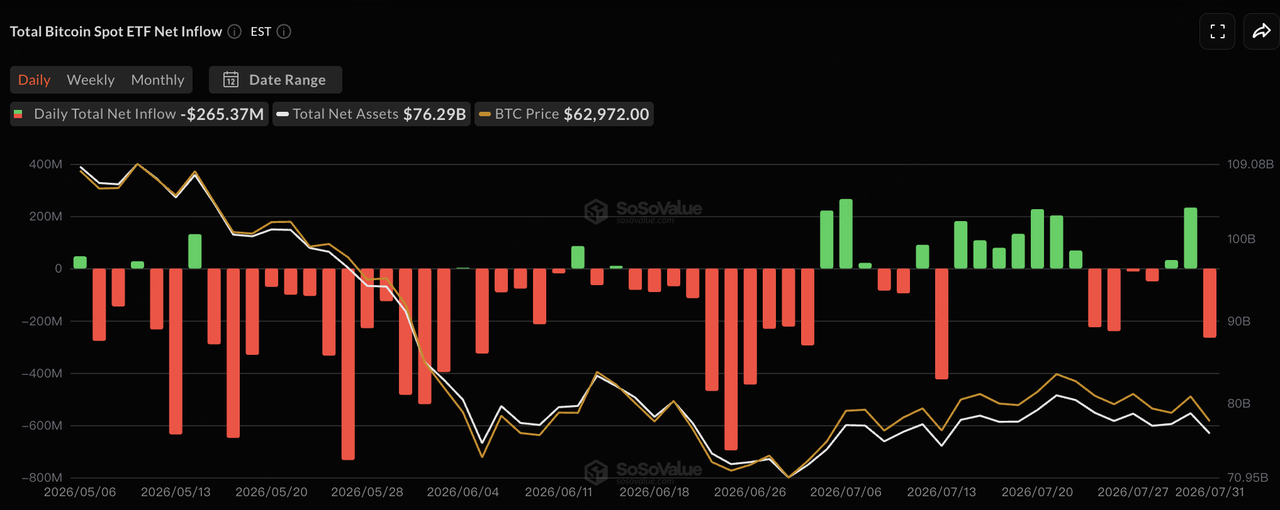
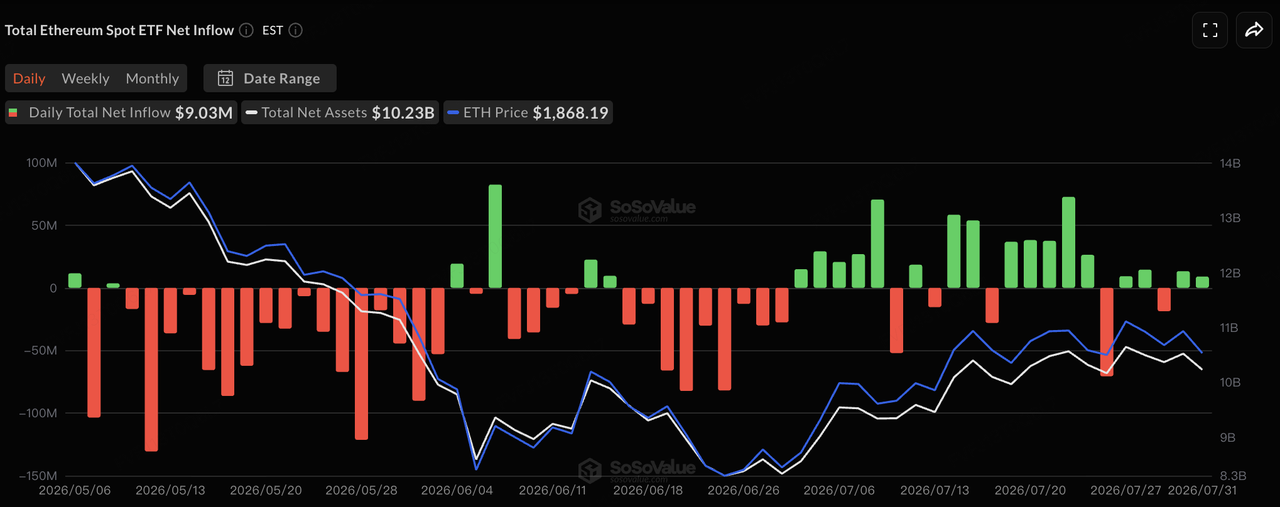
The crypto market traded broadly sideways last week. BTC fluctuated mainly between $63,000 and $65,000, as the Federal Reserve’s restrictive stance, rising U.S. Treasury yields, and the potential unwinding of yen-funded carry trades limited further upside. ETH performed relatively better but did not establish an independent trend detached from global liquidity conditions.
According to SoSoValue, U.S. spot BTC ETFs recorded approximately $61.53 million in net outflows last week. Against a backdrop of tightening liquidity expectations and weakening upward price momentum, some institutional investors appeared to take profits or reduce risk exposure.
Spot ETH ETFs, by contrast, posted approximately $27.42 million in net inflows, extending their recent relative strength.
The divergence between BTC and ETH ETF flows indicates that institutional capital has not withdrawn from the crypto market entirely, but is instead being reallocated between the two assets. ETH has benefited from its previously lower institutional allocation and a recovery in relative valuation, giving it a temporary funding advantage over BTC.
However, the weekly inflow remained limited and is not sufficient to confirm the beginning of a sustained ETH-led market or a broad altcoin cycle.
Combined with the continued contraction in total stablecoin market capitalization, the crypto market remains primarily driven by the rotation of existing capital. The return of BTC ETF outflows shows that macro interest rates and risk appetite remain constraints. ETH’s marginal inflows provide localized support but have not translated into new liquidity across the broader market.
Stablecoins: Total Market Capitalization Declines Again as Major On-Chain Dollar Supplies Contract
Data Source: DeFiLlama
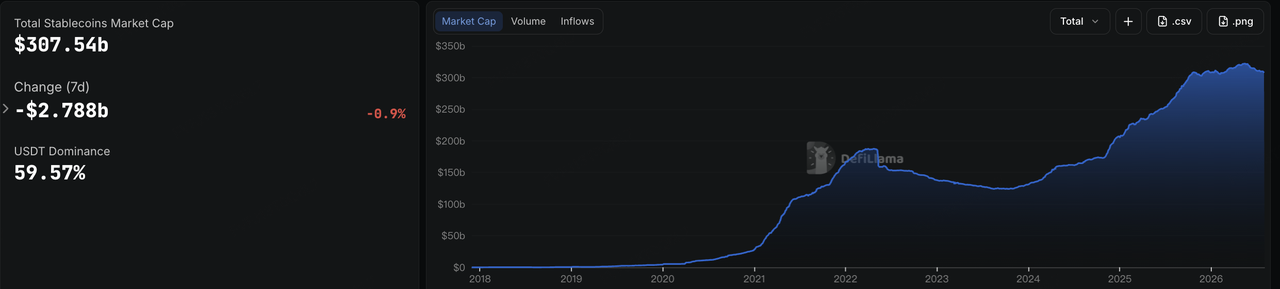
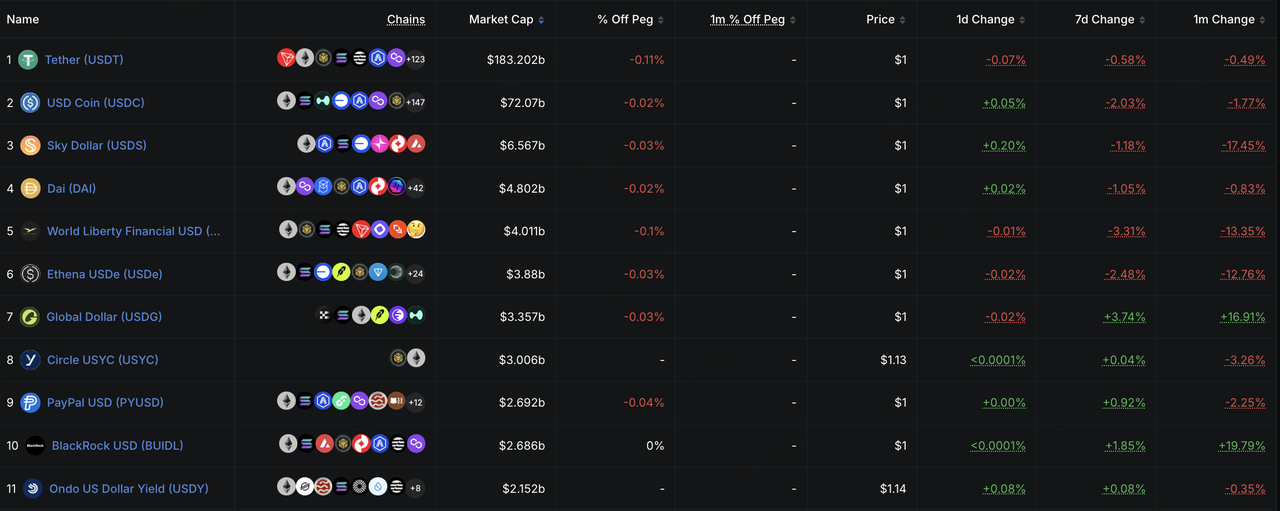
DeFiLlama data showed that total stablecoin market capitalization stood at approximately $307.5 billion, falling by around $2.79 billion, or 0.9%, over the previous seven days and by approximately 1% over the previous 30 days.
USDT’s market share rose to approximately 59.57%, although its supply also declined slightly. USDC supply fell by approximately 2.0% over the week, indicating that the contraction was not limited to a single DeFi-native stablecoin and that demand for major on-chain dollars was also weak.
Among the ten largest stablecoins, USD1 and USDe declined by approximately 3.3% and 2.5%, respectively, reflecting continued weakness in ecosystem capital, arbitrage activity, and yield-driven demand.
USDG increased by approximately 3.7%, while BUIDL grew by around 1.9%, showing that limited incremental capital remained concentrated in products supported by exchange distribution, payment channels, or real-world yield.
Overall, the stablecoin market continued to display a pattern of total supply contraction alongside localized product growth, providing little additional liquidity support for the broader crypto market.
The relative stability of BTC and ETH prices has therefore depended more on ETF flows and the reallocation of existing positions than on a broad expansion in the supply of on-chain dollars.
Federal Reserve Outlook: September Rate-Hike Probability Rises, but the Policy Path Still Depends on Employment, Inflation, and Financial Conditions
Data Source: CME FedWatch Tool
The July FOMC kept rates unchanged, but three members supported an immediate increase, reflecting growing concern within the committee over energy-related shocks and persistent inflation.
Chair Kevin Warsh continued to emphasize price stability and data dependence while avoiding an explicit commitment regarding September policy. This suggests that the Federal Reserve intends to preserve flexibility to adjust its actions in response to economic data.
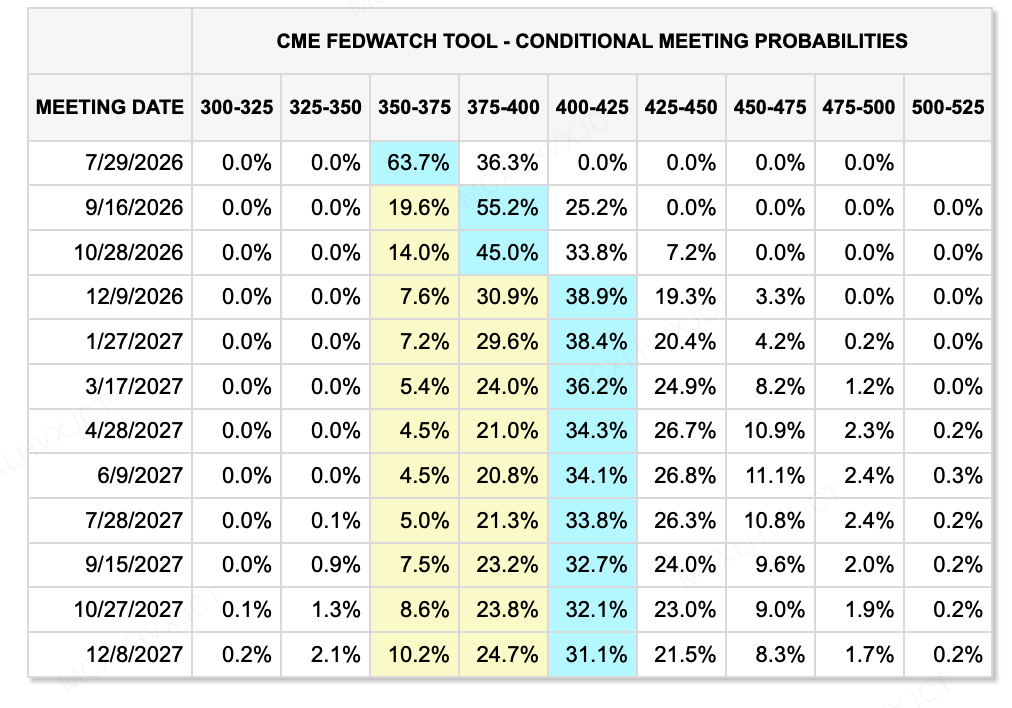
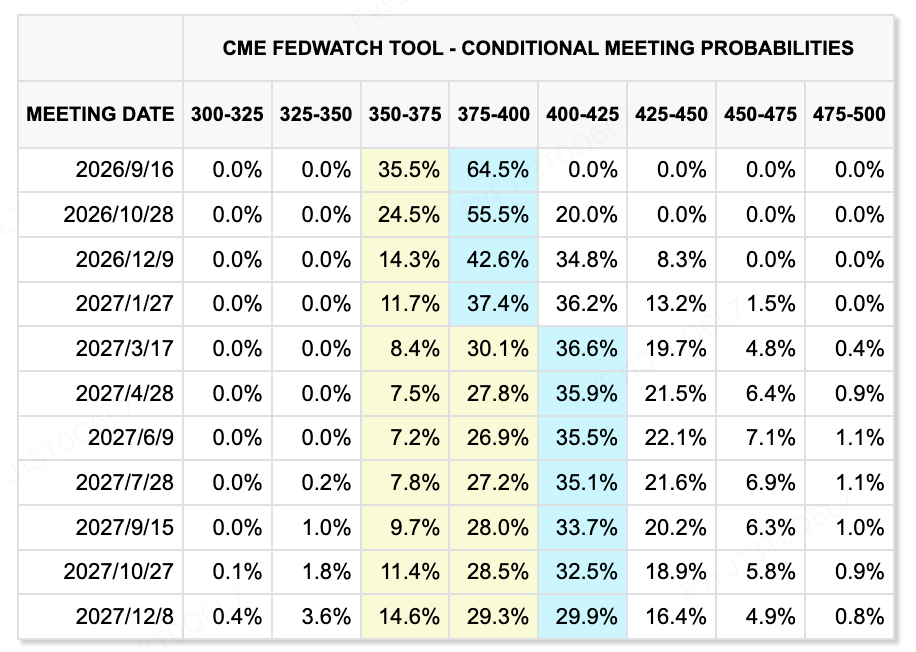
As of August 3, the CME FedWatch Tool showed that markets assigned an approximately 64.5% probability to a 25-basis-point rate increase at the September meeting, up from around 57% immediately following the release of the FOMC statement.
Markets now view a September rate hike as a relatively high-probability scenario, although they have not fully priced in consecutive or more aggressive tightening.
Whether Warsh pushes for a September increase will mainly depend on three variables: whether energy prices continue to lift inflation, whether labor-market and wage growth remain resilient, and whether rising long-term yields have already substituted for part of the tightening that would otherwise be delivered through the policy rate.
If oil prices remain elevated and employment and wage growth continue to exceed expectations, the Federal Reserve may conclude that higher market rates alone are insufficient to control inflation.
If nonfarm payrolls weaken materially, consumption slows, and the energy risk premium declines, current market pricing for a rate hike could be revised lower.
The more accurate assessment at this stage is that the Federal Reserve has clearly preserved the option of raising rates in September, but the final decision will depend on employment, inflation, and oil-price data over the coming month.
The Jackson Hole symposium in August will also provide an important opportunity to assess Warsh’s policy reaction function.
Key Events to Watch Next Week:
Markets will primarily focus on whether U.S. employment data support a September rate hike and whether U.S.-Iran negotiations can restore stable shipping through the Strait of Hormuz.
Strong employment data combined with renewed oil-price increases would add to interest-rate pressure. A cooling labor market and geopolitical de-escalation would instead support a recovery in technology stocks and crypto assets.
-
August 3: The United States releases the July ISM Manufacturing PMI. Markets will assess whether higher energy costs and interest rates are placing additional pressure on manufacturing activity.
-
August 5: The United States releases ADP employment data and the ISM Services PMI, providing early signals ahead of the nonfarm payroll report and informing expectations for a September rate hike. SpaceX reports its first earnings results following its public listing, with investors focusing on Starlink revenue, Starship commercialization, and capital expenditure. Unitree Robotics begins preliminary price consultations for its STAR Market IPO, providing a test of investor demand for humanoid-robotics valuations.
-
August 6: AMD, Sandisk, and Western Digital report earnings. Key areas of focus include AI chips, enterprise SSDs, memory, and data-center demand.
-
August 7: The United States releases July nonfarm payrolls, the unemployment rate, and average hourly earnings, which will be central to expectations for a September rate hike. China releases July trade and foreign-exchange-reserve data, with attention focused on external demand and exports of semiconductors and advanced manufacturing products.
-
August 9: China releases July CPI and PPI data. Markets will assess the recovery in consumer prices and the transmission of energy and raw-material costs into industrial prices.
Primary Market Funding Observation:
Data Source: CryptoRank
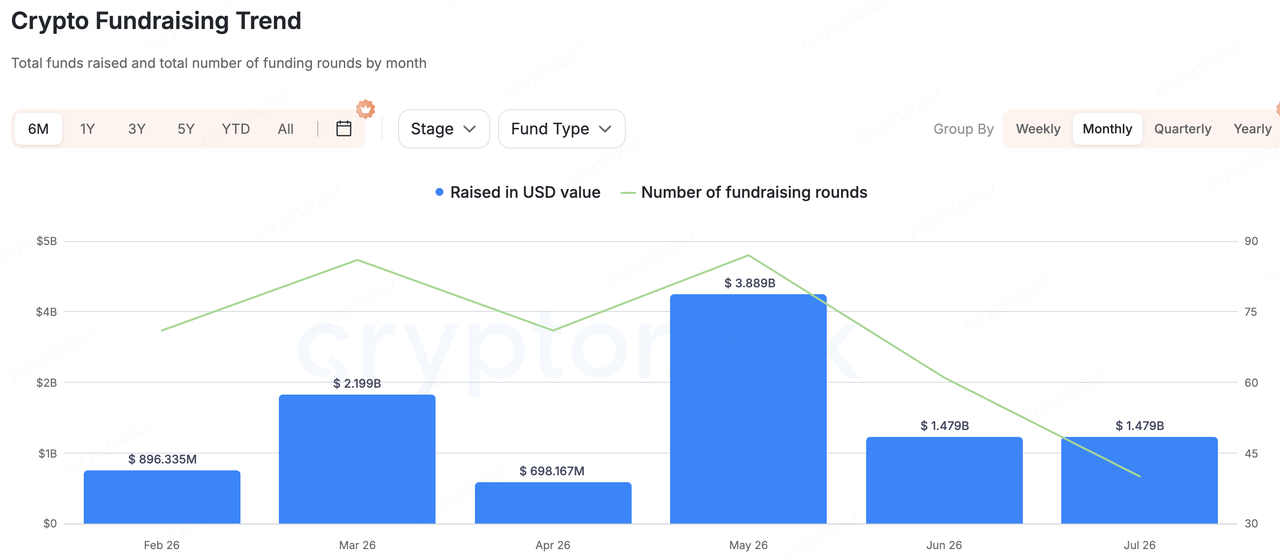
From a market-breadth perspective, CryptoRank data showed that only approximately 150 independent venture capital firms participated in crypto funding during July, the lowest level since November 2020. This indicates a continued decline in both investment frequency and early-stage risk appetite.
Capital remained concentrated in payments, stablecoins, institutional trading, compliance, and infrastructure businesses with demonstrable revenue. Undifferentiated protocols without validated users or business models are facing increasingly difficult financing conditions.
At the same time, a small number of strategic investments, acquisitions, debt financings, and large growth rounds are having an increasingly disproportionate impact on headline funding totals. The number of participating investors, deal count, and median financing size therefore provide a more accurate indication of private-market conditions than aggregate funding alone.
CryptoRank’s second-quarter data showed that the ten largest transactions accounted for 67% of disclosed funding, with only two deals contributing 38%. This further illustrates the growing divergence between headline capital totals and the financing environment experienced by the broader market.
One of the larger disclosed transactions last week was regulated prediction market ProphetX’s $35 million financing round. The company also provides prediction-market infrastructure to enterprise clients, reflecting a shift in investor interest from standalone retail trading interfaces toward licensing, liquidity, and B2B technology capabilities.
RWA PayFi project Dow Protocol completed a $9 million seed round. Its model uses unsettled e-commerce receivables to provide merchants with on-chain working capital.
Compared with straightforward asset tokenization, the model places greater emphasis on genuine borrowing demand, cash flow, and short-duration asset turnover. However, the authenticity of the underlying assets, default rates, and cross-border recovery mechanisms still need to be validated.
AI data network Perceptron completed a $6.5 million strategic financing round, indicating that AI+Crypto capital continues to concentrate on verifiable data, compute resources, and infrastructure rather than generalized AI application narratives.
Overall, private-market funding activity has returned to more normalized levels. Capital remains available for projects with regulatory access, real-world asset cash flows, or clearly defined B2B customers, while investors remain cautious toward general-purpose protocols and undifferentiated applications without validated revenue.
About KuCoin Ventures
KuCoin Ventures, is the leading investment arm of KuCoin Exchange, which is a leading global crypto platform built on trust, serving over 40 million users across 200+ countries and regions. Aiming to invest in the most disruptive crypto and blockchain projects of the Web 3.0 era, KuCoin Ventures supports crypto and Web 3.0 builders both financially and strategically with deep insights and global resources.
As a community-friendly and research-driven investor, KuCoin Ventures works closely with portfolio projects throughout the entire life cycle, with a focus on Web3.0 infrastructures, AI, Consumer App, DeFi and PayFi.
Disclaimer This general market information, possibly from third-party, commercial, or sponsored sources, is not legal, compliance, financial, or investment advice, an offer, solicitation, or guarantee. We make no express or implied representations or warranties regarding its accuracy, completeness, or reliability, and disclaim liability for any resulting losses. Investments/trading are risky; past performance doesn't guarantee future results. Users should research, judge prudently, and take full responsibility. Please consult professional legal, tax, or financial advisors if necessary.