

How Did Justin Sun Transform from a Ripple Salesman into TRON's Founder?
2026/04/27 15:30:02
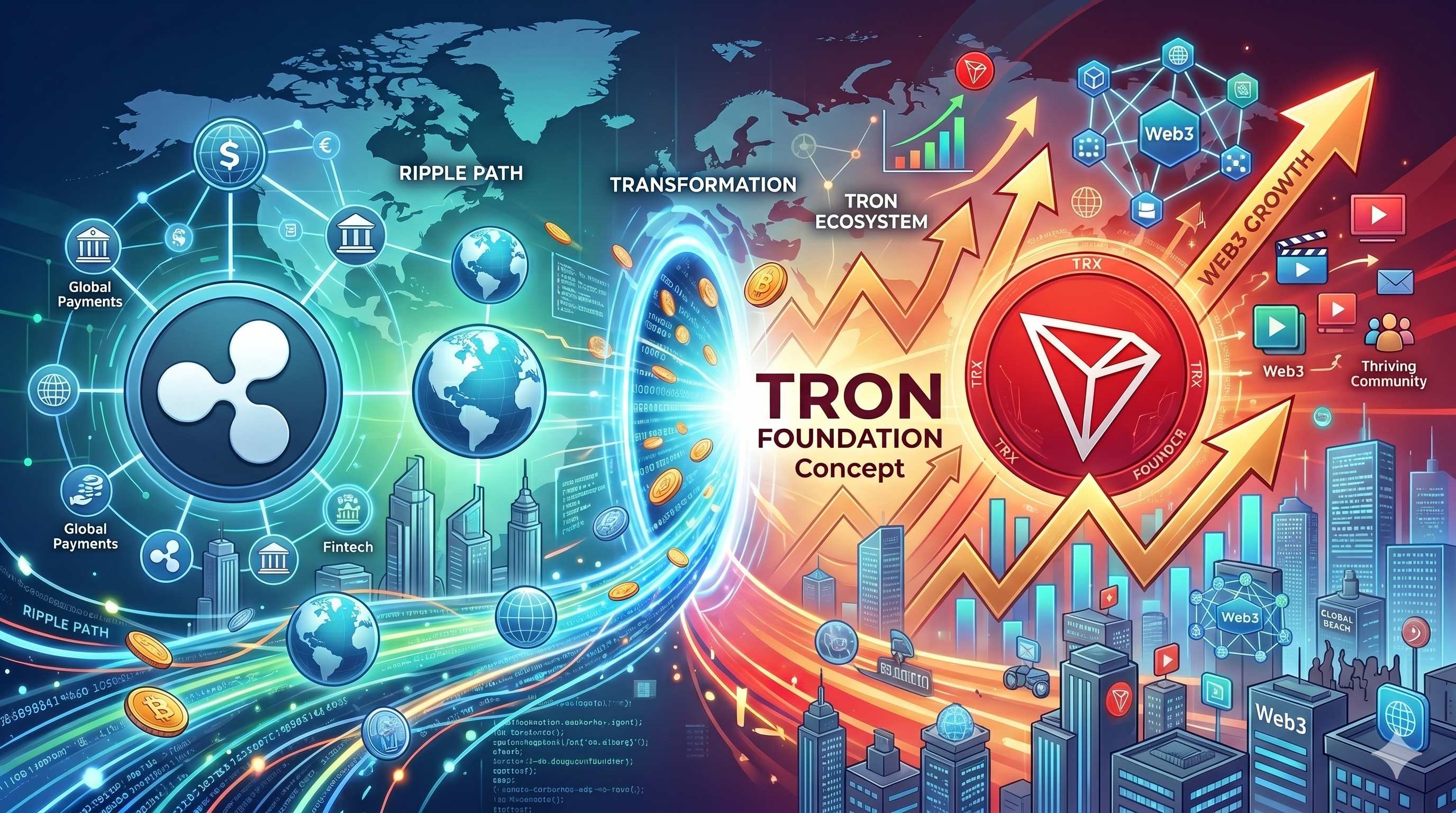
Before TRON became a $30 billion blockchain processing trillions in stablecoin volume, its founder was cold-calling bankers in China on behalf of a U.S. payments startup. Justin Sun joined Ripple Labs in late 2013 as its first employee in Greater China — not as a visionary, but as a regional representative selling the promise of blockchain-powered cross-border payments. He spent roughly two years in that role before walking away to build something of his own.
That pivot — from a hired hand promoting someone else's network to the founder of one of the world's most-used blockchains — is one of crypto's most consequential career turns.
Today, according to Forbes, Sun's net worth stands at approximately $8.5 billion, making him the 411th-richest person in the world. TRON hosts over $86.6 billion in stablecoin supply and processed nearly $2 trillion in transfer volume in Q1 2026 alone, according to CoinDesk Research. The journey from Ripple salesman to blockchain billionaire is a story worth tracing in full.
Key Takeaways
-
Justin Sun joined Ripple Labs in late 2013 as its first Greater China representative, gaining foundational knowledge of blockchain payments before founding TRON.
-
Sun launched TRON in 2017, raising $70 million in an ICO just days before China's government banned token sales — a timing many observers found suspiciously precise.
-
TRON migrated from Ethereum to its own mainnet in 2018 and acquired BitTorrent for $140 million the same year, instantly adding millions of users.
-
As of Q1 2026, TRON's stablecoin supply exceeds $86.6 billion (led by USDT), with the network capturing over 27% of the total global stablecoin market cap, per CoinDesk Research.
-
Sun settled a 2023 SEC lawsuit in March 2026 for a $10 million fine, providing the network renewed legal clarity in the U.S. market.
-
Sun filed a federal lawsuit against Trump-linked World Liberty Financial in April 2026, alleging fraudulent token freezing — the latest chapter in his increasingly public legal battles.
From Academic Prodigy to Ripple's Man in China
Education and Early Ambition
Justin Sun, born Sun Yuchen on July 30, 1990, in Xining, Qinghai Province, was academically gifted from an early age. He completed his undergraduate studies at Peking University, majoring in history — an unusual background for someone who would go on to lead a multibillion-dollar blockchain network.
He later pursued graduate studies in East Asian Studies at the University of Pennsylvania. It was during this period, around 2012, that Sun encountered his first Bitcoin article and reportedly made early purchases of the cryptocurrency at prices between $5 and $13 per coin, according to Grokipedia's recent profile.
Sun was also accepted into Hupan University — a prestigious, highly selective business school co-founded by Alibaba's Jack Ma. This connection made him one of Jack Ma's most publicly recognized protégés, a badge he has worn prominently throughout his career.
The Ripple Chapter: Learning the Language of Blockchain Payments
In late 2013, Sun joined Ripple Labs as chief representative and advisor for Greater China — a role that would prove foundational. As Ripple's first employee in the country, he led business development efforts, built partnerships, and promoted Ripple's distributed ledger technology for cross-border remittances and financial services.
What Sun gained at Ripple was more than a job title. He absorbed a crucial lesson: blockchain's most powerful real-world application was not speculation but settlement. Ripple's mission to replace the slow, costly SWIFT network for international payments gave Sun a first-hand understanding of how distributed ledger technology could transform financial infrastructure.
According to a widely shared anecdote Sun himself recounted, both he and future Ethereum co-founder Vitalik Buterin once applied for roles at Ripple. Sun got in; Buterin was reportedly turned away due to visa issues. The two would go on to build the second and ninth-largest blockchains by market cap — a fact that adds a layer of historical irony to Ripple's hiring decisions that year.
Sun reportedly worked at Ripple for approximately two years, departing around 2016 to focus full-time on his own ventures. Alongside his Ripple role, he had already launched Peiwo — a voice-based social media app that at its peak had over 10 million registered users in China. But Peiwo was a stepping stone, not a destination.
Building TRON: The $70 Million Pivot
The 2017 ICO and Its Convenient Timing
In 2017, Sun established the Tron Foundation in Singapore and launched TRON — a blockchain-based, decentralized platform originally designed to revolutionize digital content distribution by removing intermediaries between creators and audiences.
To fund the project, the Tron Foundation conducted an Initial Coin Offering (ICO) on Binance from August 31 to September 2, 2017, raising approximately $70 million. The timing was extraordinary: the sale completed just days before China's government announced a sweeping ban on ICOs. According to The Verge, Sun was aware of the impending ban and reportedly pushed for the ICO to conclude before the announcement could take effect. He subsequently relocated from China to the United States.
Whether the timing was luck, intelligence, or both, the result was that TRON emerged from China's crackdown with $70 million in capital, no regulatory penalties, and a global mandate.
The Whitepaper Controversy
Early momentum was not without embarrassment. In 2018, Ethereum co-founder Vitalik Buterin publicly alleged that TRON's whitepaper contained sections that were heavily derivative of earlier blockchain whitepapers — without attribution. The allegations of plagiarism gained traction across the crypto community.
Sun's response was characteristically oblique. Rather than directly addressing the accusations, he thanked Buterin for his input and suggested the issues stemmed from translation errors between Chinese and English. The controversy never fully disappeared, though it also never derailed TRON's growth.
Mainnet Launch, BitTorrent Acquisition, and Ecosystem Expansion
Going Independent in 2018
TRON initially launched as an Ethereum-based token — essentially building on Vitalik Buterin's infrastructure before striking out on its own. In 2018, Sun migrated TRON to its own independent mainnet, a move that signaled his intention to build a self-sufficient, sovereign blockchain rather than simply another ERC-20 project.
The mainnet, dubbed Odyssey 2.0, introduced a Delegated Proof-of-Stake (DPoS) consensus mechanism. Under DPoS, TRX holders stake tokens to vote for 27 Super Representatives who validate transactions and produce blocks. The architecture prioritizes throughput — TRON is capable of over 2,000 transactions per second — and near-zero fees, averaging less than $0.01 per transaction.
Acquiring BitTorrent: 150 Million Users Overnight
In June 2018, Sun made his boldest move yet: acquiring BitTorrent, Inc. (later renamed Rainberry Inc.) for $140 million. The deal was not just a financial transaction — it was a user acquisition of historic proportions. BitTorrent was the world's largest peer-to-peer file-sharing protocol, with an installed base running into the hundreds of millions.
By integrating BitTorrent into the TRON ecosystem and launching the BitTorrent Token (BTT), Sun instantly transformed TRON from a blockchain project into a platform with real-world user infrastructure. The acquisition remains one of the most strategically creative moves in blockchain history — a founder buying legacy internet infrastructure to bootstrap adoption on a new network.
Sun also later acquired the crypto exchanges Poloniex and HTX (formerly Huobi), further extending his influence across the digital asset ecosystem.
TRON in 2026: A Stablecoin Colossus
The Numbers That Define TRON Today
TRON's original pitch was content distribution. What it actually became is something far more consequential: the world's primary infrastructure layer for stablecoin transfers.
According to CoinDesk Research's Q1 2026 report, TRON's stablecoin supply now stands at $86.6 billion, of which approximately $85 billion is Tether (USDT) — representing over 46% of all USDT in circulation globally. The network's share of the total stablecoin market capitalization rose to 27.3% in Q1 2026.
According to metrics from Artemis cited by Finbold, TRON led all blockchains in year-to-date stablecoin inflows through April 7, 2026, recording a $6.1 billion net increase in stablecoin supply. By comparison, Ethereum recorded approximately $3 billion over the same period.
The network averaged 3.2 million daily active users in Q1 2026, up from 2.8 million in Q4 2025, second only to Solana among major Layer-1 networks, per the CoinDesk Q1 2026 TRON report.
Stablecoin Transfers: TRON as Global Plumbing
TRON's near-zero fees and three-second block confirmation times have made it the preferred rail for retail stablecoin transfers globally. According to CoinDesk's Q4 2025 report, TRON processed approximately 56% of all global retail-sized USDT transfers (under $1,000) during that quarter.
Justin Sun himself made the case plainly in recent commentary reported by Yahoo Finance: stablecoins have already won as a global payment mechanism, and TRON is the network through which trillions in USDT value flows. According to that same report, TRON cleared approximately $7.9 trillion in USDT transfer volume across 2025, with an additional $2 trillion tracked in Q1 2026 alone by Messari and Stablecoin Insider research.
The SEC Settlement and Regulatory Clarity
A significant legal cloud lifted in March 2026. As reported by CoinDesk, the U.S. Securities and Exchange Commission reached a settlement with TRON and Justin Sun, under which Rainberry Inc. — one of the companies associated with the TRON network — agreed to pay a $10 million fine and accept restrictions on future violations. The SEC had sued Sun in 2023, alleging wash trading and unregistered securities sales related to TRX and BTT tokens.
The settlement removed the most significant regulatory overhang TRON had faced in the U.S. market. According to Finbold, the resolution "bolstered the network's legal clarity in the United States and reinforced institutional confidence" — and the data supports that: institutional integrations accelerated sharply through Q1 2026, including MetaMask's addition of native TRON support and Revolut enabling in-app TRX staking for its 65 million-plus European users.
Building the Future: AI, Quantum Resistance, and Nasdaq
TRON is not standing still. According to CoinMarketCap's latest updates, the network has committed $1 billion to an AI fund to accelerate autonomous agent projects on TRON. It has also announced plans to integrate post-quantum cryptographic signatures following NIST standards — a forward-looking security upgrade designed to protect user assets against future quantum computing threats.
A Nasdaq-listed entity, Tron Inc. (formerly SRM Entertainment), is now actively accumulating TRX as a corporate treasury asset. According to Yahoo Finance, Tron Inc. held over 692 million TRX as of April 19, 2026, growing through near-daily open-market purchases — mirroring the Michael Saylor Bitcoin treasury playbook but applied to TRON's native token.
Sun the Diplomat, Sun the Dealmaker
Grenada, the WTO, and Diplomatic Immunity Questions
In 2021, Sun accepted an appointment as Grenada's Permanent Representative to the World Trade Organization in Geneva — a move that raised eyebrows across the industry. According to Wikipedia's current entry, sources speaking to The Wall Street Journal alleged that Sun sought the position partly to obtain diplomatic immunity amid U.S. Department of Justice scrutiny. He stepped down from the role in 2023 following political shifts in Grenada.
The appointment did, however, align with a broader pattern in Sun's career: using institutional credibility — whether from Hupan University, Ripple, or a Caribbean nation-state — to legitimize ventures that operated in regulatory gray zones.
The World Liberty Financial Dispute
Even as TRON's fundamentals strengthened through 2025 and into 2026, Sun found himself embroiled in a high-profile legal battle that exposed the tensions between decentralization ideology and political dealmaking.
Sun invested $45 million in World Liberty Financial (WLFI) — the Trump family–backed DeFi project — in 2024, becoming one of its largest known investors. According to CoinDesk, Sun was later pressured by WLFI representatives to invest additional capital, including a demand that he mint $200 million of WLFI's USD1 stablecoin on the TRON blockchain. When he declined, Sun alleges that WLFI used a secretly installed "blacklisting" function — added to the WLFI smart contract in August 2025 without a governance vote — to freeze approximately 2.9 billion of his WLFI tokens, worth approximately $900 million at the time.
Sun filed a federal lawsuit in California in April 2026, alleging wrongful token freezing, fraudulent misrepresentation, and what he characterized as "criminal extortion." WLFI dismissed the suit as "meritless." According to NBC News, World Liberty has yet to formally respond in court.
The dispute carries an ironic weight for the man who built TRON as a supposed bastion of decentralization — being victimized by the same centralized override mechanisms he has been accused of using within his own ecosystem.
How to Buy and Trade TRX on KuCoin
With TRON printing some of crypto's most impressive network fundamentals in 2026 — $86+ billion in stablecoin supply, $82 million in Q1 protocol revenue, TRX rising 9% while Bitcoin fell 24%, and a landmark SEC settlement clearing regulatory clouds — many traders are taking a fresh look at TRX as both a utility token and a speculative position.
KuCoin offers one of the most accessible and liquid venues to trade TRX. You can buy TRX spot, trade TRX futures for leveraged exposure, or simply hold TRX to capture yield through staking-related products.
Conclusion
Justin Sun's journey from Ripple salesman to TRON founder is the story of a builder who learned the rules from someone else's playbook, then rewrote them on his own terms. His two years at Ripple gave him the foundational conviction that blockchain's real value lay in payments — not speculation. The ICO that capitalized TRON, the BitTorrent acquisition that gave it scale, and the pivot from content platform to stablecoin infrastructure all reflect a founder who consistently adapted his vision to match what the market actually needed.
In 2026, TRON is one of the most actively used blockchains on earth, processing trillions of dollars in stablecoin volume with fees that make traditional wire transfers look prehistoric. The SEC settlement in March 2026 has given the network its clearest regulatory standing in the U.S. market to date.
Sun himself remains as polarizing as ever — simultaneously celebrating TRON's decentralization milestones while suing a Trump-backed DeFi project for centralized token freezing. Whether you see him as a visionary builder or a master of narrative arbitrage, his impact on the blockchain industry is impossible to dismiss.
FAQs
What is TRX's current price and market cap as of April 2026?
According to MetaMask's price tracker (April 25, 2026), TRX trades at approximately $0.32 with a market capitalization of roughly $30.7 billion. TRX rose 9% in Q1 2026, outperforming Bitcoin, which fell 24% during the same period, per CoinDesk Research.
What is TRON's connection to Tether (USDT)?
TRON hosts the majority of Tether's circulating supply. As of Q1 2026, TRON held approximately $85 billion in USDT — over 46% of all USDT globally — making it Tether's single largest distribution network. TRON's low fees (often under $0.01) and fast settlement (3 seconds) make it the preferred rail for retail stablecoin transfers worldwide.
Does Justin Sun still control TRON daily operations?
Sun stepped back from daily CEO duties in December 2021 when he became Grenada's WTO ambassador. He returned to a more active public role after his term ended in 2023. As of 2025, he remains TRON's most prominent spokesperson and largest token holder, though critics argue his majority TRX holdings make the network far less decentralized than marketed.
What is the $1 billion AI fund TRON announced in 2026?
According to CoinMarketCap's TRON updates, TRON committed $1 billion to an AI fund designed to accelerate autonomous agent projects, AI-powered DeFi applications, and machine learning integration into the TRON ecosystem. The initiative follows TRON's GreatVoyage-v4.8.1 protocol upgrade in February 2026, which improved infrastructure compatibility with AI applications. This represents TRON's strategic pivot beyond stablecoin dominance toward becoming a platform for AI-driven financial automation.
Disclaimer: This article is for informational purposes only and does not constitute financial or investment advice. Cryptocurrency investments carry significant risk. Always conduct your own research before trading.