

Intel Stock Plunges 23% After Q4 2026 Guidance Disappoints Despite Strong Q3 Earnings
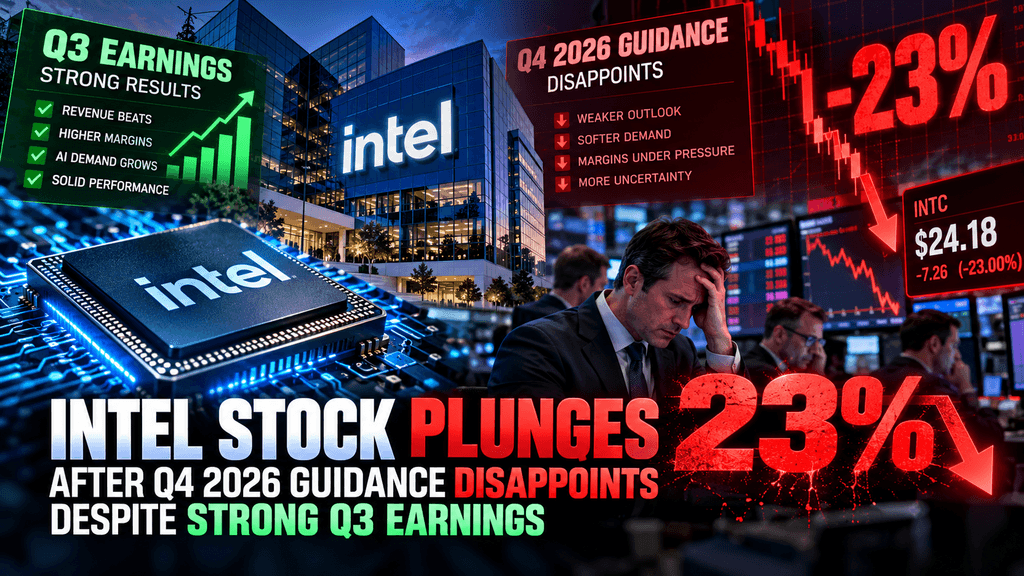
Intel's third-quarter 2026 results exposed a growing divide between demand for AI server chips and the company's ability to manufacture and deliver them. Although revenue increased 21% year over year to $16.51 billion and non-GAAP earnings per share reached $0.52, Intel's shares plunged approximately 23% in after-hours trading on October 29 after its fourth-quarter outlook fell short of Wall Street expectations. The company forecast revenue of $15 billion to $16 billion and adjusted EPS of $0.25, while analysts had expected approximately $17.07 billion and $0.43, respectively. Manufacturing disruptions at its Israeli facility, elevated memory prices, and persistent PC-market weakness added to investor concerns. The sell-off highlights an important shift in the AI investment landscape: strong demand does not automatically translate into revenue growth when production capacity, supply chains, and capital requirements become constraints.
Key Takeaways
-
Intel reported Q3 2026 revenue of $16.51 billion, up 21% year over year, while non-GAAP EPS reached $0.52.
-
Data Center and AI revenue increased 78% to $7.3 billion, but Client Computing revenue declined 5% to $8.1 billion.
-
Q4 revenue guidance of $15 billion–$16 billion fell below analysts' approximately $17.07 billion estimate, while adjusted EPS guidance of $0.25 missed the $0.43 consensus.
-
An accident at Intel's Kiryat Gat facility in Israel is expected to reduce revenue by approximately $600 million across Q4 2026 and Q1 2027.
-
Intel expects approximately $20 billion in 2026 capital expenditure and does not anticipate positive cash flow for the full year.
-
The sell-off highlights broader risks across AI infrastructure, semiconductor manufacturing, and technology-related risk assets, including cryptocurrency markets.
Intel Q3 2026 Earnings: Strong Results Fail to Prevent a Stock Sell-Off
Intel's third-quarter financial performance demonstrated improving revenue and operating margins, but the results were not strong enough to offset concerns about its next-quarter outlook. The company reported $16.513 billion in revenue, compared with $13.653 billion in Q3 2025, representing 21% year-over-year growth. GAAP diluted EPS was $0.60, while non-GAAP diluted EPS reached $0.52, compared with $0.23 in the previous year's non-GAAP results. Non-GAAP net income increased 169% to approximately $2.76 billion. The company also generated $5.1 billion in operating cash flow during the quarter. These figures suggest that Intel's operating performance improved considerably, although the market remained concerned about the sustainability of that progress.
Data Center and AI Revenue Become Intel's Main Growth Driver
The strongest part of Intel's Q3 results was its Data Center and AI (DCAI) business, which generated $7.3 billion in revenue, an increase of 78% year over year. Demand for Xeon server processors was a major contributor, reflecting continued investment in cloud computing, AI infrastructure, and enterprise data centers. Intel's management described data center revenue growth as its strongest in 15 years, highlighting the importance of server CPUs in the expanding AI ecosystem. Although GPUs receive much of the attention in AI infrastructure discussions, CPUs remain essential for general-purpose computing, workload orchestration, data processing, and server operations. This creates an opportunity for Intel to benefit from AI infrastructure expansion even as competition in specialized accelerators remains intense.
However, growth was uneven across Intel's business segments. Client Computing and Physical AI Group (CCPG) revenue declined 5% to $8.1 billion, reflecting weakness in the PC market. Intel Foundry reported $6.7 billion in segment revenue, up 58% year over year, although this figure includes intersegment transactions and should not be confused with consolidated external revenue. After accounting for intersegment eliminations and other businesses, total company revenue was $16.513 billion. The results therefore show a company benefiting from AI-related server demand while still facing challenges in traditional PC markets and the economics of semiconductor manufacturing.
Intel's Q3 2026 Financial Performance
One important distinction is that Intel's GAAP diluted EPS declined from $0.90 to $0.60 year over year, even though non-GAAP EPS improved from $0.23 to $0.52. The difference reflects adjustments between the two accounting measures, including items such as share-based compensation, acquisition-related costs, and other specified accounting effects. Investors should therefore avoid describing the entire earnings picture as uniformly stronger. Non-GAAP profitability improved substantially, but the GAAP comparison presents a more complicated picture of the company's reported earnings.
Why Intel Stock Plunged 23% After Q4 2026 Guidance
Intel's weaker fourth-quarter outlook was the immediate catalyst for the after-hours sell-off. The company forecast revenue of $15 billion to $16 billion and non-GAAP diluted EPS of $0.25, substantially below analysts' expectations. Using the midpoint of its revenue guidance, Intel expects approximately $15.5 billion in Q4 revenue, around 9.2% below the $17.07 billion analyst estimate cited by Reuters. Its adjusted EPS outlook is approximately 41.9% below the $0.43 consensus. These gaps suggested that the improvement reported in Q3 might not translate into the same pace of earnings growth during the next quarter.
Q4 Revenue and EPS Guidance Miss Wall Street Expectations
| Financial Metric | Q4 2026 Guidance | Analyst Expectation |
| Revenue | $15B–$16B | $17.07B |
| Revenue midpoint | $15.5B | $17.07B |
| Non-GAAP diluted EPS | $0.25 | $0.43 |
| Non-GAAP gross margin | 38.00% | — |
Intel also forecast a Q4 GAAP diluted EPS of $0.10, compared with its non-GAAP forecast of $0.25. The distinction matters because the company reports both measures, and comparisons with analyst estimates should use the corresponding accounting basis. The company projected a non-GAAP gross margin of approximately 38%, down from 44.1% in Q3. This anticipated decline indicates that Intel expects profitability to face pressure even as demand for its server products remains strong. A combination of supply limitations, product mix, manufacturing costs, and PC-market weakness makes the fourth-quarter earnings outlook less favorable than the headline Q3 revenue growth might suggest.
Why Forward Guidance Matters More Than Historical Earnings
Financial markets generally value companies according to expectations of future earnings and cash flows rather than simply rewarding strong historical results. Intel's Q3 performance had already occurred, but its Q4 guidance provided investors with new information about the company's near-term operating environment. When management forecasts lower revenue and weaker margins than analysts expect, investors may revise their estimates of future profitability and the valuation they are willing to assign to the company. This effect can be particularly pronounced when a stock has already experienced a substantial rally. Reuters reported that Intel shares had more than doubled during 2026 before the latest sell-off, increasing the sensitivity of its valuation to disappointing forward guidance.
The approximately 23% decline referred to the initial after-hours market reaction on October 29, not a confirmed full-day closing return on October 30. Other reports recorded different declines at different points in extended trading. This distinction is important for accurate financial reporting because after-hours prices can change rapidly as investors respond to earnings releases, management commentary, and broader market conditions. The central message remains that investors were concerned about the gap between Intel's strong AI-related demand and its ability to convert that demand into near-term revenue and earnings.
Intel's Manufacturing Constraints and Semiconductor Supply Chain Challenges
Manufacturing capacity is one of the most important factors behind Intel's disappointing guidance. The company faces a situation in which customer demand for server processors remains strong, but production limitations restrict its ability to deliver enough products. An accident at its Kiryat Gat facility in Israel added another disruption to an already constrained manufacturing environment. The incident caused an approximately two-week shutdown, and Intel expects the impact to reduce revenue by around $600 million across Q4 2026 and Q1 2027. This shows why semiconductor demand alone cannot guarantee higher revenue: manufacturers also need reliable production facilities, functioning equipment, sufficient materials, and predictable delivery schedules.
The Kiryat Gat Factory Incident and Its Financial Impact
Intel's Kiryat Gat facility experienced a serious accident in October that resulted in two reported deaths and one serious injury, according to local reporting cited by Reuters. The company subsequently disclosed the production disruption during its Q3 earnings discussion. CFO David Zinsner indicated that the initial assessment included approximately $300 million in Q4 revenue impact and around 200 basis points of gross-margin pressure. A similar revenue impact is expected in Q1 2027, bringing the estimated combined revenue effect to approximately $600 million over two quarters. Intel planned to resume production activities by the end of October, although assessing which wafers could be recovered and used remained part of the recovery process.
The impact extends beyond the immediate shutdown because semiconductor manufacturing involves complex production schedules and long processing cycles. A disruption can affect wafer availability, delivery commitments, factory utilization, and the timing of revenue recognition. Even after a facility resumes operation, production may need time to return to normal levels. For Intel, the incident therefore adds uncertainty to its ability to meet customer demand for server processors and other products. Investors will need to monitor subsequent management updates to determine whether the estimated financial impact remains limited to the two quarters initially identified.
Memory Prices and Weak PC Demand Add Pressure
The manufacturing disruption is not Intel's only supply-chain challenge. Elevated memory prices have also affected the broader PC market, increasing costs for manufacturers and potentially raising prices for end users. When memory components become more expensive, PC makers may face difficult decisions about product pricing, specifications, and inventory. Higher retail prices can encourage consumers and businesses to delay device replacement, placing additional pressure on processor demand. Intel's management warned that the PC slowdown could continue through at least the first half of 2027.
This situation creates a difficult combination for Intel. Its data center business is benefiting from AI infrastructure investment, but the PC business faces weaker demand and higher component costs. Meanwhile, manufacturing constraints limit the company's ability to capture the full benefit of strong server CPU demand. These factors help explain why the Q4 revenue outlook was weaker despite significant year-over-year growth in Q3. They also show that the semiconductor industry's performance depends on the interaction between demand, production capacity, component pricing, and supply-chain reliability rather than on AI investment alone.
Intel's $20 Billion Capital Expenditure and Cash Flow Challenge
Intel's long-term recovery depends partly on expanding manufacturing capacity and improving its semiconductor technology, but these initiatives require substantial capital investment. The company expects approximately $20 billion in capital expenditure during 2026, with spending projected to increase significantly in 2027. CFO David Zinsner also indicated that Intel does not expect to generate positive cash flow for the full year. This creates a central financial challenge: Intel needs to invest heavily to address production constraints and compete in advanced manufacturing, while its near-term earnings outlook and cash generation remain under pressure.
Why Intel Needs More Manufacturing Investment
Intel is attempting to strengthen its position in semiconductor manufacturing while expanding the capacity needed to meet demand for its products. Capital expenditure supports factory construction, manufacturing equipment, process technology, and advanced packaging capabilities. These investments are important because leading-edge semiconductor production requires sophisticated equipment, substantial engineering resources, and years of development. However, the financial returns do not arrive immediately. A new facility or production line must be developed, equipped, qualified, and brought to an economically viable utilization level before it can contribute meaningfully to revenue and margins.
Intel's Q3 results included several developments related to its foundry ambitions. The company released its Intel 14A process design kit in October and announced collaborations involving advanced packaging and manufacturing technology. It also highlighted work with ASML, Lam Research, and Applied Materials. These initiatives illustrate the scale of the company's effort to strengthen its manufacturing ecosystem. However, partnerships and technology milestones should not be treated as equivalent to confirmed large-scale commercial production. Investors need evidence of customer commitments, production readiness, manufacturing yields, and sustained financial returns before concluding that the foundry expansion has achieved its strategic objectives.
Intel 18A and the Potential for Manufacturing Cost Improvements
A positive development in Intel's earnings discussion was management's statement that manufacturing costs for its 18A process had declined approximately 40% compared with the first quarter. The 18A technology is an important part of Intel's advanced manufacturing roadmap and supports its effort to improve competitiveness in high-performance computing. Lower production costs could help the company strengthen gross margins as manufacturing volumes increase, provided that yields, product demand, and production efficiency continue to improve.
Nevertheless, cost reductions at the process level do not automatically resolve Intel's broader financial challenges. The company must also improve capacity utilization, deliver products on schedule, control operating expenses, and manage the cash required for its expansion. Its Q4 non-GAAP gross-margin forecast of 38%, compared with 44.1% in Q3, illustrates the near-term pressure. The key question for investors is whether technology improvements and manufacturing investments can eventually produce stronger operating leverage and sustainable free cash flow.
What Intel's Sell-Off Means for AI Stocks and Cryptocurrency Markets
Intel's earnings reaction offers a broader lesson for the AI investment market: strong demand does not guarantee that every company in the supply chain will benefit equally. The semiconductor sector depends on a complex ecosystem of processors, memory, manufacturing facilities, advanced packaging, networking, electricity, and data center infrastructure. Intel's difficulties demonstrate how production constraints and capital requirements can limit the financial benefits of AI demand. The wider market response also showed that investors were reassessing semiconductor companies with exposure to similar supply-chain and investment-cycle risks.
Semiconductor Stocks and the AI Infrastructure Trade
Following Intel's disappointing outlook, shares of several other semiconductor companies also declined in extended trading. Reuters reported declines of approximately 1% to 6% among Nvidia, Broadcom, AMD, Micron, Qualcomm, and Arm in the immediate market reaction. These movements reflected broader investor caution rather than evidence that every company faced Intel's specific operational problems. Nvidia's GPU exposure, AMD's server processor business, Broadcom's networking and custom silicon activities, and Micron's memory business have different revenue drivers and supply-chain structures.
The broader implication is that investors are increasingly examining the financial returns of AI infrastructure investment. Large technology companies and cloud providers may continue spending on computing capacity, but semiconductor suppliers must demonstrate that demand can translate into shipments, revenue, margins, and cash flow. Intel's experience highlights the difference between an expanding addressable market and a company's ability to capture that market profitably. For the AI sector, manufacturing execution and capital efficiency are becoming as important as product roadmaps and demand forecasts.
Potential Implications for Bitcoin and Digital Asset Markets
Intel's stock decline does not directly determine Bitcoin's price, but it can provide information about broader technology-sector risk appetite. Cryptocurrency markets are influenced by global liquidity, interest-rate expectations, institutional positioning, and investor willingness to hold volatile assets. When major technology companies report weaker outlooks or face concerns about capital spending, investors may reassess exposure to growth-oriented assets. Such changes can affect sentiment across technology equities and digital assets, although the relationship is not automatic and should not be interpreted as a direct causal link.
There is also an infrastructure connection between semiconductor manufacturing and the cryptocurrency industry. AI data centers rely on CPUs, GPUs, memory, networking equipment, and electricity, while Bitcoin mining depends primarily on specialized ASIC hardware, power availability, and cooling infrastructure. Although these industries use different computing architectures, both are exposed to semiconductor supply conditions, equipment costs, energy prices, and infrastructure investment cycles. Companies operating both AI data centers and Bitcoin mining facilities may therefore need to evaluate how capital should be allocated between businesses with different equipment requirements and revenue models.
For crypto investors, Intel's results reinforce the importance of looking beyond industry narratives. Growing AI adoption or increasing demand for computing capacity does not automatically guarantee higher profitability for every infrastructure company or digital asset project. Evaluating revenue quality, operating expenses, financing requirements, hardware efficiency, and cash generation provides a more reliable framework for understanding the financial health of companies participating in these markets.
What Investors Should Watch in 2027
Intel's recovery will depend on whether it can resolve its near-term manufacturing constraints while converting AI-related demand into sustainable earnings and cash flow. Three areas deserve particular attention: the recovery of its manufacturing operations, the direction of PC-market demand, and the financial returns from advanced manufacturing investment. These indicators will help investors determine whether the Q4 weakness represents a temporary disruption or a more persistent challenge to the company's recovery strategy.
Factory Recovery and Server CPU Deliveries
The first priority is the recovery of Intel's Kiryat Gat manufacturing operations and the normalization of its broader supply chain. Investors should monitor whether production resumes according to management's expectations, whether the estimated $600 million revenue impact remains unchanged, and whether Intel can meet customer demand for Xeon server processors. Because data center and AI revenue grew 78% in Q3, the company's ability to increase supply will be important to sustaining this growth. Improved product availability could support revenue, but the timing and financial impact will depend on manufacturing recovery and customer delivery schedules.
PC Demand, Gross Margins, and Cash Flow
The second priority is the PC market. Intel expects weakness to continue through at least the first half of 2027, making memory prices, device affordability, and replacement demand important indicators. The third priority is financial performance. Investors should track gross margins, capital expenditure, manufacturing costs, operating cash flow, and free cash flow to determine whether Intel's investments are producing measurable economic benefits. Improvements in 18A manufacturing costs are encouraging, but they need to translate into higher production efficiency and stronger financial results.
Ultimately, Intel's ability to restore market confidence will depend on execution rather than demand forecasts alone. Strong AI server demand creates an opportunity, but manufacturing capacity, supply-chain reliability, and capital discipline will determine how much of that opportunity becomes sustainable shareholder value.
Conclusion
Intel's approximately 23% after-hours stock decline following its Q3 2026 earnings illustrates how disappointing forward guidance can outweigh strong historical financial performance. Revenue increased 21% year over year to $16.51 billion, while Data Center and AI revenue surged 78% to $7.3 billion. However, the company's Q4 revenue and adjusted EPS forecasts fell well below analyst expectations, reflecting manufacturing constraints, elevated memory prices, and continued weakness in the PC market. The disruption at its Kiryat Gat facility added another challenge, with an estimated $600 million revenue impact across two quarters.
Intel's longer-term opportunity remains connected to AI server demand, advanced manufacturing, and its 18A technology roadmap. Yet the company must demonstrate that its substantial capital expenditure can improve production capacity, margins, and cash generation. For technology and cryptocurrency investors, the broader lesson is that growing demand for computing infrastructure must be supported by operational execution and sustainable financial returns. Monitoring Intel's supply recovery, PC demand, and cash flow will be essential to understanding its position in the evolving AI and semiconductor markets.
FAQs
What is the difference between Intel's GAAP and non-GAAP earnings?
GAAP earnings follow standardized accounting rules, while non-GAAP earnings exclude selected items that management believes may obscure underlying operating performance. Intel's Q3 diluted EPS was $0.60 under GAAP and $0.52 under non-GAAP reporting. Investors should examine both measures and review the company's reconciliation rather than relying exclusively on adjusted earnings.
What is Intel Foundry?
Intel Foundry is the company's semiconductor manufacturing business, which develops and produces chips using Intel's manufacturing processes and advanced packaging capabilities. It is also intended to serve external customers that want to manufacture their semiconductor designs. Its success depends on attracting customers, achieving competitive manufacturing yields, and building economically sustainable production capacity.
What are Xeon processors used for?
Intel Xeon processors are server and workstation CPUs designed for demanding computing environments. They support enterprise applications, cloud infrastructure, databases, virtualization, and AI-related data center workloads. They can work alongside GPUs and specialized accelerators to manage different parts of complex computing systems.
Why does the semiconductor industry require such high capital expenditure?
Semiconductor manufacturing requires expensive fabrication facilities, advanced lithography equipment, specialized materials, engineering expertise, and strict environmental controls. Building and qualifying a production facility can take substantial time and capital. Companies must also continue investing in process development and equipment upgrades to remain technologically competitive.
Does Intel's Q3 performance mean its stock is undervalued after the sell-off?
Not necessarily. A sharp stock-price decline does not automatically indicate undervaluation. Investors need to evaluate future earnings expectations, manufacturing recovery, cash flow, capital expenditure, competitive positioning, and valuation assumptions. The share price may also reflect risks that are not fully visible in a single quarterly earnings report.
Disclaimer: This general market information, possibly from third-party, commercial, or sponsored sources, is provided for reference and educational purposes only and does not constitute financial or investment advice, an offer, solicitation, or guarantee. We disclaim liability for its accuracy, completeness, reliability, and any resulting losses. Investments/trading are risky; past performance doesn’t guarantee future results. Users should research, judge prudently, and take full responsibility. For further details, please consult KuCoin’s Terms of Use and Risk Disclosure.